Page 240 of 354
Downloaded from www.Manualslib.com manuals search engine To Check Coolant
When your engine is cold, the coolant level should be at ADD, or a little
higher. When
your engine is warm, the level should be up to FULL HOT, or
a little higher.
To Add Coolant
If you need more coolant, add the proper mix at the coolant recovery tank.
Add coolant mix at the recovery tank, but be careful not to spill it.
Radiator Pressure Cap
NOTICE:
Your radiator cap is a 15 psi (105 kPa) pressure-type cap and
must be tightly installed to prevent coolant loss and possible \
engine damage from overheating. Be sure the arrows on the cap \
line up with the overflow tube on the radiator filler neck.
6-23
Page 242 of 354
Downloaded from www.Manualslib.com manuals search engine How To Check Power Steering Fluid
When the engine compartment is cool, unscrew the cap and wipe the
dipstick with a clean rag. Replace
the cap and completely tighten it. Then
remove the cap again and look at the fluid level
on the dipstick.
The
level should be at the FULL COLD mark. Add enough fluid to bring
the level up to the mark.
A fluid loss
in this system could indicate a problem. Have the system
inspected and repaired.
What to Add
Refer to the Maintenance Schedule to determine what kind of fluid to use.
See "Recommended Fluids and Lubricants"
in the Index.
NOTICE:
When adding power steering fluid or making a complete fluid
change, always use the proper fluid. Failure to use the proper
fluid can cause leaks and damage hoses and seals.
Windshield Washer Fluid
What to Use
When you need windshield washer fluid, be sure to read the manufacturer's
instructions before use. If you will be operating your vehicle in an area
where
the temperature may fall below freezing, use a fluid that has
sufficient protection against freezing.
t
L
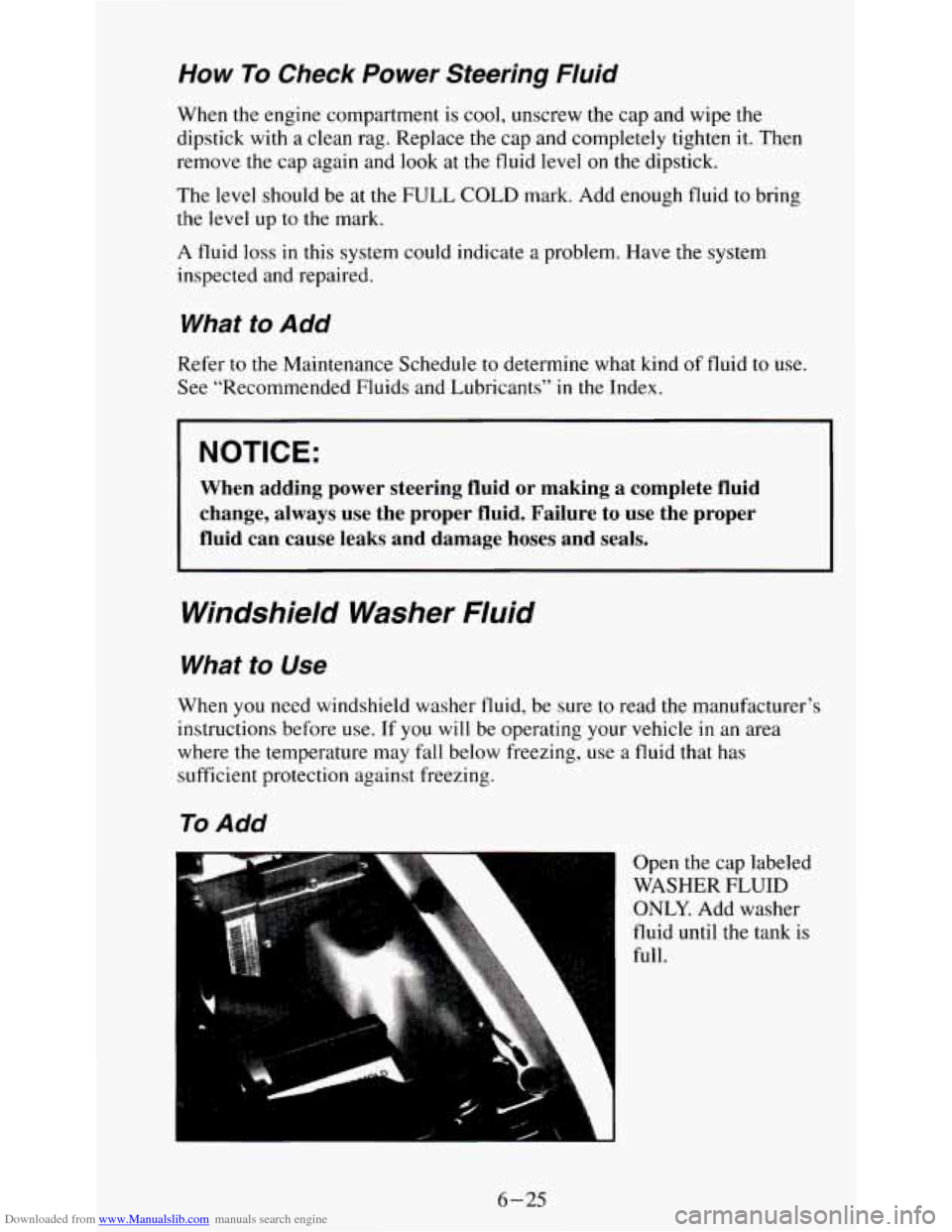
To Add
Open the cap labeled
WASHER
FLUID
ONLY. Add washer
fluid until
the tank is
full.
L
L
t
6-25
Page 244 of 354
Downloaded from www.Manualslib.com manuals search engine Refer to the Maintenance Schedule to determine when to check your brake
fluid. See “Periodic Maintenance Inspections”
in the Index.
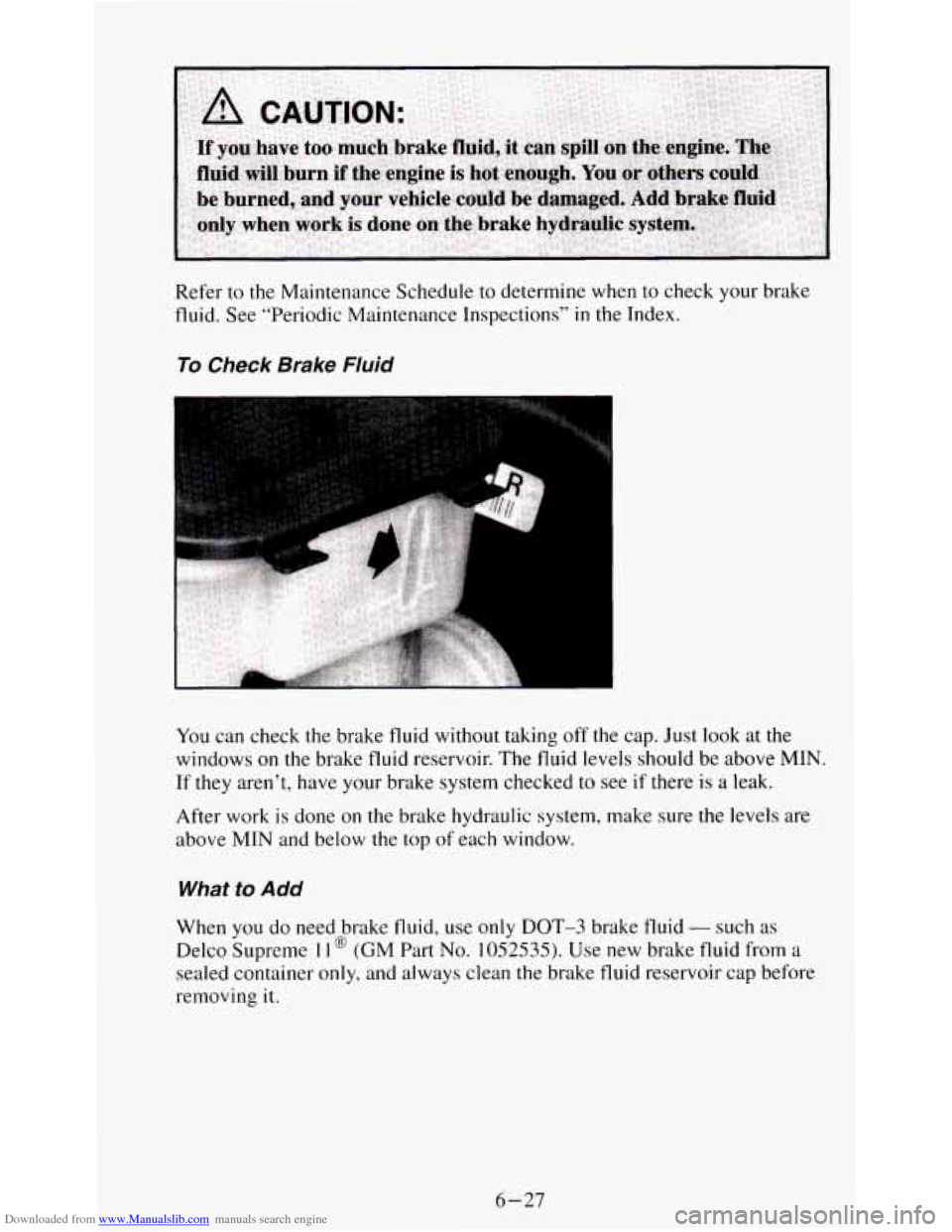
To Check Brake Fluid
You can check the brake fluid without taking off the cap. Just look at the
windows
on the brake fluid reservoir. The fluid levels should be above MIN.
If they aren’t, have your brake system checked to see if there is a leak.
After work is done
on the brake hydraulic system, make sure the levels are
above
MIN and below the top of each window.
What to Add
When you do need brake fluid, use only DOT-3 brake fluid - sucn as
Delco Supreme I I @ (GM Part No. 1052535). Use new brake fluid from a
sealed container only, and always clean the brake fluid reservoir cap before
removing
it.
6-27
Page 255 of 354
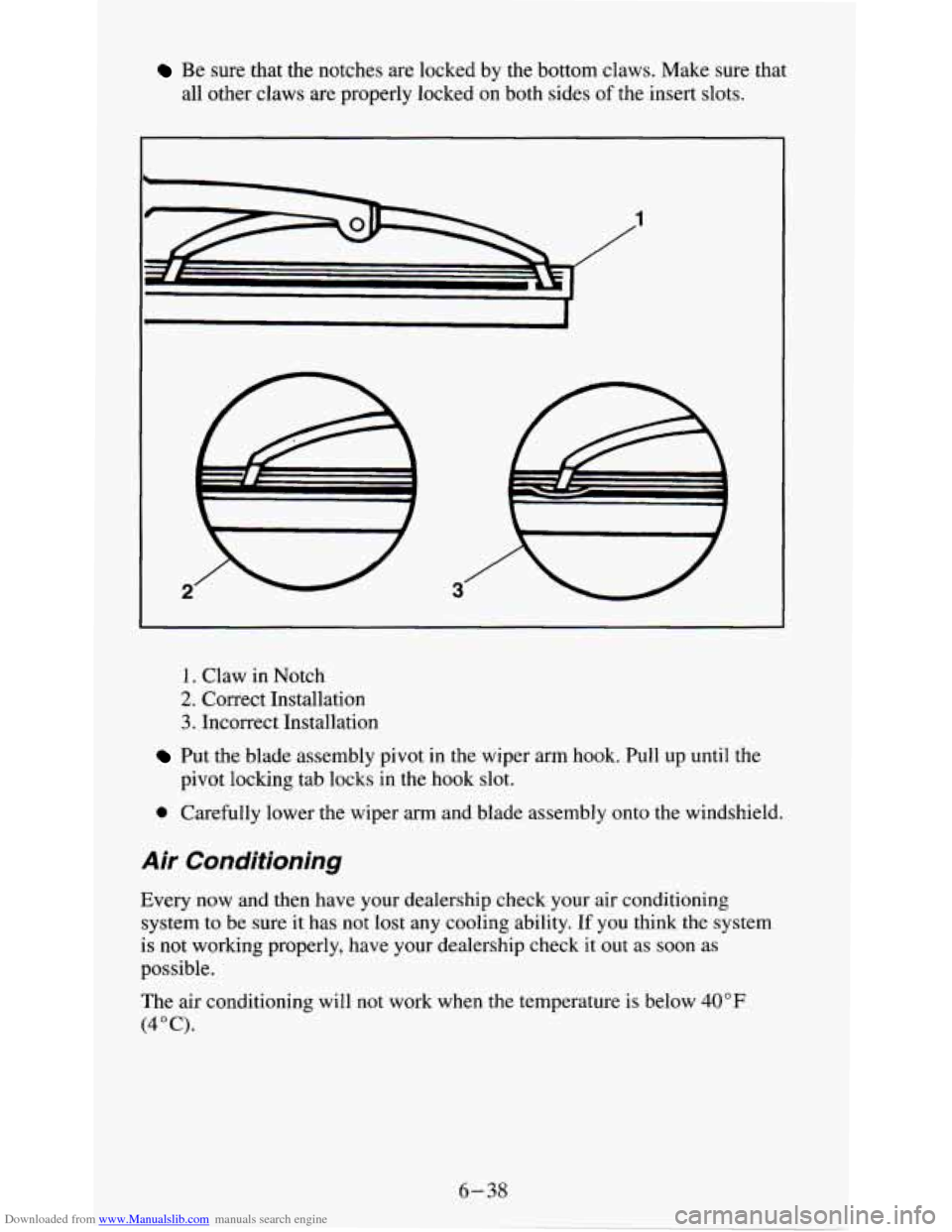
Downloaded from www.Manualslib.com manuals search engine Be sure that the notches are locked by the bottom claws. Make sure that
all other claws are properly locked on both sides
of the insert slots.
2 e 3 /
1. Claw in Notch
2. Correct Installation
3. Incorrect Installation
Put the blade assembly pivot in the wiper arm hook. Pull up until the
0 Carefully lower the wiper arm and blade assembly onto the windshield.
pivot locking tab locks
in the hook slot.
Air Conditioning
Every now and then have your dealership check your air conditioning
system to be sure it has not
lost any cooling ability. If you think the system
is not working properly, have your dealership check it out as soon as
possible.
The air conditioning will
not work when the temperature is below 40°F
(4°C).
6-38
Page 258 of 354
Downloaded from www.Manualslib.com manuals search engine NOTICE:
~~
Don’t let anyone tell you that underinflation or overinflation is
all right. It’s not. If your tires don’t have enough air
(underinflation) you can get:
Too much flexing
Too much heat
Tire overloading
Bad wear
Bad handling
Bad fuel economy.
If your tires have too much air (overinflati
Unusual wear
Bad handling
Rough ride
Needless damage from road hazards. can
get
‘e re
When to Check
Check your tires once a month or more. Also, check the tire pressure of the
spare tire.
How to Check
Use a good quality pocket-type gage to check tire pressure. Simply looking
at the tires will not tell you the pressure, especially if you have radial tires
- which may look properly inflated even if they’re underinflated.
If your tires have valve caps, be sure to put them back on. They help prevent
leaks by keeping out dirt and moisture.
Tire Inspection and Rotation
Tires should be inspected every 6,000 to 8,000 miles (10 000 to 13 000 km)
for any signs of unusual wear. If unusual wear is present, rotate your tires as
soon
as possible and check wheel alignment. Also check for damaged tires
or wheels. See “When it’s Time for New Tires” and “Wheel Replacement”
later in
this section for more information.
6-41
Page 260 of 354
Downloaded from www.Manualslib.com manuals search engine When it’s Time for New Tires
You need a new tire if:
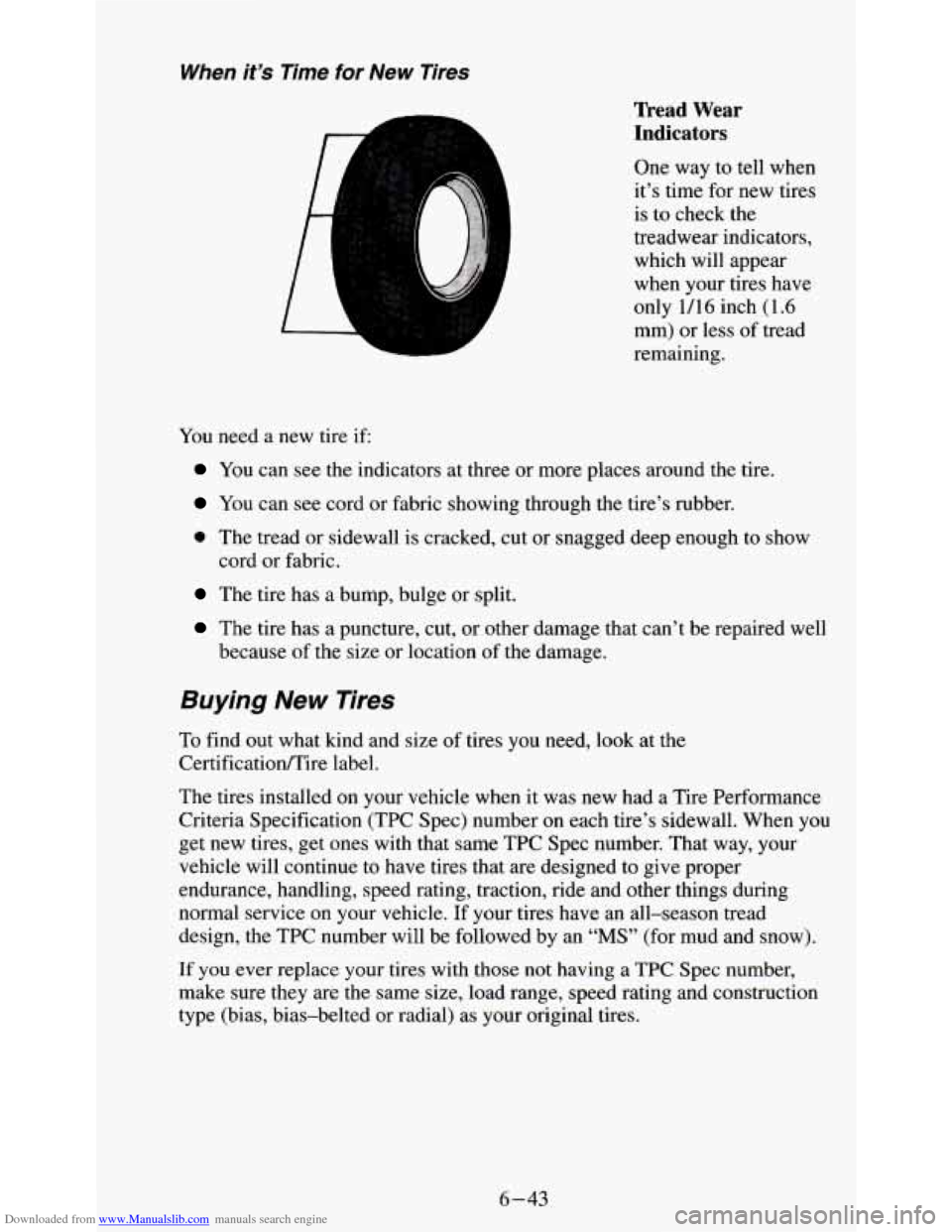
Tread Wear
Indicators
One way to tell when
it’s time for new tires
is to check the
treadwear indicators,
which will appear
when your tires have
only
1/16 inch (1.6
mm) or less of tread
remaining.
You can see the indicators at three or more places around the tire.
You can see cord or fabric showing through the tire’s rubber.
0 The tread or sidewall is cracked, cut or snagged deep enough to show
cord or fabric.
The tire has a bump, bulge or split.
The tire has a puncture, cut, or other damage that can’t be repaired well
because
of the size or location of the damage.
Buying New Tires
To find out what kind and size of tires you need, look at the
Certificationmire label.
The tires installed on your vehicle when it was new had a Tire Performance
Criteria Specification (TPC Spec) number on each tire’s sidewall. When you
get new tires, get ones with that same TPC Spec number. That way, your
vehicle will continue to have tires that are designed
to give proper
endurance, handling, speed rating, traction, ride and other things during
normal service on your vehicle. If your tires have an all-season tread
design, the TPC number will be followed by an
“MS” (for mud and snow).
If you ever replace your tires with those not having a TPC Spec number,
make sure they are the same size, load range, speed rating and construction
type (bias, bias-belted or radial) as your original tires.
6-43
Page 269 of 354
Downloaded from www.Manualslib.com manuals search engine Glass
Glass should be cleaned often. GM Glass Cleaner (GM Part No. 1050427)
or a liquid household glass cleaner will remove normal tobacco smoke and
dust films.
Don’t use abrasive cleaners on glass, because they may cause scratches.
Avoid placing decals on the inside rear window, since they may have to be
scraped
off later.
Cleaning the Outside of the Windshield and
Wiper Blades
If the windshield is not clear after using the windshield washer, or if the
wiper blade chatters when running, wax or other material may be on the
blade or windshield.
Clean the outside
of the windshield with GM Windshield Cleaner, Bon-Ami
Powder@
(GM Part No. 105001 1). The windshield is clean if beads do not
form when you rinse it with water.
Clean the blade by wiping vigorously with a cloth soaked
in full strength
windshield washer solvent. Then rinse the blade with water.
Wiper blades should be checked on a regular basis and replaced when worn.
Weatherstrips
Silicone grease on weatherstrips will make them last longer, seal better, and
not stick or squeak. Apply silicone grease with a clean cloth at least every
six months. During very cold, damp weather more frequent application may
be required. (See “Recommended Fluids
& Lubricants” in the Index.)
Cleaning the Outside of Your Vehicle
The paint finish on your vehicle provides beauty, depth of color, gloss
retention and durability.
Washing Your Vehicle
The best way to preserve your vehicle’s finish is to keep it clean by washing
it often with lukewarm or cold water.
Don’t wash your vehicle in the direct rays of the sun. Don’t use strong soaps
or chemical detergents.
Use liquid hand, dish or car washing (mild
detergent) soaps. Don’t use cleaning agents that are petroleum based, or that
contain acid
or abrasives. All cleaning agents should be flushed promptly
and not allowed to dry on the surface, or they could stain. Dry the finish
with a soft, clean chamois or a
100% cotton towel to avoid surface scratches
and water spotting.
High pressure vehicle washes may cause water to enter your vehicle.
6-52
Page 276 of 354
Downloaded from www.Manualslib.com manuals search engine Service Parts Identification Label
You’ll find this label on the inside of the glove box.
It’s very helpful
if you ever need to order parts. On this label is:
your VIN,
0 the model designation,
0 paint information, and
0 a list of all production options and special equipment.
Be sure that this label is not removed from the vehicle.
Add-on Electrical Equipment
NOTICE:
Don’t add anything electrical to your vehicle unless you check
with your dealer first. Some electrical equipment can damage
your vehicle and the damage wouldn’t be covered by your
warranty. Some add-on electrical equipment can keep other components from working as they should.
Your vehicle has
electrical to
your
in the Index. an
air bag system. Before attempting to add anything
* vehicle, see “Servicing Your Air Bag-Equipped Vehicle”
Fuses and Circuit Breakers
The wiring circuits in your vehicle are protected from short circuits by a
combination of fuses, circuit breakers, and fusible thermal links in the
wiring itself. This greatly reduces the chance of fires caused by electrical
problems.
6-59