1995 CHEVROLET S10 wheel alignment
[x] Cancel search: wheel alignmentPage 258 of 354
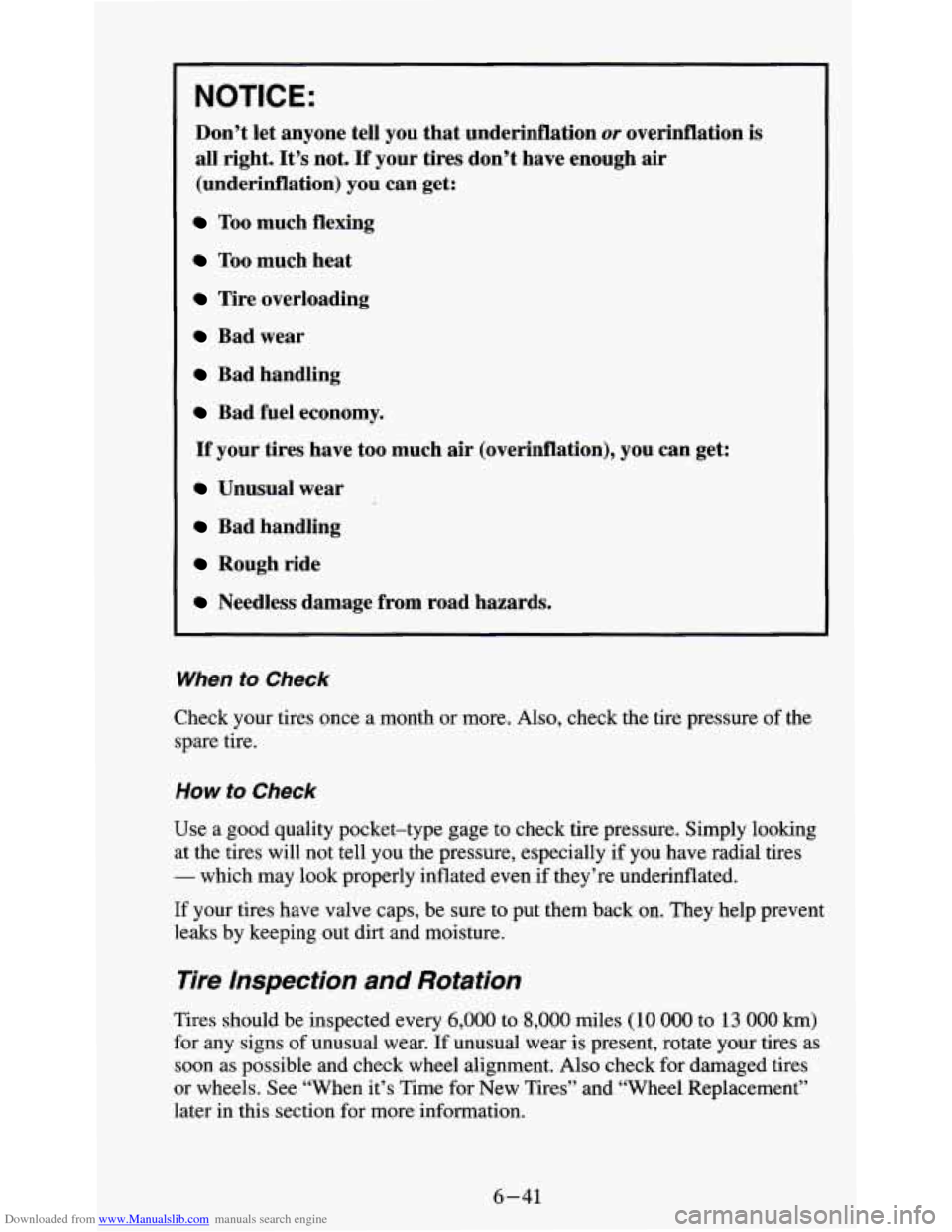
Downloaded from www.Manualslib.com manuals search engine NOTICE:
~~
Don’t let anyone tell you that underinflation or overinflation is
all right. It’s not. If your tires don’t have enough air
(underinflation) you can get:
Too much flexing
Too much heat
Tire overloading
Bad wear
Bad handling
Bad fuel economy.
If your tires have too much air (overinflati
Unusual wear
Bad handling
Rough ride
Needless damage from road hazards. can
get
‘e re
When to Check
Check your tires once a month or more. Also, check the tire pressure of the
spare tire.
How to Check
Use a good quality pocket-type gage to check tire pressure. Simply looking
at the tires will not tell you the pressure, especially if you have radial tires
- which may look properly inflated even if they’re underinflated.
If your tires have valve caps, be sure to put them back on. They help prevent
leaks by keeping out dirt and moisture.
Tire Inspection and Rotation
Tires should be inspected every 6,000 to 8,000 miles (10 000 to 13 000 km)
for any signs of unusual wear. If unusual wear is present, rotate your tires as
soon
as possible and check wheel alignment. Also check for damaged tires
or wheels. See “When it’s Time for New Tires” and “Wheel Replacement”
later in
this section for more information.
6-41
Page 262 of 354
Downloaded from www.Manualslib.com manuals search engine Warning: The temperature grade for this tire is established for a tire that is
properly inflated and not overloaded. Excessive speed, underinflation, or
excessive loading, either separately or in combination, can cause heat
buildup and possible tire failure.
These grades are molded on the sidewalls of passenger
car tires.
While the tires available as standard or optional equipment on General
Motors vehicles may vary with respect to these grades, all such tires meet
General Motors performance standards and have been approved for use on
General Motors vehicles. All passenger type
(P Metric) tires must conform
to Federal safety requirements in addition to these grades.
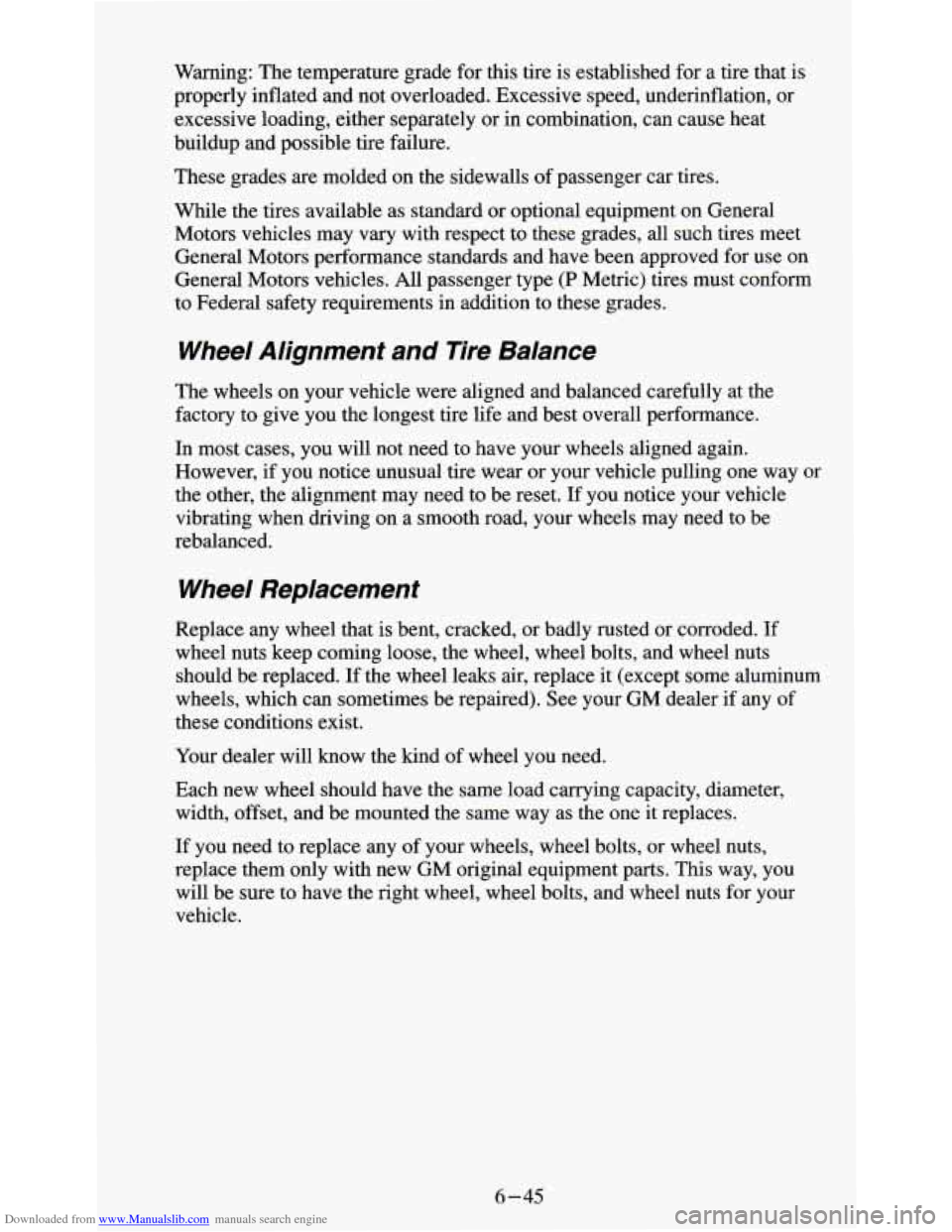
Wheel Alignment and Tire Balance
The wheels on your vehicle were aligned and balanced carefully at the
factory to give you the longest tire life and best overall performance.
In most cases, you will not need to have your wheels aligned again.
However, if you notice unusual tire wear or your vehicle pulling one way or
the other, the alignment may need to be reset. If you notice your vehicle
vibrating when driving on a smooth road, your wheels may need to be
rebalanced.
Wheel Replacement
Replace any wheel that is bent, cracked, or badly rusted or corroded. If
wheel nuts keep coming loose, the wheel, wheel bolts, and wheel nuts
should be replaced. If the wheel leaks air, replace it (except some aluminum
wheels, which can sometimes be repaired). See your GM dealer if any of
these conditions exist.
Your dealer will know the kind of wheel you need.
Each new wheel should have the same load carrying capacity, diameter,
width, offset, and be mounted the same way as the one it replaces.
If you need to replace any of your wheels, wheel bolts, or wheel nuts,
replace them only with new GM original equipment parts. This way, you
will be sure to have the right wheel, wheel bolts, and wheel nuts for your
vehicle.
6-45
Page 351 of 354
Downloaded from www.Manualslib.com manuals search engine Seats (continued) Front Seatback Latches
.......................................... 1-4
Jump Seat (Extended Cab Models) ................................. 1-6
Lumbar Adjustment ............................................ 1-2
Reclining Front Seatbacks (Bucket Seats or
60/40 Bench) .............. 1-3
Bulletins ..................................................... 8-8
Doing Your Own Service Work ................................... 6-1
Parts Identification Label ....................................... 6-59
Publications ................................................... 8-8
Replacement Parts and Filter Recommendations .... .......... 6-69
Service
Service Engine Soon Light (See “Lights”)
Shift Indicator Light (See “Lights”)
Shifting Into Park
(P) ............................................. 2-23
SpareTire ...................................................... 5-22
Specifications Chart (See “Service - Replacement Parts and Filter
Recommendations”)
Speedometer and Odometer (See “Gages”)
Starting Your Engine (See “Engine-Starting”)
Steering
........................................................ 4-7
InEmergencies ................................................ 4-8
Tips ......................................................... 4-7
Storage Compartments ............................................ 2-50
SunVisors ..................................................... 2-48
Supplemental Inflatable Restraint System (SIR) ........................ 1-16
Adding Equipment to Your Air Bag-Equipped Vehicle ................ 1-21
How the Air Bag System Works .................................. 1-17
Servicing Your Air Bag-Equipped Vehicle ......................... 1-20
T
Tachometer (See “Gages”)
Tailgate
................. ... ............. 2-5
Removal ................................................. 2-6
Theft
........................................................... 2-8
Thermostat ..................................................... 6-24
Tilt Wheel (Option) .............................................. 2-34
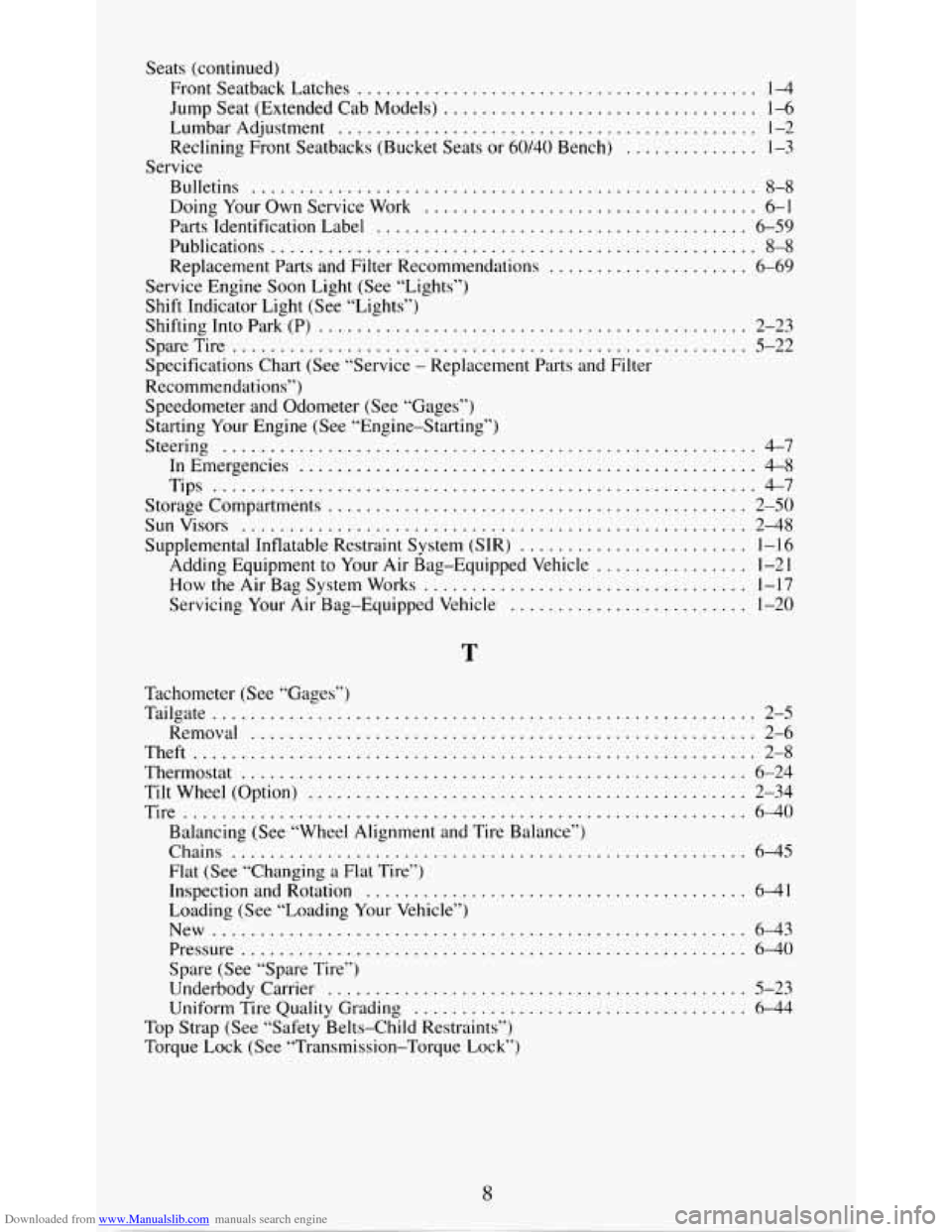
Tire ........................................................... 640
Balancing (See “Wheel Alignment and Tire Balance”)
Chains
...................................................... 6-45
Flat (See “Changing a Flat Tire”)
Inspection and Rotation
...................................... 6-41
Loading (See “Loading Your Vehicle”)
New
........................................................ 6-43
Pressure ..................................................... 6-40
Spare (See “Spare Tire”)
Underbody Carrier
............................................ 5-23
Uniform Tire Quality Grading ................................... 6-44
Top Strap (See “Safety Belts-Child Restraints”)
Torque Lock (See “Transmission-Torque Lock”)
Page 352 of 354
Downloaded from www.Manualslib.com manuals search engine Towing ATrailer
.................................................... 4-43
Driving on Grades
.......................................... 4-48
Driving with a Trailer ....................................... 4-46
ParkingonHills
............................................ 4-48
Passing
................................................... 447
SafetyChains
.............................................. 4-46
Hitches
..................................................... 4-45
Recreational Vehicle (Four-wheel Drive Only) ...................... 4-35
TowingYourVehicle
.............................................. 5-6
Trailer
Brakes
...................................................... 446
Wiring Harness
.......................................... 2-68, 6-60
Trailering Package
( See “Loading Your Vehicle”)
Transfer Case
................................................... 6-19
Electronic
( See “Four Wheel Drive”)
Manual
( See “Four Wheel Drive”)
Automatic
................................................... 2-17
When to Check and Change Fluid
.............................. 6-14
HowToCheck
............................................. 6-14
HowToAdd
............................................... 6-16
Five-Speed Manual
........................................... 2-20
Whentocheck
............................................. 6-17
HowToCheck
............................................. 6-17
Transmission
HowToAdd
............................................... 6-18
Shift Light
( See “Lights”)
Torque Lock (Automatic Transmission)
.......................... 2-25
Trip Odometer
( See “Gages”)
Turn Signal and Lane Change Indicator
.............................. 2-35
Vehicle Damagewarnings
................................................ v
Identification Number ..................................... 6-57, 6-58
Loading ( See “Loading Your Vehicle”)
Storage
..................................................... 6-29
Symbols
.............................................. v, vi, vu, vlll
Ventilation System ................................................ 3-4
Tips ......................................................... 34
Voltmeter
( See “Gages”)
.....
W
Warning Devices. Other
................................................ 5-2
Hazard Flashers ( See “Hazard Warning Flashers”)
Lights and Indicators
........................................... 2-56
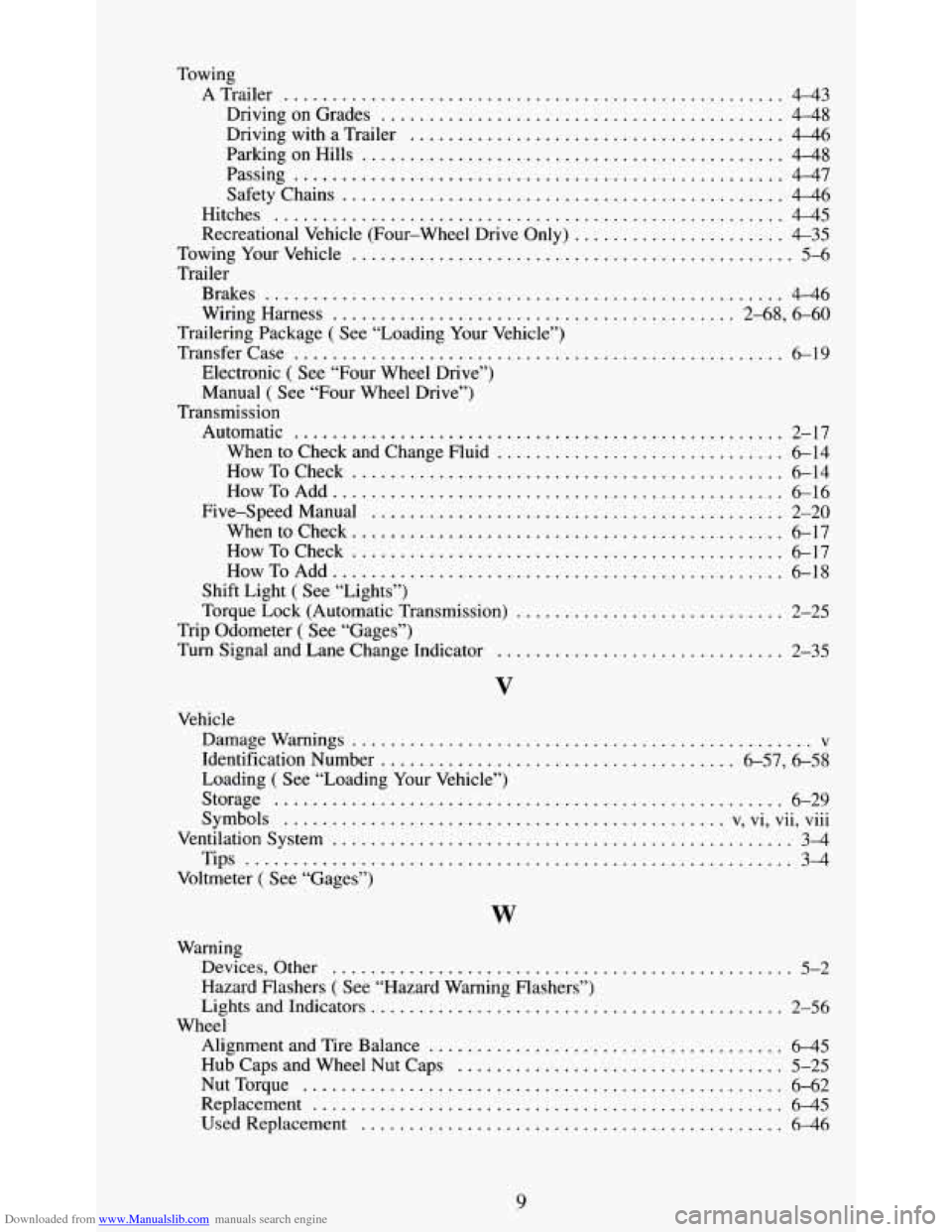
Alignment and Tire Balance
..................................... 6-45
Hub Caps and Wheel
Nut Caps .................................. 5-25
NutTorque .................................................. 6-62
Replacement
................................................. 645
Used Replacement
............................................ 6-46
Wheel
9