1995 CHEVROLET S10 change time
[x] Cancel search: change timePage 231 of 354
Downloaded from www.Manualslib.com manuals search engine Automatic Transmission Fluid
When to Check and Change
A good time to check your automatic transmission fluid level is when the
engine oil is changed. Refer to the Maintenance Schedule to determine
when to change your fluid. See “Scheduled Maintenance Services” in the
Index.
How to Check
Because this operation can be a little difficult, you may choose to have this
done at your GM dealership Service Department.
If
you do it yourself, be sure to follow all the instructions here, or you could
get a false reading on the dipstick.
I NOTICE:
Too much or too little fluid can damage your transmission. Too
much can mean that some of the fluid could come out and fall\
on
hot engine parts or exhaust system parts, starting a fire. Be sure
to get an accurate reading if you check your transmission fluid.
Wait at least 30 minutes before checking the transmission fluid level if you
have been driving:
When outside temperatures are above 90°F (32°C).
0 At high speed for quite a while.
0 In heavy traffic - especially in hot weather.
0 While pulling a trailer.
To get the right reading, the fluid should be at normal operating
temperature, which
is 180°F to 200°F (82°C to 93°C).
To check transmission fluid hot: Get the vehicle warmed up by driving
about
15 miles (24 krn) when outside temperatures are above 50°F ( 1 0°C).
If it’s colder than 50°F (lO”C), drive the vehicle in THIRD GEAR (D) until
the engine temperature gage moves and then remains steady for ten minutes.
Then follow the hot check procedures.
6- 14
Page 234 of 354
Downloaded from www.Manualslib.com manuals search engine Manual Transmission Fluid
When to Check
A good time to have it checked is when the engine oil is changed. However,
the fluid in your manual transmission doesn't require changing.
How to Check
Because this operation can be a little difficult, you may choose to have this
done at your
GM dealership Service Department.
If you do it yourself, be sure to follow all the instructions here, or you could
get a false reading.
NOTICE:
Too much or too little fluid can damage your transmission. Too
much can mean that some of the fluid could come out and fall on
hot engine parts or exhaust system parts, starting a fire. Be sure
to get an accurate reading if
you check your transmission fluid.
Check the fluid level only when your engine is off, the vehicle is parked on
a level place and the transmission is cool enough for
you to rest your fingers
on the transmission case.
Then, follow these steps:
h
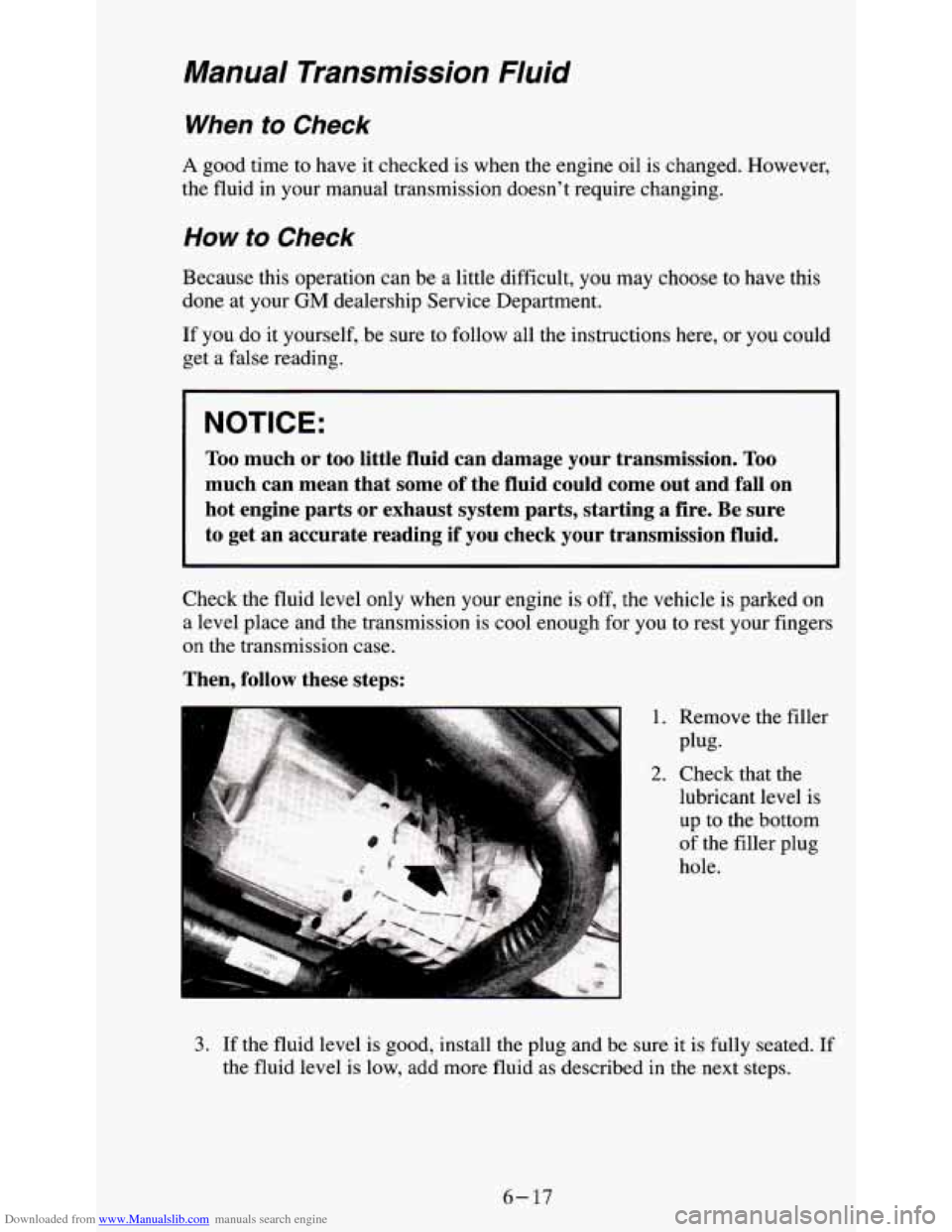
1. Remove the filler
Plug-
2. Check that the
lubricant level is
up to the bottom
of the filler plug
hole.
3. If the fluid level is good, install the plug and be sure it is fully seated. If
the fluid level is low, add more fluid as described in the next steps.
6-17
Page 246 of 354
Downloaded from www.Manualslib.com manuals search engine Brake Pedal Travel
See your dealer if the brake pedal does not return to normal height, or if
there is a rapid increase in pedal travel. This could be a sign
of brake
trouble.
Brake Adjustment
Every time you make a brake stop, your disc brakes adjust for wear.
If your brake pedal goes down farther than normal, your rear drum brakes
may need adjustment. Adjust them by backing up and firmly applying the
brakes a few times.
Replacing Brake System Parts
The braking system on a modern vehicle is complex. Its many parts have to
be of top quality and work well together if the vehicle is to have really good
braking. Vehicles we design and test have top-quality GM brake parts in
them, as your vehicle does when it is new. When you replace parts
of your
braking system
- for example, when your brake linings wear down and
you have to have new ones put in
- be sure you get new genuine GM
replacement parts. If you don’t, your brakes may no longer work properly.
For example, if someone puts in brake linings that are wrong for your
vehicle, the balance between your front and rear brakes can change
- for
the worse. The braking performance you’ve come to expect can change in
many other ways if someone puts in the wrong replacement brake parts.
Battery
Every new vehicle has a Delco Freedom@ battery. You never have to add
water to one
of these. When it’s time for a new battery, we recommend a
Delco Freedom@ battery. Get one that has the replacement number shown
on the original battery’s label.
Vehicle Storage
If you’re not going to drive your vehicle for 25 days or more, take off the
black, negative
(-) cable from the battery. This will help keep your battery
from running down.
6-29
Page 278 of 354
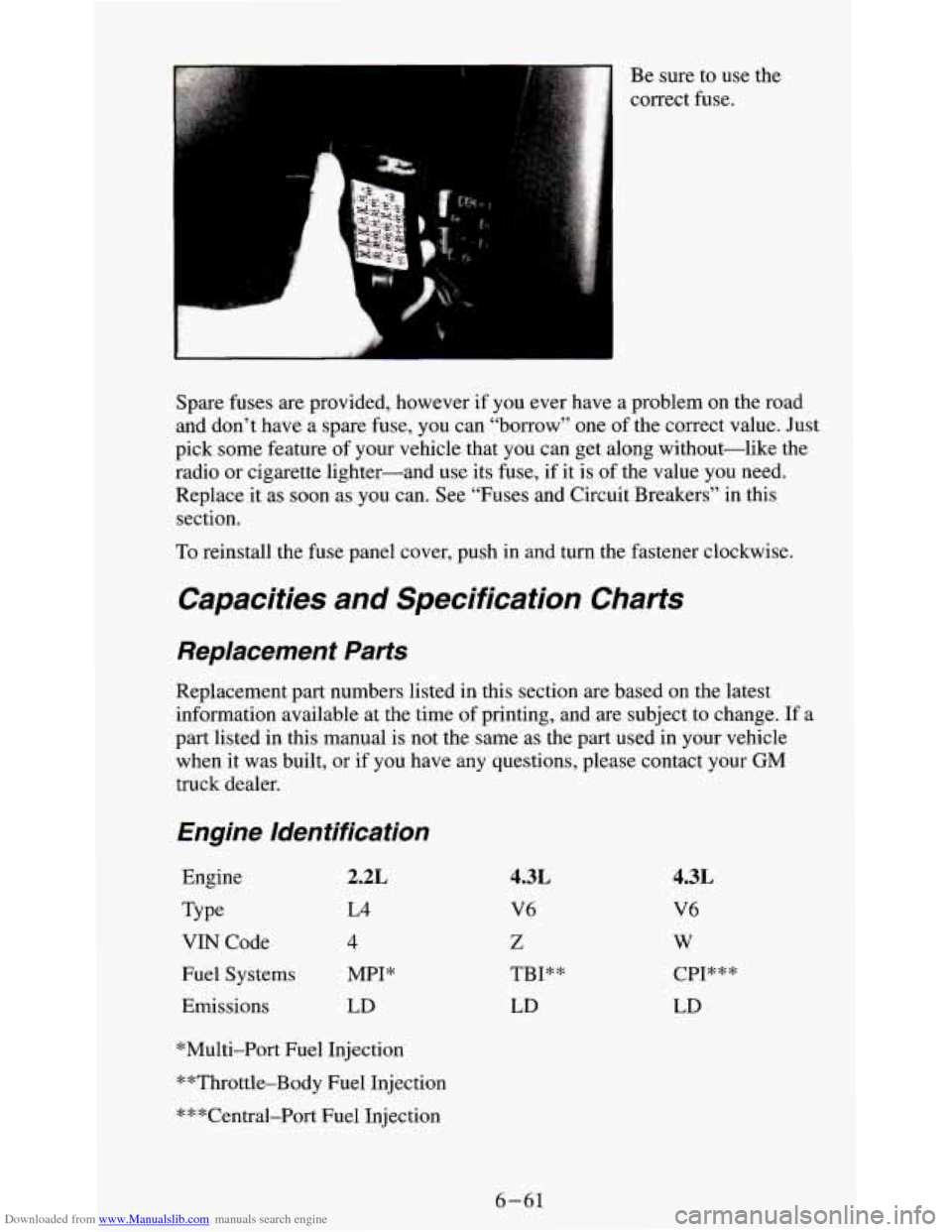
Downloaded from www.Manualslib.com manuals search engine Be sure to use the
correct fuse.
Spare fuses are provided, however if you ever have a problem on the road
and don’t have a spare fuse, you
can “borrow” one of the correct value. Just
pick some feature of your vehicle that you can get along without-like the
radio or cigarette lighter-and use its fuse, if it is of the value you need.
Replace it as soon as you
can. See “Fuses and Circuit Breakers” in this
section.
To reinstall the fuse panel cover, push in and turn the fastener clockwise.
Capacities and Specification Charts
Replacement Parts
Replacement part numbers listed in this section are based on the latest
information available at the time of printing, and are subject to change. If a
part listed in this manual is not the same as the part used in your vehicle
when
it was built, or if you have any questions, please contact your GM
truck dealer.
Engine Ideniificafion
Engine
Type VIN Code
Fuel Systems Emissions 2.2L
L4
4
MPI*
LD
4.3L
V6
Z
m1* *
LD
4.3L
V6
W
CPI* * *
LD
*Multi-Port Fuel Injection
**Throttle-Body Fuel Injection
***Central-Port Fuel Injection
6-61
Page 338 of 354
Downloaded from www.Manualslib.com manuals search engine Courtesy Transportation
Chevrolet/Geo offers Courtesy Transportation for customers needing
warranty service. Courtesy Transportation will be offered in conjunction
with
the coverage provided by the BUMPER TO BUMPER New Vehicle
Limited Warranty
to retail purchasers of 1995 Chevrolet/Geo passenger car
and light duty trucks (please
see your selling dealer for details).
COURTESY TRANSPORTATION INCLUDES:
One way SHUTTLE RIDE for any warranty repair completed during
Up to $30 maximum daily VEHICLE RENTAL allowance for any
the same day.
overnight warranty repair up
to 5 day, OR
Up to $30 maximum daily CAB, BUS, or OTHER transportation
allowance in lieu
of rental for any overnight warranty repair up to 5
day, OR
0 Up to $10 daily FUEL allowance for rides provided by another person
(i.e., friend, neighbor,
etc.) in lieu of rental for any overnight warranty
repair up
to 5 days.
Note: All Courtesy Transportation arrangements will be administer\
ed
by your Chevrolet/Geo dealership service management. Claim amount\
s
should reflect all actual costs.
The Chevrolet/Geo Courtesy Transportation Program is not part of the
BUMPER TO BUMPER New Vehicle Limited Warranty.
Chevrolet/Geo reserves the right
to make any changes or discontinue
the Courtesy Transportation Program at any time without notification.
For additional program details contact your Chevrolet/Geo dealer.
In Canada, please consult your GM dealer for information on courtesy
transportation.
The Roadside Assistance Center uses companies that will provide
you with
quality and priority service. When roadside services are required, our
advisors
will explain any payment obligations that may be incurred for
utilizing outside services.
For prompt assistance when calling, please have the following information
available to give to the advisor:
Vehicle Identification Number
License plate number
0 Vehicle color
Vehicle location
Telephone number where you can be reached
Vehicle mileage
0 Description of the problem
8-7
Page 348 of 354
Downloaded from www.Manualslib.com manuals search engine I
If You’re Stuck: In Sand. Mud. Ice. or Snow ........................... 5-32
Ignitionswitch
.................................................. 2-10
Inflation-Tire Pressure
( See “Tires”)
Instrument Cluster
............................................... 2-53
Instrumentpanel
................................................ 2-53
Jacking Equipment Storage
........................................ 5-20
Jumpstarting .................................................... 5-2
K
KeyLockCylinders .............................................. 6-39
Key Release Button
.............................................. 2-11
Keyless Entry System
............................................. 2-6
Keys
........................................................... 2-1
L
Labels
Lamps Certificatioflire
( See “Certification/Tire Label”)
Center High Mounted
Stop Lamp (CHMSL) ........................ 2-67
Dome
....................................................... 2-46
FogLamps
.................................................. 2-44
Headlights (See “Headlamps”)
Replacement
(See “Bulb Replacement”)
Lights
......................................................... 2-43
Air Bag Readiness Light
........................................ 2-57
Anti-Lock Brake System Warning Light
........................... 2-59
BrakeSystemLight
............................................ 2-58
Charging System Indicator Light
................................. 2-62
Check Gages Indicator Light
.................................... 2-62
Daytime Running Lamps (DRL) Indicator Light
................ 2-45. 2-63
Headlamp High Beam Indicator Light
............................. 2-64
Headlights (See “Headlamps”)
Malfunction Indicator
..................................... 2-60. 6-39
Safety Belt Reminder Light
..................................... 2-57
Service Engine Soon (See “Malfunction Indicator”) Shift Indicator Light
...................................... 2-21. 2-63
Turn Signal and Lane Change Indicator Light
....................... 2-64
Loading Your Vehicle
............................................ 4-36
Add-on Equipment
........................................... 4-39
Off-Road Driving
............................................. 4-13
Payload ..................................................... 4-38
Pickup Conversion to Chassis Cab
................................ 4-42
TraileringPackage
............................................ 4-39
Truck-Camper Loading Information
.............................. 440
Two-Tiered Loading ........................................... 4-38
Lock Cylinders (See “Key Lock Cylinders”)
Loss of Control (See “Driving-Loss of Control”)
Lubrication (See “Recommended Fluids and Lubricants”)
5