Page 186 of 354
Downloaded from www.Manualslib.com manuals search engine NOTICE:
Ignoring these steps could result in costly damage to your
vehicle that wouldn’t be covered by your warranty.
Trying to start your vehicle by pushing or pulling
it could
damage your vehicle, even if you have a manual transmission.
And if you have an automatic transmission, it won’t
start that
way.
To Jump Start Your Vehicle;
1. Check the other vehicle. It must have a 12-volt battery with a negative
ground system.
NOTICE:
If the other system isn’t a 12-volt system with a negative
ground, both vehicles can be damaged.
2. Get the vehicles close enough so the jumper cables can reach, but be
sure the vehicles aren’t touching each other. If they are, it could cause
a
ground connection you don’t want. You wouldn’t be able to start your
vehicle, and the bad grounding could damage the electrical systems.
You could be injured if the vehicles roll. Set the parking brake firmly
on each vehicle. Put an automatic transmission in
PARK (P) or a
manual transmission in NEUTRAL (N). If you have
a
four-wheel-drive vehicle with a manual transfer case shift lever, be
sure the transfer case is not in NEUTRAL
(N).
3. Turn off the ignition on both vehicles. Turn off all lights that aren’t
needed, and radios. This will avoid sparks and help save both batteries.
And it could save your radio!
NOTICE:
If you leave your radio on, it could be badly damaged. The
repair wouldn’t be covered by your warranty.
4. Open the hoods and locate the batteries. Find the positive (+) and
negative
(-) terminals on each battery.
5-3
Page 190 of 354
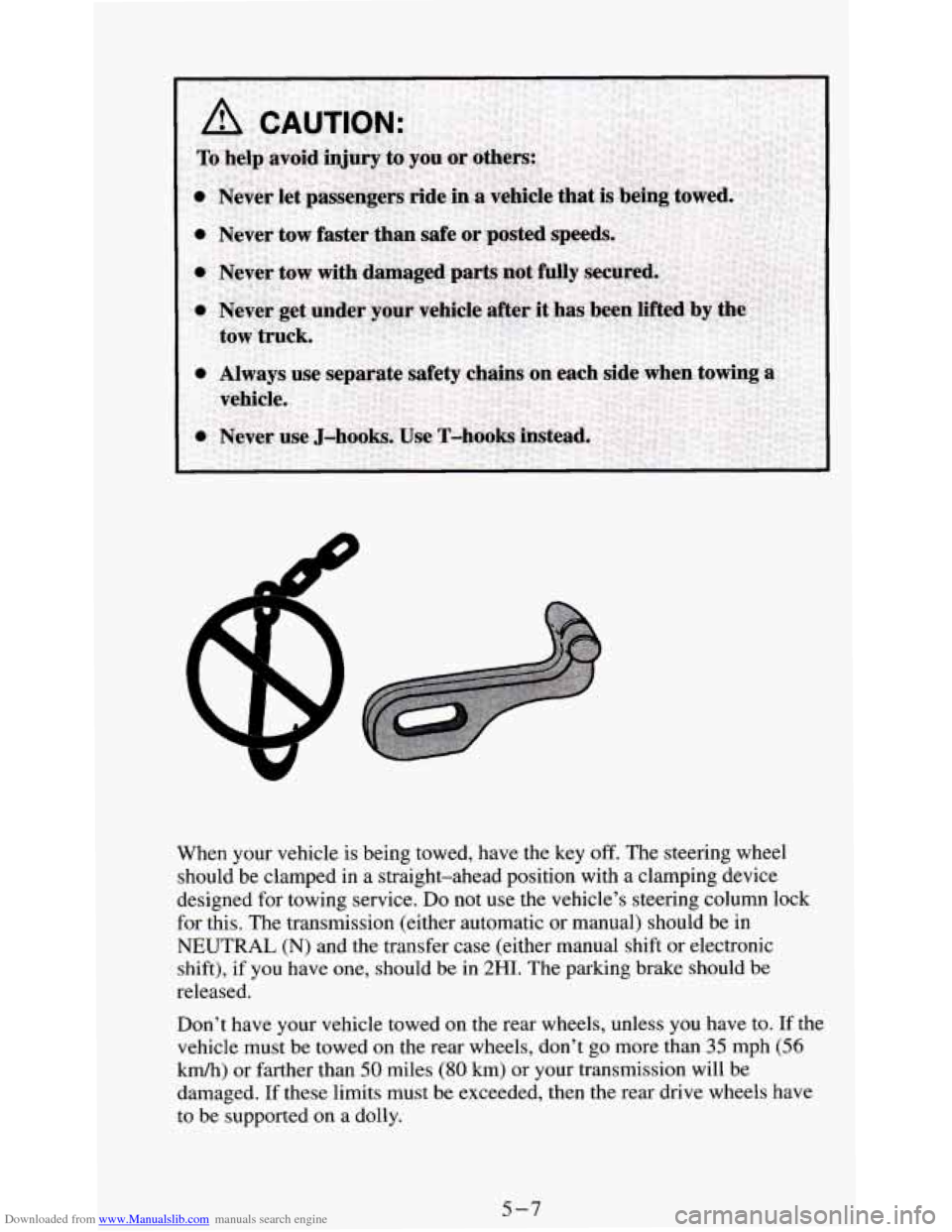
Downloaded from www.Manualslib.com manuals search engine When your vehicle is being towed, have the key off. The steering wheel
should be clamped in a straight-ahead position with
a clamping device
designed for towing service.
Do not use the vehicle’s steering column lock
for this. The transmission (either automatic or manual) should be
in
NEUTRAL (N) and the transfer case (either manual shift or electronic
shift), if you have one, should be in 2HI.
The parking brake should be
released.
Don’t have your vehicle towed
on the rear wheels, unless you have to. If the
vehicle must be towed on the rear wheels, don’t
go more than 35 mph (56
kmk) or farther than 50 miles (80 km) or your transmission will be
damaged.
If these limits must be exceeded, then the rear drive wheels have
to be supported on a dolly.
5-7
Page 194 of 354
Downloaded from www.Manualslib.com manuals search engine If your engine catches fire because you keep driving with no
coolant, your vehicle can be badly damaged. The costly repairs \
would not be covered by your warranty.
If No Steam Is Coming From Your Engine
If you get the overheat warning but see or hear no steam, the problem may
not be too serious. Sometimes the engine can get a little too hot when you:
Climb a long hill on a hot day.
Stop after high speed driving.
Idle for long periods in traffic.
Tow a trailer. See “Driving on Grades’’ in the Index.
If you get the overheat warning with
no sign of steam, try this for a minute
or
so:
1. If you have an air conditioner, turn it off.
2. Turn on your heater to full hot at the highest fan speed and open the
window as necessary.
3. If you’re in a traffic jam, shift to NEUTRAL (N); otherwise, shift to the
highest gear while driving
- AUTOMATIC OVERDRIVE (0) or
DRIVE
(D) for automatic transmissions.
If
you no longer have the overheat warning, you can drive. Just to be safe,
drive slower for about
ten minutes. If the warning doesn’t come back on,
you can drive normally.
If the warning continues, pull over, stop, and park your vehicle right away.
If there’s still no sign of steam, push
the accelerator until the engine speed is
about twice as fast as normal idle speed. Bring the engine speed back to
normal idle speed after two or three minutes. Now see
if the warning stops.
But then, if
you still have the warning, turn ofSthe engine and get everyone
out of the vehicle until it cools down.
You may decide not to lift the hood but to get service help right away.
5-11
Page 231 of 354
Downloaded from www.Manualslib.com manuals search engine Automatic Transmission Fluid
When to Check and Change
A good time to check your automatic transmission fluid level is when the
engine oil is changed. Refer to the Maintenance Schedule to determine
when to change your fluid. See “Scheduled Maintenance Services” in the
Index.
How to Check
Because this operation can be a little difficult, you may choose to have this
done at your GM dealership Service Department.
If
you do it yourself, be sure to follow all the instructions here, or you could
get a false reading on the dipstick.
I NOTICE:
Too much or too little fluid can damage your transmission. Too
much can mean that some of the fluid could come out and fall\
on
hot engine parts or exhaust system parts, starting a fire. Be sure
to get an accurate reading if you check your transmission fluid.
Wait at least 30 minutes before checking the transmission fluid level if you
have been driving:
When outside temperatures are above 90°F (32°C).
0 At high speed for quite a while.
0 In heavy traffic - especially in hot weather.
0 While pulling a trailer.
To get the right reading, the fluid should be at normal operating
temperature, which
is 180°F to 200°F (82°C to 93°C).
To check transmission fluid hot: Get the vehicle warmed up by driving
about
15 miles (24 krn) when outside temperatures are above 50°F ( 1 0°C).
If it’s colder than 50°F (lO”C), drive the vehicle in THIRD GEAR (D) until
the engine temperature gage moves and then remains steady for ten minutes.
Then follow the hot check procedures.
6- 14
Page 233 of 354
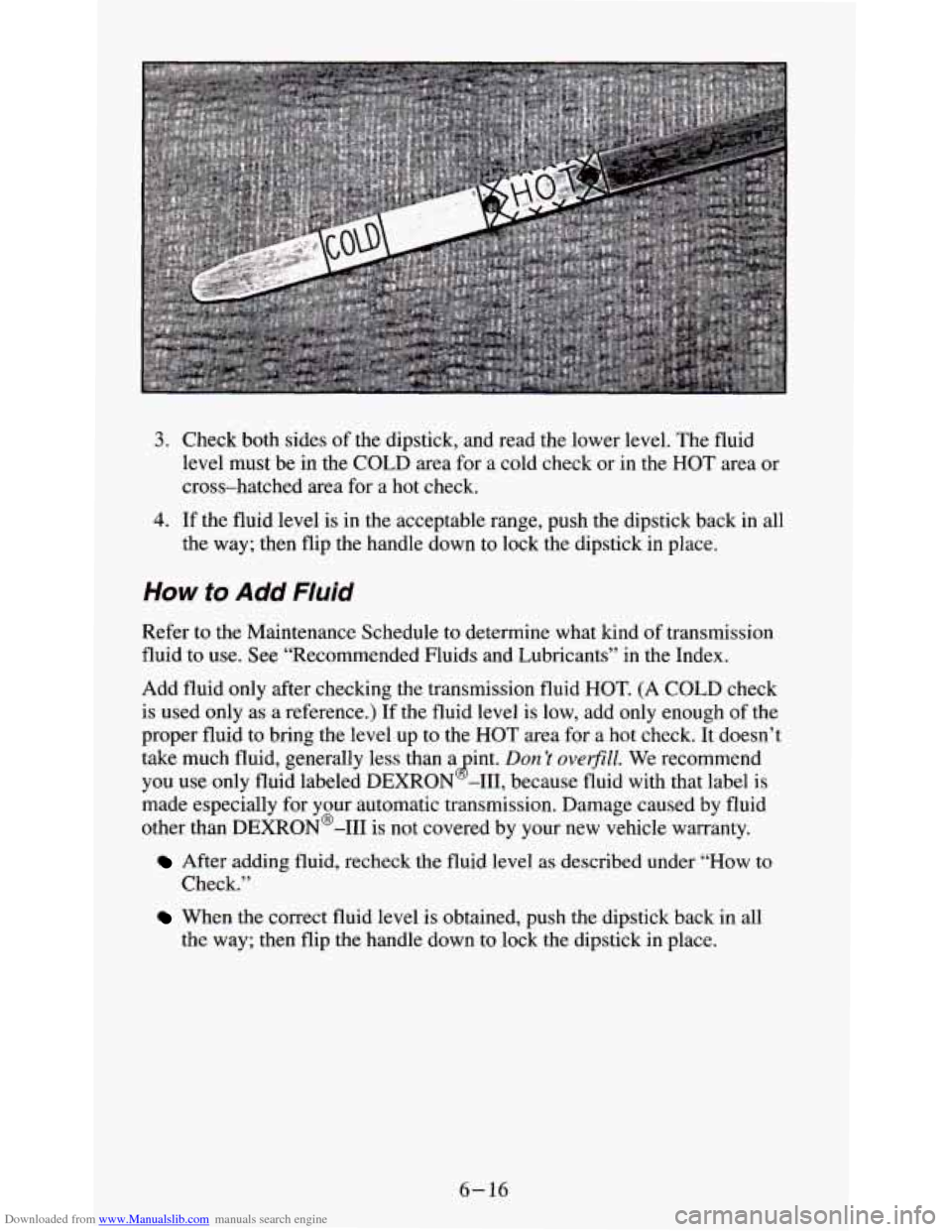
Downloaded from www.Manualslib.com manuals search engine 3. Check both sides of the dipstick, and read the lower level. The fluid
level must be
in the COLD area for a cold check or in the HOT area or
cross-hatched area for a hot check.
4. If the fluid level is in the acceptable range, push the dipstick back in all
the way; then flip the handle down to lock the dipstick
in place.
How to Add Fluid
Refer to the Maintenance Schedule to determine what kind of transmission
fluid to use.
See “Recommended Fluids and Lubricants” in the Index.
Add fluid only after checking the transmission fluid HOT.
(A COLD check
is used only as
a reference.) If the fluid level is low, add only enough of the
proper fluid to bring the level up to the
HOT area for a hot check. It doesn’t
take much fluid, generally less than a int.
Don ’I overjill. We recommend
you use only fluid labeled DEXRON -111, because fluid with that label is
made especially for your automatic transmission. Damage caused by fluid
other than DEXRON@-I11 is not covered by your new vehicle warranty.
After adding fluid, recheck the fluid level as described under “How to
8
Check.”
When the correct fluid level is obtained, push the dipstick back in all
the wav: then flip the handle down to lock the dipstick in place.
6- 16
Page 286 of 354
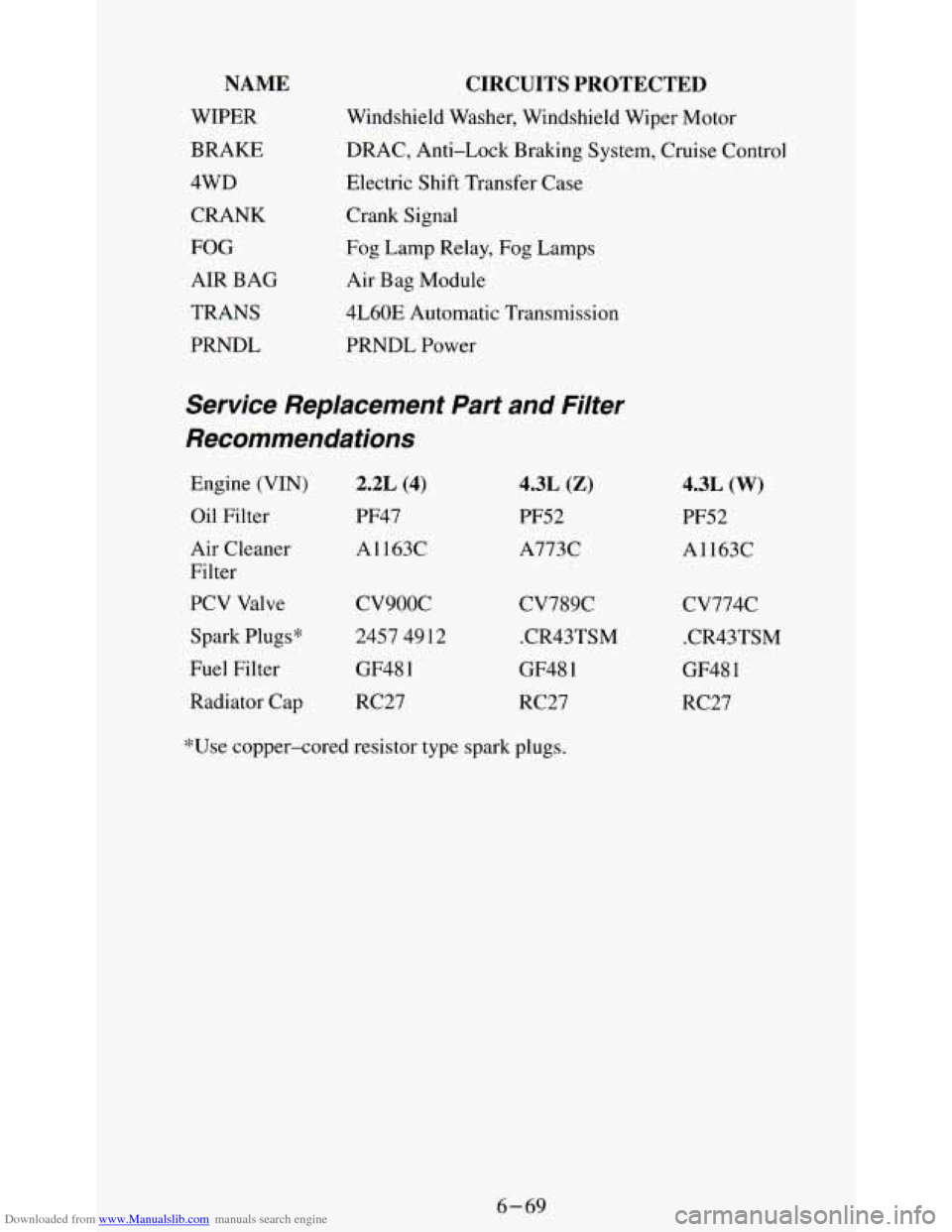
Downloaded from www.Manualslib.com manuals search engine NAME
WIPER
BRAKE
4WD CRANK
FOG
AIR BAG
TRANS
PRNDL
CIRCUITS PROTECTED
Windshield Washer, Windshield Wiper Motor
DRAC, Anti-Lock Braking System, Cruise Control
Electric Shift Transfer Case
Crank Signal
Fog Lamp Relay, Fog Lamps
Air Bag Module
4L60E Automatic Transmission
PRNDL Power
Service Replacement Part and Filter
Recommendations
Engine (VIN)
Oil Filter
Air Cleaner
Filter
PCV Valve
Spark Plugs*
Fuel Filter
Radiator Cap
2.2L (4)
PF47 A1163C
cv9ooc
2457 49 12
GF48
1
RC27
4.3L (Z)
PF52
A773C
CV789C .CR43TSM
GF48
1
RC27
4.3L (W)
PF52
A1163C
cv774c .CR43TSM
GF48
1
RC27
*Use copper-cored resistor type spark
plugs.
6-69
Page 292 of 354
Downloaded from www.Manualslib.com manuals search engine Every 50,000 Miles (83 000 km)
Automatic Transmission Service (severe conditions)
Every 60,000 Miles (100 000 km)
Engine Accessory Drive Belt Inspection
Spark Plug Wire Inspection
Engine Timing Check
Fuel Tank, Cap and Lines Inspection
Every 100,000 Miles (166 000 km)
Spark Plug Replacement (2.2L Code 4 engine Only)
-
Schedule /I Definition
Follow Schedule I1 only if none of the conditions from Schedule I is true.
Schedule I1 Intervals I
Every 7,500 Miles (12 500 km)
Engine Oil and Filter Change (or every 12 months)
Chassis Lubrication (or every 12 months)
Drive Axle Service
At 7,500 Miles (12 500 km) - Then Every 15,000 Miles (25 000 km)
Tire Rotation
Every 30,000 Miles (50 000 km)
Cooling System Service (or every 24 months)
Spark Plug Replacement (Except 2.2L Code
4 engine)
Fuel Filter Replacement
Air Cleaner Filter Replacement
Front Wheel Bearing Repack (2-Wheel Drive
Only)
Every 50,000 Miles (83 000 km)
Automatic Transmission Service (severe conditions)
7-5
Page 302 of 354
Downloaded from www.Manualslib.com manuals search engine I Maintenance Schedule I
48,000 Miles (80 000 km)
Change engine oil and filter (or every 3 months, whichever occurs
0 Lubricate the front suspension, ball joints, steering linkage and transfer
case shift linkage, parking brake cable guides, propshaft splines,
universal joints, brake pedal springs, and clutch pedal springs (or every
6 months, whichever occurs first).
first).
An Emission
Control Service.
0 Check readfront axle fluid level and add fluid as needed. Check
constant velocity joints and axle seals for leaking.**
DATE ACTUAL MILEAGE SERVICED BY
50,000 Miles (83 000 km)
0 Change automatic transmission fluid and filter if the vehicle is mainly
- In heavy city traffic where the outside temperature regularly
reaches
90°F (32°C) or higher.
- In hilly or mountainous terrain.
- When doing frequent trailer towing.
- Uses such as found in taxi, police or delivery service.
driven under
one or more
of these conditions:
If you do not use your vehicle under any of these conditions, the fluid
andfilter do not require changing.
Manual transmission fluid doesn’t require change.
I DATE I ACTUALMILEAGE SERVICED BY
-.
7-15