Page 180 of 386
Downloaded from www.Manualslib.com manuals search engine The heavier the rain, the harder it is to see. Even if your
windshield wiper blades are in good shape, a heavy rain
can make it harder to see road signs and traffic signals,
pavement markings, the edge of the road, and even
people walking.
It’s wise to keep your wiping equipment in good shape
and keep your windshield washer tank filled. Replace
your windshield wiper inserts when they show signs of
streaking or missing areas on the windshield, or when
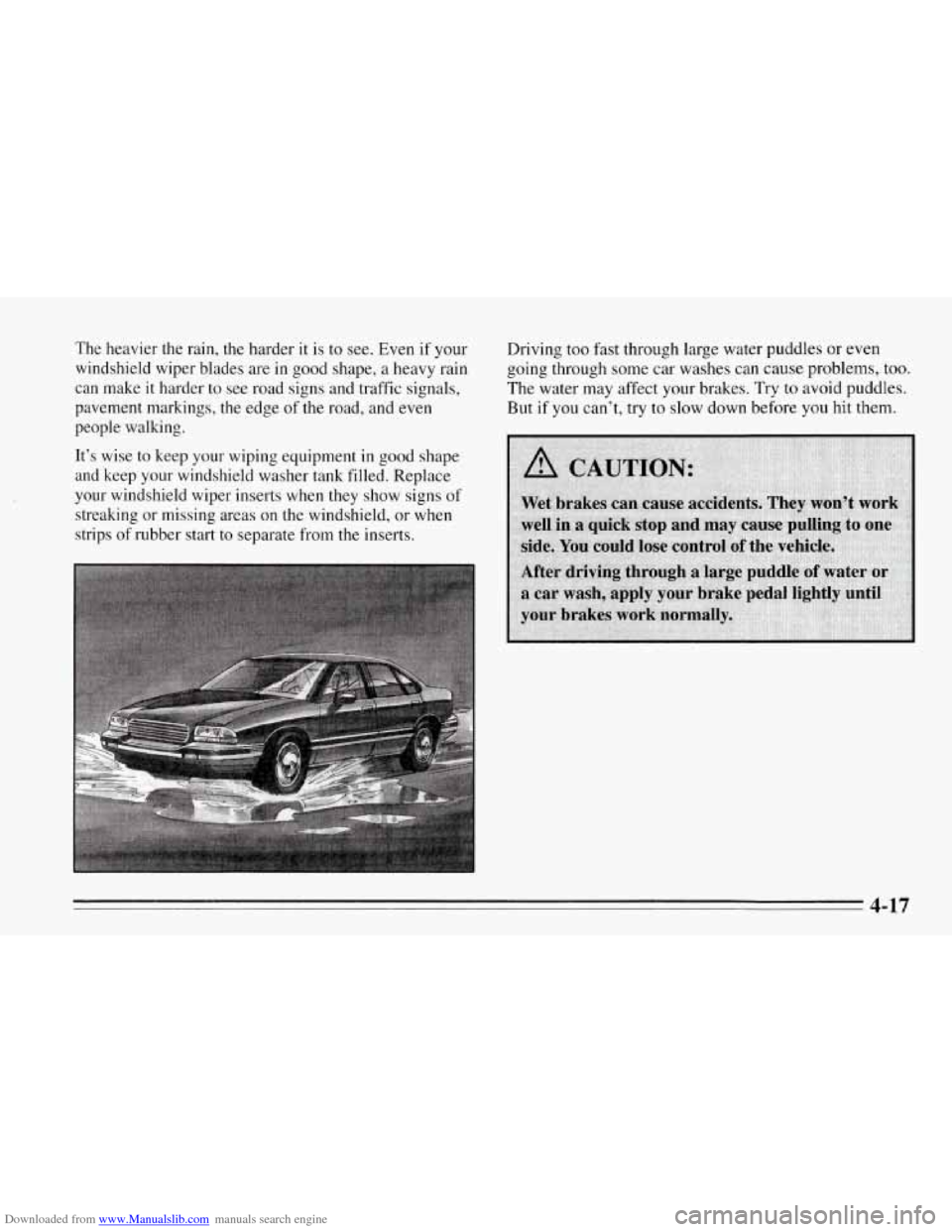
strips of rubber start to separate from the inserts. Driving too fast
through large water puddles or even
going through some car washes can cause problems, too.
The water may affect your brakes. Try to avoid puddles.
But if you can’t, try to slow down before
you hit them.
4-17
Page 186 of 386
Downloaded from www.Manualslib.com manuals search engine If you drive regularly in steep country, or if you’re
planning to visit there, here are some tips that can make
your trips safer and more enjoyable.
0 Keep your vehicle in good shape. Check all fluid
levels and also the brakes, tires, cooling system and
transmission. These parts can work hard on
mountain roads.
0 Know how to go down hills. The most important
thing
to know is this: let your engine do some of the
slowing down. Shift
to a lower gear when you go
down a steep or long hill. 0 Know how to go uphill. You may want to shift down
0
0
0
to a lower gear. The lower gears help cool your engine
and transmission, and you can climb the hill better.
Stay in your own lane when driving on two-lane
roads
in hills or mountains. Don’t swing wide or cut
across the center of the road. Drive at speeds that let
you stay in your own lane.
As you go over the top of a hill, be alert. There could
be something in your lane, like a stalled car
or an
accident.
You may
see highway signs on mountains that warn of
special problems. Examples are long grades, passing
or
no-passing zones, a falling rocks area, or winding
roads. Be alert to these
and take appropriate action.
4-23
Page 188 of 386
Downloaded from www.Manualslib.com manuals search engine Driving on Snow or Ice
Most of the time, those places where your tires meet the
road probably have good traction.
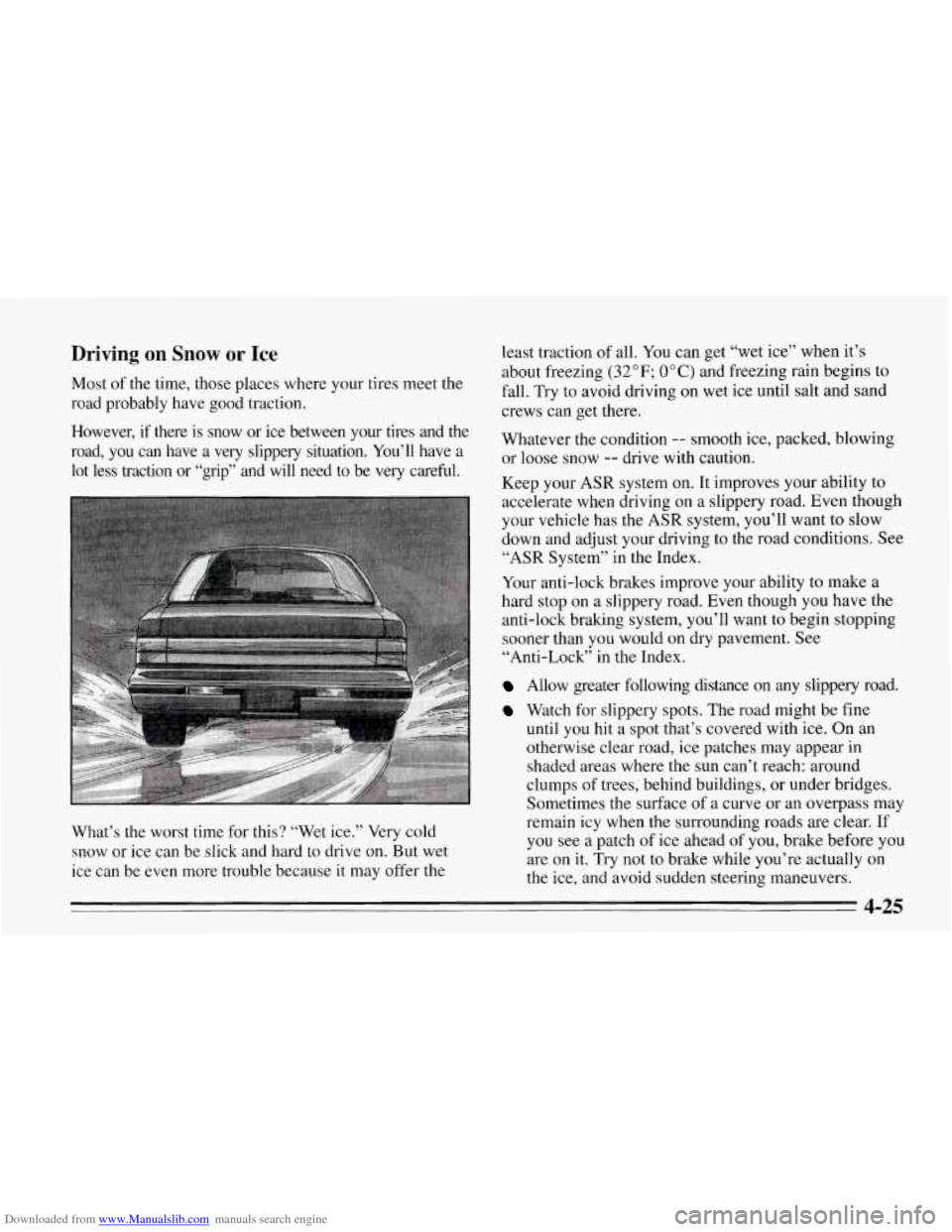
However, if there is snow or ice between your tires and the
road, you can have a very slippery situation. You’ll have a
lot less traction or
“grip” and will need to be very careful.
What’s the worst time for this? “Wet ice.” Very cold
snow or ice can be slick and hard to drive on. But wet
ice can be even more trouble because it may offer the least traction
of all. You can get “wet ice” when it’s
about freezing
(32°F; 0°C) and freezing rain begins to
fall. Try to avoid driving on wet ice until salt and sand
crews can get there.
Whatever the condition
-- smooth ice, packed, blowing
or loose snow
-- drive with caution.
Keep your ASR system on. It improves your ability to
accelerate when driving on a slippery road. Even though
your vehicle has the ASR system, you’ll want
to slow
down and adjust your driving to the road conditions. See
“ASR System’’ in the Index.
Your anti-lock brakes improve your ability to make a
hard stop on a slippery road. Even though you have the
anti-lock braking system, you’ll want to begin stopping
sooner than you would on dry pavement. See
“Anti-Lock” in the Index.
Allow greater following distance on any slippery road.
Watch for slippery spots. The road might be fine
until you hit a spot that’s covered with ice. On an
otherwise clear road, ice patches may appear in
shaded areas where the sun can’t reach: around
clumps of trees, behind buildings, or under bridges.
Sometimes the surface of a curve or an overpass may
remain icy when the surrounding roads
are clear. If
you see a patch of ice ahead of
you, brake before you
are on it. Try not to brake while you’re actually on
the ice, and avoid sudden steering maneuvers.
4-25
Page 201 of 386
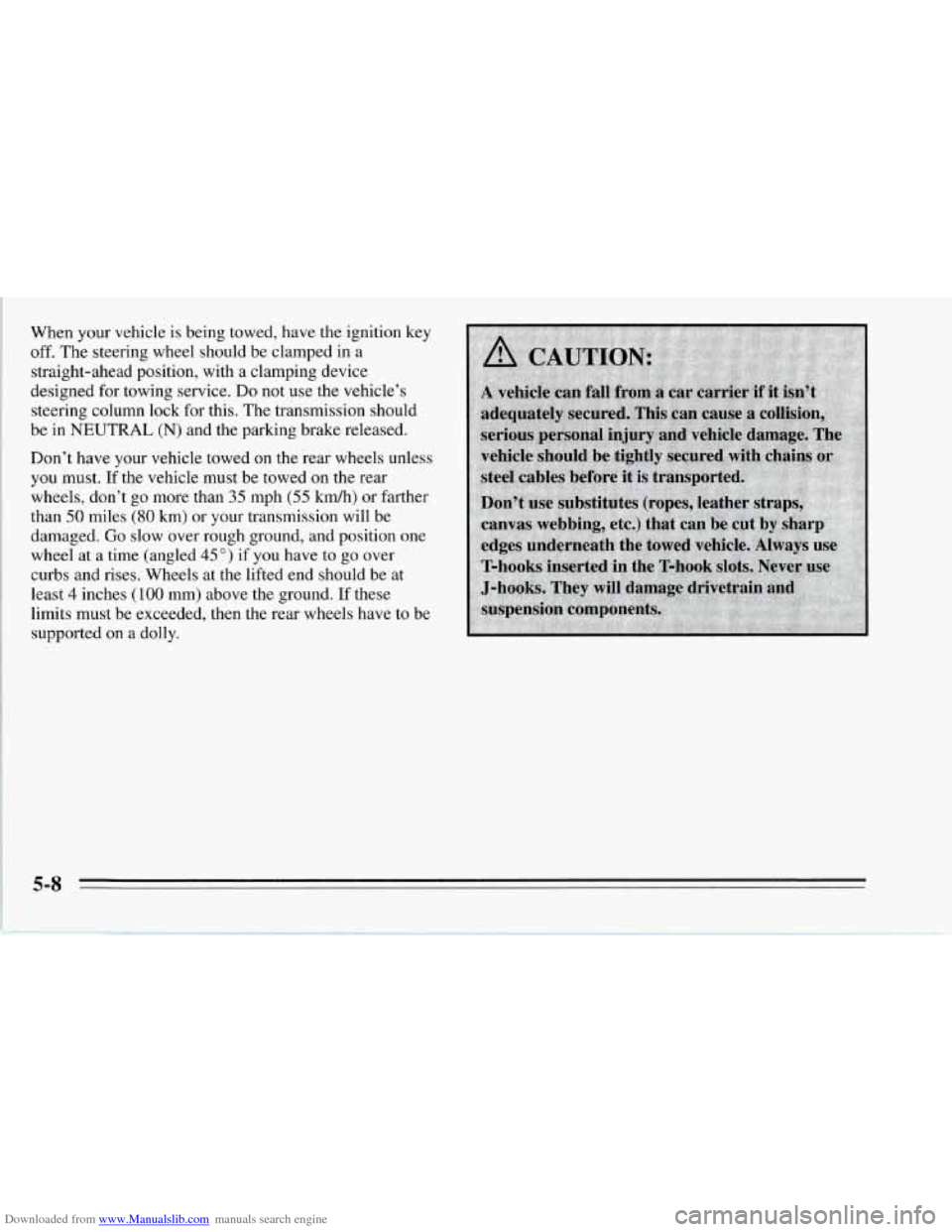
Downloaded from www.Manualslib.com manuals search engine When your vehicle is being towed, have the ign
off. The steering wheel should be clamped in a
straight-ahead position, with a clamping device
designed for towing service.
Do not use the veh .ition key
icle's
steering column lock for this. The transmission should
be in
NEUTRAL (N) and the parking brake released.
Don't have your vehicle towed on the rear wheels unless
you must.
If the vehicle must be towed on the rear
wheels, don't
go more than 35 mph (55 km/h) or farther
than
50 miles (80 km) or your transmission will be
damaged.
Go slow over rough ground, and position one
wheel at a time (angled
45 ") if you have to go over
curbs and rises. Wheels at the lifted end should be at
least
4 inches (100 mm) above the ground. If these
limits must be exceeded, then the rear wheels have to be
supported on a dolly.
-
Page 219 of 386
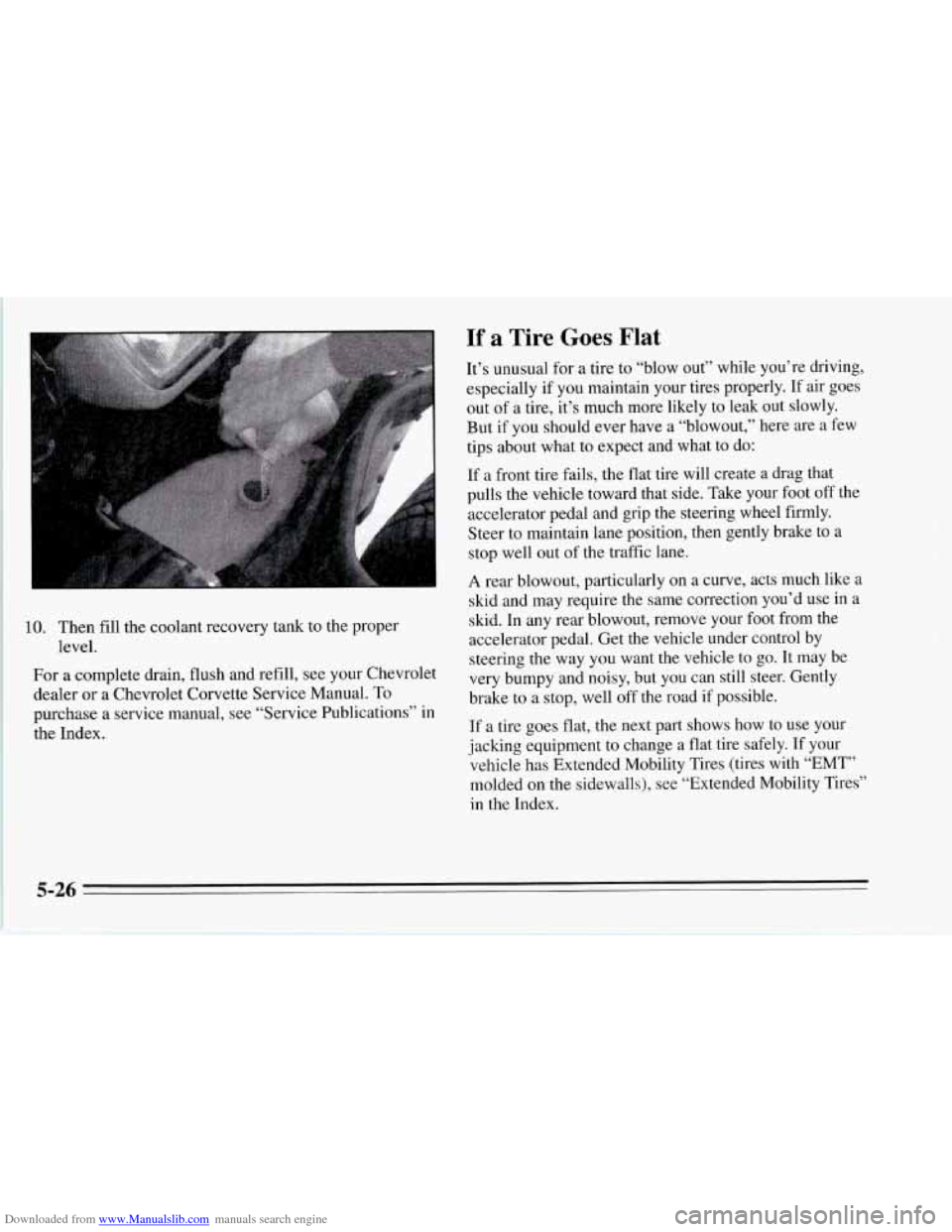
Downloaded from www.Manualslib.com manuals search engine 10. Then fill the coolant recovery tank
level. to the proper
For a complete drain, flush and refill, see your Chevrolet
dealer
or a Chevrolet Corvette Service Manual. To
purchase a service manual, see “Service Publications” in
the Index.
If a Tire Goes Flat
It’s unusual for a tire to “blow out” while you’re driving,
especially if you maintain your tires properly. If air goes
out of a tire, it’s much more likely to leak out slowly.
But if you should ever have
a “blowout,” here are a few
tips about what to expect and what
to do:
If a front tire fails, the flat tire will create a drag that
pulls the vehicle toward that side. Take your foot off the
accelerator pedal and grip the steering wheel firmly.
Steer to maintain lane position, then gently brake to a
stop well out of the traffic lane.
A rear blowout, particularly on a curve, acts much like a
skid and may require the same correction you’d use in a
skid. In any rear blowout, remove your foot from the
accelerator pedal. Get the vehicle under control by
steering the way you want the vehicle to
go. It may be
very bumpy and noisy, but you can still steer. Gently
brake to a stop, well off the road if possible.
If a tire goes flat, the next part shows how to use your
jacking equipment to change a flat tire safely. If your
vehicle has Extended Mobility Tires (tires with “EMT”
molded on the sidewalls), see “Extended Mobility Tires”
in the Index.
5-26
Page 244 of 386
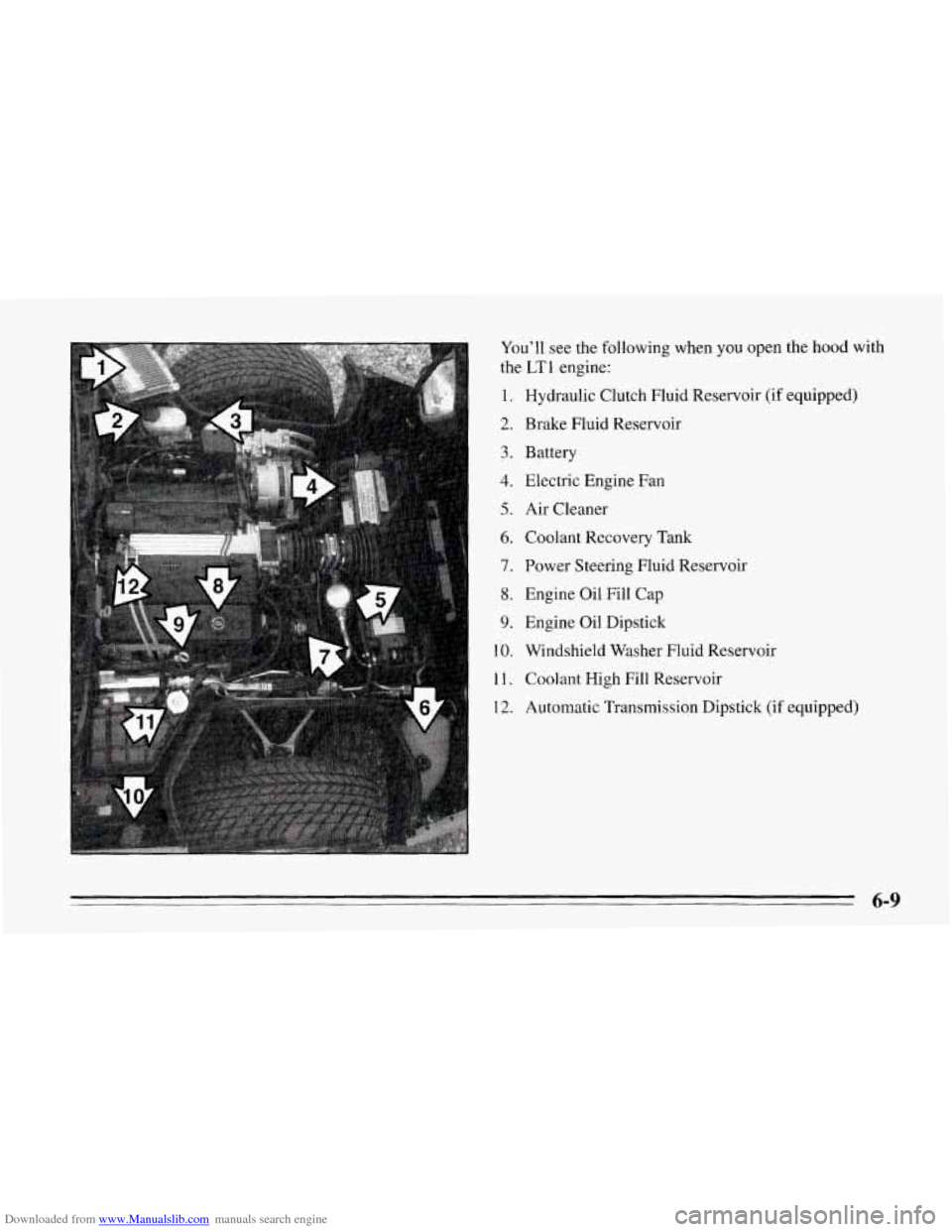
Downloaded from www.Manualslib.com manuals search engine You’ll see the following when you open the hood with
the
LTl engine:
1.
2.
3.
4.
5.
6.
7.
8.
9.
10.
11.
12.
Hydraulic Clutch Fluid Reservoir (if equipped)
Brake Fluid Reservoir
Battery
Electric Engine Fan
Air Cleaner
Coolant Recovery Tank Power Steering Fluid Reservoir
Engine Oil Fill Cap
Engine Oil Dipstick Windshield Washer Fluid Reservoir
Coolant High
Fill Reservoir
Automatic Transmission Dipstick (if equipped)
6-9
Page 245 of 386
Downloaded from www.Manualslib.com manuals search engine Before closing the hood, be sure all the filler caps are
on.
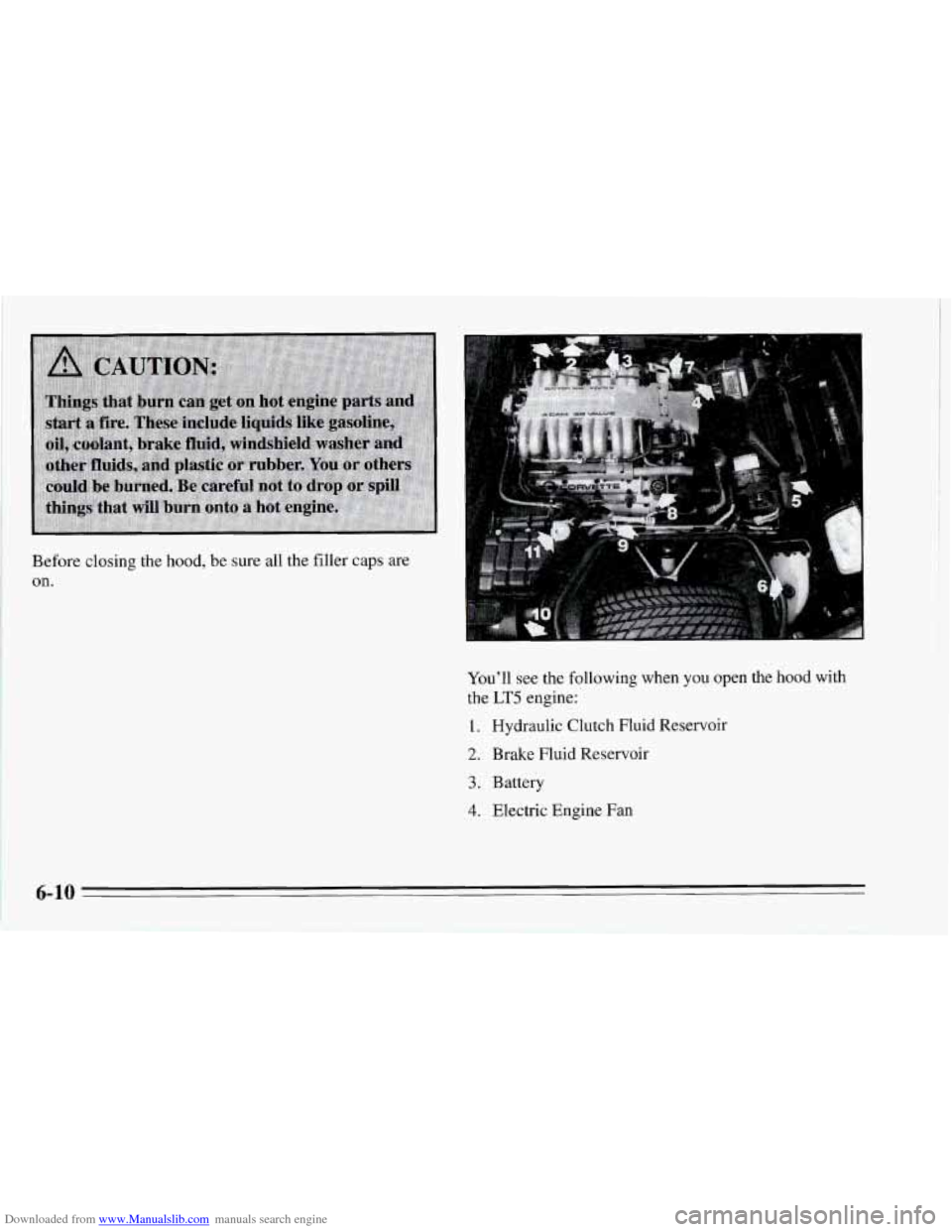
You’ll see the following when you open the hood with
the
LT5 engine:
1. Hydraulic Clutch Fluid Reservoir
2. Brake Fluid Reservoir
3. Battery
4. Electric Engine Fan
6-10
Page 256 of 386
Downloaded from www.Manualslib.com manuals search engine Wait at least 30 minutes before checking the
transmission fluid level if you have been driving:
When outside temperatures are above 90°F (32°C).
At high speed for quite a while.
In heavy traffic -- especially in hot weather.
To get the right reading, the fluid should be at normal
operating temperature, which is
1 80°F to 200°F (82 "C
to 93 " C).
To check transmission fluid hot: Get the vehicle
warmed up by driving about
15 miles (24 km) when
outside temperatures are above 50°F
(10°C). You may
have to drive longer to bring the fluid to 180°F to
200" F
(82°C to 93 "C) in colder outside temperatures. See
"Automatic Transmission Fluid Temperature Reading"
in the Index.
To check transmission fluid cold: A cold check is
made after the vehicle has been sitting for eight hours or
more with the engine off and is used only as a reference.
Let the engine run at idle for five minutes if outside
temperatures are
50°F (10°C) or more. If it's colder
than
50°F (IOOC), you may have to idle the engine
longer. Should the fluid level be low during a cold
check, you
must perform a hot check before adding
fluid. This will give you
a more accurate reading of the
fluid level.
To check the fluid hot or cold
Park your vehicle on a level place. Keep the engine
running.
in PARK (P).
With the parking brake applied, place the shift lever
With your foot on the brake pedal, move the shift
lever through each gear range, pausing for about
three seconds in each range. Then, position the shift
lever in PARK (P).
Let the engine run at idle for three minutes or more.
Then, without shutting off the engine, follow these steps:
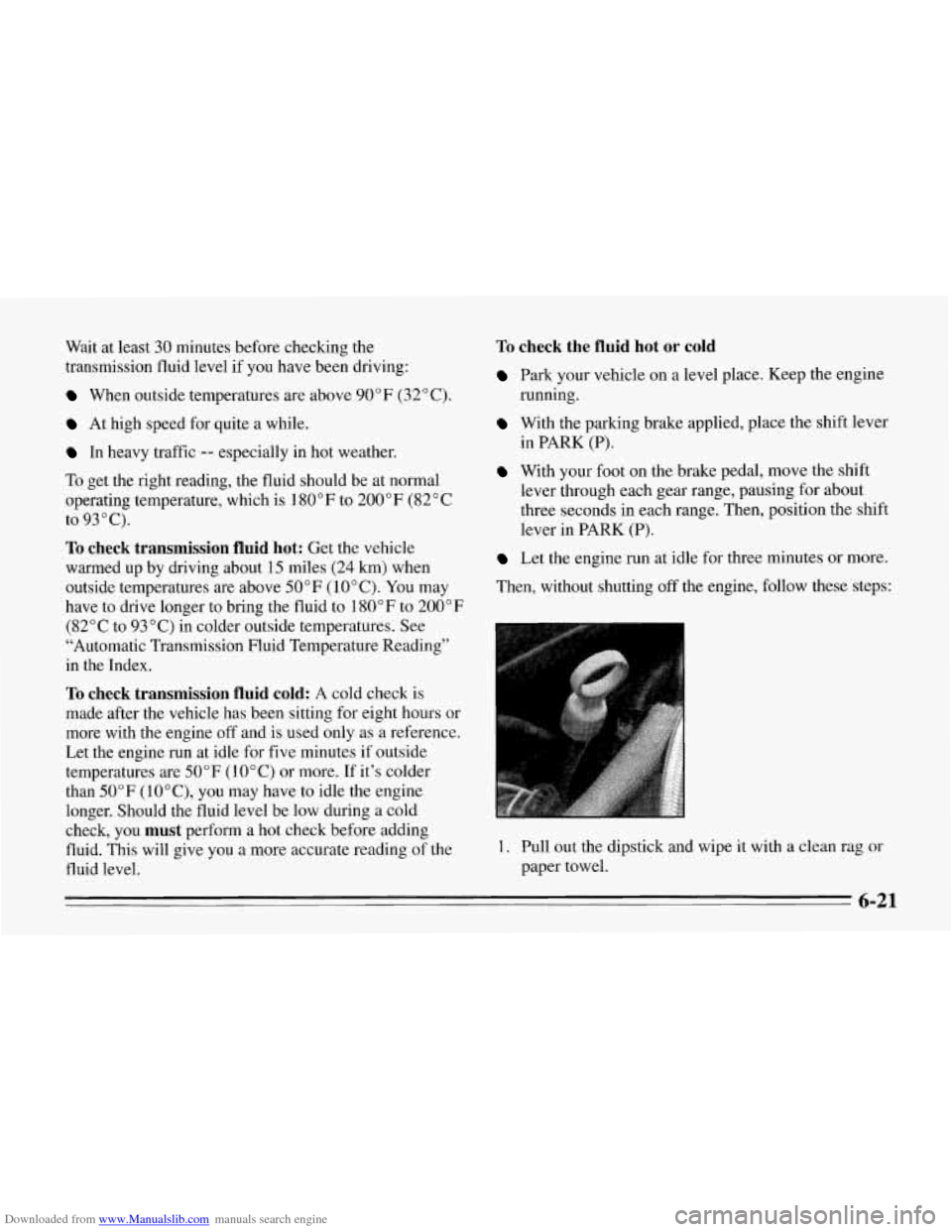
1. Pull out the dipstick and wipe it with a clean rag or
paper towel.
6-21