1995 CHEVROLET CAVALIER fuel
[x] Cancel search: fuelPage 217 of 340
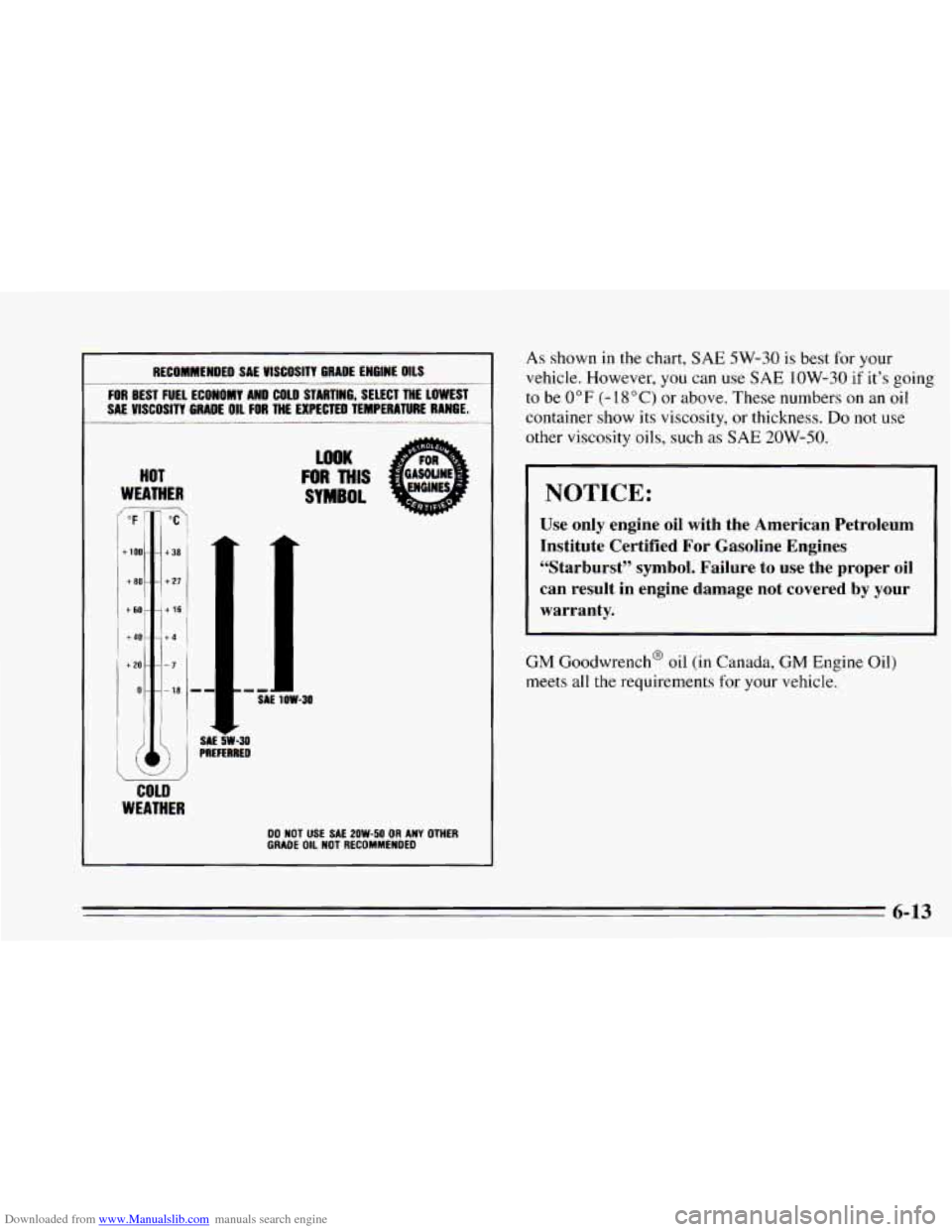
Downloaded from www.Manualslib.com manuals search engine RECOMMENDED SAE VISCOSITY GRADE ENGINE OILS
FOR BEST FUEL ECONOMY AND COLD STARTING, SELECT THE LOWEST
SAE VISCOSITY GRADE OIL
FOR THE EXPECTED TEMPERATURE RANGE.
HOT
WEATHER -
J
LOOK
FOR THIS
SYMBOL
COLD
WEATHER
00 NOT USE SAE 2OW-50 OR ANY OTHER
GRADE OIL NOT RECOMMENDED
As shown in the chart, SAE 5W-30 is best for your
vehicle. However, you can use
SAE low-30 if it’s going
to be 0°F (- 18 “C) or above. These numbers on an oil
container show its viscosity, or thickness.
Do not use
other viscosity oils, such
as SAE 20W-50.
NOTICE:
Use only engine oil with the American Petroleum
Institute Certified For Gasoline Engines
%tarburst” symbol. Failure to use the proper oil
can result in engine damage not covered by your warranty.
GM Goodwrench@ oil (in Canada, GM Engine Oil)
meets
all the requirements for your vehicle.
6-13
Page 238 of 340
Downloaded from www.Manualslib.com manuals search engine Inflation - Tire Pressure
The Tire-Loading Information label which is on the rear
edge
of the driver’s door shows the correct inflation
pressures for your tires, when they’re cold. “Cold”
means your vehicle has been sitting for at least three
hours or driven
no more than a mile.
NOTICE:
Don’t let anyone tell you that underinflation or
overinflation is all right. It’s not. If your tires
don’t have enough air (underinflation) you can
get:
Too much flexing
Too much heat
Tire overloading
Bad wear
Bad handling
Bad fuel economy.
NOTICE: (Continued) NOTICE:
(Continued)
If your tires have too much air (overinflation),
you can get:
Unusual wear
Bad handling
0 Rough ride
Needless damage from road hazards.
When to Check
Check your tires once a month or more.
Don’t forget your compact spare tire.
It should be at
60 psi (420 kPa).
How to Check
Use a good quality pocket-type gage to check tire
pressure. Simply looking at the tires will not tell
you the
pressure, especially if you have radial tires
-- which
may look properly inflated even if they’re underinflated.
If your tires have valve caps, be sure to put them back
on. They help prevent leaks by keeping
out dirt and
moisture.
6-34
Page 253 of 340
Downloaded from www.Manualslib.com manuals search engine Underbody Maintenance
Chemicals used for ice and snow removal and dust
control can collect
on the underbody. If these are not
removed, accelerated corrosion (rust) can occur on the
underbody parts such as fuel lines, frame, floor pan, and
exhaust system even though they have corrosion
protection.
At least every spring, flush these materials from the
underbody with plain water. Clean any areas where mud
and other debris can collect. Dirt packed
in closed areas
of
the frame should be loosened before being flushed.
Your dealer
or an underbody vehicle washin, 0 s 'y stem
can do this for
you.
Chemical Paint Spotting
Some weather and atmospheric conditions can create a
chemical fallout. Airborne pollutants can fall upon and
attack painted surfaces on your vehicle. This damage
can take two forms: blotchy, ringlet-shaped
discolorations, and small irregular dark spots etched into
the paint surface.
Although no defect
in the paint job causes this,
Chevrolet will repair, at no charge to the owner, the
surfaces of new vehicles damaged by this Fallout
condition within 12 months or
12,000 miles (20 000 km)
of purchase, whichever comes first.
6-49
Page 257 of 340
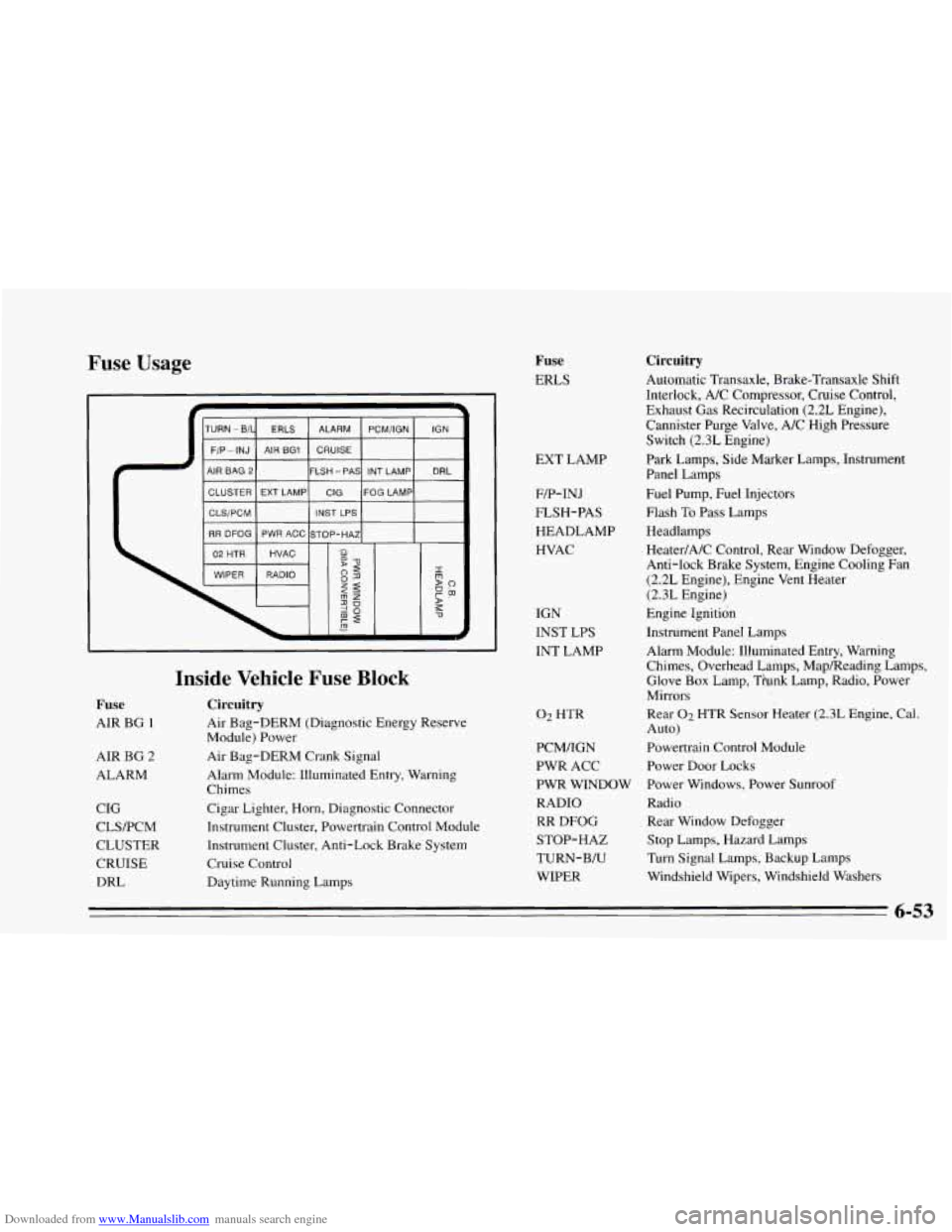
Downloaded from www.Manualslib.com manuals search engine Fuse Usage
S ALARM PCM/IGN IGN
Fuse
AIR BG 1
AIR BG 2
ALARM
CIG
CLSPCM
CLUSTER
CRUISE DRL
Inside Vehicle Fuse Block
Circuitry
Air Bag-DERM (Diagnostic Energy Reserve
Module) Power
Air Bag-DERM Crank Signal
Alarm Module: Illuminated Entry, Warning
Chimes
Cigar Lighter, Horn, Diagnostic Connector
Instrument Cluster, Powertrain Control Module
Instrument Cluster, Anti-Lock Brake System Cruise Control
Daytime Running Lamps IGN
INST
LPS
INT LAMP
Fuse
ERLS
EXT LAMP
F/P-INJ
FLSH-PAS
HEADLAMP
HVAC
Circuitry
Automatic Transaxle, Brake-Transaxle Shift
Interlock, A/C Compressor, Cruise Control,
Exhaust Gas Recirculation (2.2L Engine),
Cannister Purge Valve, A/C High Pressure
Switch (2.3L Engine)
Park Lamps, Side Marker Lamps, Instrument
Panel Lamps
Fuel Pump, Fuel Injectors
Flash To Pass Lamps
Headlamps
Heater/A/C Control, Rear Window Defogger,
Anti-lock Brake System, Engine Cooling Fan
(2.2L Engine), Engine Vent Heater
(2.3L Engine)
Engine Ignition
Instrument PaneiLamps
Alarm Module: 11,luminated Entry, Warning
Chimes, Overhead Lamps, MapReading Lamps,
Glove Box Lamp, Thnk Lamp, Radio, Power
Mirrors
Auto)
02 HTR Rear 02 HTR Sensor keater (2.3L Engine, Cal.
PCM/IGN Powertrain Control Module
PWR ACC Power
Door Locks
PWR WINDOW Power Windows, Power Sunroof
RADIO Radio
RR DFOG Rear Window Defogger
STOP-HAZ Stop Lamps, Hazard Lamps
TURN-B/U Turn
Signal Lamps, Backup Lamps
WIPER Windshield
Wipers, Windshield Washers
6-53
Page 259 of 340
Downloaded from www.Manualslib.com manuals search engine 4.0 quarts 3.80 L
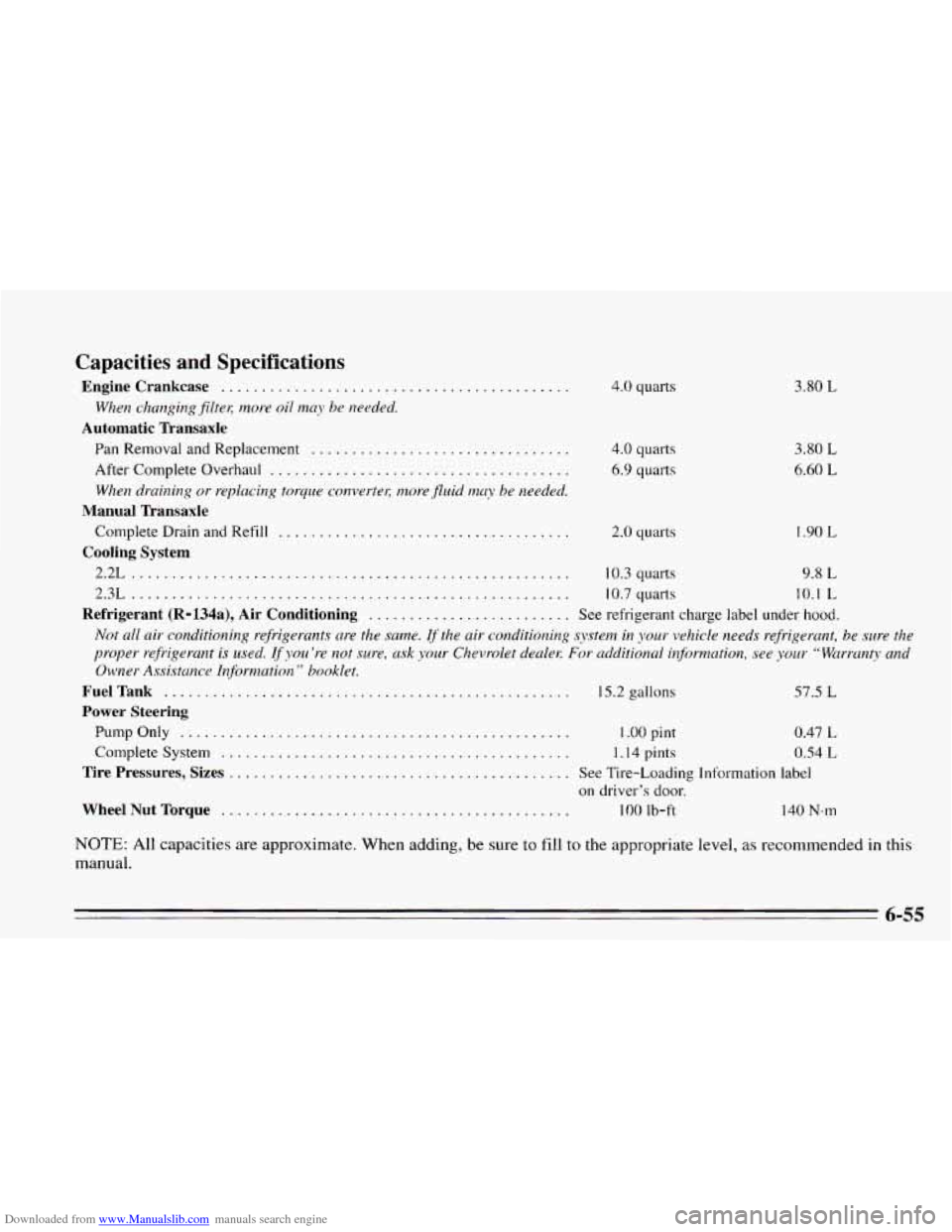
Capacities and Specifications
Enginecrankcase ...........................................
Automatic Transaxle
When chcwging$lte& more oil! rnuy be needed.
Pan Removal and Replacement ................................
When draining or replacing torque convertec 1nore.fluid may be needed.
Complete Drain and Refill ....................................
After Complete Overhaul .....................................
Manual Transaxle
Cooling System
2.2L ...................................................... 10.3 quarts 9.8 L
2.3L
...................................................... 10.7 quarts 10.1 L
Refrigerant (R-l34a), Air Conditioning ......................... See refrigerant charge label under hood.
Not all air conditioning refrigerants are the same. If the air conditioning system in your vehicle needs refrigerant, he sure the
proper refrigerant is used. IJ’you ’re not sure, ask your Chevrolet dealer:
For additionul information, see your “Warrunty and
Owner Assistunce Infixmution, ” booklet.
FuelTank ...............................................
Power Steering
PumpOnly ................................................ 1 .OO pint 0.47 L
Complete System ........................................... 1.14 pints 0.54 L
Tire Pressures, Sizes
.......................................... See Tire-Loading Information label
on driver’s door.
WheelNutTorque ........................................... 100 Ib-ft
4.0 quarts
6.9 quarts
2.0 quarts
15.2 gallons
3.80 L
6.60 L
I .90 L
57.5 L
140 N.m
NOTE: All capacities are approximate. When adding, be sure to fill to the appropriate level, as reconmended in this
manual.
6-55
Page 264 of 340
Downloaded from www.Manualslib.com manuals search engine How This Section is Organized
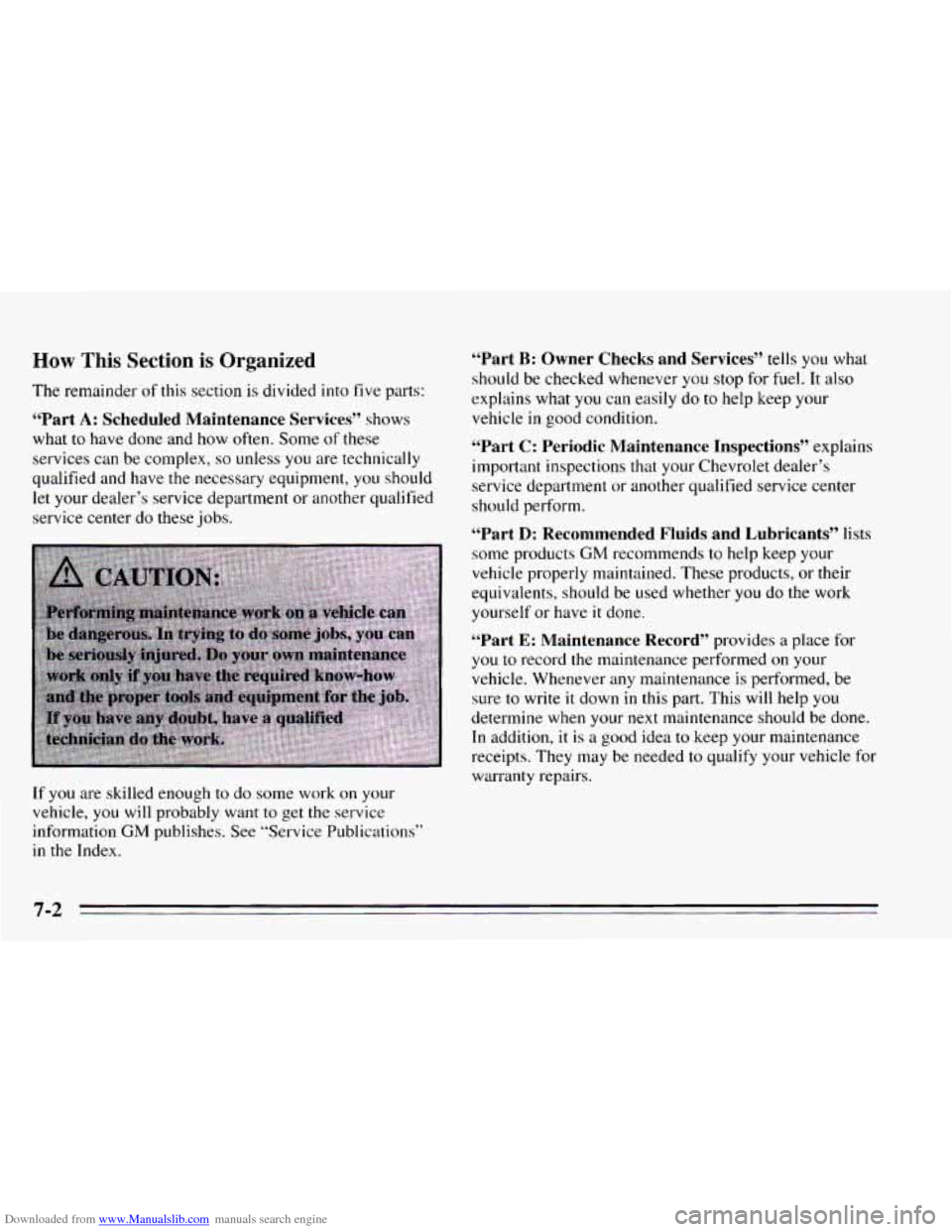
The remainder of this section is divided into five parts:
“Part A: Scheduled Maintenance Services’’ shows
what
to have done and how often. Some of these
services can be complex,
so unless you are technically
qualified and have the necessary equipment,
you should
let your dealer’s service department or another qualified
service center do these jobs.
If you are skilled enough to do some work
on your
vehicle,
you will probably want to get the service
information
GM publishes. See “Service Publications”
in
the Index.
“Part B: Owner Checks and Services” tells you what
should be checked whenever you stop for fuel. It also
explains what you can easily
do to help keep your
vehicle
in good condition.
“Part C: Periodic Maintenance Inspections’’ explains
important inspections that your Chevrolet dealer’s
service department or another qualified service center
should perform.
“Part D: Recommended Fluids and Lubricants” lists
some products
GM recommends to help keep your
vehicle properly maintained. These products,
or their
equivalents, should be used whether
you do the work
yourself or have
it done.
“Part E: Maintenance Record” provides a place for
you
to record the maintenance performed on your
vehicle. Whenever any maintenance is performed, be
sure to write
it down in this part. This will help you
determine when your next maintenance should be done.
In addition,
it is a good idea to keep your maintenance
receipts. They may be needed
to qualify your vehicle for
warranty repairs.
7-2
Page 265 of 340
Downloaded from www.Manualslib.com manuals search engine Part A: Scheduled Maintenance
Services
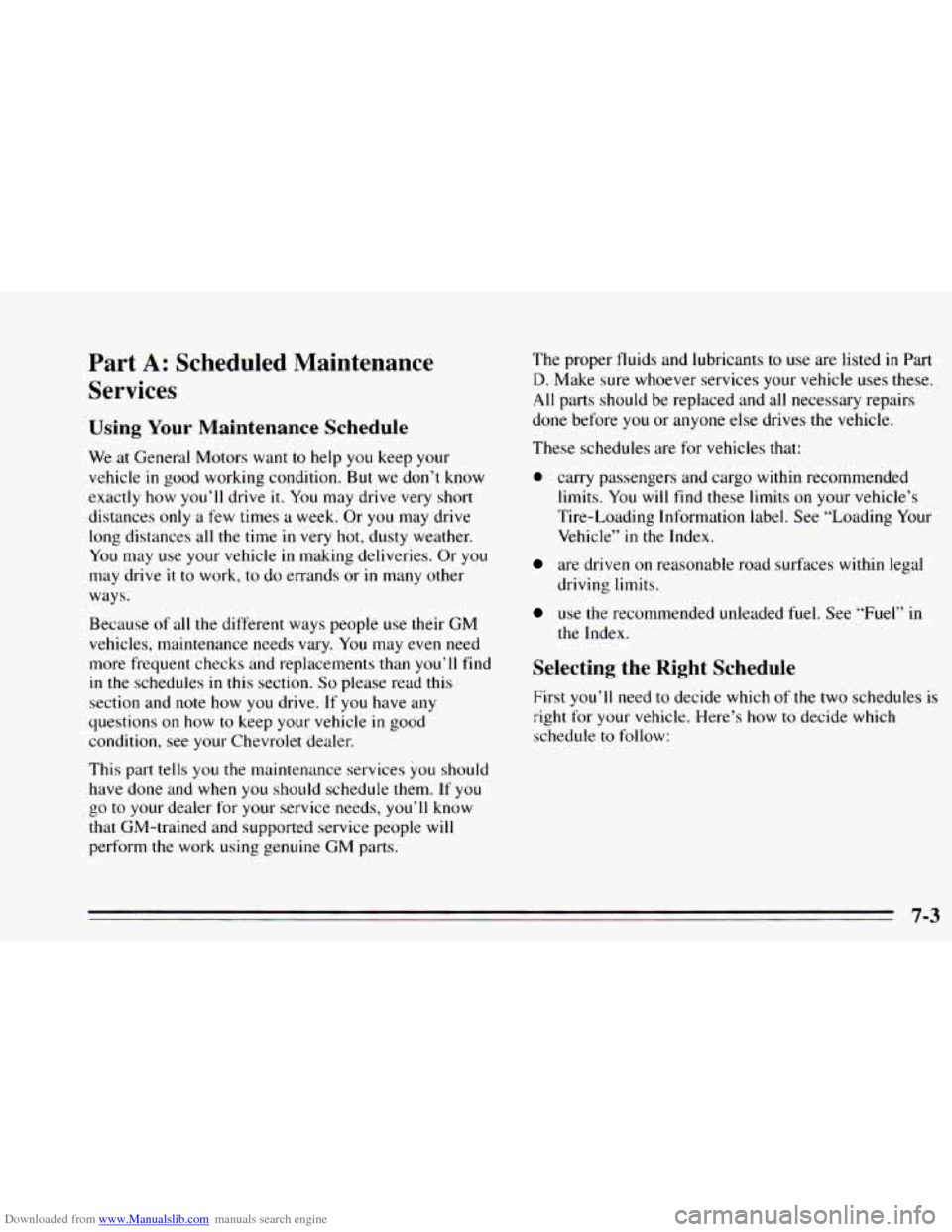
Using Your Maintenance Schedule
We at General Motors want to help you keep your
vehicle
in good working condition. But we don’t know
exactly how
you’ll drive it. You may drive very short
distances
only a few times a week. Or you may drive
long distances all
the time in very hot, dusty weather.
You may
use your vehicle in making deliveries. Or you
may drive
it to work, to do errands or in many other
ways.
Because
of all the different ways people use their GM
vehicles, maintenance needs vary.
You may even need
more frequent checks and replacements than you’ll find
in the schedules in this section. So please read this
section and note how
you drive. If you have any
questions
on how to keep your vehicle in good
condition, see your Chevrolet dealer.
This part tells you the maintenance services
you should
have done and when you should schedule them.
If you
go to your dealer for
your service needs, you’ll know
that GM-trained and supported service people
will
perform the work using genuine GM parts.
The proper fluids and lubricants to use are listed in Part
D. Make sure whoever services your vehicle uses these.
All parts should be replaced and all necessary repairs
done before
you or anyone else drives the vehicle.
These schedules are for vehicles that:
0 carry passengers and cargo within recommended
limits. You will find these limits on your vehicle’s
Tire-Loading Information label. See “Loading Your
Vehicle”
in the Index.
are driven on reasonable road surfaces within legal
driving limits.
use the recommended unleaded fuel. See “Fuel” in
the Index.
Selecting the Right Schedule
First you’ll need to decide which of the two schedules is
right for your vehicle. Here’s how to decide which
schedule
to follow:
7-3
Page 266 of 340
Downloaded from www.Manualslib.com manuals search engine Maintenance Schedule
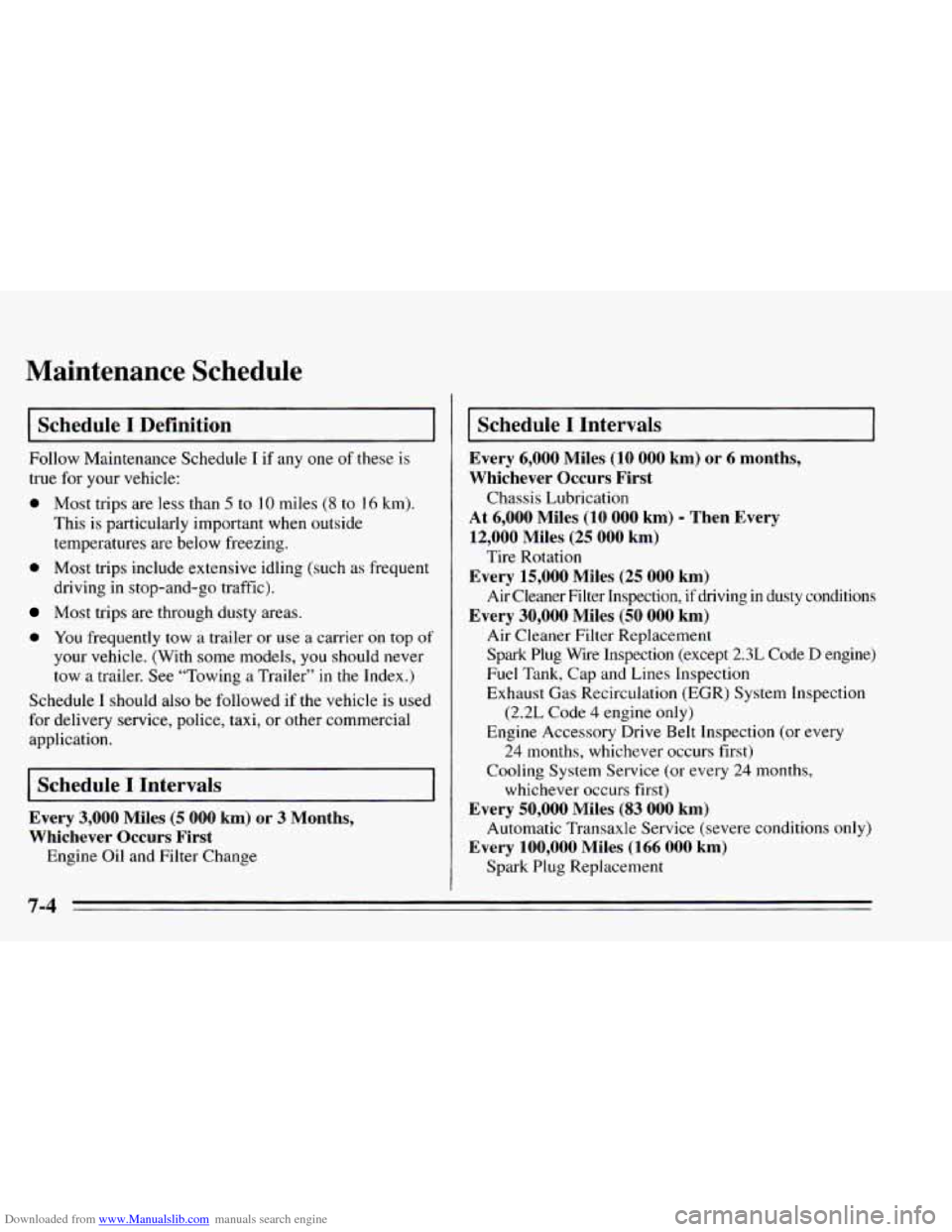
Schedule I Definition
Follow Maintenance Schedule I if any one of these is
true for your vehicle:
0 Most trips are less than 5 to 10 miles (8 to 16 km).
This
is particularly important when outside
temperatures are below freezing.
0 Most trips include extensive idling (such as frequent
driving in stop-and-go traffic).
Most trips are through dusty areas.
0 You frequently tow a trailer or use a carrier on top of
your vehicle. (With some models, you should never
tow a trailer. See “Towing a Trailer”
in the Index.)
Schedule
I should also be followed if the vehicle is used
for delivery service, police, taxi, or other commercial
application.
Schedule I Intervals
Every 3,000 Miles (5 000’km) or 3 Months,
Whichever Occurs First
Engine Oil and Filter Change
Schedule I Intervals
Every 6,000 Miles (10 000 km) or 6 months,
Whichever Occurs First
Chassis Lubrication
At 6,000 Miles (10 000 km) - Then Every
12,000 Miles (25 000 km)
Tire Rotation
Every 15,000 Miles (25 000 km)
Air Cleaner Filter Inspection, if driving in dusty conditions
Every 30,000 Miles (50 000 km)
Air Cleaner Filter Replacement
Spark Plug Wire Inspection (except 2.3L Code D engine)
Fuel Tank, Cap and Lines Inspection
Exhaust Gas Recirculation (EGR) System Inspection
Engine Accessory Drive Belt Inspection (or every
Cooling System Service (or every 24 months,
(2.2L Code 4 engine only)
24 months, whichever occurs first)
whichever occurs first)
Every 50,000 Miles (83 000 km)
Every
100,000 Miles (166 000 km)
Automatic Transaxle Service (severe conditions only)
Spark Plug Replacement
7-4