1995 CHEVROLET CAVALIER instrument panel
[x] Cancel search: instrument panelPage 117 of 340
Downloaded from www.Manualslib.com manuals search engine When one of the warning lights comes on and stays on
when
you are driving, or when one of the gages shows
there may be a problem, check
the section that tells you
what to do about
it. Please follow this manual’s advice.
Waiting to do repairs can be costly
-- and even
dangerous.
So please get to know your warning lights
and gages. They’re
a big help.
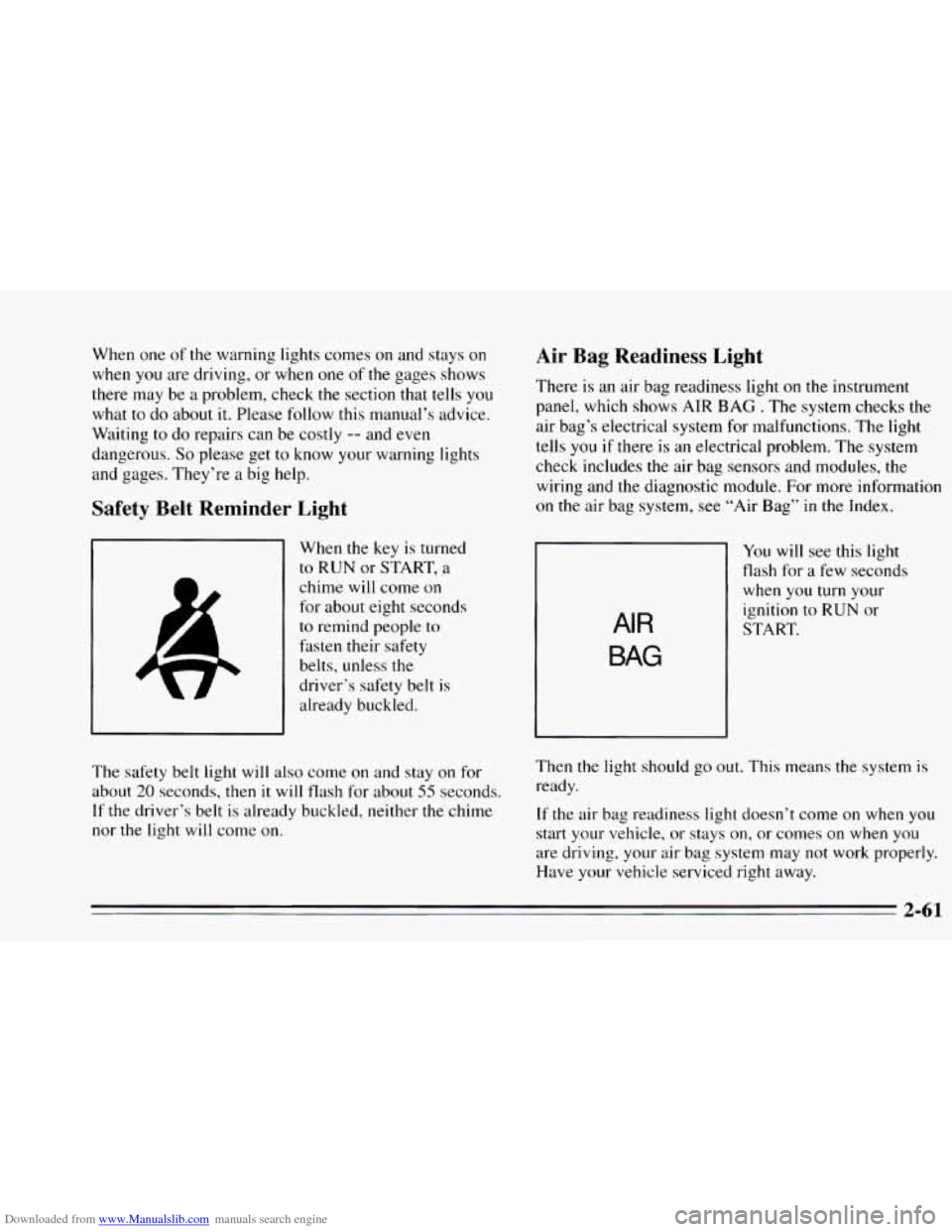
Safety Belt Reminder Light
When the key is turned
to RUN or START, a
chime will come on
for about eight seconds
to remind people to
fasten their safety
belts, unless
the
driver’s safety belt is
already buckled.
Air Bag Readiness Light
There is an air bag readiness light on the instrument
panel, which shows AIR
BAG . The system checks the
air bag’s electrical system for malfunctions. The light
tells
you if there is an electrical problem. The system
check includes the air bag sensors and modules, the
wiring and the diagnostic module.
For more information
on the air bag system, see “Air Bag” in the Index.
rl
You will see this light
flash for
a few seconds
when you turn your
ignition
to RUN or
AIR
BAG
START.
The safety belt light
will also come on and stay on for
about
20 seconds, then it will flash for about 55 seconds.
If the driver’s belt is already buckled, neither the chime
nor
the light will come on. Then
the light should
go out. This means the system is
ready.
If the air bag readiness light doesn’t come on when you
start your vehicle, or stays on, or comes on
when you
are driving. your air bag system may not work properly.
Have your vehicle serviced right away.
2-61
Page 128 of 340
Downloaded from www.Manualslib.com manuals search engine Mode Knob
The right knob has several settings to control the
direction
of air flow. For each setting, set the
temperature to a comfortable setting.
0 MAX (Option): This setting recirculates much of
the air inside your vehicle and sends it through the
instrument panel outlets. The air conditioning
compressor will run automatically
in this setting when it
is needed to help dry the air in the vehicle.
2 VENT: This setting brings in outside air and
directs it through the instrument panel.
BI-LEVEL: This setting brings in outside air and
directs
it two ways. Some air is directed through the
instrument panel outlets. Most of the air is directed
through the floor ducts and a little
to the defrost and side
window vents.
1j FLOOR: This setting sends most of the air through
the ducts near the floor. The rest comes
out of the
defroster and side window vents.
9 DEFOG: This setting allows half of the air to go to
the floor ducts and half to the defrost and side window
vents.
9 DEFROST: This setting directs most of the air
through the defroster and side window vents. Some
of
the air goes to the floor ducts. If your vehicle is
equipped with an
air conditioner, the air conditioning
compressor will
run automatically in this setting when it
is needed to help dry
the air in the vehicle.
Air Conditioning Compressor Button
Press the A/C button to operate the air conditioner
compressor. The indicator light above the button will
glow when the button
is pressed. You don’t have to
press
the button to run the compressor in MAX or
DEFROST.
Air Conditioning (Option)
On very hot days, open the windows long enough to let
hot, inside air escape. This reduces the time it takes for
your vehicle to cool down, which should help fuel
economy.
For quick cool-down on very hot days, use
MAX with
the temperature
knob all the way in the blue area. If this
3-2
Page 146 of 340
Downloaded from www.Manualslib.com manuals search engine Avoid needless heavy braking. Some people drive in
spurts
-- heavy acceleration followed by heavy braking
-- rather than keeping pace with traffic. This is a
mistake. Your brakes may not have time to cool between
hard stops. Your brakes will wear out much faster
if you
do a lot of heavy braking. If you keep pace with the
traffic and allow realistic following distances, you will
eliminate a lot
of unnecessary braking. That means
better braking and longer brake life.
If your engine ever stops while you’re driving, brake
normally but don’t pump
your brakes. If you do, the
pedal may get harder to push down. If your engine
stops,
you will still have some power brake assist. But
you will
use it when you brake. Once the power assist is
used up, it may take longer to stop and the brake pedal
will be harder to push.
Anti-Lock Brakes (ABS)
Your Chevrolet has an advanced electronic braking
system that will help prevent
a braking skid.
This light on
the
instrument panel will
come on briefly when
you start your vehicle.
When you start
your vehicle, or when you begin to drive
away,
you may hear a momentary motor or clicking
noise. And you may even notice that
your brake pedal
moves
a little while this is going on. This is the ABS
system testing itself. If there’s a problem with the
anti-lock brake system,
the anti-lock brake system
warning light will stay
on or flash.
See “Anti-Lock Brake System Warning Light” in the
Index.
Page 175 of 340
Downloaded from www.Manualslib.com manuals search engine Turn Signals When Towing a Trailer
When you tow a trailer, your vehicle has to have a
different turn signal flasher and extra wiring. The green
arrows on your instrument panel will flash whenever
you signal a turn or lane change. Properly hooked up,
the trailer lamps will also flash, telling other drivers
you‘re about
to turn, change lanes or stop.
When towing a trailer, the green arrows on
your
instrument panel will flash for turns even if the bulbs on
the trailer are burned out. Thus, you may think drivers
behind
you are seeing your signal when they are not. It’s
important
to check occasionally to be sure the trailer
bulbs are
still working.
Driving On Grades
Reduce speed and shift to a lower gear lwfot-e you start
down
a long or steep downgrade. If you don’t shift
down, you might have to use your brakes so much that
they would get hot and no longer work well.
On a long uphill grade, shift down and reduce your
speed
to around 45 mph (70 km/h) to reduce the
possibility of engine and transaxle overheating.
Parking on Hills
You really should not park your vehicle, with a trailer
attached,
on a hill. If something goes wrong, your rig
could start
to move. People can be injured, and both
your vehicle and
the trailer can be damaged.
But if you ever have to park your rig on a hill, here’s
how to do
it:
1. Apply your regular brakes, but don’t shift into
PARK (P) yet.
2. Have someone place chocks under the trailer wheels.
3. When the wheel chocks are in place, release the
regular brakes
until the chocks absorb the load.
4. Reapply the regular brakes. Then apply your parking
brake, and then shift
to PARK (P).
5. Release the regular brakes.
4-35
Page 188 of 340
Downloaded from www.Manualslib.com manuals search engine NOTICE: (Continued)
equipment
or rear bumper valance will be
damaged. Use wheel-lift equipment with a towing
dolly or car carrier equipment. Additional
ramping may be required
for car carrier
equipment. Use safety chains and wheel straps.
Engine Overheating
You will find a coolant temperature gage on your
Chevrolet’s instrument
panel.
If Steam Is Coming From Your Engine
I I
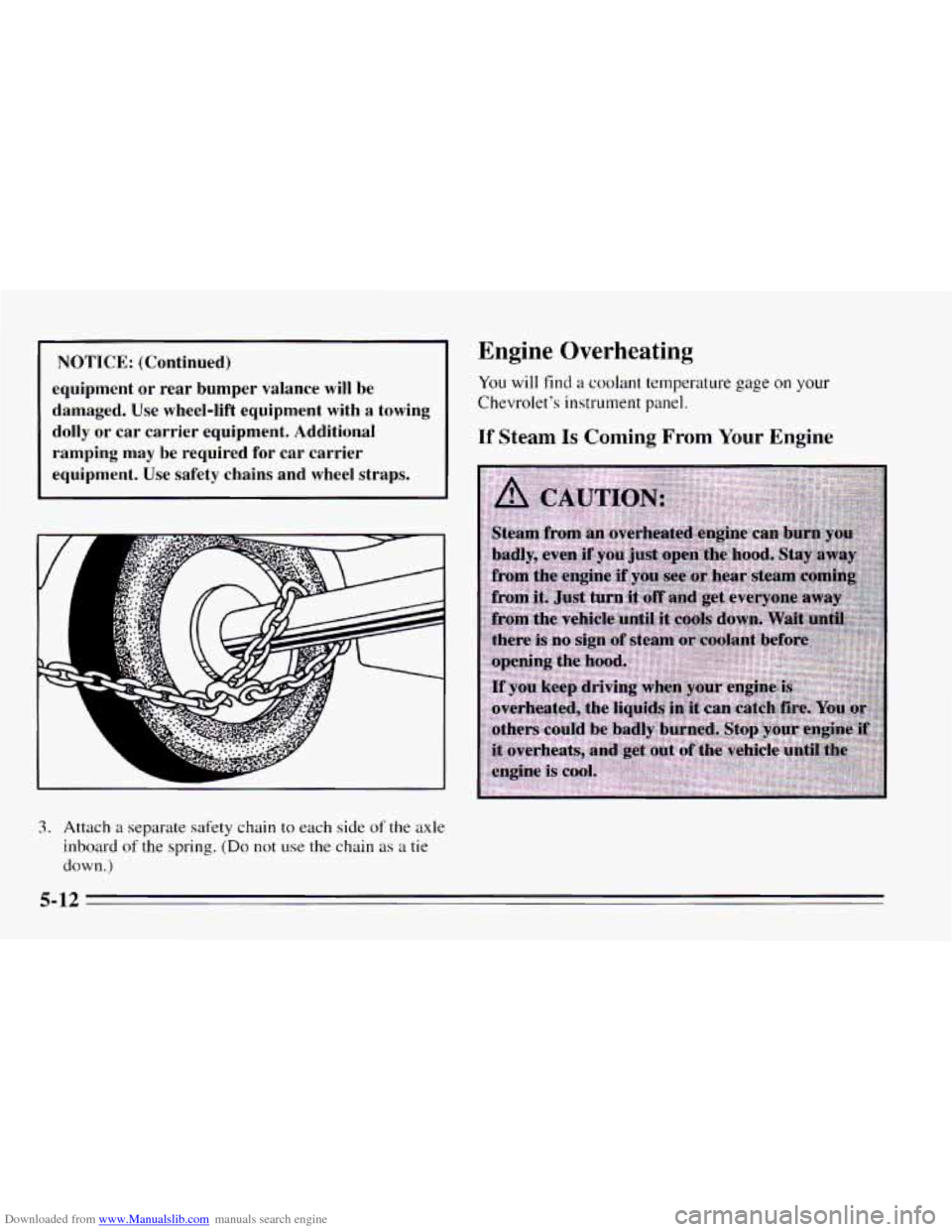
3. Attach a separate safety chain to each side of the axle
inboard
of the spring. (Do not use the chain as a tie
down.)
5-12
Page 214 of 340
Downloaded from www.Manualslib.com manuals search engine Engine Oil
If the CHECK OIL light on the instrument panel comes
on,
it means you need to check your engine oil level
right away. For more information, see “Check Oil
Light” in the Index. You should check your engine oil
level regularly; this is
an added reminder.
It’s a good idea to check your engine oil every time you
get fuel. In order
to get an accurate reading, the oil must
be warm and the vehicle must be on level ground.
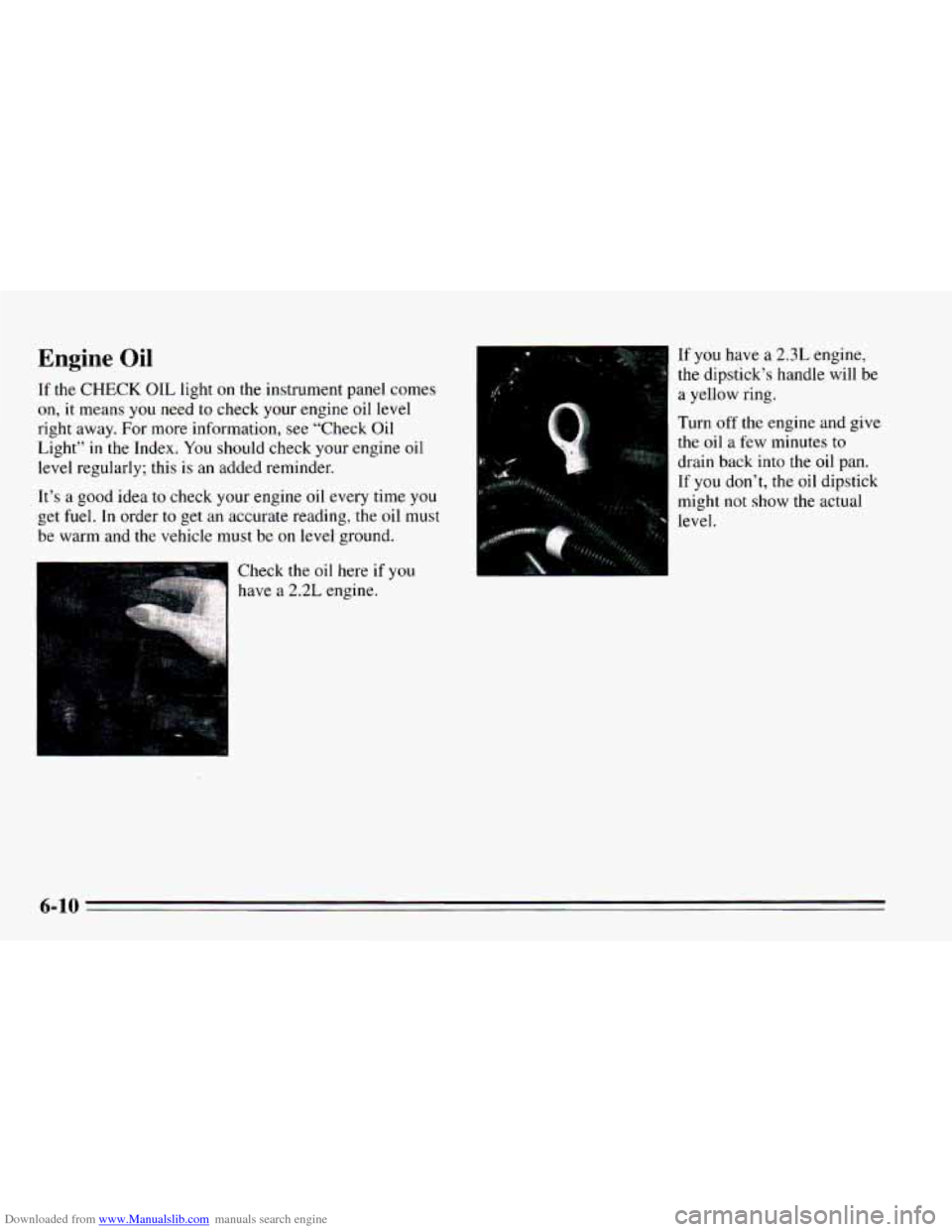
Check
have
a
the oil here if
2.2L engine.
If you have a 2.3L engine,
the dipstick’s handle will be
a yellow ring.
Turn
off the engine and give
the oil a few minutes to
drain back into the oil pan.
If you don’t, the oil dipstick
might not show
the actual
level.
U’IV
Page 249 of 340
Downloaded from www.Manualslib.com manuals search engine Cleaning the Top of the Instrument Panel
Use only mild soap and water to clean the top surfaces
of the instrument panel. Sprays containing silicones or
waxes may cause annoying reflections
in the windshield
and even make
it difficult to see through the windshield
under certain conditions.
Care of Safety Belts
Keep belts clean and dry.
Glass
Glass should be cleaned often. GM Glass Cleaner (GM
Part
No. 1050427) or a liquid household glass cleaner
will remove normal tobacco smoke and dust films. Don’t use
abrasive cleaners on glass, because they may
cause scratches. Avoid placing decals on the inside rear
window, since they may have
to be scraped off later. If
abrasive cleaners are used on the inside
of the rear
window, an electric defogger element may be damaged.
Any temporary license should
not be attached across the
defogger grid.
Cleaning the Outside of the
Windshield and Wiper Blades
If the windshield is not clear after using the windshield
washer, or if
the wiper blade chatters when running, wax
or other material may be on the blade or windshield.
Clean the outside
of the windshield with GM
Windshield Cleaner, Bon-Ami Powder@ (GM Part
No.
105001 1). The windshield is clean if beads do not form
when you rinse it with water.
Clean the blade
by wiping vigorously with a cloth
soaked in
full strength windshield washer solvent. Then
rinse the blade with water.
Wiper blades should be checked on a regular basis and
replaced when worn.
6-45
Page 255 of 340
Downloaded from www.Manualslib.com manuals search engine Vehicle Identification Number (VIN)
SAMPLE4UXSMO72675
ENGINE / 1995 ASSEMBLY
?
CODE MODEL YEAR PLANT
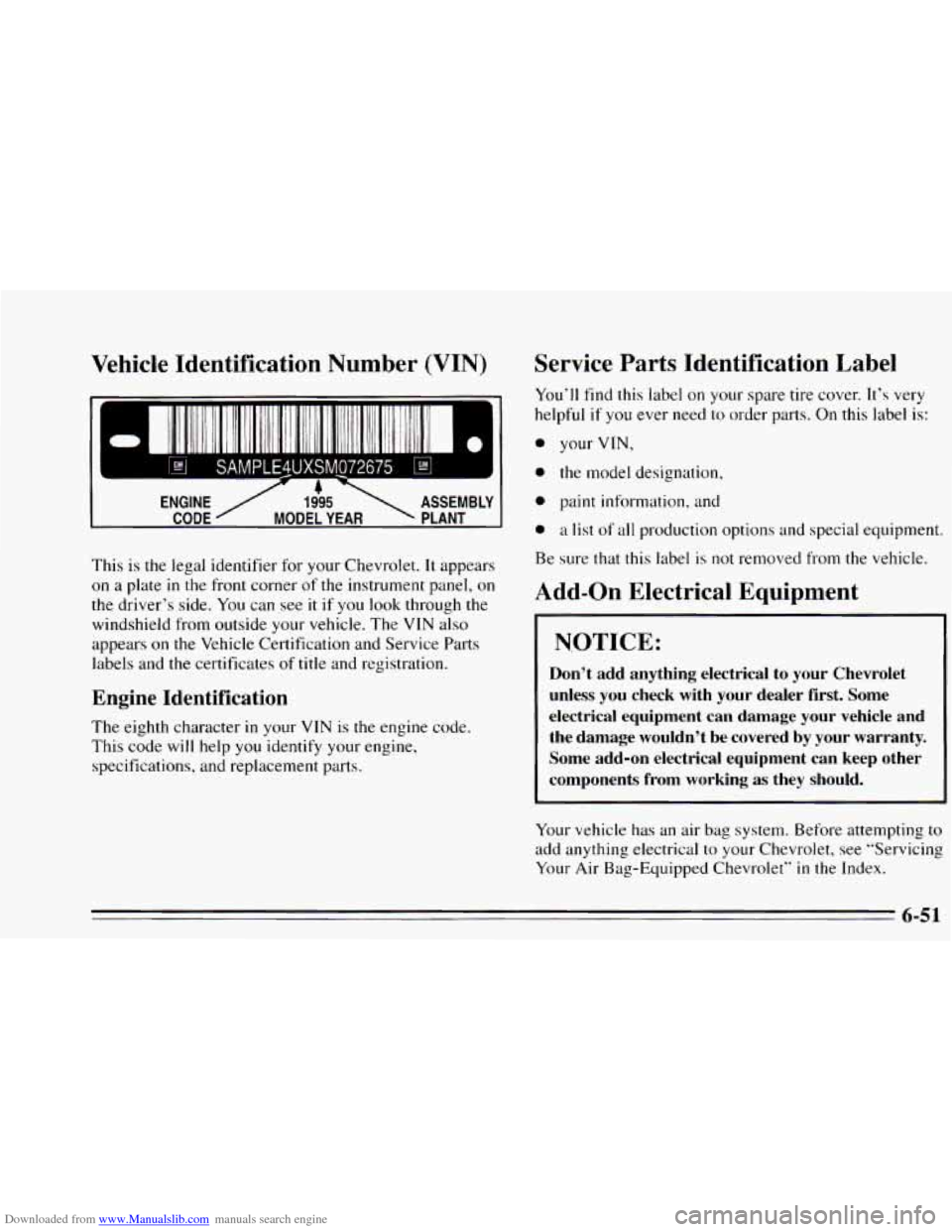
This is the legal identifier for your Chevrolet. It appears
on
a plate in the front corner of the instrument panel, on
the driver’s side. You can see it if you look through the
windshield from outside your vehicle. The VIN also
appears on
the Vehicle Certification and Service Parts
labels and the certificates
of title and registration.
Engine Identification
The eighth character in your VIN is the engine code.
This code will help
you identify your engine,
specifications, and replacement parts.
Service Parts Identification Label
You’ll find this label on your spare tire cover. It’s very
helpful
if you ever need to order parts. On this label is:
0 your VIN,
0 the model designation,
0 paint information, and
0 a list of all production options and special equipment.
Be sure that this label is not removed from the vehicle.
Add-on Electrical Equipment
N.OTICE:
Don’t add anything electrical to your Chevrolet
unless you check with your dealer first. Some
electrical equipment can damage your vehicle and
the damage wouldn’t be covered by your warranty.
Some add-on electrical equipment can keep other
components from working
as they should.
Your vehicle has an air bag system. Before attempting to
add anything electrical to your Chevrolet, see “Servicing
Your Air Bag-Equipped Chevrolet”
in the Index.
6-51