1995 CHEVROLET CAVALIER service
[x] Cancel search: servicePage 300 of 340
Downloaded from www.Manualslib.com manuals search engine Part B: Owner Chews and Services
Listed below are owner checks and services which
should be performed at the intervals specified to help
ensure the safety, dependability and emission control
performance of your vehicle.
Be sure any necessary repairs are completed at once.
Whenever any fluids or lubricants are added
to your
vehicle, make sure
they are the proper ones, as shown in
Part D.
At Each Fuel Fill
It is important for you or a service station attendant to
pe$orm these underhood checks at each fuel fill.
Engine Oil Level Windshield Washer Fluid Level
Check the windshield washer fluid level
in the
windshield washer tank and add the proper fluid
if
necessary. See “Windshield Washer Fluid” in the Index
for further details.
At Least Once a Month
Tire Inflation
Check tire inflation. Make sure tires are inflated to the
pressures specified on the Tire-Loading Information
label located
on the rear edge of the driver’s door. See
“Tires”
in the Index for further details.
Cassette Deck
Clean cassette deck. Cleaning should be done every
50 hours of tape play. See “Audio Systems’’ in the Index
for further details.
Check the engine oil level
and add the proper oil if
necessary. See “Engine Oil” in the Index for further
details.
At Least Twice a Year
Engine Coolant Level
Check the engine coolant level and add the proper
coolant mix if necessary. See “Coolant”
in the Index for
further details.
Hydraulic Clutch System Inspection
Check the fluid level in the clutch reservoir. See
“Hydraulic Clutch Fluid“ in the Index.
A fluid loss in
this system could indicate
a problem. Have the system
inspected and repaired at once.
7-38
Page 301 of 340
Downloaded from www.Manualslib.com manuals search engine At Least Once a Year
Key Lock Cylinders
Lubricate the key lock cylinders with the lubricant
specified
in Part D.
Body Lubrication
Lubricate all body door and rear compartment hinges.
Also lubricate all hinges and latches, including those for
the hood, glove box door, console door and any folding
seat hardware. Part
D tells you what to use. More
frequent lubrication may be required when exposed
to a
corrosive envlronment.
Starter Switch
1. Before you start, be sure you have enough room
around the vehicle.
2. Firmly apply both the parking brake (see “Parking
Brake”
in the Index if necessary) and the regular
brake.
NOTE:
Do not use the accelerator pedal, and be
ready
to turn off the engine immediately if it starts.
3. On automatic transaxle vehicles, try to start the
engine
in each gear. The starter should work only in
PARK (P) or NEUTRAL (N). If the starter works in
any other position, your vehicle needs service.
On manual transaxle vehicles, put the shift lever in
NEUTRAL
(N), push the clutch down halfway and
try to start the engine.
The starter should work only
when the clutch is pushed down all the way
to the
floor. If the starter works when the clutch isn’t
pushed
all the way down, your vehicle needs service.
7-39
Page 302 of 340
Downloaded from www.Manualslib.com manuals search engine Brake-Transaxle Shift Interlock -- BTSI (Automatic
Transaxle)
1.
2.
3.
Before you start, be sure you have enough room
around the vehicle. It should be parked
on a level
surface.
Firmly apply the parking brake (see “Parking Brake”
in the Index
if necessary).
NOTE: Be ready to apply the regular brake
immediately
if the vehicle begins to move.
With the engine off, turn the key to the RUN
position, but don’t start the engine. Without applying
the regular brake, try
to move the shift lever out of
PARK (P) with normal effort, If the shift lever
moves
out of PARK (P), your vehicle’s BTSI needs
service.
Steering Column Lock
While parked, and with the parking brake set, try to turn
the key to
LOCK in each shift lever position.
0 With an automatic transaxle, the key should turn to
LOCK only when the shift lever
is in PARK (P).
With a manual transaxle, the key should turn to
LOCK only when the shift lever is in
REVERSE
(R).
On vehicles with a key release button, try to turn the key
to LOCK without pressing the button. The key should
turn to
LOCK only with the key button depressed.
On all vehicles, the
key should come out only in LOCK.
Turn the steering wheel to
the left and to the right. It
should only lock when turned
to the right.
7-40
Page 304 of 340
Downloaded from www.Manualslib.com manuals search engine Part C: Periodic Maintenance
Inspections
Listed below are inspections and services which should
be performed at least twice a year (for instance, each
spring and fall). You should let your
GM dealer’s
service department or other qualified service center do
these
jobs. Make sure any necessary repairs are
completed at once.
Restraint Systems
Now and then, make sure all your belts, buckles, latch
plates, retractors, anchorages and reminder systems are
working properly. Look for any loose parts or damage.
If you see anything that might keep a restraint system
from doing its job, have it repaired.
Steering, Suspension and Front-Wheel-Drive
Axle Boot and Seal Inspection
Inspect the front and rear suspension and steering
system for damaged, loose or missing parts, signs
of
wear, or lack of lubrication. Inspect the power steering
lines and hoses for proper hookup, binding, leaks,
cracks, chafing, etc. Clean and then inspect the drive
axle boot seals for damage, tears or leakage. Replace
seals if necessary.
Exhaust System Inspection
Inspect the complete exhaust system. Inspect the body near
the exhaust system.
Look for broken, damaged, missing or
out-of-position
parts as well as open seams, holes, loose
connections, or other conditions which could cause a heat
build-up in the floor pan or could let exhaust fumes into
the vehicle. See “Engine Exhaust”
in the Index.
Throttle Linkage Inspection
Inspect the throttle linkage for interference or binding, and f\
or
damaged or missing parts. Replace parts
as needed.
Accelerator and cruise control cables should not
be lubricated.
Manual Transaxle
Check the transaxle fluid level; add if needed. See
“Manual Transaxle” in the Index.
A fluid loss may
indicate a problem. Check the system and repair
if needed.
Brake System Inspection
Inspect the complete system. Inspect brake lines and
hoses for proper hookup, binding, leaks, cracks, chafing,
etc. Inspect disc brake pads for wear and rotors for
surface condition.
Also inspect drum brake linings for
wear and cracks. Inspect other brake parts, including
drums, wheel cylinders, calipers, parking brake, etc.
Check parking brake adjustment.
You may need to have
your brakes inspected more often if your driving habits
or conditions result in frequent braking.
7-42
~
Page 307 of 340
Downloaded from www.Manualslib.com manuals search engine Part E: Maintenance Record
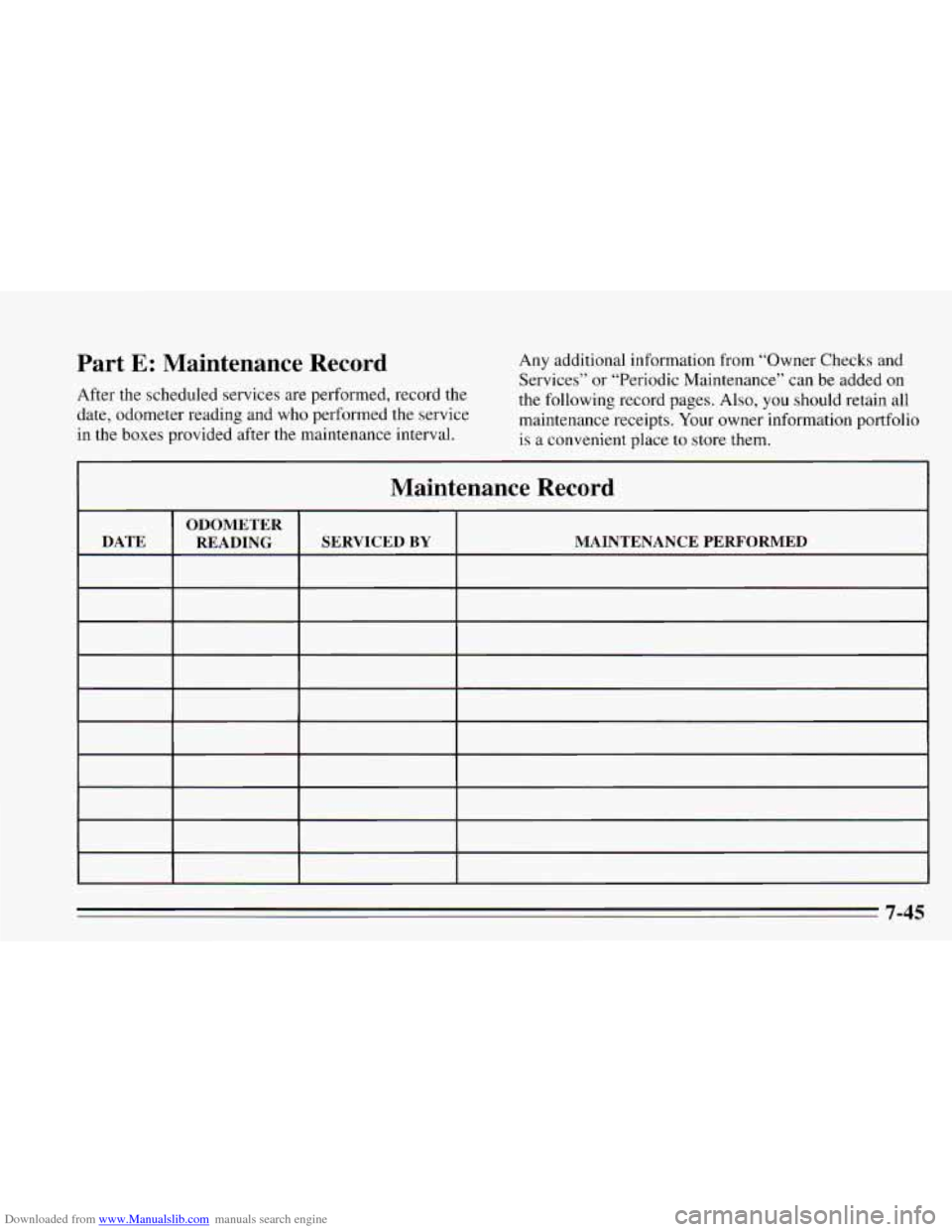
After the scheduled services are performed, record the
date, odometer reading and who performed the service
in the boxes provided after the maintenance interval. Any
additional information from “Owner Checks and
Services” or “Periodic Maintenance” can be added on
the following record pages. Also, you should retain all
maintenance receipts. Your owner information portfolio
is
a convenient place to store them.
7-45
Page 308 of 340
Downloaded from www.Manualslib.com manuals search engine Maintenance Record
ODOMETER
DATE MAINTENANCE PERFORMED
SERVICED
BY READING
7-46
Page 309 of 340
Downloaded from www.Manualslib.com manuals search engine 0 Section 8 Customer Assistance Information
Here you will find out how to contact Chevrolet if you
need assistance. This section also tells
you how to obtain
service publications and how to report any safety
defects.
This section includes information on: The Customer
Satisfaction Procedure, Customer Assistance for
Hearing or Speech Impaired,
BBB Auto Line -
Alternative Dispute Resolution Program, Reporting
Safety Defects, Roadside Assistance, and Service and
Owner Publications.
Customer Satisfaction Procedure
Your satisfaction and goodwill are important to your
dealer and Chevrolet. Normally, any concern with the
sales transaction or the operation
of your vehicle will be
resolved by your dealer’s Sales or Service Departments.
Sometimes, however, despite the best intentions of all
concerned, misunderstandings can occur. If your
concern has not been resolved to your satisfaction, the
following steps should be taken:
STEP ONE -- Discuss your concern with a member of
dealer management. Normally, concerns can be quickly
resolved at that level. If the matter has already been
reviewed with
the Sales, Service, or Parts Manager,
contact the owner of the dealer or the General Manager.
STEP TWO -- If after contacting a member of dealer
management, it appears your concern cannot be resolved
by the dealer without further help, contact the Chevrolet
Customer Assistance Center by calling
1 -800-222- 1020.
In Canada, contact GM of Canada Customer Assistance
Center
in Oshawa by calling 1-800-263-3777 (English)
or 1-800-263-7854 (French).
In Mexico, call (525) 254-3777. In Puerto Rico, call
1-800-494-9992 (English) or 1-800-496-9993
(Spanish). In the
U.S. Virgin Islands, call
1-800-496-9994. In other overseas locations, contact
GM North American Export Sales in Canada by calling
1-905-644-4
1 12.
Page 313 of 340
Downloaded from www.Manualslib.com manuals search engine REPORTING SAFETY DEFECTS
TO THE CANADIAN
GOVERNMENT
If you live in Canada, and you believe that your vehicle
has a safety defect, you should immediately notify
Transport Canada,
in addition to notifying General
Motors of Canada Limited.
You may write to:
Transport Canada
Box 8880
Ottawa, Ontario K 1 G 3 52
REPORTING SAFETY DEFECTS
TO GENERAL MOTORS
In addition to notifying NHTSA (or Transport Canada)
in a situation like this, we certainly hope you’ll notify
us. Please call us at 1-800-222- 1020, or write:
Chevrolet Motor Division
Chevrolet Customer Assistance Center
P. 0. Box 7047
Troy,
MI 48007-7047
In Canada, please call us at 1-800-263-3777 (English)
or 1-800-263-7854 (French). Or, write:
General Motors
of Canada Limited
Customer Assistance Center
1908 Colonel Sam Drive
Oshawa, Ontario
L 1 H 8P7
Chevrolet Roadside Assistance Program
To enhance Chevrolet’s strong commitment to customer
satisfaction, Chevrolet has established the
Chevrolet/Geo Roadside Assistance Center.
Roadside Assistance is available 24 hours a day, 365
days a year, by calling 1-800-CHEV-USA
(1-800-243-8872). This toll free number
will provide
you over-the-phone roadside assistance
with minor
mechanical problems.
If your problem cannot be
resolved over the phone, our advisors have access to a
nationwide network
of dealer-recommended service
providers. Roadside membership is free however some
services may incur
costs.
8-5