1995 CHEVROLET CAVALIER lights
[x] Cancel search: lightsPage 10 of 340
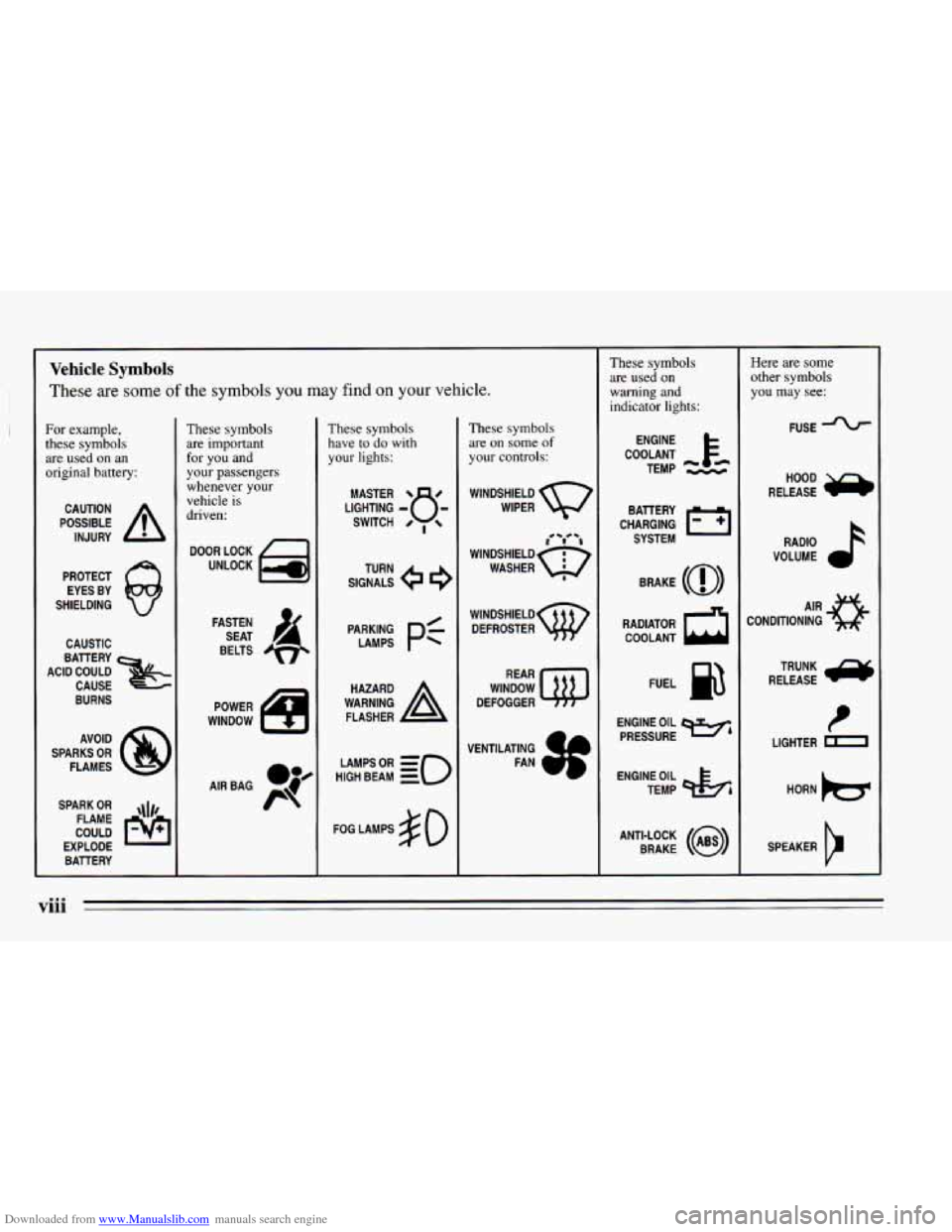
Downloaded from www.Manualslib.com manuals search engine Vehicle Symbols
These are some of the symbols you may find on your vehicle.
For example,
these symbols are used on an
original battery:
POSSIBLE A
CAUTION
INJURY
PROTECT EYES BY
SHIELDING
Q
CAUSTIC
ACID COULD BATTERY
CAUSE
BURNS
AVOID
SPARKS
OR
FLAMES
SPARK
OR ,\I/,
COULD FLAME
EXPLODE BATTERY
These symbols
are important
for you and
your passengers
whenever your
vehicle is
driven:
DOOR LOCK
UNLOCK
FASTEN SEAT
4
BELTS
POWER
WINDOW
These symbols have to
do with
your lights:
SIGNALS 6
TURN
HIGH
LAMPSoR BEAM = =o
FOG LAMPS $0
These symbols
are on
some of
your controls:
WINDSHIELD
WIPER
i i
WINDSHIELD
WASHER I
WINDSHIELD DEFROSTER
WINDOW
DEFOGGER
VENTILATING FAN
These symbols are used on
warning and
indicator lights:
COOLANT F-
ENGINE
TEMP
--
CHARGING I-1
BATTERY SYSTEM
BRAKE
(0)
RADIATOR COOLANT
a
FUEL
ENGINE OIL
PRESSURE
Wb
TEMP OIL &
ANTI-LOCK (@)
BRAKE
Here are some
other symbols
you may
see:
FUSE
RELEASE
a
RADIO
VOLUME
CONDITIONING
AIR 43
LIGHTER HORN
)b.
SPEAKER
b
viii
Page 64 of 340
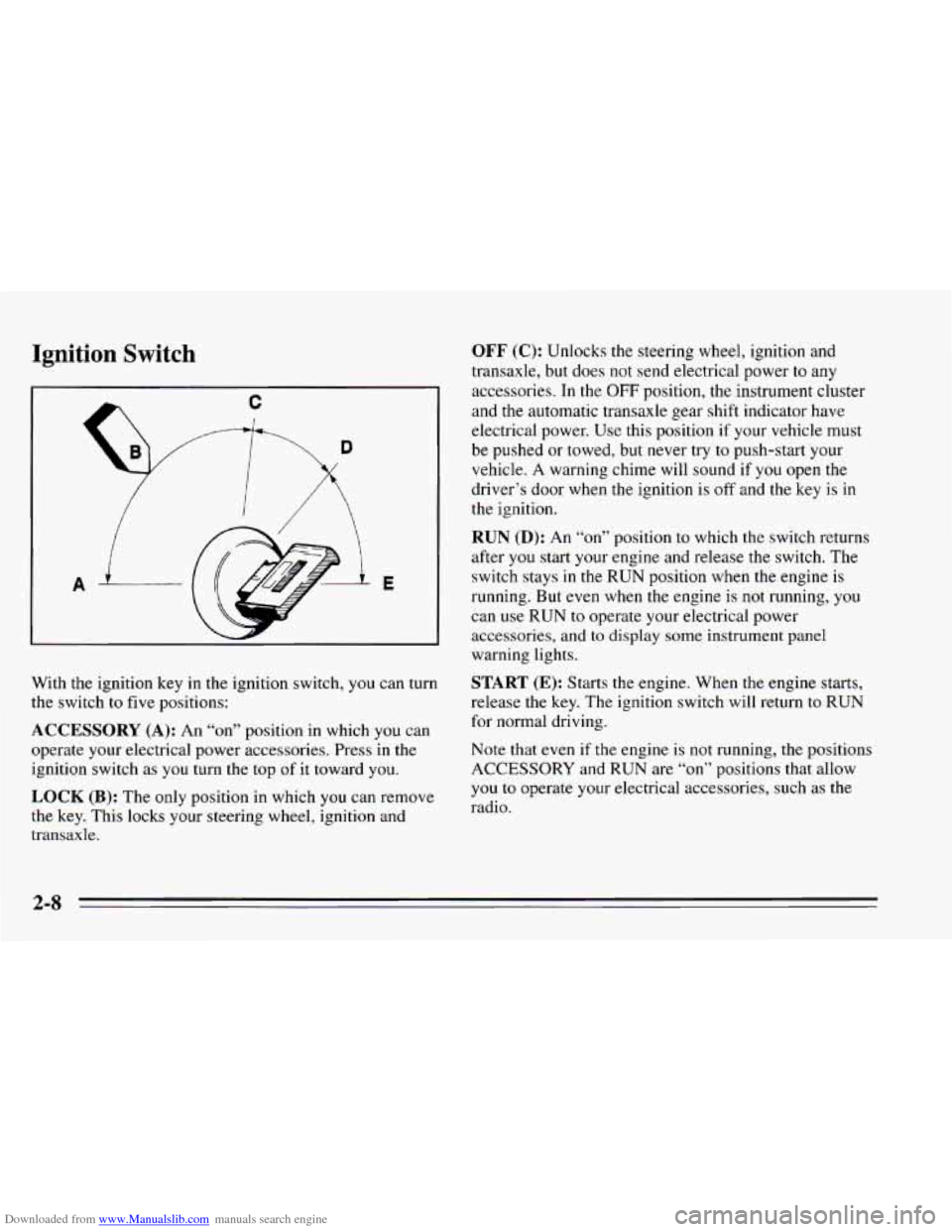
Downloaded from www.Manualslib.com manuals search engine Ignition Switch
E
With the ignition key in the ignition switch, you can turn
the switch to five positions:
ACCESSORY (A): An “on” position in which you can
operate your electrical power accessories. Press in the
ignition switch as
you turn the top of it toward you.
LOCK (B): The only position in which you can remove
the key. This locks your steering wheel, ignition and
transaxle.
OFF (C): Unlocks the steering wheel, ignition and
transaxle, but does not send electrical power
to any
accessories. In the
OFF position, the instrument cluster
and the automatic transaxle gear shift indicator have
electrical power. Use this position if your vehicle must
be pushed or towed, but never try
to push-start your
vehicle. A warning chime will sound if
you open the
driver’s door when the ignition is
off and the key is in
the ignition.
RUN (D): An “on7’ position to which the switch returns
after
you start your engine and release the switch. The
switch stays
in the RUN position when the engine is
running. But
even when the engine is not running, you
can use
RUN to operate your electrical power
accessories,
and to display some instrument panel
warning lights.
START (E): Starts the engine. When the engine starts,
release the key. The ignition switch will return
to RUN
for normal driving.
Note that even if
the engine is not running, the positions
ACCESSORY and RUN are
“on” positions that allow
you
to operate your electrical accessories, such as the
radio.
Page 114 of 340
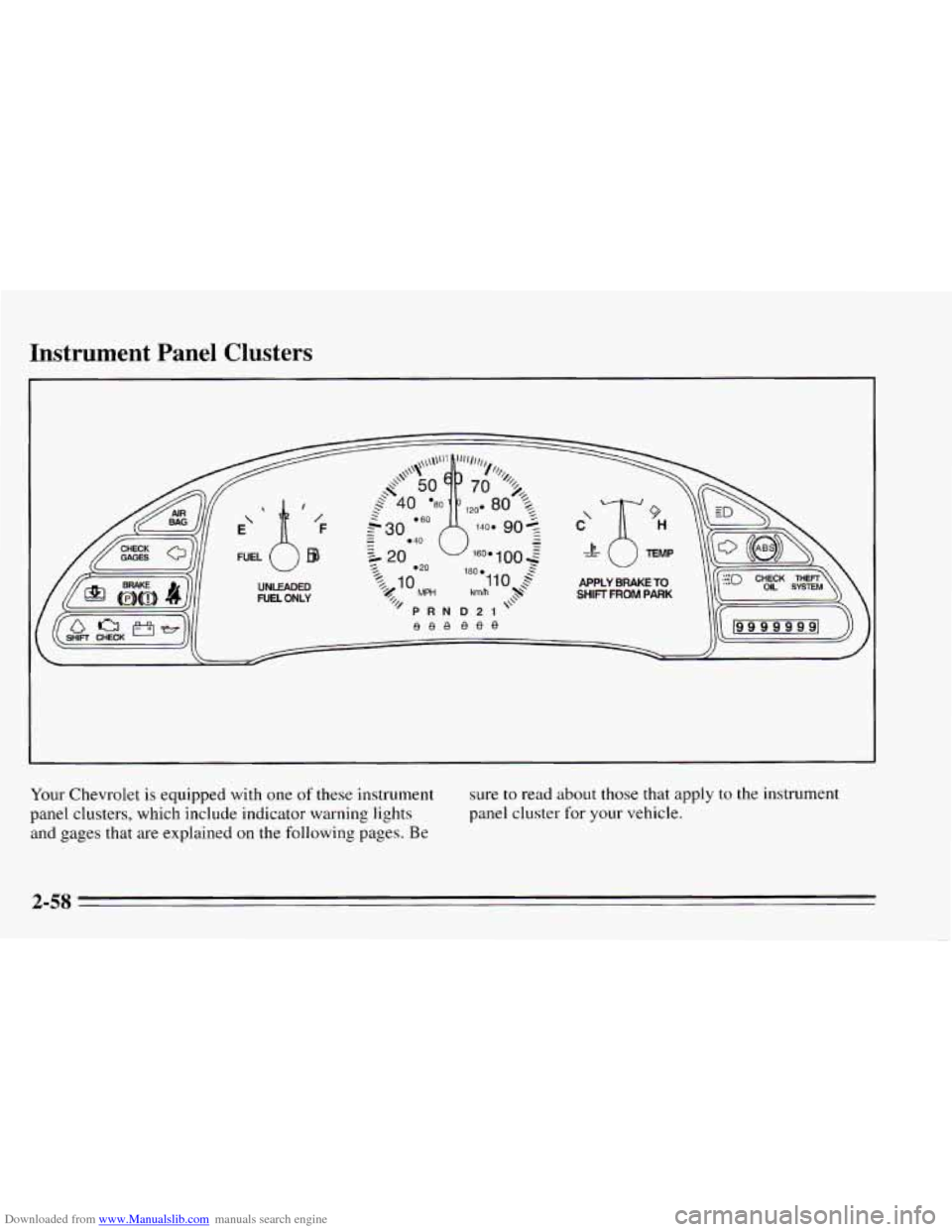
Downloaded from www.Manualslib.com manuals search engine Instrument Panel Clusters
Your Chevrolet is equipped with one of these instrument
panel clusters, which include indicator warning lights
and gages that are explained
on the following pages. Be
sure to read about those that apply to the instrument
panel cluster for your vehicle.
2-58
Page 116 of 340
Downloaded from www.Manualslib.com manuals search engine You may wonder what happens if your vehicle needs a
new odometer installed.
If the new one can be set to the mileage total of the old
odometer, then it must be. But
if it can’t, then it’s set at
zero and
a label must be put on the driver’s door to show
the old mileage reading when the new odometer was
installed.
Trip Odometer (Option)
The trip odometer can tell you how far your vehicle has
been driven since
you last set the trip odometer to zero.
To set
the trip odometer to zero, press the knob to the
right
of it.
Tachometer (Option)
The tachometer displays the engine speed in revolutions
per minute (rpm).
I NOTICE:
I
Do not operate the engine with the tachometer in
the red area, or engine damage may
occur.
Warning Lights, Gages and
Indicators
This part describes the warning lights and gages that
may be
on your vehicle. The pictures will help you
locate them.
Warning lights and gages can signal that something is
wrong before
it becomes serious enough to cause an
expensive repair or replacement. Paying attention
to
your warning lights and gages could also save you or
others from injury.
Warning lights come
on when there may be or is a
problem with one of your vehicle’s functions.
As you
will
see in the details on the next few pages, some
warning lights come
on briefly when you start the
engine just to let you know they’re working. If you are
familiar with this section,
you should not be alarmed
when this happens.
Gages can indicate when there may be or is a problem
with one
of your vehicle’s functions. Often gages and
warning lights work together to let you know when
there’s a problem with your vehicle.
2-60
Page 117 of 340
Downloaded from www.Manualslib.com manuals search engine When one of the warning lights comes on and stays on
when
you are driving, or when one of the gages shows
there may be a problem, check
the section that tells you
what to do about
it. Please follow this manual’s advice.
Waiting to do repairs can be costly
-- and even
dangerous.
So please get to know your warning lights
and gages. They’re
a big help.
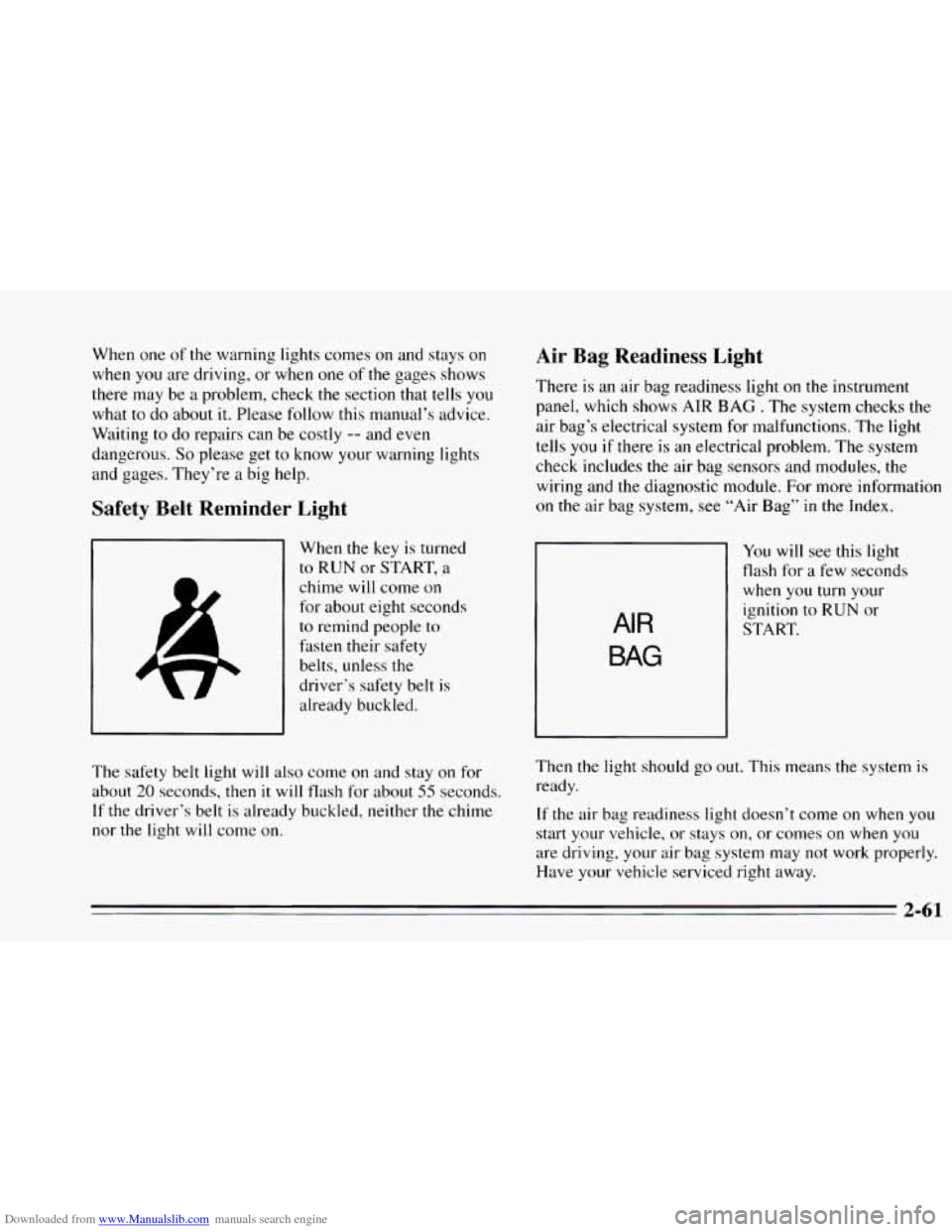
Safety Belt Reminder Light
When the key is turned
to RUN or START, a
chime will come on
for about eight seconds
to remind people to
fasten their safety
belts, unless
the
driver’s safety belt is
already buckled.
Air Bag Readiness Light
There is an air bag readiness light on the instrument
panel, which shows AIR
BAG . The system checks the
air bag’s electrical system for malfunctions. The light
tells
you if there is an electrical problem. The system
check includes the air bag sensors and modules, the
wiring and the diagnostic module.
For more information
on the air bag system, see “Air Bag” in the Index.
rl
You will see this light
flash for
a few seconds
when you turn your
ignition
to RUN or
AIR
BAG
START.
The safety belt light
will also come on and stay on for
about
20 seconds, then it will flash for about 55 seconds.
If the driver’s belt is already buckled, neither the chime
nor
the light will come on. Then
the light should
go out. This means the system is
ready.
If the air bag readiness light doesn’t come on when you
start your vehicle, or stays on, or comes on
when you
are driving. your air bag system may not work properly.
Have your vehicle serviced right away.
2-61
Page 154 of 340
Downloaded from www.Manualslib.com manuals search engine sunshine you are wise to wear sunglasses. Your eyes will
have less trouble adjusting to night. But if you’re
driving, don’t wear sunglasses
at night. They may cut
down on glare from headlamps, but they also make a lot
of things invisible.
You can be temporarily blinded by approaching
headlamps.
It can take a second or two, or even several
seconds, for your eyes
to readjust to the dark. When you
are faced with severe glare
(as from a driver who
doesn’t lower the high beams, or a vehicle with
misaimed headlamps), slow down a little. Avoid staring
directly into the approaching headlamps.
Keep your windshield and all the glass on your vehicle
clean
-- inside and out. Glare at night is made much
worse by dirt on the glass. Even the inside of the glass
can build up
a film caused by dust. Dirty glass makes
lights dazzle and flash more than clean glass would,
making
the pupils of your eyes contract repeatedly.
Remember that
your headlamps light up far less of a
roadway when
you are in a turn or curve. Keep your
eyes moving; that way, it’s easier
to pick out dimly
lighted objects. Just as your headlamps should be
checked regularly for proper aim,
so should your eyes
be examined regularly. Some drivers suffer from night
blindness
-- the inability to see in dim light -- and aren’t
even aware of it.
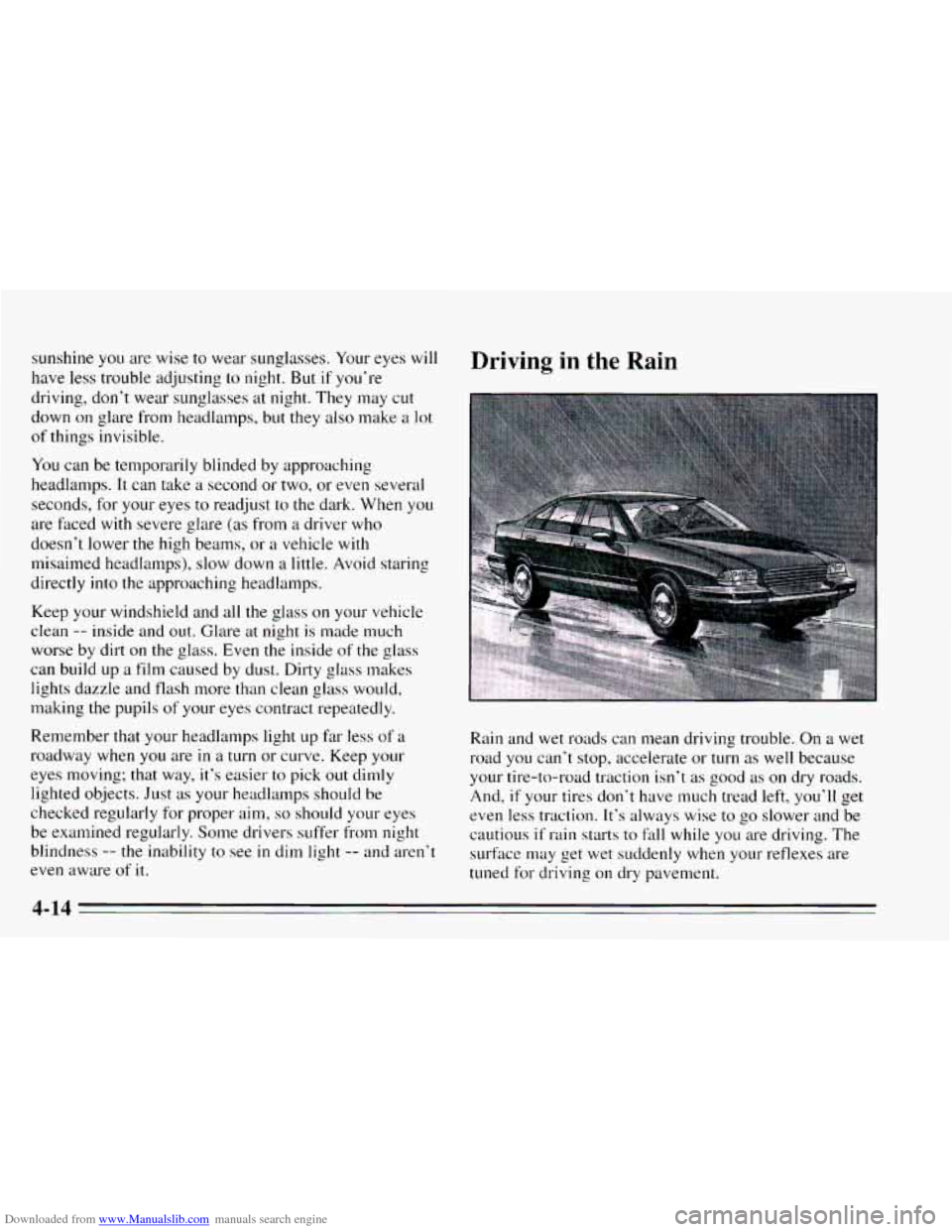
Driving in the Rain
Rain and wet roads can mean driving trouble. On a wet
road you can’t stop, accelerate or turn as well because
your tire-to-road traction
isn’t as good as on dry roads.
And,
if your tires don‘t have much tread left, you’ll get
even less traction. It‘s always wise to
go slower and be
cautious
if rain starts to fall while you are driving. The
surfxe may get wet suddenly when your reflexes are
tuned for driving
on dry pavement.
4-14
Page 177 of 340
Downloaded from www.Manualslib.com manuals search engine 0 Section 5 Problems on the Road
Here you’ll find what to do about some problems that
can occur on the road.
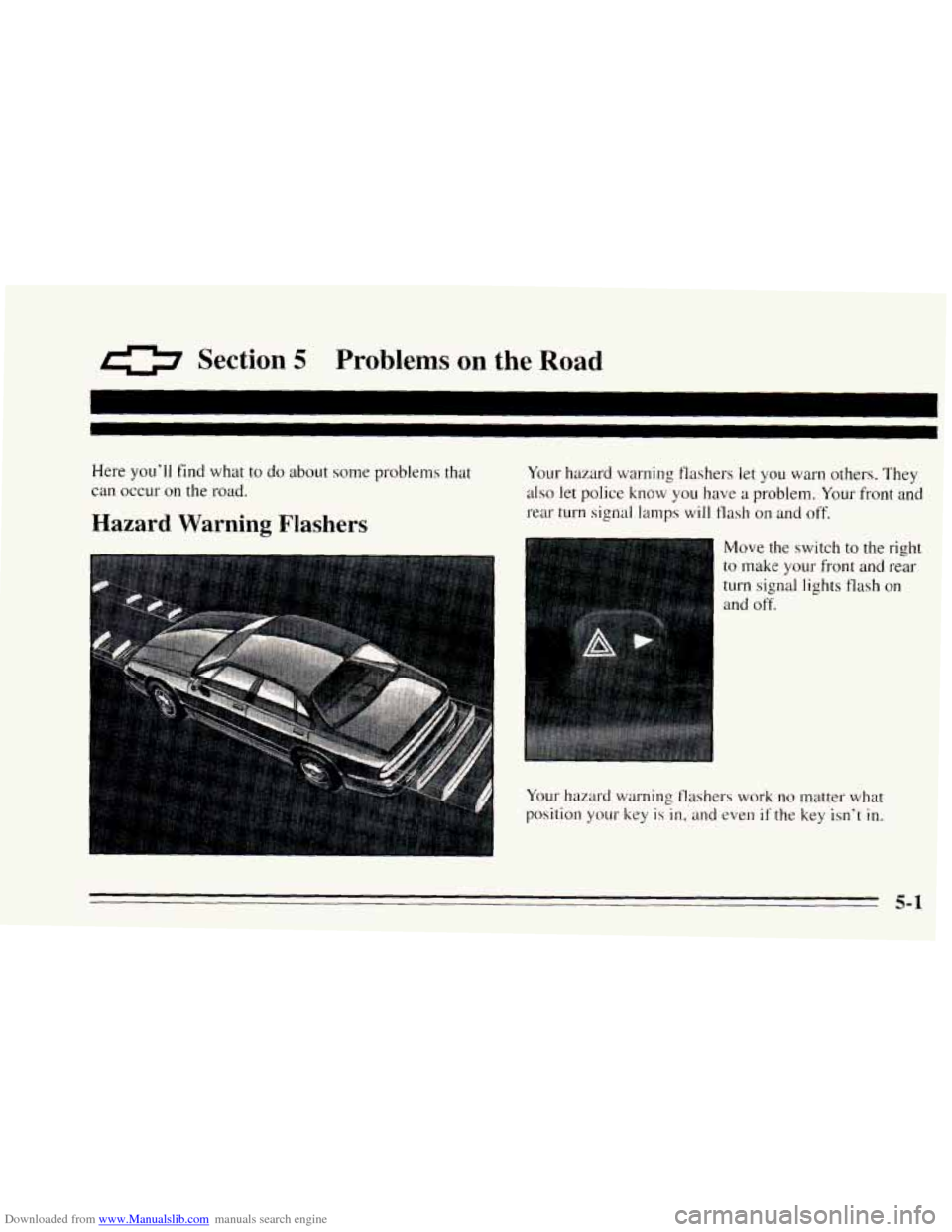
Hazard Warning Flashers
Your hazard warning flashers let you warn others. They
also let police know you have a problem. Your front and
rear turn signal lamps will flash on and off.
Move the switch to the right
to make your front and rear
turn signal lights flash on
and off.
Your hazard warning flashers work
no matter what
position your
key is in, and even if the key isn’t in.
5-1
Page 179 of 340
Downloaded from www.Manualslib.com manuals search engine To Jump Start Your Chevrolet
1. Check the other vehicle. It must have a 12-volt
battery with
a negative ground system.
3. Turn off the ignition on both vehicles. Turn off all
lights that aren’t needed, and radios. This will avoid
sparks and help save both batteries. And it could
save your radio!
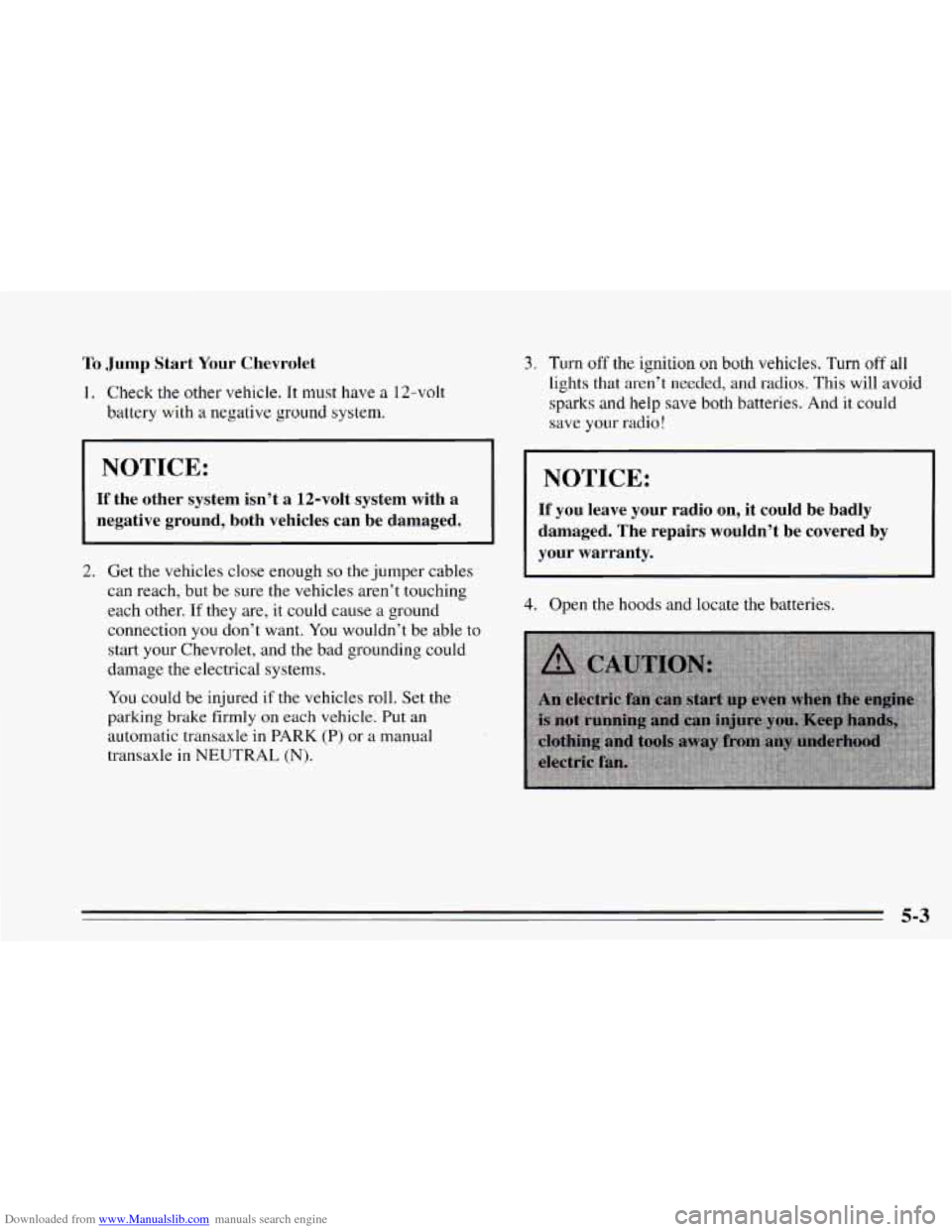
NOTICE:
If the other system isn’t a 12-volt system with a
negative ground, both vehicles can be damaged.
2. Get the vehicles close enough so the jumper cables
can reach, but be sure the vehicles aren’t touching
each other.
If they are, it could cause a ground
connection you don’t want. You wouldn’t be able to
start your Chevrolet, and the bad grounding could
damage the electrical systems.
You could be injured if the vehicles roll. Set the
parking
brake firmly on each vehicle. Put an
automatic transaxle in PARK (P) or a manual
transaxle
in NEUTRAL (N).
NOTICE:
If you leave your radio on, it could be badly
damaged. The repairs wouldn’t be covered by
your warranty.
4. Open the hoods and locate the batteries.
5-3