Page 10 of 388
Downloaded from www.Manualslib.com manuals search engine Vehicle Symbols
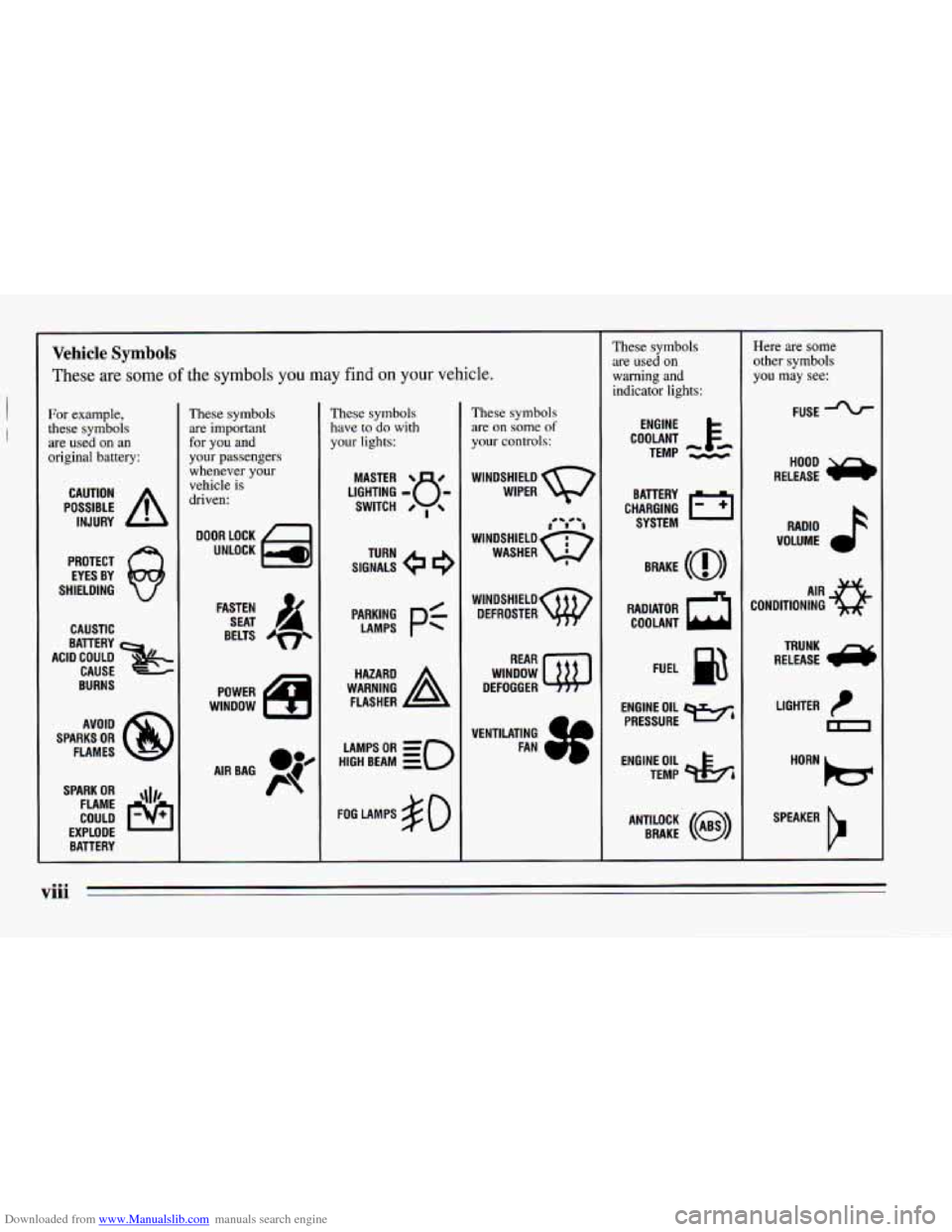
These are some of the symbols you may find on your vehicle.
For example,
these symbols
are used
on an
original battery:
POSSIBLE A
CAUTION
INJURY
PROTECT EYES BY
SHIELDING
Q
CAUSTIC
ACID COULD
BATTERY
CAUSE
BURNS
AVOID
SPARKS
OR
FLAMES
SPARK
OR ,111,
COULD FLAME
EXPLODE BATTERY
These symbols
are important
for you and
your passengers
whenever your
vehicle
is
driven:
FASTEN SEAT 4
BELTS
POWER
WINDOW
These symbols
have to do with
your lights:
SIGNALS e
TURN
PARKING
PC
LAMPS
WARNING
A
HAZARD
FLASHER
These symbols are on
some of
your controls:
WINDSHIELD WIPER w
WINDsHIELDw DEFROSTER
WINDOW
DEFOGGER
VENTILATING FAN
HIGH BEAM =
FOG LAMPS $0
These symbols
are used
on
warning and
indicator lights:
COOLANT Fe
TEMP --
ENGINE
CHARGING
I-1
BATTERY SYSTEM
RADIATOR
a
COOLANT FUEL
ENGINE OIL
w,
PRESSURE
TEMP OIL
pk,
ANTILOCK (@)
BRAKE
Here are some
other symbols
you may see:
FUSE -%-
RADIO >
VOLUME
CONDITIONING RELEASE
e
TRUNK
LIGHTER
m
SPEAKER
b
viii
~
Page 58 of 388

Downloaded from www.Manualslib.com manuals search engine Should interference to this system occur, try this:
0
0
0
0
Check to determine if battery replacement is
necessary. See the instructions on battery
replacement.
Check the distance. You may be too far from your
vehicle. This product has a maximum range.
Check the location. Other vehicles or objects may be
blocking the signal.
See your Chevrolet dealer or a qualified technician
for service.
Changes or modifications to this system
by other than an
authorized service facility could void authorization to
use this equipment.
Operation
The driver’s door will unlock automatically when
UNLOCK is pressed. If UNLOCK is pressed again
within five seconds, the passenger door will also unlock.
All doors will lock when
DOOR is pressed. The hatch
will unlock when
the opened trunk symbol is pressed,
but only when the ignition switch
is not in RUN, and the
transmission is in
PARK (P) if you have an automatic
transmission. If you have a manual transmission, the
parking brake must be set.
The system will turn on the interior lights for about
40 seconds, or until the ignition switch is turned to
RUN, when you unlock the doors or hatch. The interior
lamps
will come on for about two seconds when you
lock the doors.
2-6
Page 62 of 388
Downloaded from www.Manualslib.com manuals search engine Remote Hatch Release (Option)
I\
‘
Press the switch in your glove box to unlock the hatch
from inside your vehicle.
If you have an automatic
transmission, your shift lever must be in PARK
(P) or
NEUTRAL (N) to use the switch. If you have a manual
transmission and the ignition switch is in
RUN, you
must
set the parking brake before you can use the
switch. The
switch only works when the ignition switch
is in.
RUN or ACC, or when RAP is present. (See “Retained
Accessory
Power” in the Index.)
NOTICE:
If you put things in the hatchback area, be sure
they won’t break the glass when
you close it.
Never slam the hatch down.
You could break the
glass or damage the defogger grid (if equipped).
2-10
Page 78 of 388

Downloaded from www.Manualslib.com manuals search engine I I
1 NOTICE:
Shift to REVERSE (R) only after your vehicle is
stopped. Shifting to REVERSE (R) while your
vehicle
is moving could damage your transmission.
Also, use Reverse, along with the parking brake, for
parking your vehicle.
Six-Speed
1 3 5 R
2 4 6
This is your shift pattern. Here’s how to operate your
transmission:
FIRST (1): Press the clutch pedal and shift into
FIRST
(1). Then, slowly let up on the clutch pedal as
you press the accelerator pedal.
You can shift into FIRST (1) when you’re going less
than
20 mph (30 km/h). If you’ve come to a complete
stop and it’s hard to shift into
FIRST (1) put the shift
lever in NEUTRAL
(N) and let up on the clutch. Press
the clutch pedal back down. Then shift into FIRST
(1).
SECOND (2): Press the clutch pedal as you let up on
the accelerator pedal and shift into
SECOND (2). Then,
slowly let up
on the clutch pedal as you press the
accelerator pedal
THIRD, FOURTH, 1 ?TH AND SIXTH (3,4,5 and
6 gears): Shift into THIRD, FOURTH, FIFTH AND
SIXTH gear the same way you do for SECOND (2).
Slowly let up on the clutch pedal as you press the
accelerator pedal.
To Stop: Press the clutch pedal and the brake pedal, and
shift to
NEUTRAL (N).
Neutral: Use this position when you start or idle your
engine.
2-26
Page 81 of 388
Downloaded from www.Manualslib.com manuals search engine NOTICE:
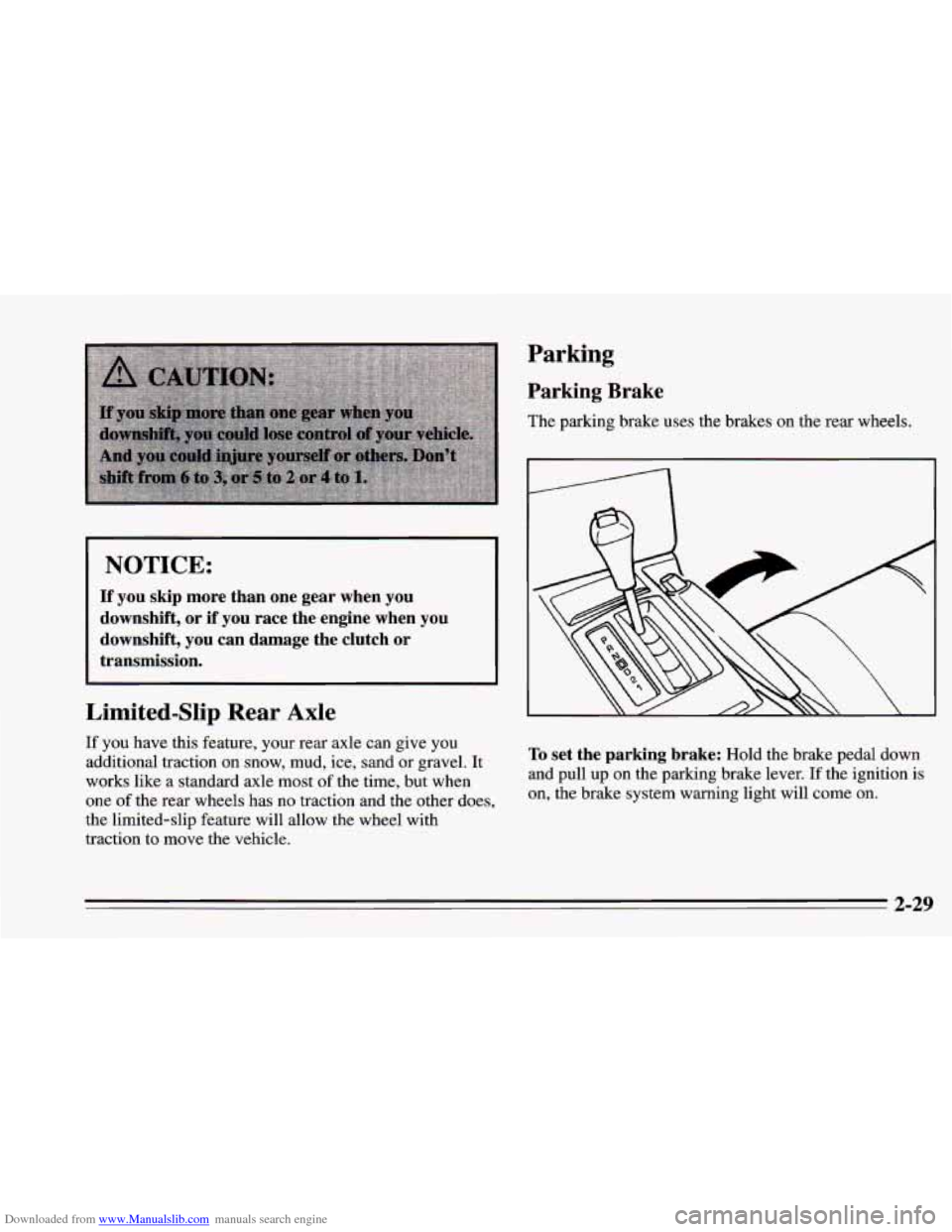
If you skip more than one gear when you
downshift, or if you race the engine when you
downshift, you can damage the clutch or
transmission.
Limited-Slip Rear Axle
If you have this feature, your rear axle can give you
additional traction on snow, mud, ice, sand or gravel. It
works like a standard axle most
of the time, but when
one of the rear wheels has no traction and the other does,
the limited-slip feature will allow
the wheel with
traction to move the vehicle.
Parking
Parking Brake
The parking brake uses the brakes on the rear wheels.
To set the parking brake: Hold the brake pedal down
and
pull up on the parking brake lever. If the ignition is
on, the brake system warning light will come on.
2-29
Page 82 of 388
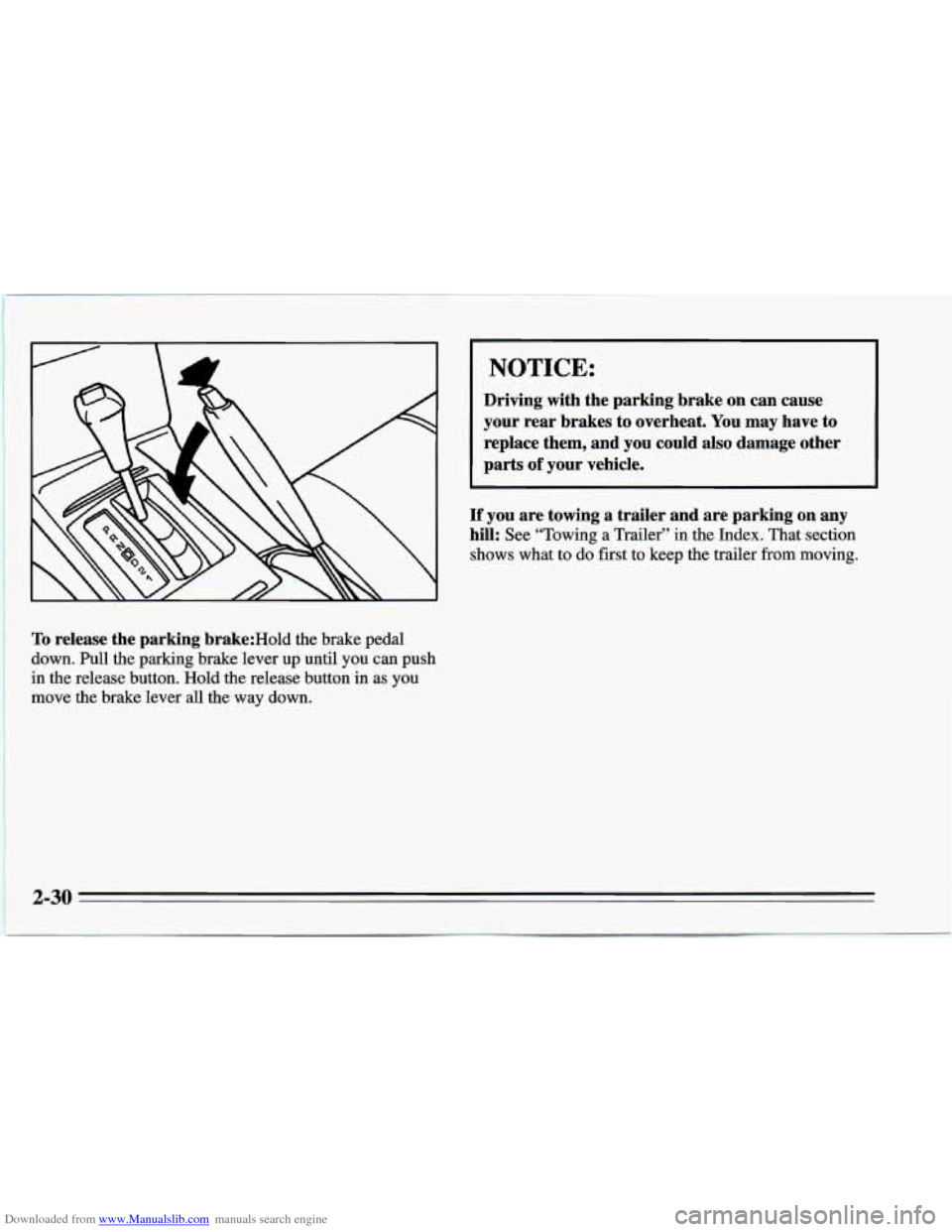
Downloaded from www.Manualslib.com manuals search engine To release the parking brake:Hold the brake pedal
down. Pull the parking brake lever
up until you can push
in the release button. Hold the release button in as you
move the brake lever
all the way down.
I NOTICE:
Driving with the parking brake on can cause
your rear brakes to overheat. You
may have to
replace them, and you could also damage other
parts
of your vehicle.
If you are towing a trailer and are parking on any
hill: See “Towing a Trailer”
in the Index. That section
shows what to do first to keep the trailer from moving.
Page 83 of 388
Downloaded from www.Manualslib.com manuals search engine Shifting Into PARK (P)
(Automatic Transmission Models only)
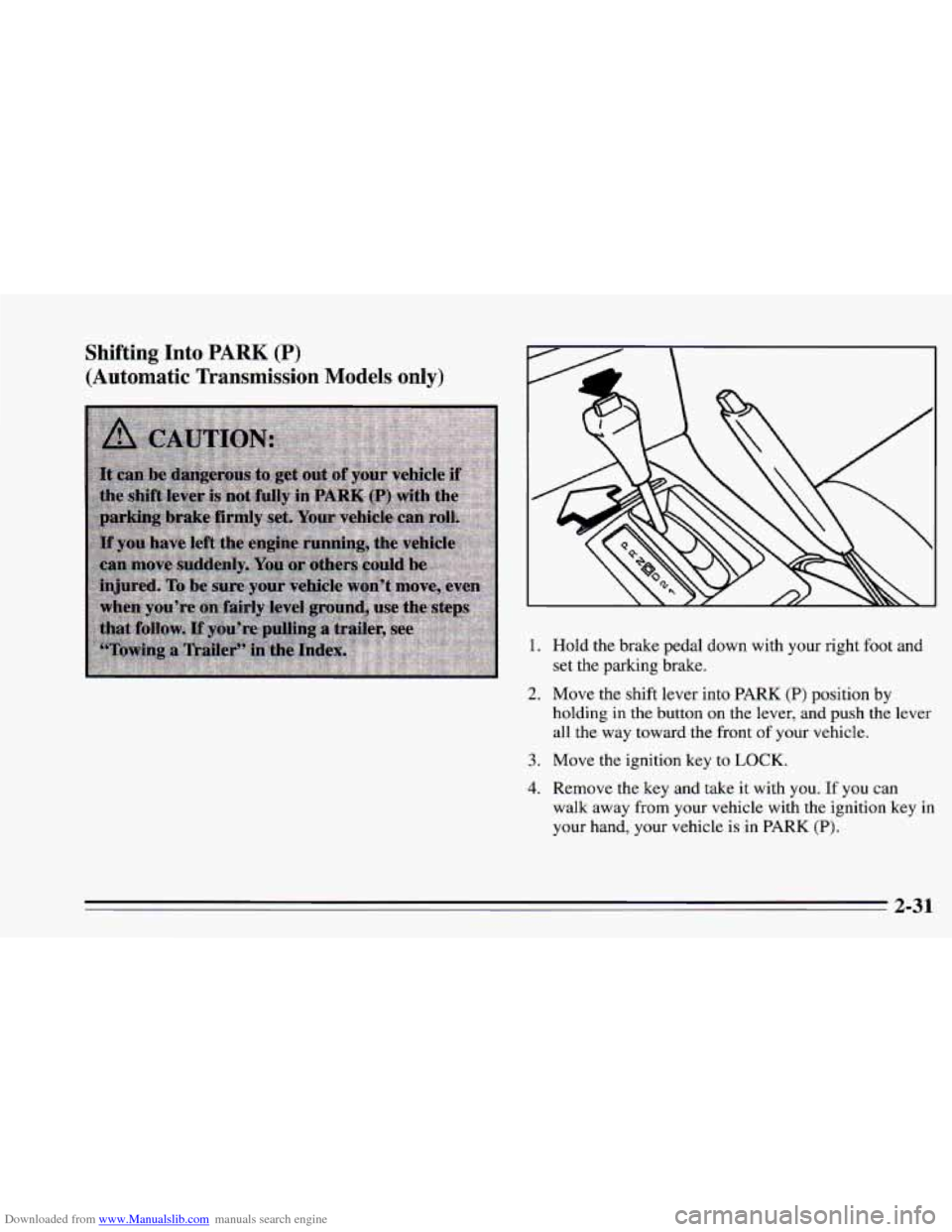
1. Hold the brake pedal down with your right foot and
set the parking brake.
2. Move the shift lever into PARK (P) position by
holding in the button on the lever, and push the lever
all the way toward the front
of your vehicle.
3. Move the ignition key to LOCK.
4. Remove the key and take it with you. If you can
walk away
from your vehicle with the ignition key in
your hand, your vehicle is in PARK (P).
2-31
Page 84 of 388
Downloaded from www.Manualslib.com manuals search engine Leaving Your Vehicle With the Engine
Running (Automatic Tkansmission)
If you have to leave your vehicle with the engine
running, be sure your vehicle
is in PARK (P) and your
parking brake
is firmly set before you leave it. After
you’ve moved the shift lever into the PARK (P)
position, hold the regular brake pedal down. Then, see if
you can move the shift lever away from PARK
(P)
without first pushing the button. If you can, it means
that the shift lever wasn’t fully locked into PARK
(P).
Torque Lock (Automatic Transmission)
If you are parking on a hill and you don’t shift your
transmission into PARK
(P) properly, the weight of the
vehicle may put too much force on the parking pawl in
the transmission. You may find it difficult to pull the
shift lever out of PARK (P). This
is called “torque lock.”
To prevent torque lock, set the parking brake and then
shift into PARK
(P) properly before you leave the
driver’s seat.
To find out how, see “Shifting into
PARK (P) in the Index.
When
ydu are ready to drive, move the shift lever out of
PARK
(P) before you release the parking brake.
If “torque lock” does occur, you may need to have
another vehicle push yours a little uphill to take some
of
the pressure from the transmission, so you can pull the
shift lever out
of PARK (P).
2-32

I\
‘
Press the switch in your glove box to unlock the hatch
from inside your vehicle.
If you have")