1995 CHEVROLET CAMARO flat tire
[x] Cancel search: flat tirePage 3 of 388
Downloaded from www.Manualslib.com manuals search engine 0 The 1995 Chevrolet Carnaro Owner’s Manual
How to Use This Manual .................................................................. vi
Seats and Restraint Systems .............................................................. 1-1
This section tells you how to use your manual and includes safety and vehicle damage warnings and symbols.
This section tells you how to use your seats and safety belts properly.
It also explains the “SIR”
(Air Bag) System.
This section explains how to start and operate your Chevrolet.
This section tells you how to adjust the ventilation and comfort controls and how to operate your
sound system.
Here you’ll find helpful information and tips about the road and how to drive under different conditions.
This section tells you what
to do if you have a problem while driving, such as a flat tire or engine
overheating, etc.
Here the manual tells you how to keep your Chevrolet running properly and looking good.
This section tells
you when to perform vehicle maintenance and what fluids and lubricants to use.
This section tells you how to contact Chevrolet for assistance and how to get service publications. It
also
gives you information on “Reporting Safety Defects” on page 8-4.
Here’s an alphabetical listing of almost every subject in this manual. You can use it to quickly find
something you want
to read.
Features and Controls .................................................................. 2-1
Comfort Controls and Audio Systems ..................................................... 3-1
YourDrivingandtheRoad .............................................................. 4-1
ProblemsontheRoad .................................................................. 5-1
ServiceandAppearanceCare ............................................................ 6-1
Maintenanceschedule.............. .................................................... 7-1
Customer Assistance Information ........................................................ 8-1
Index ........................................................................\
......... 9-1
i
Page 178 of 388
Downloaded from www.Manualslib.com manuals search engine Once you are moving on the freeway, make certain you
allow a reasonable following distance. Expect to move
slightly slower at night.
When you want to leave the freeway, move
to the proper
lane well in advance.
If you miss your exit do not, under
any circumstances, stop and back up. Drive
on to the
next exit.
The exit ramp can be curved, sometimes quite sharply.
The exit speed is usually posted.
Reduce your speed according to your speedometer,
not
to your sense of motion. After driving for any distance
at higher speeds, you may tend to think you are going
slower than you actually are.
Before Leaving on a Long Trip
Make sure you’re ready. Try to be well rested. If you
must start when you’re not fresh -- such as after a day’s
work
-- don’t plan to make too many miles that first part
of the journey. Wear comfortable clothing and shoes
you
can easily drive in.
Is your vehicle ready for a long trip? If you keep it
serviced and maintained, it’s ready to
go. If it needs
service, have it done before starting out.
Of course,
you’ll find experienced and able service experts
in
Chevrolet dealers all across North America. They’ll be
ready and willing to help if you need it.
Here are some things you can check before
a trip:
0
0
0
0
0
0
0
Windshield Washer Fluid: Is the reservoir full? Are
all windows clean inside and outside?
Wiper Blades: Are they in good shape?
Fuel, Engine Oil, Other Fluids: Have you checked
all levels?
Lumps: Are they all working? Are the lenses clean?
Tires: They are vitally important to a safe,
trouble-free trip.
Is the tread good enough for
long-distance driving? Are
the tires all inflated to the
recommended pressure?
Weather Forecasts: What’s the weather outlook
along your route? Should
you delay your trip a short
time to avoid a major storm system?
Maps: Do you have up-to-date maps?
4-22
Page 179 of 388
Downloaded from www.Manualslib.com manuals search engine Highway Hypnosis
Is there actually such a condition as “highway hypnosis”?
Or is it just plain falling asleep at the wheel? Call
it
highway hypnosis, lack of awareness, or whatever.
There
is something about an easy stretch of road with the
same scenery, along with the hum
of the tires on the road,
the drone
of the engine, and the rush of the wind against
the vehicle that can make you sleepy. Don’t let it happen
to you! If it does, your vehicle can leave the road in less
than a second, and you could crash and be injured.
What can
you do about highway hypnosis? First, be
aware that
it can happen.
Then here are some tips:
a
a
a
Make sure your vehicle is well ventilated, with a
comfortably cool interior.
Keep your eyes moving. Scan
the road ahead and to
the sides. Check your rearview mirrors and your
instruments frequently.
If you get sleepy, pull off the road into a rest, service,
or parking area and take
a nap, get some exercise, or
both. For safety, treat drowsiness on the highway
as
an emergency.
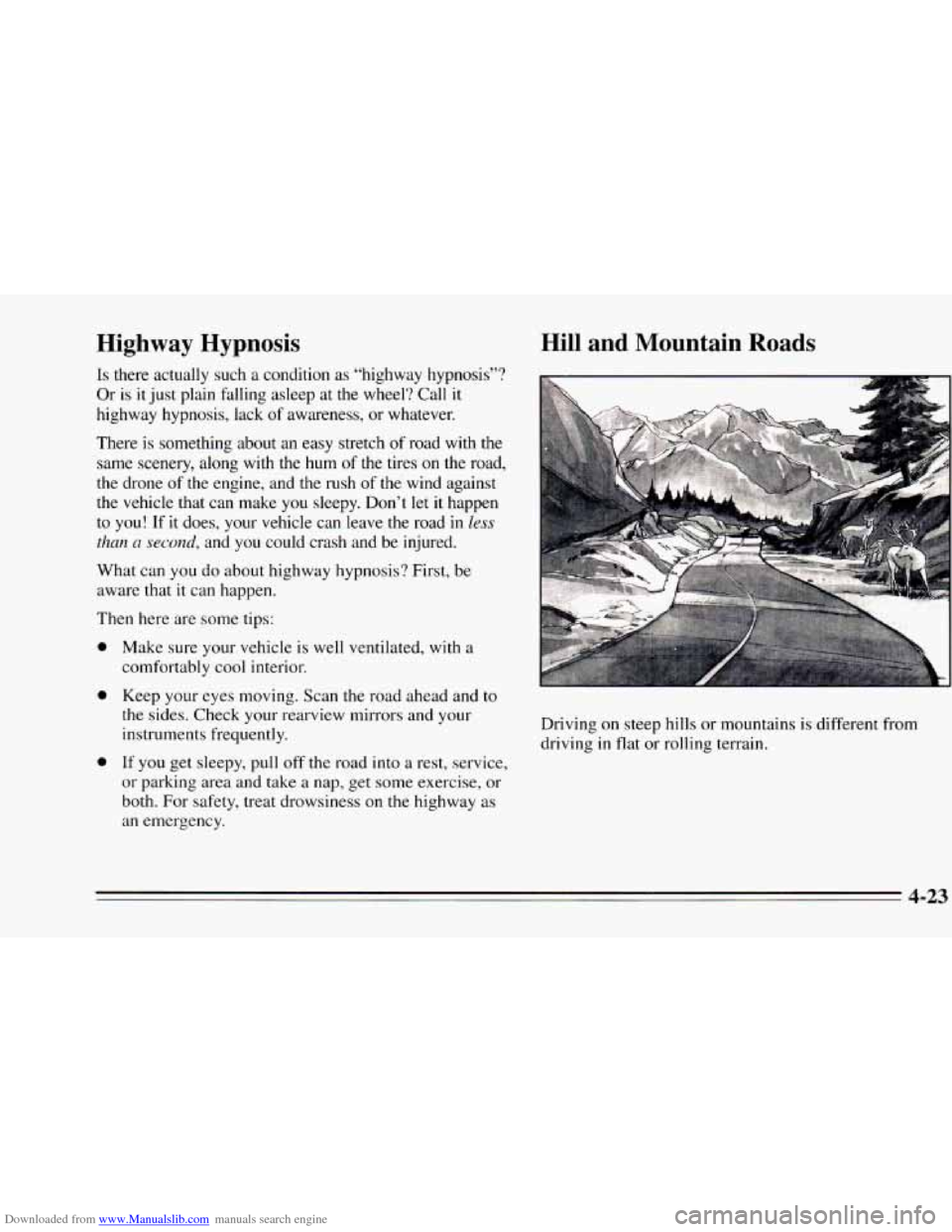
Hill and Mountain Roads
c
Driving on steep hills or mountains is different from
driving in flat or rolling terrain.
4-23
Page 185 of 388
Downloaded from www.Manualslib.com manuals search engine from the cold. But do it as little as possible. Preserve the
fuel as long as you can.
To help keep warm, you can get
out
of the vehicle and do some fairly vigorous exercises
every half hour or
so until help comes.
Loading Your Vehicle
can be in your vehicle. It also gives you important
information about
the number of people that can be in
your vehicle and
the total weight that you can carry.
This weight is called the Vehicle Capacity Weight and
includes the weight of all occupants, cargo, and all
nonfactory-installed options.
OCCUPANTS
VEHICLE CAP. WT.
TIRE-LOADING INFORMATION
FRT.
CTR. RR. TOTAL LBS. KG
MAX. LOADING & GVWR SAME AS VEHICLE
CAPACITY WEIGHT XXX COLD TIRE
TIRE SIZE SPEED PRESSURE
RTG PSliKPa
FRT.
RR.
SPA.
IF TIRES ARE HOT. ADD 4PSIi28KPa
SEE OWNER‘S MANUAL FOR ADDITIONAL
INFORMATION
MFDBYGENERALMOTORSCORP
DATE GVWR GAWR FRT GAWR
RR
THIS VEHICLE CONFORMS TO ALL APPLI-
CABLE U.S. FEDERAL MOTOR VEHICLE
SAFETY, BUMPER, AND THEFT PREVENTION
STANDARDS
IN EFFECT ON THE DATE OF
MANUFACTURE SHOWN ABOVE.
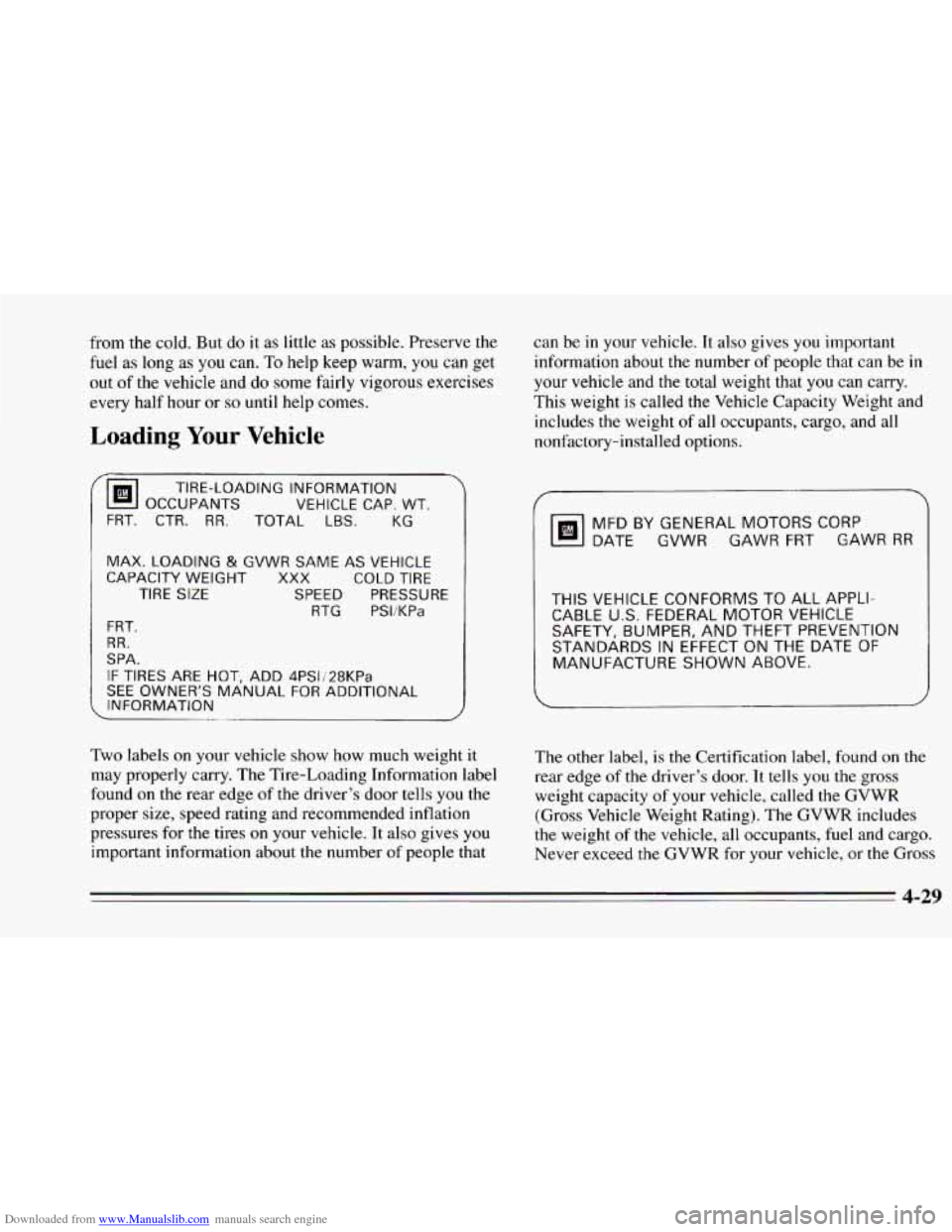
Two labels on your vehicle show how much weight it
may properly carry. The Tire-Loading Information label
found
on the rear edge of the driver’s door tells you the
proper size, speed rating and recommended inflation
pressures for the tires
on your vehicle. It also gives you
important information about the number of people that The other label,
is the
Certification label, found on the
rear edge of the driver’s door. It tells you the gross
weight capacity of your vehicle, called the GVWR
(Gross Vehicle Weight Rating). The GVWR includes
the weight
of the vehicle, all occupants, fuel and cargo.
Never exceed the GVWR for your vehicle, or the Gross
4-29
Page 189 of 388
Downloaded from www.Manualslib.com manuals search engine Weight of the Trailer Tongue
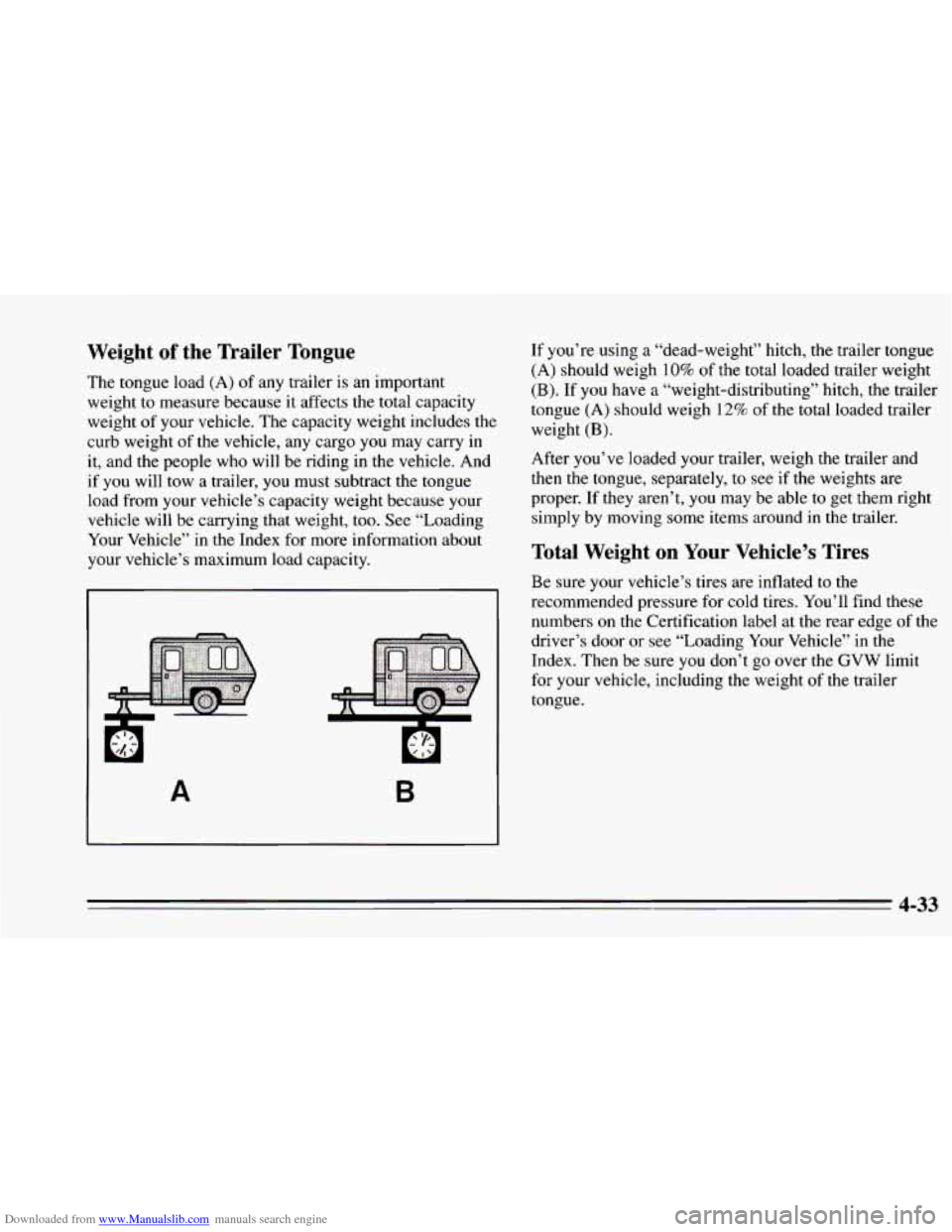
The tongue load (A) of any trailer is an important
weight to measure because
it affects the total capacity
weight
of your vehicle. The capacity weight includes the
curb weight of the vehicle, any cargo you may carry in
it, and the people who
will be riding in the vehicle. And
if you will tow a trailer, you must subtract the tongue
load from your vehicle’s capacity weight because your
vehicle will be carrying that weight, too. See “Loading
Your Vehicle”
in the Index for more information about
your vehicle’s maximum load capacity.
A
’ I‘
B
If you’re using a “dead-weight” hitch, the trailer tongue
(A) should weigh 10% of the total loaded trailer weight
(B). If you have a “weight-distributing” hitch, the trailer
tongue
(A) should weigh 12% of the total loaded trailer
weight
(B).
After you’ve loaded your trailer, weigh the trailer and
then the tongue, separately, to see
if the weights are
proper. If they aren’t, you may be able to get them right
simply by moving some items around in the trailer.
Total Weight on Your Vehicle’s Tires
Be sure your vehicle’s tires are inflated to the
recommended pressure for cold tires. You’ll find these
numbers on the Certification label at the rear edge
of the
driver’s door or see “Loading Your Vehicle” in the
Index. Then be sure you don’t go over the GVW limit
for your vehicle, including the weight of the trailer
tongue.
4-33
Page 220 of 388
Downloaded from www.Manualslib.com manuals search engine If a Tire Goes Flat
It’s unusual for a tire to “blow out” while you’re driving,
especially if you maintain your tires properly. If air goes
out of a tire, it’s much more likely to leak out slowly.
But if you should ever have a “blowout,” here are a few
tips about what to expect and what to do:
If a front tire fails, the flat tire will create a drag that
pulls the vehicle toward that side. Take your foot off the
accelerator pedal and grip the steering wheel firmly.
Steer to maintain lane position, then gently brake to a
stop well out of the traffic lane.
A rear blowout, particularly on a curve, acts much like a
skid and may require the same correction you’d use in a
skid. In any rear blowout, remove your foot from the
accelerator pedal. Get the vehicle under control
by
steering the way you want the vehicle to go. It may be
very bumpy and noisy, but you can still steer. Gently
brake to a stop, well off the road if possible.
If a tire goes flat, the next part shows how
to use your
jacking equipment to change a flat tire safely.
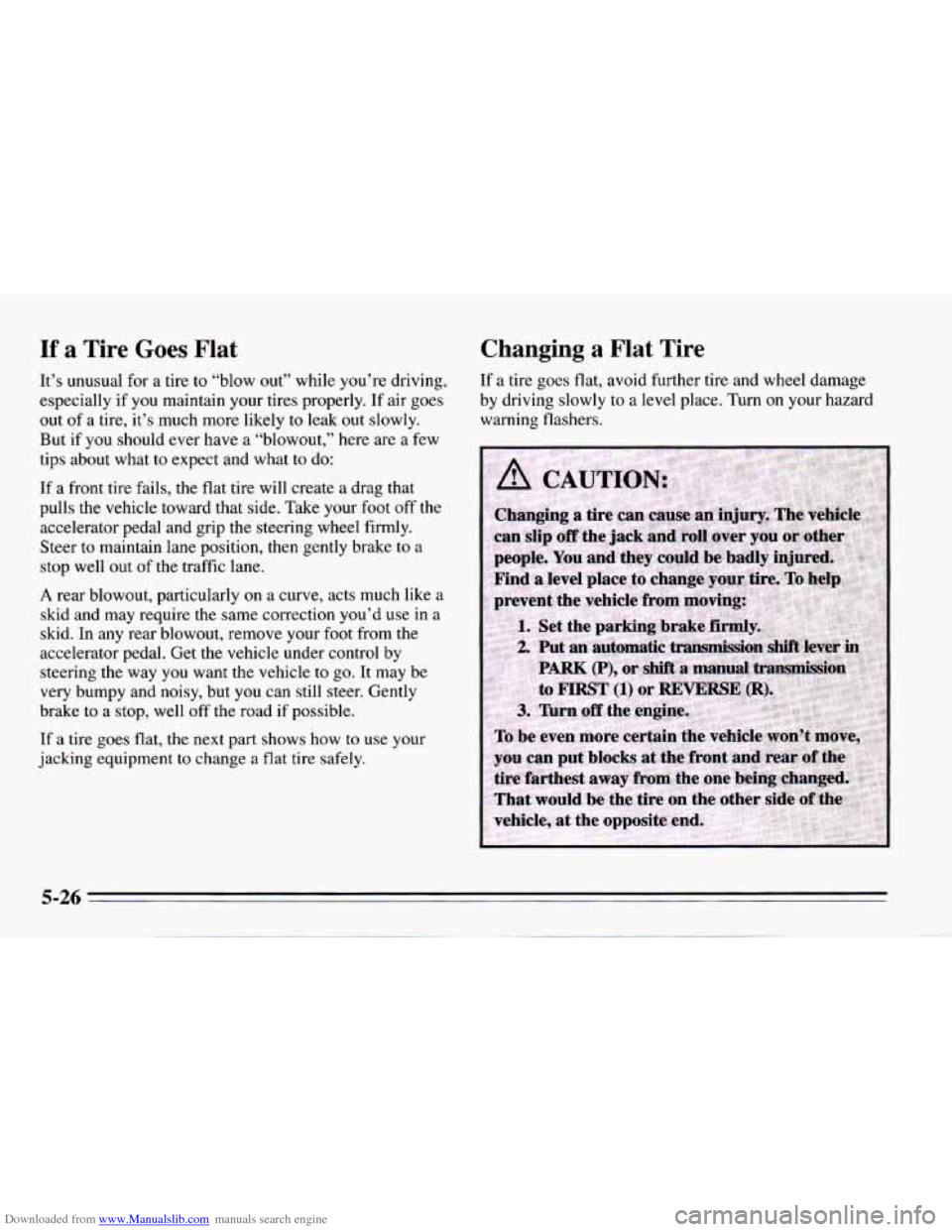
Changing a Flat Tire
If a tire goes flat, avoid further tire and wheel damage
by driving slowly to
a level place. Turn on your hazard
warning flashers.
5-26
Page 226 of 388
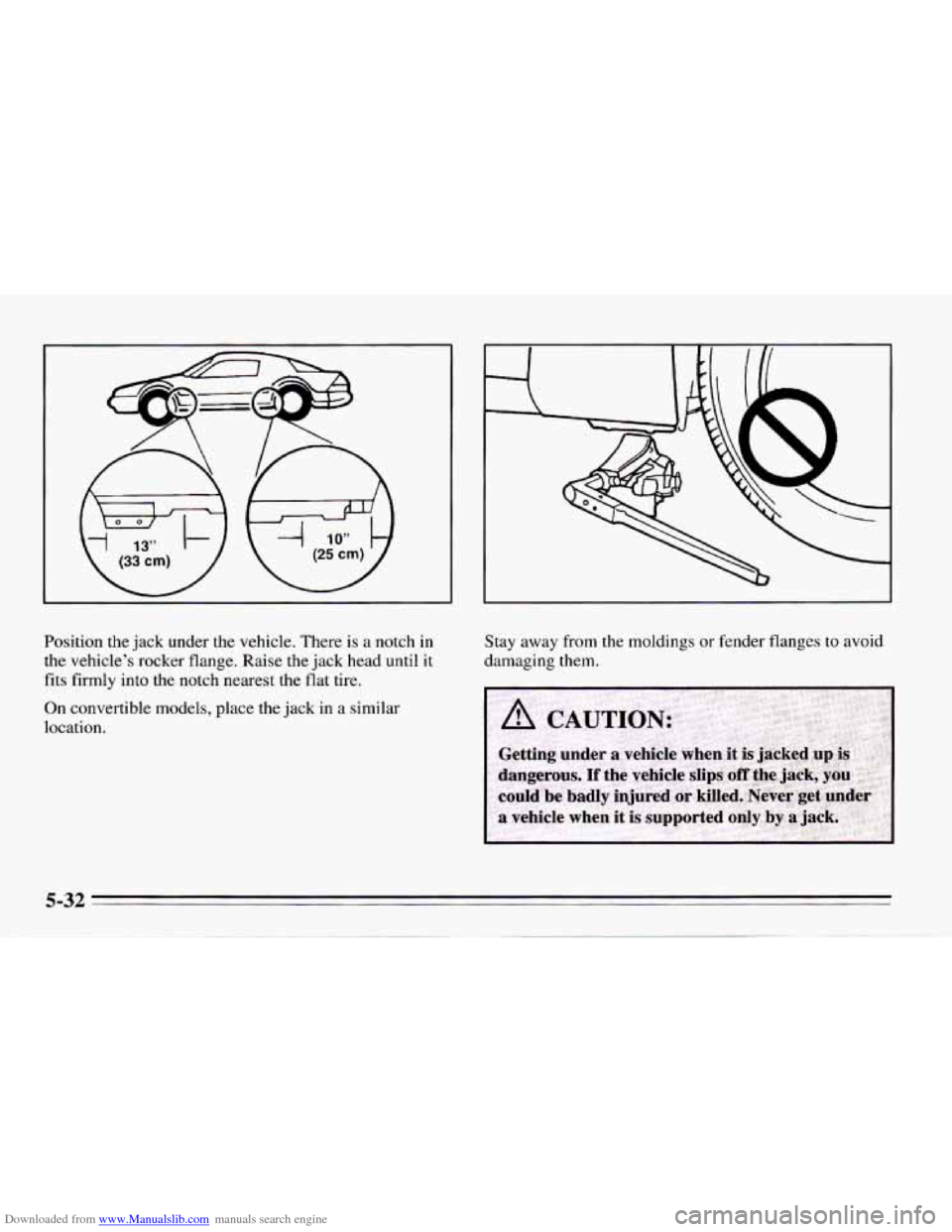
Downloaded from www.Manualslib.com manuals search engine Position the jack under the vehicle. There is a notch in
the vehicle's rocker flange. Raise the jack head until it
fits firmly into the notch nearest the flat tire.
On convertible models, place the jack in a similar
location. Stay
away from the moldings
or fender flanges to avoid
damaging them.
Page 227 of 388
Downloaded from www.Manualslib.com manuals search engine NOTICE:
Raising your vehicle with the jack improperly
positioned will damage the vehicle or may allow
the vehicle to fall off the jack. Be sure to fit the
jack lift head into the proper location before raising your vehicle.
7I-T
a
a
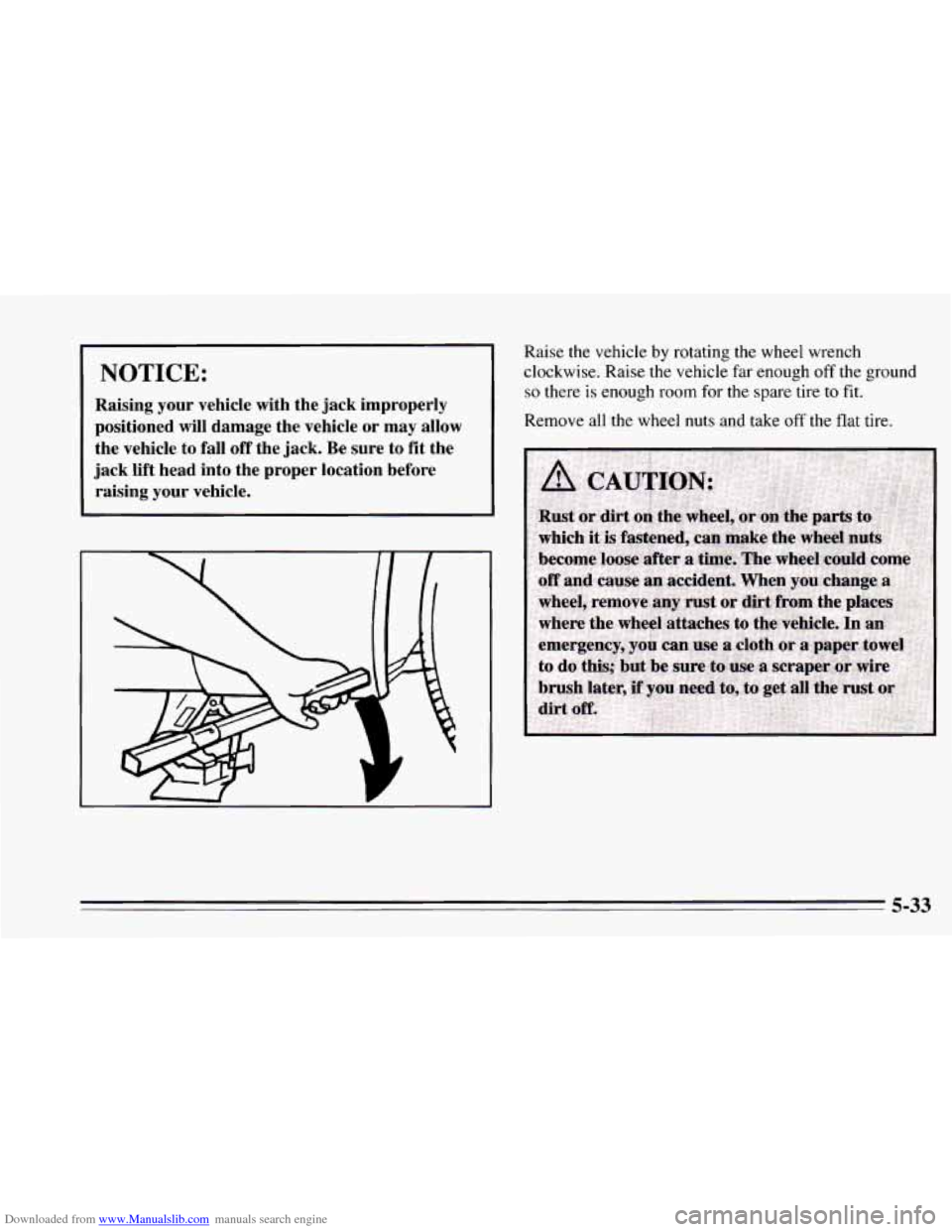
Raise the vehicle by rotating the wheel wrench
clockwise. Raise the vehicle far enough
off the ground
so there is enough room for the spare tire to fit.
Remove all the wheel nuts and take
off the flat tire.
5-33