Page 5 of 380
Downloaded from www.Manualslib.com manuals search engine Important Notes to Owners and Drivers
About This Manual
Please keep this manual in your vehicle so it will be there if you ever need it
when you’re on the road. If you sell the vehicle, please leave this manual in
it
so the new owner can use it.
This manual includes the latest information at the time it
was printed. We
reserve the right to make changes in
the product after that time without
further notice. For vehicles first
sold in Canada, substitute the name
“General Motors of Canada Limited” for Chevrolet Motor Division
whenever it appears in this manual.
About Driving Your Blazer
As with other vehicles of this type, failure to operate this vehicle correctly
may result in loss of control or
an accident. Be sure to read the
“on-pavement” and “off-road” driving guidelines in this manual. (See
“Driving Guidelines” and “Off-Road Driving With your Four-wheel Drive
Vehicle” in the Index.)
WE SUPPORT
VOLUNTARY TECHNICIAN
CERTIFICATION
THROUGH
National Institute for
AUTOMOTIVE
SERVICE
EXCELLENCE
iii
Page 12 of 380
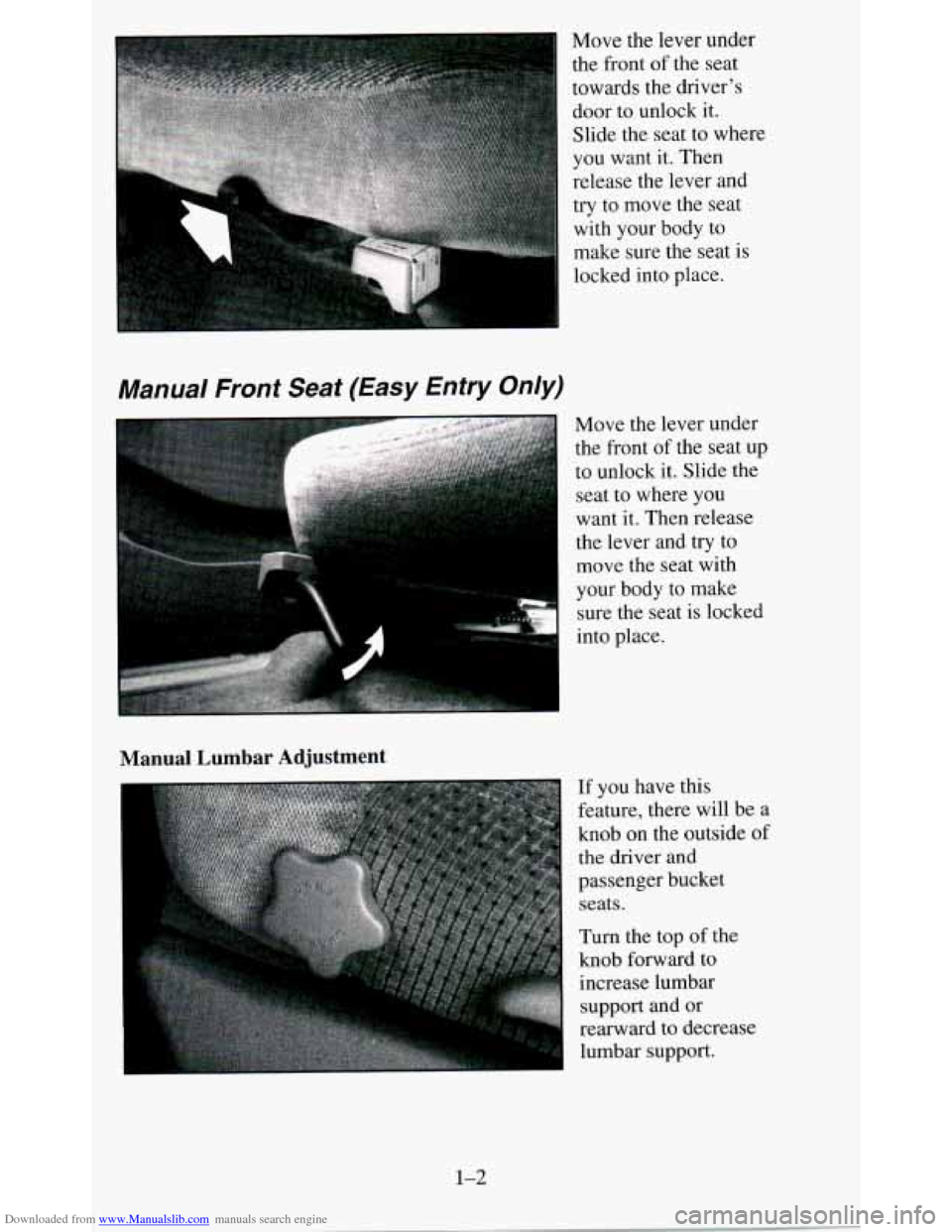
Downloaded from www.Manualslib.com manuals search engine Manual Front Seat (Easy Entry Only)
Move the lever under
the front of the seat
towards the driver's
door to unlock it.
Slide the seat to where
you want it. Then
release the lever and
try to move the seat with your body to
make sure the seat is
locked into place.
Move the lever under
the front of the seat up
to unlock it. Slide the
seat to where you
want it. Then release
the lever and try to move the seat with
' your body to make
-_ a, sure the seat is locked
into place.
Manual Lumbar Adjustment
If you have this
feature, there will be
a
knob on the outside of
the driver and
passenger bucket seats.
Turn the top
of the
knob forward to
increase lumbar support and or
rearward to decrease
lumbar support.
1-2
Page 13 of 380
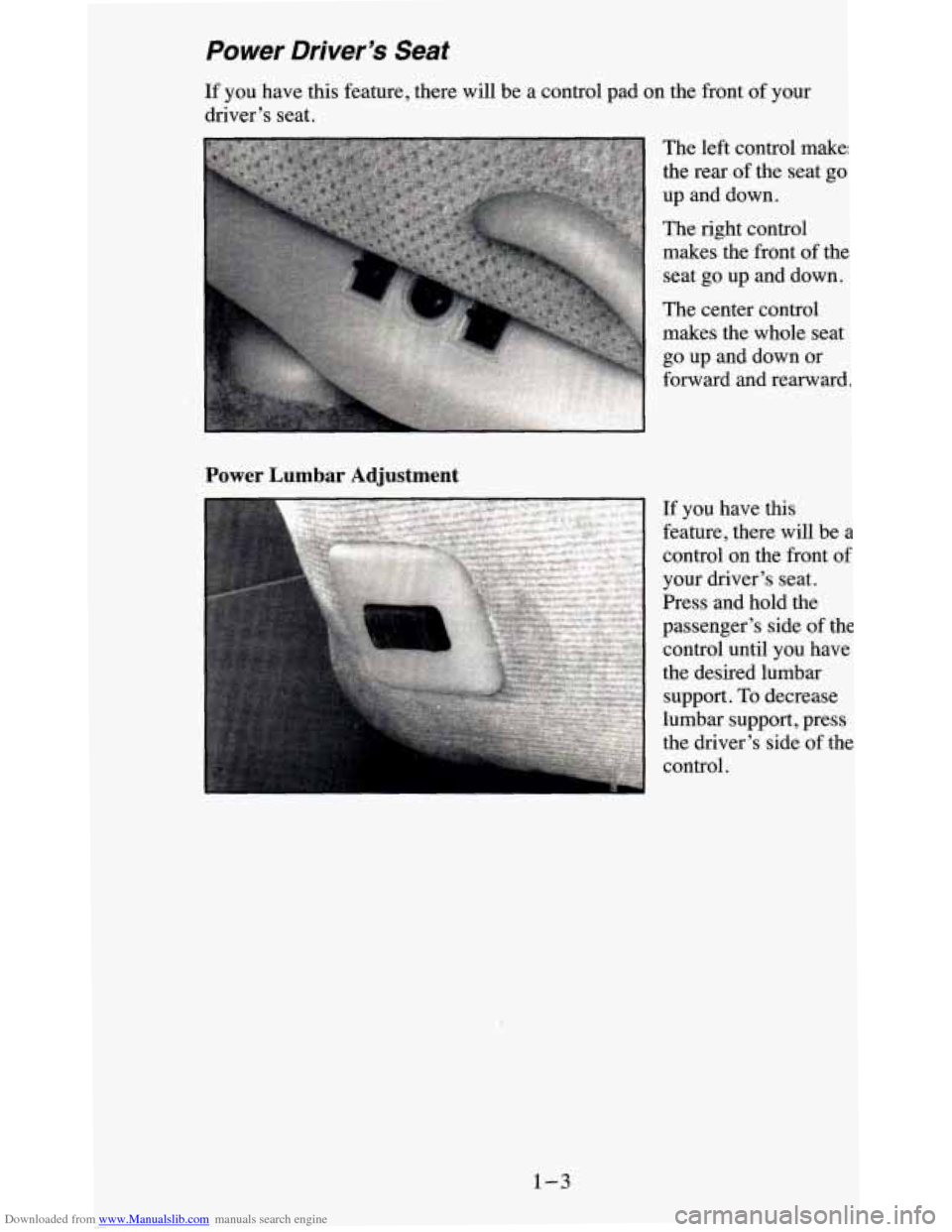
Downloaded from www.Manualslib.com manuals search engine Power Driver’s Seat
If you have this feature, there will be a control pad on the front of your
driver’s seat.
Power Lumbar Adjustment
The left control make
the rear of the seat
go
up and down.
The right control
makes the front of the
seat go up and down..
The center control
makes the whole seat
go up and down or
forward and rearward
If you have this
feature, there will be
a
control on the front of
your driver’s seat.
Press and hold the
passenger’s side of the
control until you have
the desired lumbar support. To decrease
lumbar support, press
the driver’s side
of the
control.
1-3
Page 21 of 380
Downloaded from www.Manualslib.com manuals search engine 0: Why don’t they just put in air bags so people won’t have to wear
safety belts?
A: Air bags are in many vehicles today and will be in more of them in the
future. But
they are supplemental systems only; so they work with
safety belts - not instead of them. Every air bag system ever offered
for sale has required the use of safety belts. Even
if you’re in a vehicle
that has air bags, you still have to buckle up to get the most protection.
That’s true not only in frontal collisions,’but especially
in side and
other collisions.
0: If I’m a good driver, and I never drive far from home, why should I
wear safety belts?
A: You may be an excellent driver, but if you’re in an accident - even
one that isn’t your fault
- you and your passengers can be hurt. Being
a good driver doesn’t protect you from things beyond your control,
such
as bad drivers.
Most accidents occur within
25 miles (40 km) of home. And the
greatest number
of serious injuries and deaths occur at speeds of less
than
40 mph (65 kndh).
Safety belts are for everyone.
How to Wear Safety Belts Properly
Adults
This part is only for people of adult size.
Be aware that there are special things
to know about safety belts and
children. And there are different rules for smaller children and babies. If a
child will be riding in your vehicle,
see the part of this manual called
“Children.” Follow those rules
for everyone’s protection.
First, you’ll want to know which restraint systems your vehicle has.
We’ll start with the driver position.
Driver Position
This part describes the driver’s restraint system.
1-11
Page 22 of 380
Downloaded from www.Manualslib.com manuals search engine Lap-Shoulder Belt
The driver has a lap-shoulder belt. Here’s how to wear it \
properly.
1. Close and lock the door.
2. Adjust the seat (to see how, see “Seats” in the Index) so you can sit up
straight.
3. Pick up the latch
plate and pull the
belt across
you.
Don’t let it get
twisted.
4. Push the latch plate into the buckle until it clicks.
Pull up on the latch plate
to make sure it is secure.
If the belt isn’t long enough, see “Safety Belt Extender” at the end
of
this section.
Make sure
the release button on the buckle is positioned so you would
be able to unbuckle the safety belt quickly if you ever had to.
5. To make the lap
part tight, pull
down on the buckle end
of the
belt as you pull
up on the
shoulder belt.
.
1-12
Page 27 of 380
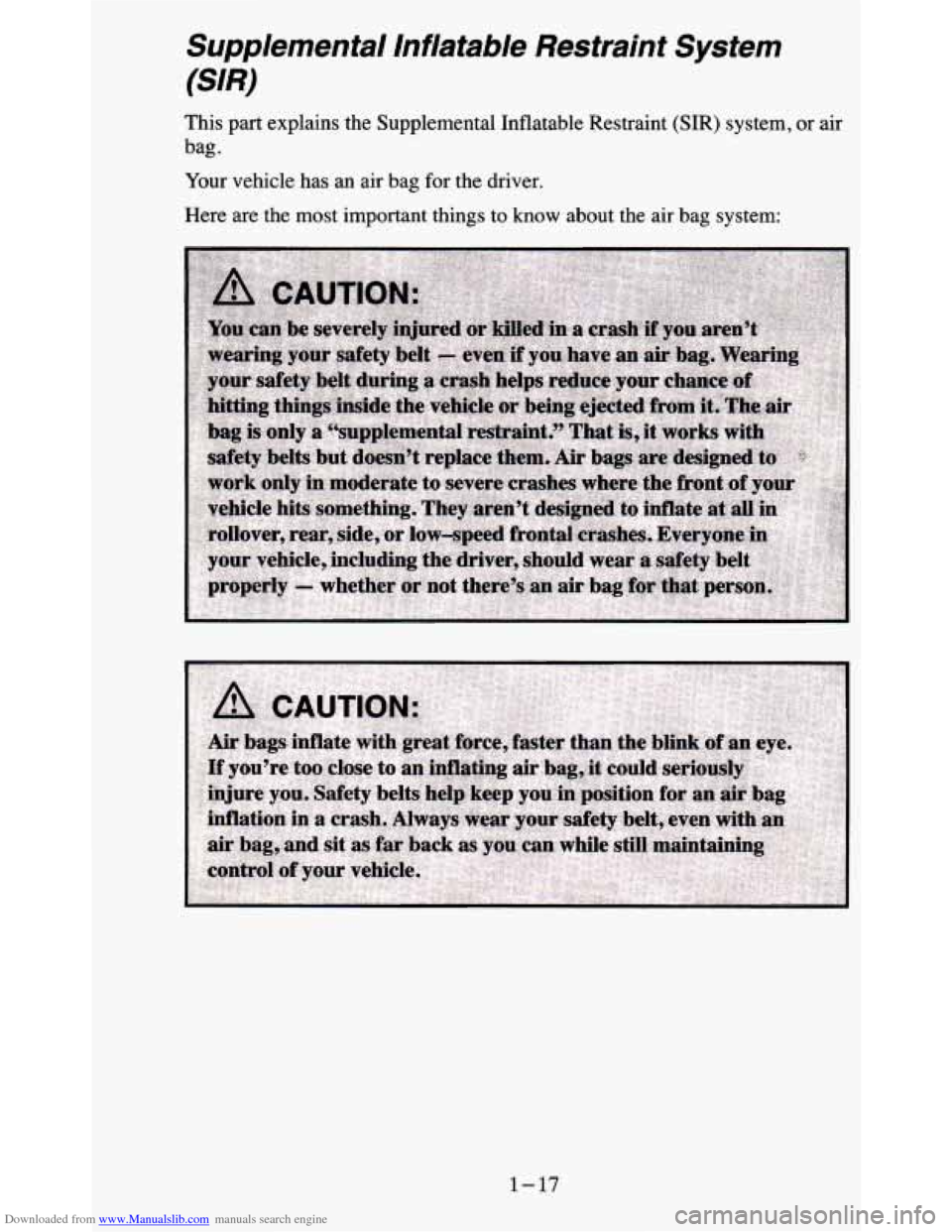
Downloaded from www.Manualslib.com manuals search engine Supplemental Inflatable Restraint System
(SIR)
This part explains the Supplemental Inflatable Restraint (SIR) system, or air
bag.
Your vehicle has an air bag for the driver.
Here are the most important things to
know about the air bag system:
1-17
Page 28 of 380
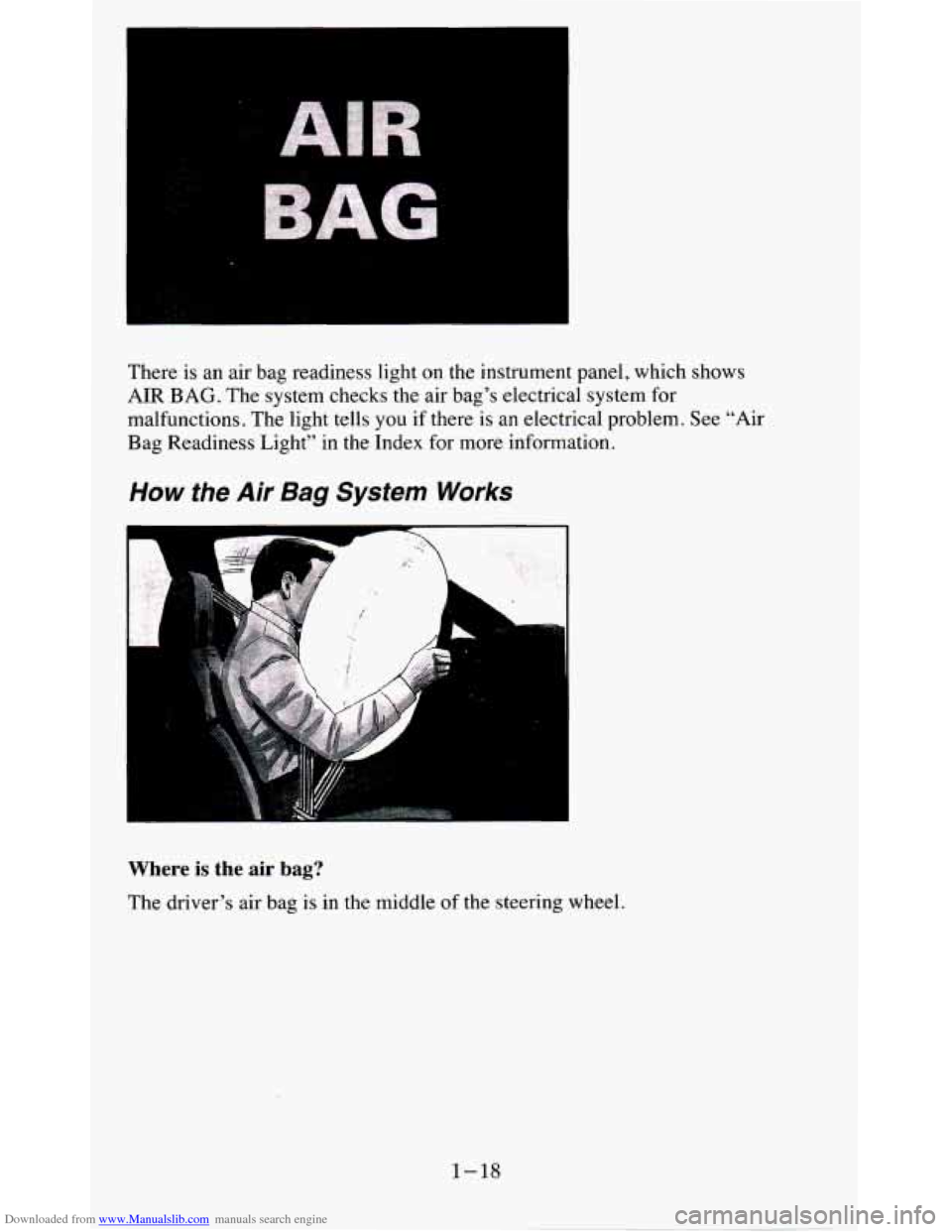
Downloaded from www.Manualslib.com manuals search engine There is an air bag readiness light on the instrument panel, which shows
AIR BAG. The system checks the air bag’s electrical system for
malfunctions. The light tells
you if there is an electrical problem. See “Air
Bag Readiness Light’’ in the Index for more information.
How the Air Bag System Works
1 .. ..
Where is the air bag?
The driver’s air bag is in the middle of the steering wheel.
1-18
Page 30 of 380

Downloaded from www.Manualslib.com manuals search engine regarded as anything more than a supplement to safety belts, and then only\
in moderate to severe frontal or near-frontal collisions.
What will you see after an air bag inflates?
After the air bag inflates, it quickly deflates. This occurs so quickly that
some people may not even realize the air bag inflated. Some compone\
nts of
the air bag module in the steering wheel hub will be hot for a short\
time, but
the part
of the bag that comes into contact with you will not be hot to the
touch. There will be some smoke and dust coming from vents in the deflated
air bag. Air bag inflation will not prevent the driver from seeing\
or from
being able to steer the vehicle, nor will it stop people from leaving
the
vehicle.
The air bag is designed to inflate only once. After it inflates, you’ll
need some new parts for your air bag system. If you don’t get them, the
air bag system won’t be there to help protect
you in another crash. A
new system will include the air bag module and possibly other parts.
The service manual for your vehicle covers the need
to replace other
parts.
information about the air bag system. The module records information
about the readiness of the system, when the sensors are activated and
driver’s safety belt usage at deployment.
Your vehicle is equipped with a diagnostic module, which records
Let only qualified technicians work on your air bag system. Improper
service can mean that your air bag system won’t work properly.
See
your dealer for service.
NOTICE:
If you damage the cover for the driver’s air bag, it may not work
properly. You may have to replace the air bag module. Do not
open or break the air bag cover.
1-20