1995 CHEVROLET BLAZER trailer
[x] Cancel search: trailerPage 66 of 380
Downloaded from www.Manualslib.com manuals search engine New Vehicle “Break-In”
NOTICE:
Your modern vehicle doesn’t need an elaborate “break-in.” But
it will perform better in the long run
if you follow these
guidelines:
Keep your speed at 55 mph (88 km/h) or less for the first 500
miles (804 km).
Don’t drive at any one speed - fast or slow - for the first
500 miles (804 km). Don’t make full-throttle starts.
Avoid making hard stops for the first 200 miles (322 km) or
so. During this time your new brake linings aren’t yet broken
in. Hard stops with new linings can mean premature wear and
earlier replacement. Follow this “breaking-in” guideline
every time
you get new brake linings.
Don’t tow a trailer during ‘(break-in.” See “Towing a Trailer’’
in the Index for more information.
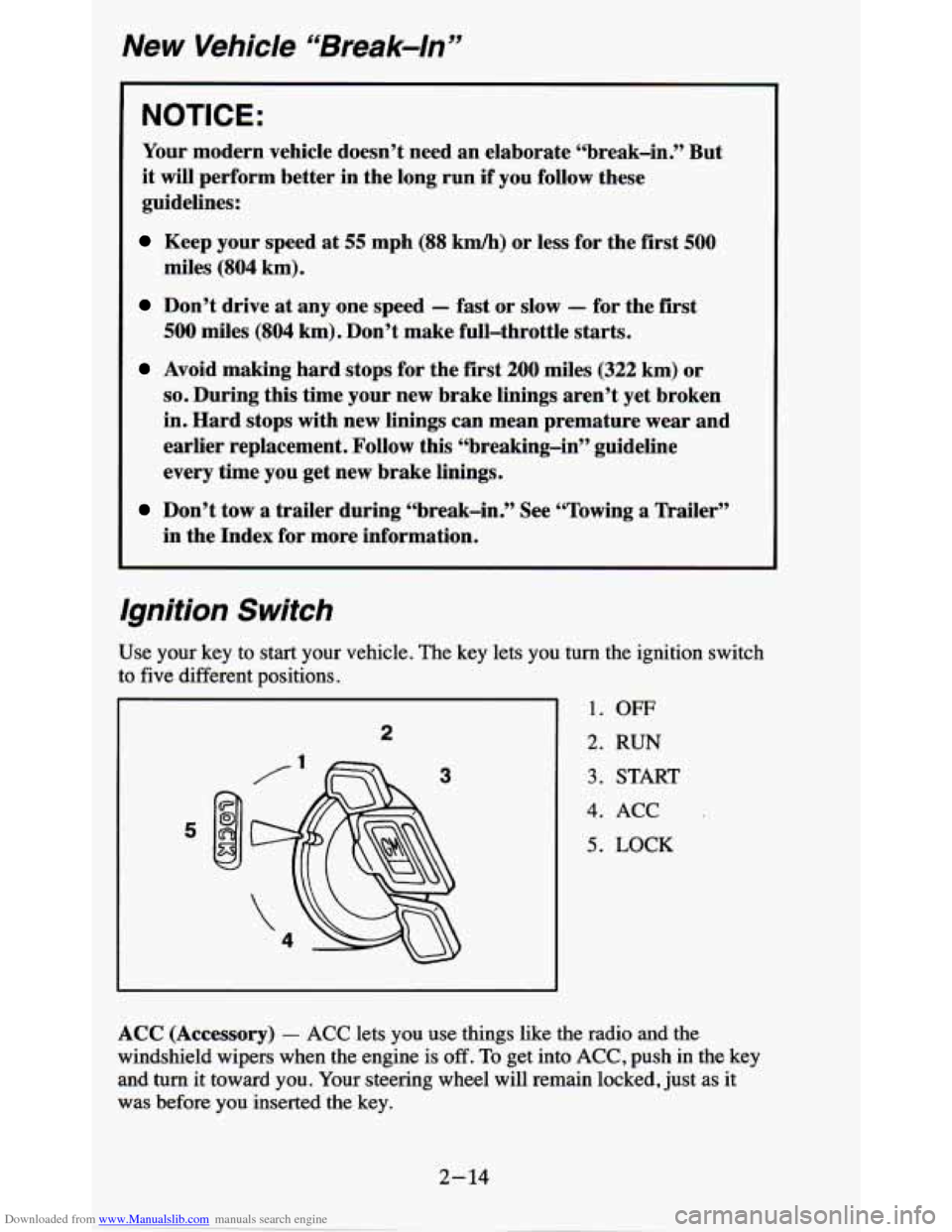
Ignition Switch
Use your key to start your vehicle. The key lets you turn the ignition switch
to
five different positions.
2
1. OFF
2. RUN
3. START
4. ACC
5. LOCK
ACC (Accessory) - ACC lets you use things like the radio and the
windshield wipers when the engine is
off. To get into ACC, push in the key
and
turn it toward you. Your steering wheel will remain locked, just as it
was before you inserted the key.
Page 73 of 380
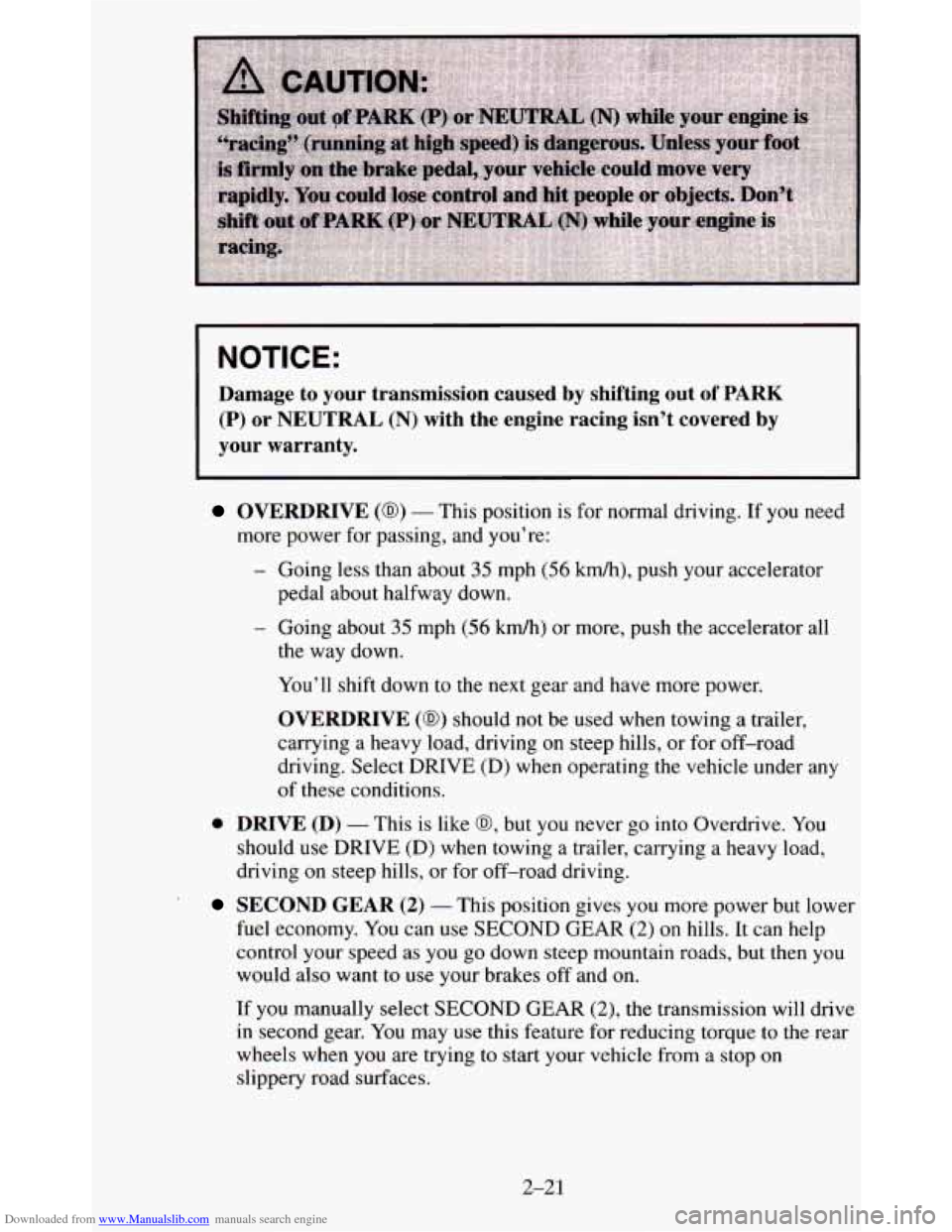
Downloaded from www.Manualslib.com manuals search engine NOTICE:
Damage to your transmission caused by shifting out of PARK
(P) or
NEUTRAL (N) with the engine racing isn’t covered by
your warranty.
OVERDRIVE (0) - This position is for normal driving. If you need
more power for passing, and you’re:
pedal about halfway down.
- Going less than about 35 mph (56 km/h), push your accelerator
- Going about 35 mph (56 kdh) or more, push the accelerator all
the way down.
You’ll shift down
to the next gear and have more power.
OVERDRIVE (a) should not be used when towing a trailer,
carrying
a heavy load, driving on steep hills, or for off-road
driving. Select
DRIVE (D) when operating the vehicle under any
of these conditions.
0 DRIVE (D) - This is like @, but you never go into Overdrive. You
should
use DRIVE (D) when towing a trailer, carrying a heavy load,
driving on steep
hills, or for off-road driving.
SECOND GEAR (2) - This position gives you more power but lower
fuel economy. You
can use SECOND GEAR (2) on hills. It can help
control your speed as you
go down steep mountain roads, but then you
would also want to use your brakes off and on.
If you manually select
SECOND GEAR (2), the transmission will drive
in second gear. You may use this feature for reducing torque to the rear
wheels when
you are trying to start your vehicle from a stop on
slippery road surfaces.
2-21
Page 77 of 380

Downloaded from www.Manualslib.com manuals search engine r
~~ ~
NOTICE: I
Driving with the parking brake on can cause your rear brakes \
to overheat. You may have to replace them, and you could also
damage other parts
of your vehicle.
If you are on a hill: See “Parking on Hills” in the Index. That section
shows how to turn your front wheels.
If you are towing a trailer and are parking on any hill: See “Towing a
Trailer” in the Index. That section shows what to
do first to keep the trailer
ffom moving.
Shifting Into PARK (P)
(Automatic Transmission
Models Only)
2-25
Page 79 of 380
Downloaded from www.Manualslib.com manuals search engine lever out of PARK (P). This is called “torque lock.” To prevent torque lock,
set the parking brake and then shift into
PARK (P) properly before you
leave the driver’s seat.
To find out how, see “Shifting Into PARK (P)” in the
Index.
When you are ready to
drive, move the shift lever out of PARK (P) before
you release the parking brake.
If “torque lock” does occur, you may need to have another vehicle push
yours a little uphill to take some of the pressure from the transmission,
so
you can pull the shift lever out of PARK (P).
Parking Your Vehicle (Manual Transmission
Models Only)
Before you get out of your vehicle, turn off your engine, put your manual
transmission in
REVERSE (R) and firmly apply the parking brake.
If you have four-wheel drive with a manual transfer case shift lever, be sure
your transfer case is in a drive gear. Your vehicle could roll
if it isn’t.
If you are parking on a hill, or if your vehicle is equipped to tow a trailer,
see “Parking on Hills” or “Towing a Trailer” in the Index.
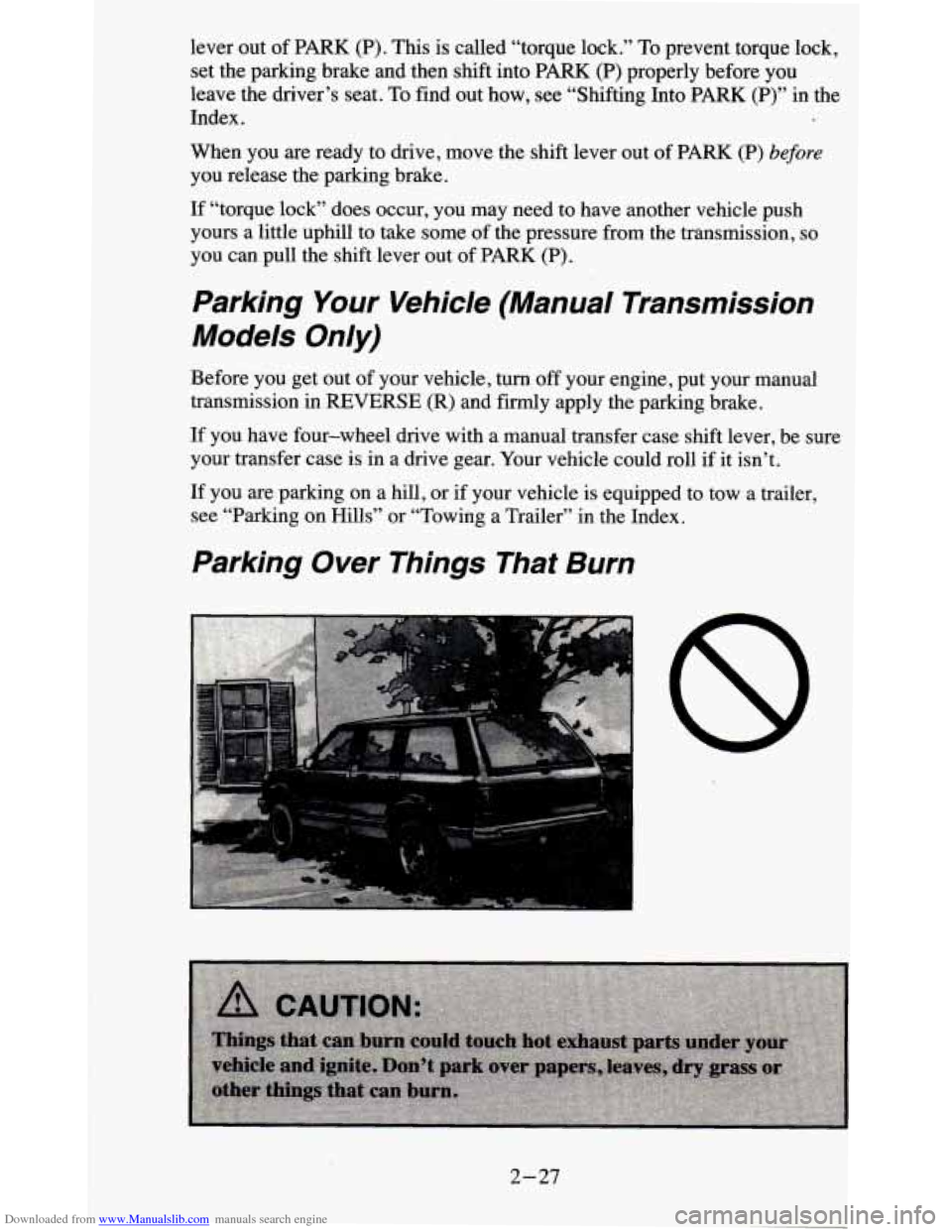
Parking Over Things That Burn
2-27
Page 81 of 380
Downloaded from www.Manualslib.com manuals search engine If you have four-wheel drive with a manual transfer case shift lever and
your transfer case is in
NEUTRAL (N), your vehicle will be free to roll,
even if your shift lever is
in PARK (P). So, be sure the transfer case is in a
drive gear
- not in NEUTRAL (N). Always set your parking brake. Follow
the proper steps to be sure your vehicle won’t move. See “Shifting Into
PARK (P)” in the Index.
If you’re pulling a trailer, see “Towing a Trailer”
in the Index.
All- Wheel Drive (Option)
If your vehicle has all-wheel drive, your engine’s driving power\
is sent to
all four wheels for extra traction. This
is like four-wheel drive, but there is
no lever or switch to engage or disengage the front axle. It is fully automatic
and adjusts itself as needed for road conditions.
2-29
Page 90 of 380
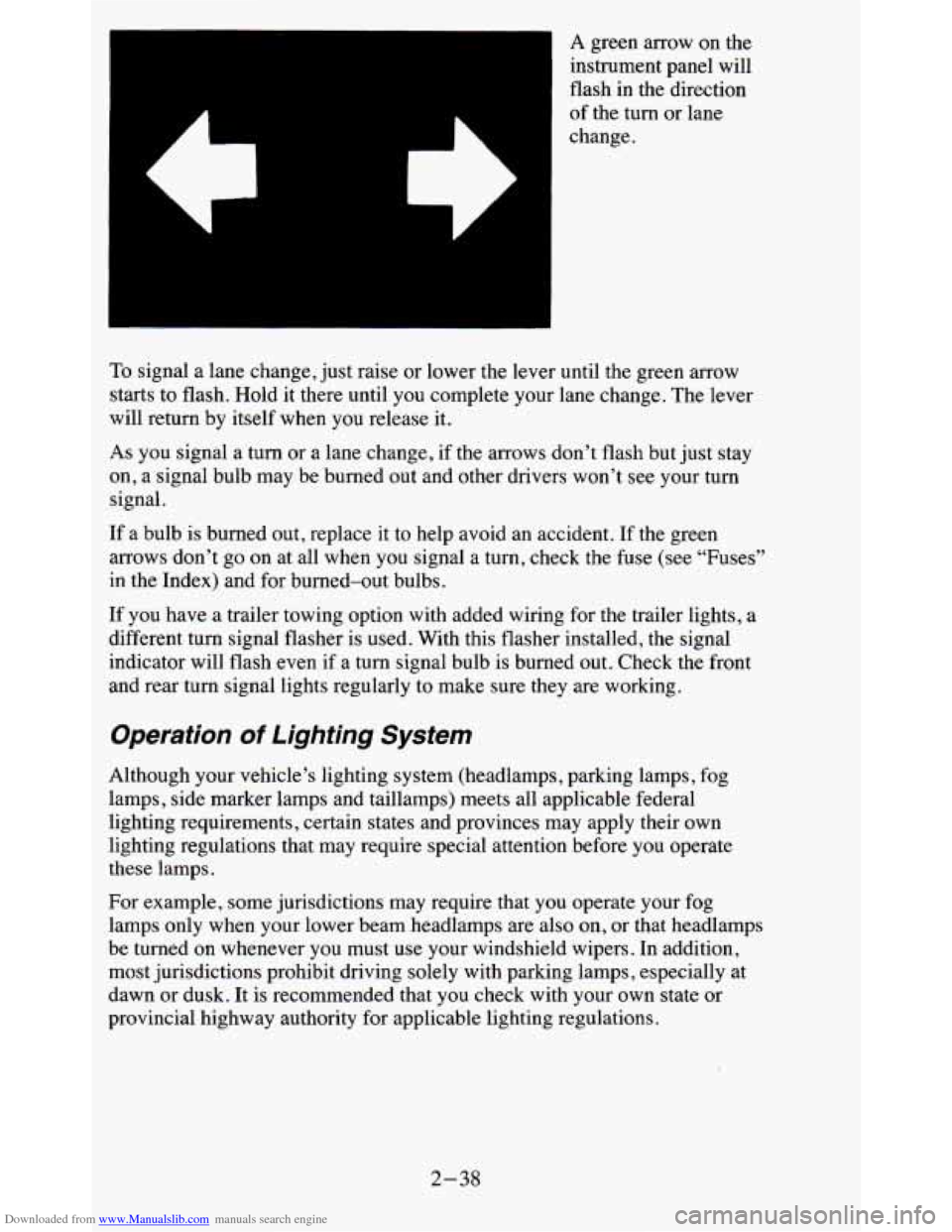
Downloaded from www.Manualslib.com manuals search engine A green arrow on the
instrument panel will
flash
in the direction
of the turn or lane
change.
To signal a lane change, just raise or lower the lever until the green arrow
starts to flash. Hold it there until you complete your lane change. The lever
will return by itself when you release it.
As you signal a turn or a lane change, if the arrows don’t flash but just stay
on, a signal bulb may be burned out and other drivers won’t see your turn
signal.
If a bulb is burned out, replace it to help avoid an accident. If the green
arrows don’t go on at all when
you signal a turn, check the fuse (see “Fuses”
in the Index) and for burned-out bulbs.
If you have a trailer towing option with added wiring for the trailer lights, a
different turn signal flasher is used. With this flasher instal\
led, the signal
indicator will flash even if
a turn signal bulb is burned out. Check the front
and rear turn signal lights regularly to make sure they are w\
orking.
Operation of Lighting System
Although your vehicle’s lighting system (headlamps, parking lamps, fog
lamps, side marker lamps and taillamps) meets all applicable federal
lighting requirements, certain states and provinces may apply their own
lighting regulations that may require special attention before you operate
these lamps.
For example, some jurisdictions may require that you operate your fog
lamps only when your lower beam headlamps are also on,
or that headlamps
be turned on whenever you must use your windshield wipers. In \
addition,
most jurisdictions prohibit driving solely with parking lamps, especially at
dawn or dusk. It is recommended that you check with your own state or
provincial highway authority for applicable lighting regulations.
2-38
Page 125 of 380
Downloaded from www.Manualslib.com manuals search engine indicated by the system before any problem is apparent, which may prevent
more serious damage to your vehicle, This system is
also designed to assist
your service technician in correctly diagnosing any malfunction.
The
“SERVICE ENGINE SOON” light should come on, as a check to show
you it is working, when the ignition is on and the engine is not running. This
light will also come during
a malfunction in one of two ways:
Light on steady - indicates a system malfunction has been detected.
Drive the vehicle to the dealer for service at your first opportunity.
Light flashing - indicates a misfire has been detected which may
damage the emission control system. The damage may be reduced by
lowering the vehicle speed, reducing the amount of cargo being hauled
or trailered, avoiding hard acceleration, or by avoiding steep uphill
grades.
If these actions are effective, the light will stop flashing and
remain
on steady. Drive the vehicle to a dealer for service. If the light
continues to flash, stop
the vehicle. Wait for a steady light to come on,
then drive the vehicle to a dealer for service.
These following conditions also may cause the “SERVICE ENGINE
SOON’ light to come on:
Low Fuel/Out of Fuel - As the vehicle starts to run out of fuel the
“SERVICE ENGINE SOON” light may come on as a result of an engine
misfire. Filling your gasoline tank should correct this condition. Make sure
to install the gas cap fully. It will require a few driving trips to turn the light
off.
Poor Quality Fuel
- Be sure to fuel your vehicle with quality fuel. Your
engine may not run efficiently
on poor fuel. Poor fuel may cause stalling,
hesitation or misfire. These conditions may
go away when the engine is
warned-up. However, poor quality fuel may cause the “SERVICE ENGINE
SOON’ light to come on.
Have a dealer check the vehicle. If no problems are found, you may want to
change to another brand of fuel.
Driving Through Standing Water
- Driving your vehicle through puddles
of deep standing water may result in a temporary misfire condition. This
condition will usually correct itself shortly after the electric\
al system dries
out. It will require a few driving trips to turn the light off.
2-73
Page 133 of 380
Downloaded from www.Manualslib.com manuals search engine Don’t exceed the maximum vehicle capacity when loading your vehicle. For
more information on vehicle capacity and loading,
see “Loading Your
Vehicle’’ in the Index.
To prevent damage or loss of cargo as you’re driving, check
now and then to
make sure the luggage carrier and cargo are still securely fastened.
Trailer Wiring Harness
Your vehicle will have a 5-wire and may have a 7-wire harness.
The light duty trailer wiring is a 5-wire harness assembly taped and bundled
at the left corner
of the vehicle. The harness has no connector, and you
should have
a qualified service person wire your harness for you.
The heavy duty trailer wiring is
a 7-wire harness assembly. It is stored
under the vehicle, along the passenger-side frame crossmember on
two-door vehicles and on the driver-side corner frame crossmember on
four-door vehicles. It has a 30-amp feed wire with an inline fuse located by
the junction block. See “Fuses and Circuit Breakers” in
the Index.
Both the 5-wire harness and the 7-wire harness have no connector and
should be wired by a qualified service person. Attach the harness to the
trailer, then tape or strap
it to your vehicle’s frame rail. Be sure you leave it
loose enough
so the wiring doesn’t bend or break, but not so loose that it
drags on the ground.
Store the harness
in its original place. Wrap the harness together and tie it
neatly
so it won’t be damaged.
2-81