1995 CHEVROLET BLAZER brake fluid
[x] Cancel search: brake fluidPage 94 of 380
Downloaded from www.Manualslib.com manuals search engine automatically park on the endgate. When the glass is completely closed, the
wiper will resume the delay mode.
To turn on the wiper, press WASH.
a To wash the window, press and hold WASH. The wipers will continue
Press OFF to turn the wiper off.
to work after you release the switch.
The rear window washer uses the same fluid bottle as the windshield
washer. However, the rear window washer
will run out of fluid before the
windshield washer. If you can wash your windshield
but not your rear
window, check your fluid'level.
Cruise Control (Option)
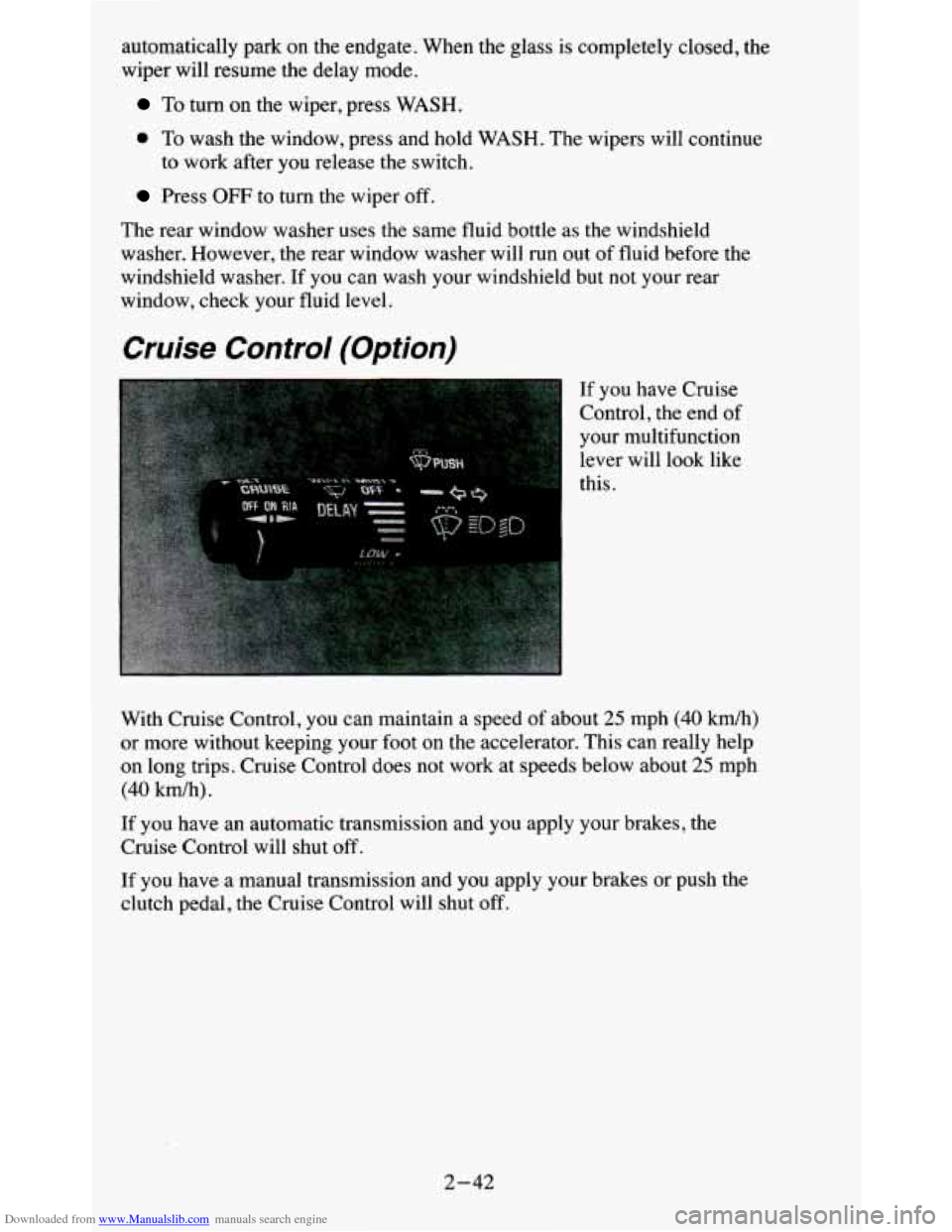
- . .. ,. If you have Cruise
Control, the end of
your multifunction lever will look like
this.
With Cruise Control, you can maintain a speed of about
25 mph (40 kdh)
or more without keeping your foot on the accelerator. This can really help
on long trips. Cruise Control does not work at speeds below about
25 mph
(40 km/h).
If you have an auromatic tran .ission and you apply your brakes, the
Cruise Control will shut
off.
If you have a manual transmission and you apply your brakes or push the
clutch pedal, the Cruise Control will shut off.
2-42
Page 166 of 380
Downloaded from www.Manualslib.com manuals search engine Driving Guidelines
This multipurpose passenger vehicle is defined as a utility vehicle in
Consumer Information Regulations issued by the National Highway Traffic
Safety Administration (NHTSA) of the United States Department
of
Transportation. Utility vehicles have higher ground clearance and\
a
narrower track to make them capable of performing
in a wide variety of
off-road applications. Specific design characteristics give them a higher
center of gravity than ordinary cars. An advantage of the higher ground
clearance is
a better view of the road allowing you to anticipate problems.
They are
not designed for cornering at the same speeds as conventional
2-wheel drive vehicles any more than low-slung sports cars are designed\
to
perform satisfactorily under off-road conditions. If
at all possible, avoid
sharp turns or abrupt maneuvers. As with other vehicles of this type, failure
to operate this vehicle correctly may result in loss
of control or vehicle
rollover.
Off-Road Driving with Your Four-wheel Drive Vehicle
This off-road guide is for vehicles that have four-wheel drive.
Also, see “Anti-Lock Brakes” in the Index.
If your vehicle doesn’t have four-wheel drive,
you shouldn’t drive off-road
unless you’re
on a level, solid surface.
Off-road driving can be great
fun. But it does have some definite hazards.
The greatest
of these is the terrain itself.
“Off-roading” means you’ve left the great North American\
road system
behind. Traffic lanes aren’t marked. Curves aren’t banked. There are
no
road signs. Surfaces can be slippery, rough, uphill or downhill. In short,
you’ve gone right
back to nature.
Off-road driving involves some new skills. And that’s why it’s very
important that
you read this guide. You’ll find many driving tips and
suggestions. These will help make your off-road driving safer and more
enjoyable.
Before You Go Off-Roading
There are some things to do before you go out. For example, be sure to have
all necessary maintenance and service work done. Check to make sure all
underbody shields (if
so equipped) are properly attached. Be sure you read
all the information about your four-wheel drive vehicle in this manual.
Is
there enough fuel? Is the spare tire fully inflated? Are the fluid levels up
where they should be? What are the local laws that apply to off-roading
where you’ll be driving?
If you don’t know, you should check with law
enforcement people in the area. Will you be on someone’s private land? If
so, be sure to get the necessary permission.
4- 12
Page 184 of 380

Downloaded from www.Manualslib.com manuals search engine Then here tire some tips:
0 Make sure your vehicle is well ventilated, with a comfortably cool
interior.
0 Keep your eyes moving. Scan the‘road ahead and to the sides. Check
your mirrors and your instruments frequently.
If you get sleepy, pull off the road into a rest, service, or parking area
and take a nap, get some exercise, or both. For safety, treat drowsiness
on the highway as an emergency.
Hill and Mountain Roads
Driving on steep hills or mountains is different from driving in flat or
rolling terrain.
If you drive regularly in steep country, or if you’re plann\
ing to visit there,
here are some tips that can make your trips safer and more enjoyable. (See \
“Off-Road Driving” in the Index for information about driving off-road.)
Keep your vehicle in good shape. Check all fluid levels and also the
brakes, tires, cooling system and transmission. These parts can work
hard on mountain roads.
0 Know how to go down hills. The most important thing to know is this:
let your engine do some of the slowing down. Shift to a lower gear
when you go down a steep or long hill.
4-30
Page 197 of 380

Downloaded from www.Manualslib.com manuals search engine Safety Chains
You should always attach chains between your vehicle and your trail\
er.
Cross the safety chains under the tongue of the trailer
so that the tongue will
not drop
to the road if it becomes separated from the hitch. Instructions
about safety chains
may be provided by the hitch manufacturer or by the
trailer manufacturer. Follow the manufacturer’s recommendation for
attaching safety chains and
do not attach them to the bumper. Always leave
just enough slack
so you can turn with your rig. And, never allow safety
chains to drag on the ground.
Trailer Brakes
If your trailer weighs more than 1,000 pounds (450 kg) loaded, then it needs
its own brakes
- and they must be adequate. Be sure to read and follow the
instructions for the trailer brakes
so you’ll be able to install, adjust and
maintain them properly.
Your trailer brakes system can tap into vehicle’s hydraulic brake system
except:
Don’t tap into your vehicle’s brake system if the trailer’s brake system \
will
use more than
0.02 cubic inch (0.3~~) of fluid from your vehicle’s master
cylinder.
If it does, both braking systems won’t work well. You could even
lose your brakes.
Will the trailer parts take
3,000 psi (20 650 kPa) of pressure? If not, the
trailer brake system must not be used with your vehicle.
If everything checks out this far, then make the brake fluid tap at the port on
the master cylinder that sends fluid to the rear brakes. But don’t
use copper
tubing for this. If
you do, it will bend and finally break off. Use steel brake
tubing.
4-43
Page 201 of 380
Downloaded from www.Manualslib.com manuals search engine When You Are Ready to Leave After Parking on a Hill
1. Apply your regular brakes and hold the pedal down while you:
Start your engine;
0 Shift into a gear; and
Release the parking brake.
2. Let up on the brake pedal.
3. Drive slowly until the trailer is clear of the chocks.
4. Stop and have someone pick up and store the chocks.
Maintenance When Trailer Towing
Your vehicle will need service more often when you’re pulling a trailer. See
the Maintenance Schedule for more on this. Things that are especially
important
in trailer operation are automatic transmission fluid (don’t
overfill), engine oil, axle lubricant, belt, cooling system, and brake
adjustment. Each
of these is covered in this manual, and the Index will help
you find them quickly. If you’re trailering, it’s a good idea to review these
sections before you start your trip.
Check periodically to see that all hitch nuts and bolts are tight.
Trailer Lighting Systems Wiring
See “Trailer Wiring Harness” in the Index.
4-47
Page 255 of 380
Downloaded from www.Manualslib.com manuals search engine NOTICE:
Too much or too little fluid can damage your transmission. Too
much can mean that some of the fluid could come out and fall on
hot engine parts or exhaust system parts, starting a fire. Be \
sure
to get an accurate reading if you check your transmission flui\
d.
Wait at least 30 minutes before checking the transmission fluid level if you
have been driving:
When outside temperatures are above 90°F (32°C).
At high speed for quite a while.
In heavy traffic - especially in hot weather.
0 While pulling a trailer.
To get the right reading, the fluid should be at normal operating
temperature, which is
180°F to 200°F (82°C to 93°C).
To check transmissionfluid hot: Get the vehicle warmed up by driving
about 15 miles (24 km) when outside temperatures are above 50°F
(10°C).
If it's colder than 50°F ( lO"C), drive the vehicle in THIRD GEAR (D) until
the engine temperature gage moves and then remains steady for ten minutes.
Then follow the hot check procedures.
To check transmissionfluid cold: A cold check is rnaae after the vehicle has
been sitting for eight hours or more with the engine
off and is used only as a
reference. Let the engine
run at idle for five minutes if outside temperatures
are
50°F (10°C) or more. If it's colder than 50°F (lO"C), you may have to
idle the engine longer. Should the fluid level be low during a cold check,
you
must perform a hot check before adding fluid. This will give you a more
accurate reading of the fluid level.
To check the fluid hot or cold
Park your vehicle on a level place. Keep the engine running.
0 With the parking brake applied, place the shift lever in Park (P).
With your foot on the brake pedal, move the shift lever through each
gear range, pausing
for about three seconds in each range. Then,
position the shift lever in Park (P).
Let the engine run at idle for three minutes or more.
6- 15
Page 267 of 380
Downloaded from www.Manualslib.com manuals search engine Brakes
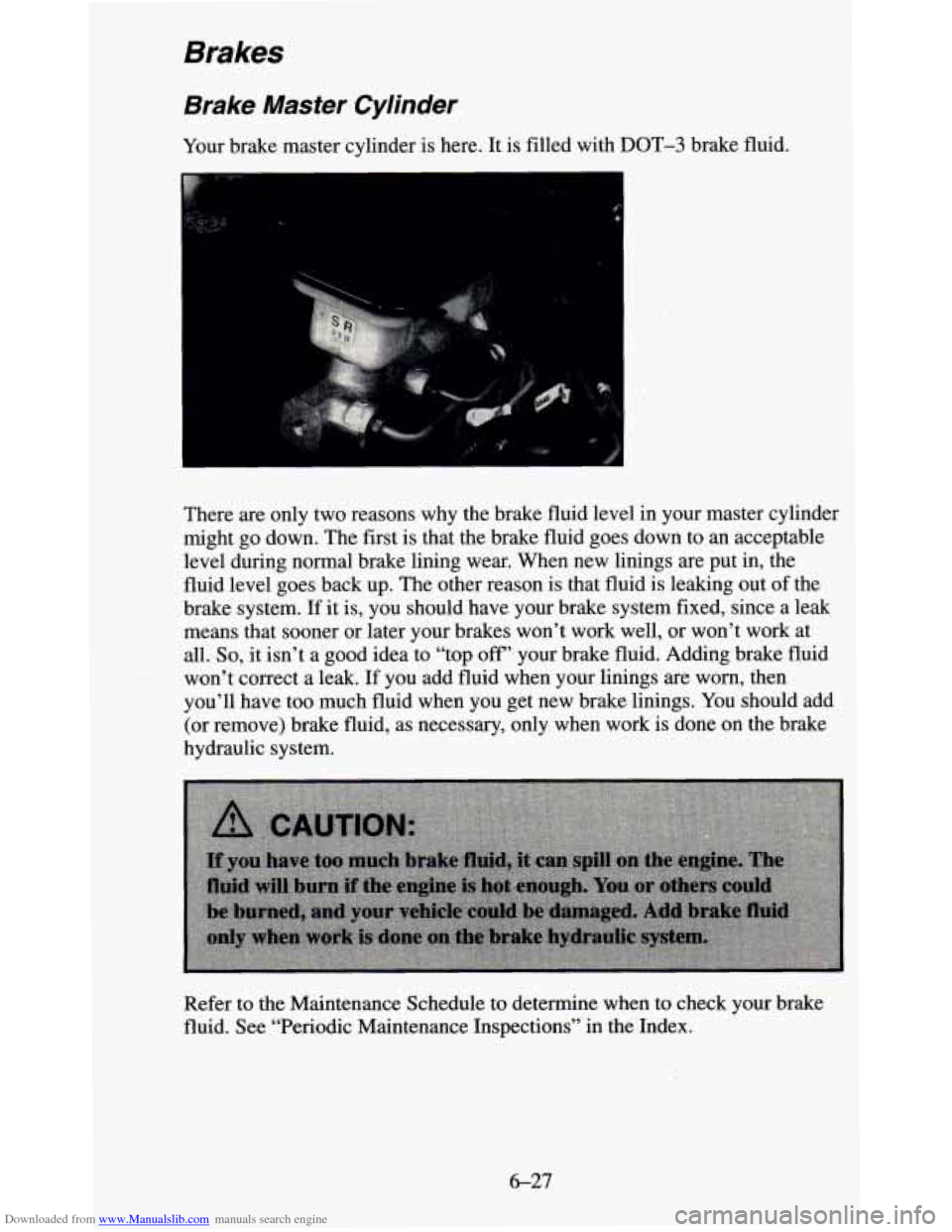
Brake Master Cylinder
Your brake master cylinder is here. It is filled with DOT-3 brake fluid.
There are only two reasons why the brake fluid level in your master\
cylinder
might
go down. The first is that the brake fluid goes down to an acceptable
level during normal brake lining wear. When new linings are put in, the
fluid level goes back up. The other reason is that fluid is leaking out of the
brake system.
If it is, you should have your brake system fixed, since a leak
means that sooner or later your brakes won’t work well,
or won’t work at
all.
So, it isn’t a good idea to “top off’ your brake fluid. Adding brake fluid
won’t correct a leak. If you add fluid when your linings are worn, then
you’ll have too much fluid when you get new brake linings.
You should add
(or remove) brake fluid, as necessary, only when work is done on the brake
hydraulic system.
Refer to the Maintenance Schedule to determine when to check your brake
fluid. See “Periodic Maintenance Inspections”
in the Index.
6-27
Page 268 of 380
Downloaded from www.Manualslib.com manuals search engine To Check Brake Fluid
.. .
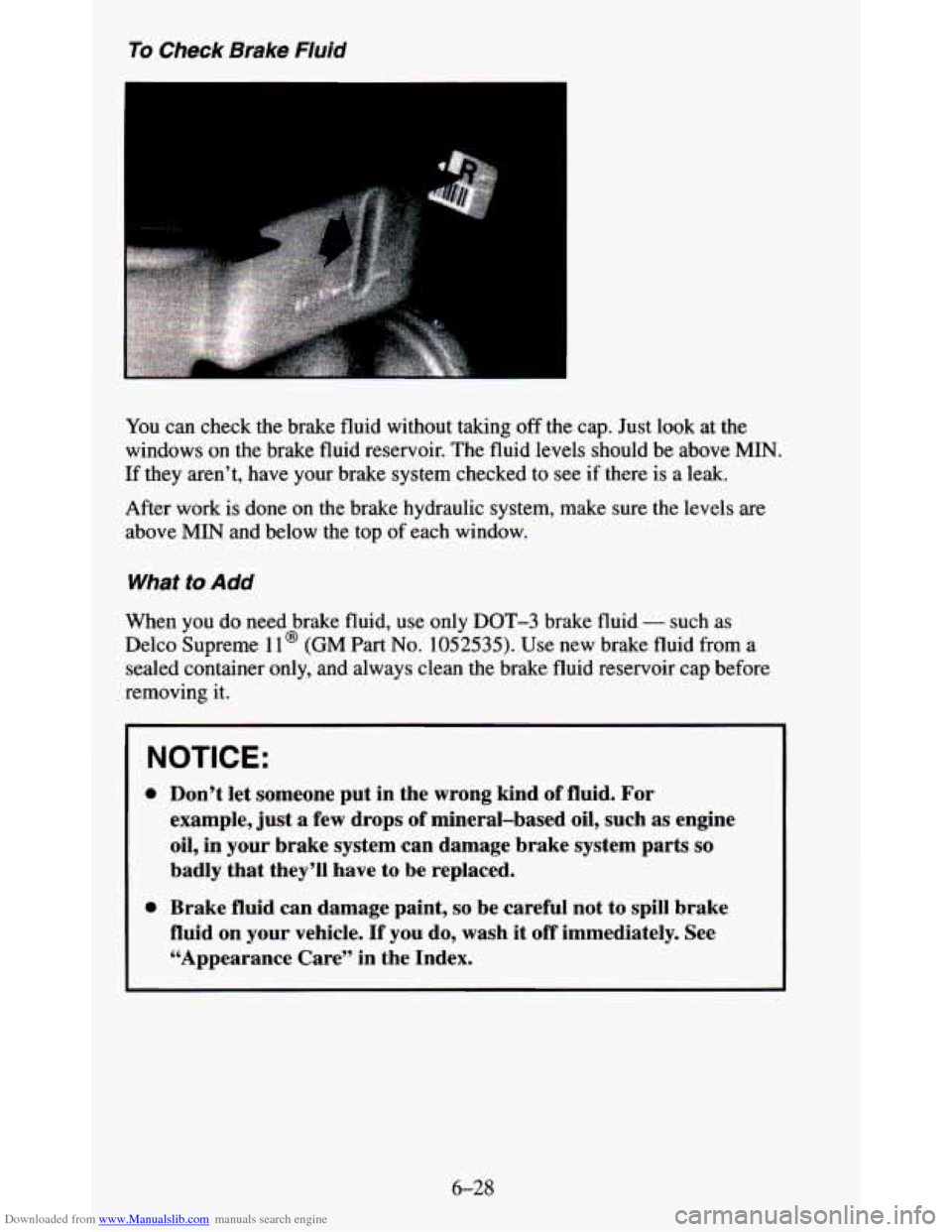
You can check the brake fluid without taking off the cap. Just look at the
windows on the brake fluid reservoir. The fluid levels should be above
MIN.
If they aren’t, have your brake system checked to see if there is a leak.
After work is done on the brake hydraulic system, make sure the levels
are
above MIN and below the top of each window.
What to Add
When you do need brake fluid, use only DOT-3 brake fluid - such as
Delco Supreme
11 @ (GM Part No. 1052535). Use new brake fluid from a
sealed container only, and always clean the brake fluid reservo\
ir cap before
removing it.
NOTICE:
0 Don’t let someone put in the wrong kind of fluid. For
example, just
a few drops of mineral-based oil, such as engine
oil, in your brake system can damage brake system parts
so
badly that they’ll have to be replaced.
0 Brake fluid can damage paint, so be careful not to spill brake
fluid on your vehicle.
If you do, wash it off immediately. See
“Appearance Care”
in the Index.
6-28