Page 191 of 380
Downloaded from www.Manualslib.com manuals search engine 2. Insert the ignition key into the ignition switch and turn it one notch
forward of the
LOCK position. This places the key into the OFF
position, which unlocks the steering column while preventing battery
drain. Unlocking the steering column
will allow for proper movement
of the front wheeldtires during towing.
I NOTICE:
I You should exercise extra care whenever towing another vehicle. \
Loading Your Vehicle
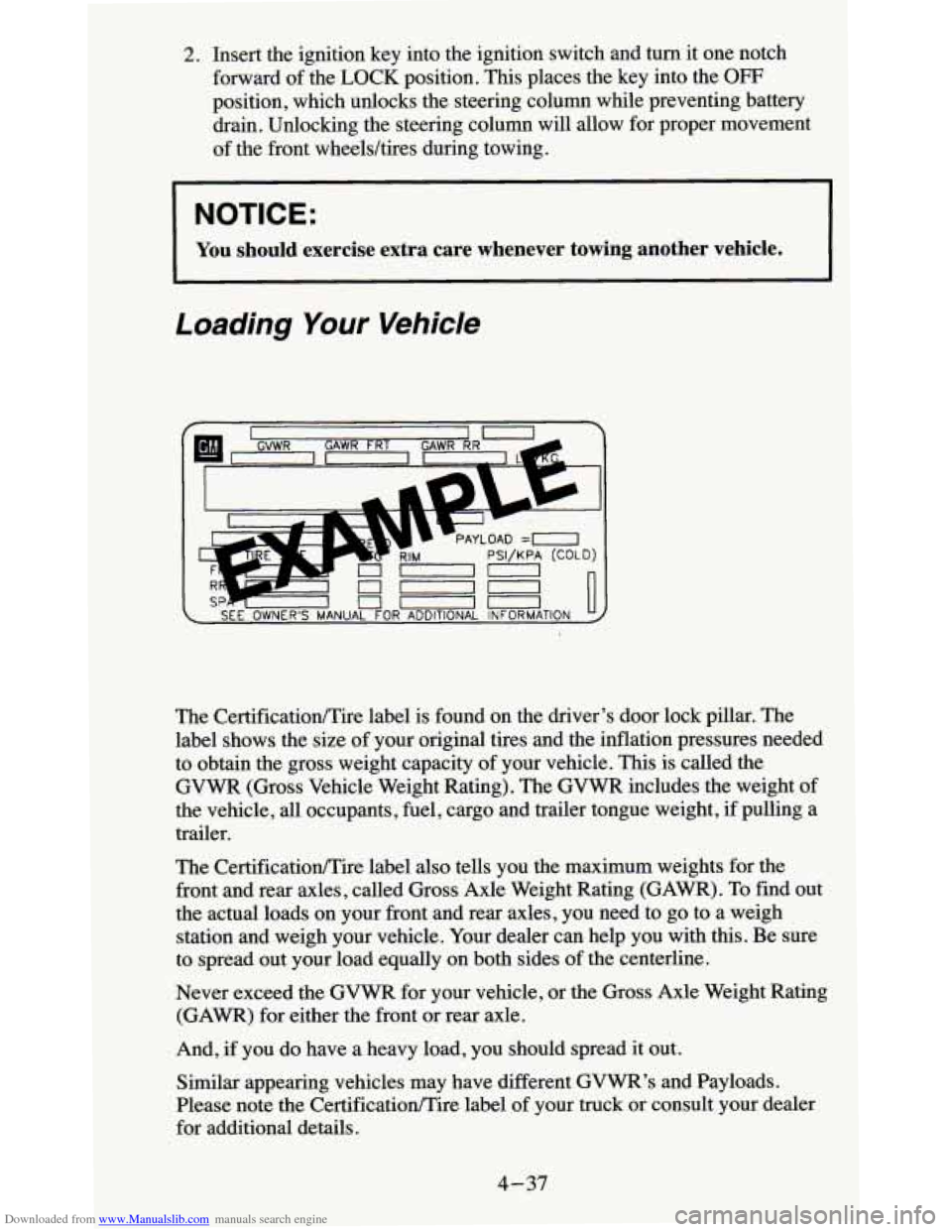
The CertificationEire label also tells you the maximum weights for the
front and rear axles, called Gross Axle Weight Rating (GAWR). To find out
the actual loads on your front and rear axles, you need to go to a weigh
station and weigh your vehicle. Your dealer can help
you with this. Be sure
to spread out your load equally on both sides
of the centerline.
Never exceed the
GVWR for your vehicle, or the Gross Axle Weight Rating
(GAWR) for either the front or rear axle.
And, if you do have
a heavy load, you should spread it out.
Similar appearing vehicles may have different
GVWR’s and Payloads.
Please note the CertificationEire label
of your truck or consult your dealer
for additional details.
4-37
Page 196 of 380
Downloaded from www.Manualslib.com manuals search engine A B
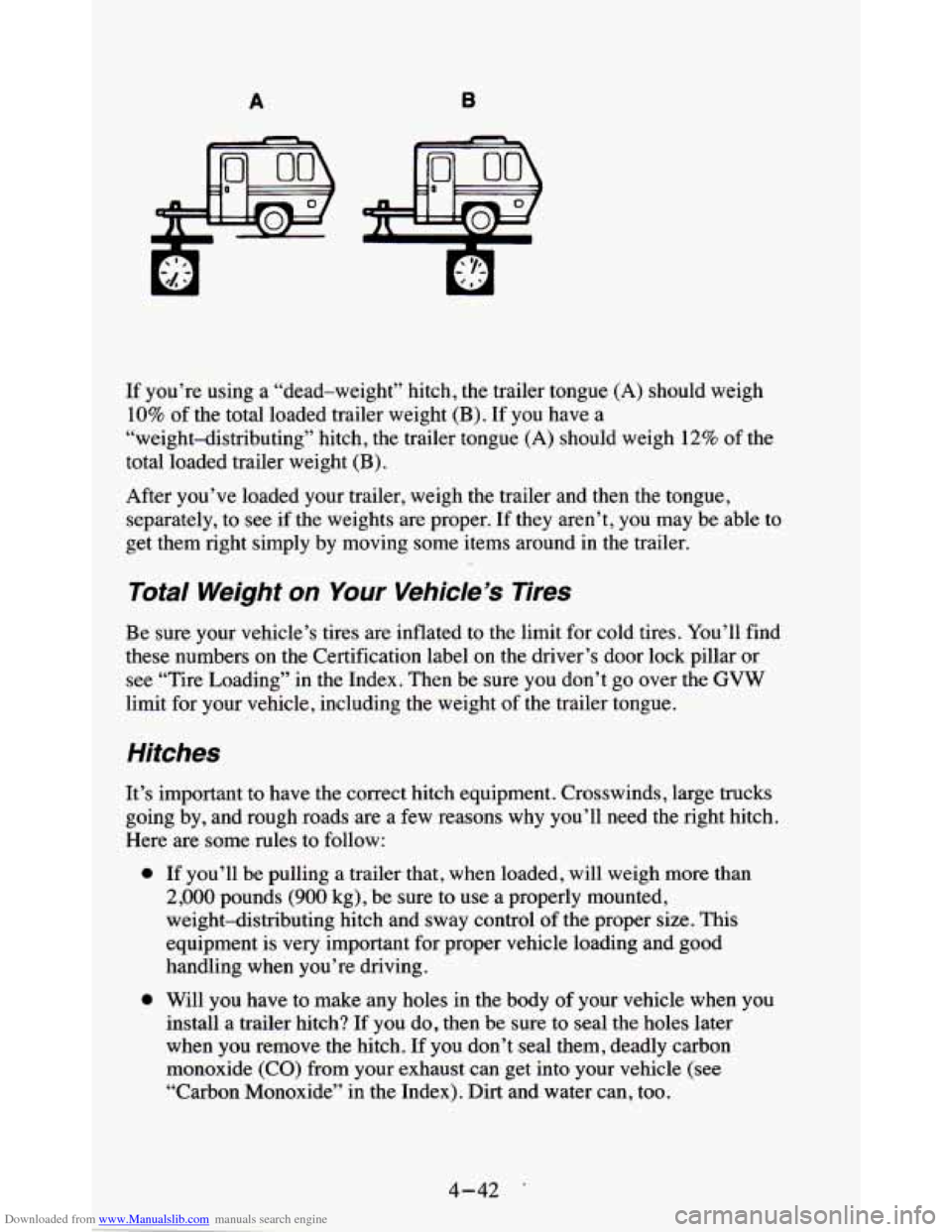
If you’re using a “dead-weight” hitch, the trailer tongue (A) should weigh
10% of the total loaded trailer weight (B). If you have a
“weight-distributing” hitch, the trailer tongue
(A) should weigh 12% of the
total loaded trailer weight (B).
After you’ve loaded your trailer, weigh the trailer and then the tongue,
separately, to see if the weights are proper.
If they aren’t, you may be able to
get them right simply by moving some items around in the trailer.
Total Weight on Your Vehicle’s Tires
Be sure your vehicle’s tires are inflated to the limit for cold tires. You’ll find
these numbers on the Certification label
on the driver’s door lock pillar or
see “Tire Loading” in the Index. Then be sure you don’t go over the
GVW
limit for your vehicle, including the weight of the trailer tongue.
Hitches
It’s important to have the correct hitch equipment. Crosswinds, large trucks
going by, and rough roads are a
few reasons why you’ll need the right hitch.
Here are some rules to follow:
0 If you’ll be pulling a trailer that, when loaded, will weigh more than
2,000 pounds (900 kg), be sure to use a properly mounted,
weight-distributing hitch and sway control of the proper size. This
equipment is very important for proper vehicle loading and good
handling when you’re driving.
0 Will you have to make any holes in the body of your vehicle when you
install
a trailer hitch? If you do, then be sure to seal the holes later
when you remove the hitch. If you don’t seal them, deadly carbon
monoxide
(CO) from your exhaust can get into your vehicle (see
“Carbon Monoxide” in the Index). Dirt and water can, too.
4-42
Page 210 of 380
Downloaded from www.Manualslib.com manuals search engine When your vehicle is being towed, have the ignition key off. The steering
wheel should be clamped in a straight-ahead position with a clamping
device designed for towing service. Do not use the vehicle’s steering
column lock
for this. The transmission (either automatic or manual) should
be
in NEUTRAL (N) and the transfer case (either manual shift or electronic
shift), if you have one, should be in
2HI. The parking brake should be
released.
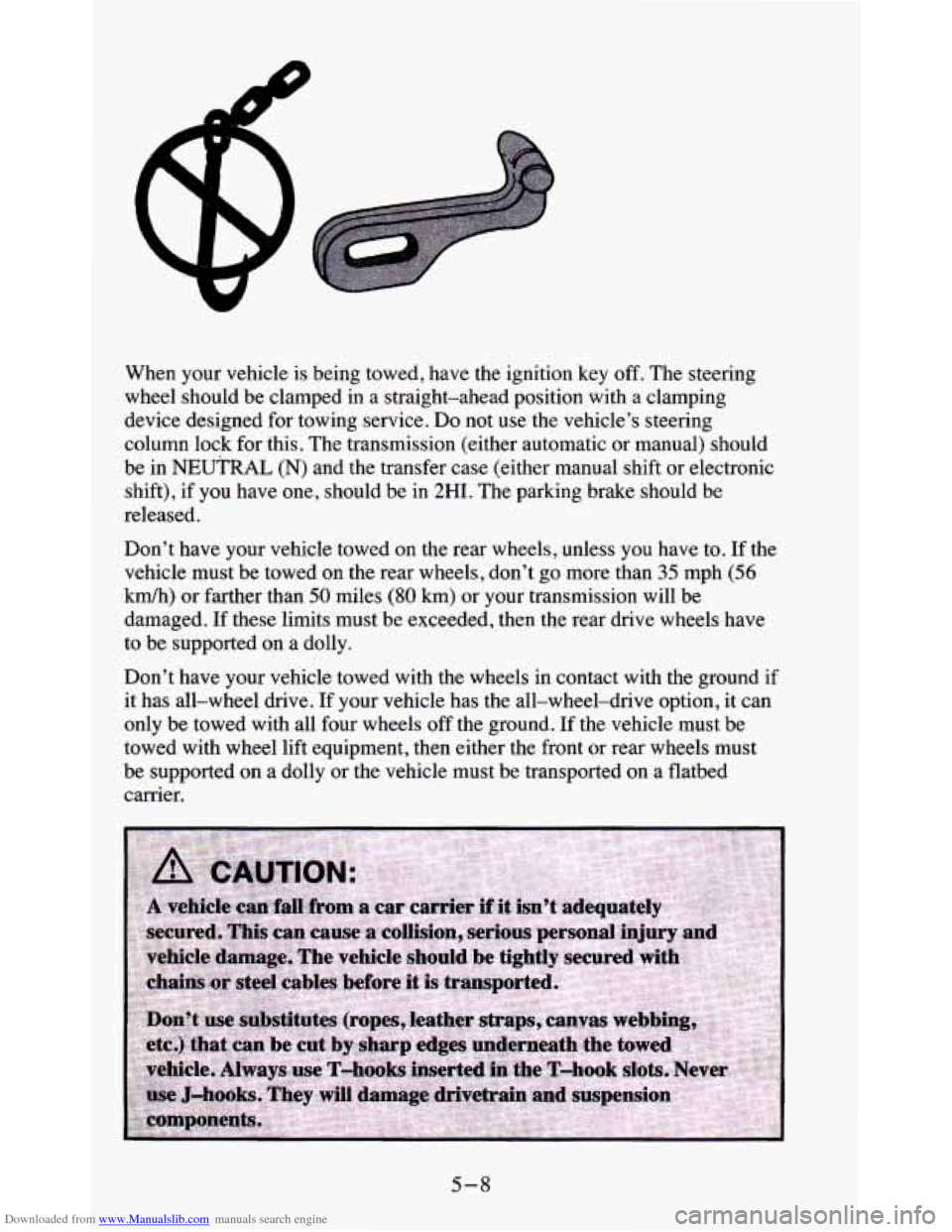
Don’t have your vehicle towed
on the rear wheels, unless you have to. If the
velucle must be towed
on the rear wheels, don’t go more than 35 mph (56
Mh) or farther than 50 miles (80 km) or your transmission will be
damaged. If these limits must be exceeded, then the rear drive wheels have
to be supported on a dolly.
Don’t have your vehicle towed with the wheels in contact with the ground if
it has all-wheel drive. If your vehicle has the all-wheel-drive option,
it can
only be towed with all four wheels off the ground. If the vehicle must be
towed with wheel lift equipment, then either the front or rear wheels must
be supported
on a dolly or the vehicle must be transported on a flatbed
carrier.
5-8
Page 224 of 380
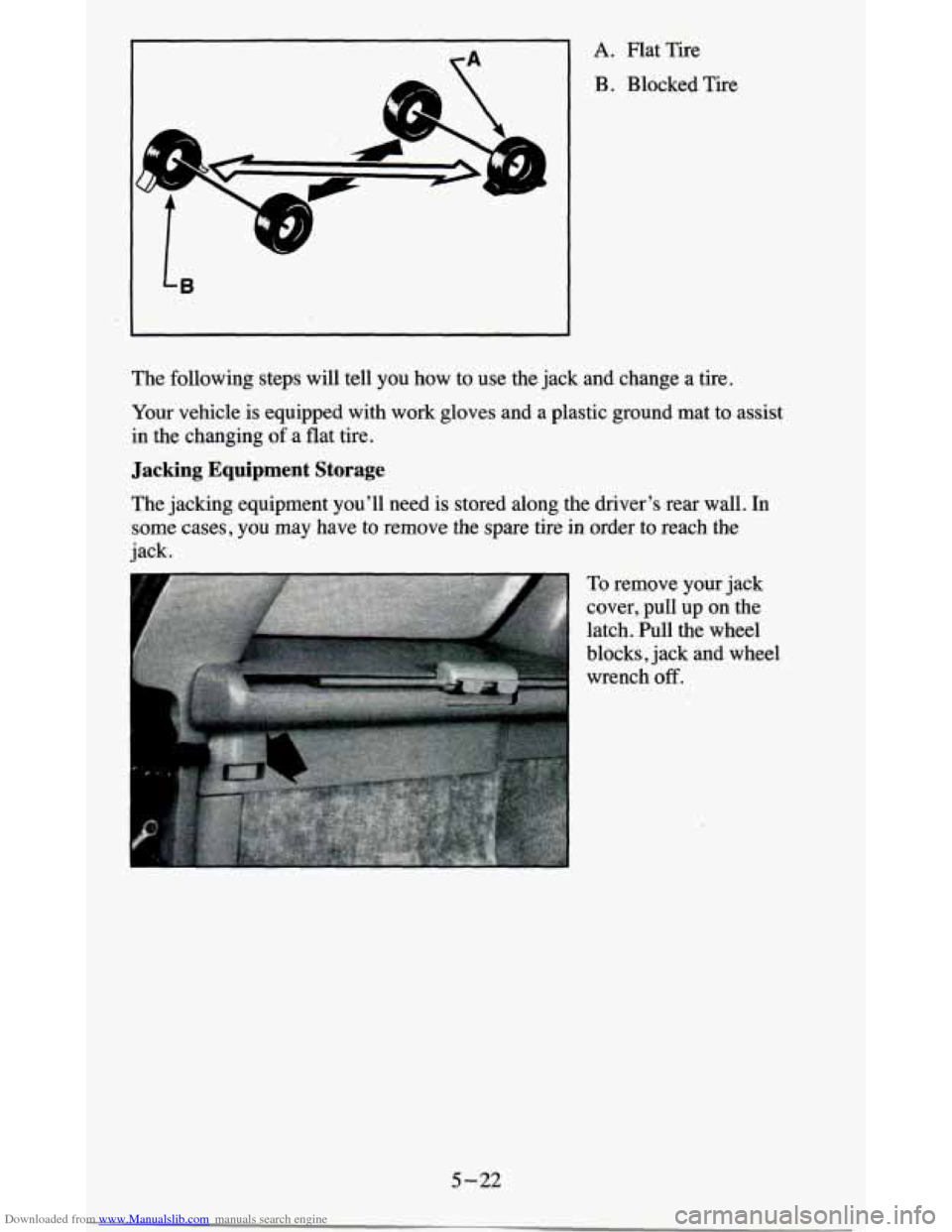
Downloaded from www.Manualslib.com manuals search engine A. Flat Tire
B . Blocked Tire
t
The following steps will tell you how to use the jack and change a tire.
Your vehicle is equipped with work gloves and a plastic ground mat to assist
in the changing of a flat tire.
Jacking Equipment Storage
The jacking equipment you’ll need is stored along the driver’s rear wall. In
some cases,
you may have to remove the spare tire in order to reach the
jack.
To remove your jack
cover, pull
up on the
latch. Pull the wheel
blocks, jack and wheel
wrench
off.
5-22
Page 225 of 380
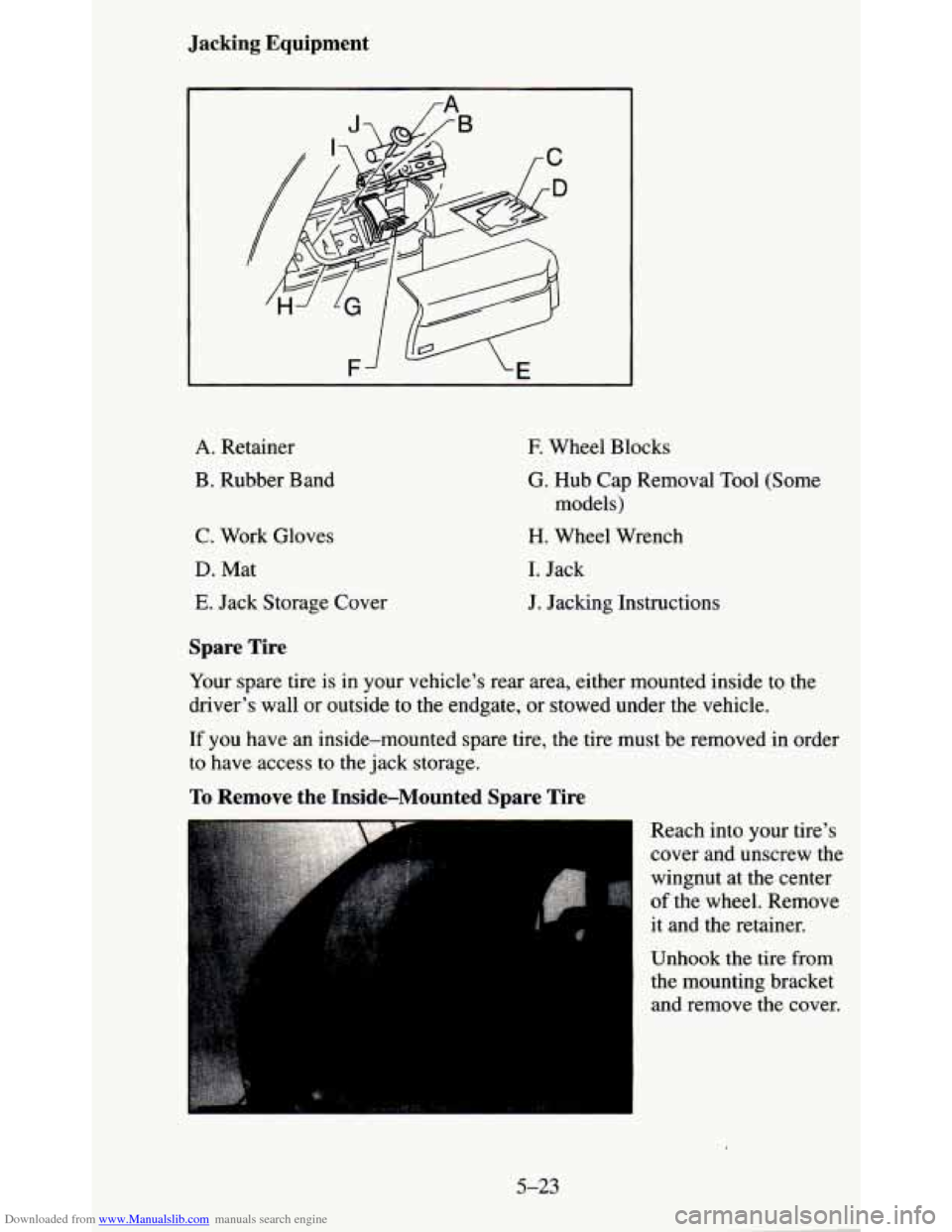
Downloaded from www.Manualslib.com manuals search engine Jacking Equipment
rA
A. Retainer
B. Rubber Band
C. Work Gloves
D. Mat
E. Jack Storage Cover
E Wheel Blocks
G. Hub Cap Removal Tool (Some
H. Wheel Wrench
I. Jack models)
J. Jacking Instructions
Spare Tire
Your spare tire is in your vehicle's rear area, either mounted inside to the
driver's wall or outside to the endgate, or stowed under the vehicle.
If you have an inside-mounted spare tire, the tire must be removed in order
to have access to the jack storage.
To Remove the Inside-Mounted Spare Tire
Reach into your tire's
cover and unscrew the
wingnut at the center
of the wheel. Remove
it and the retainer.
Unhook the tire from
the mounting bracket and remove the cover.
5-23
Page 226 of 380
Downloaded from www.Manualslib.com manuals search engine To Remove the Rear-Mounted Spare Tire
Make sure the carrier arm is fully latched to the endgate. Remove the tire's
cover.
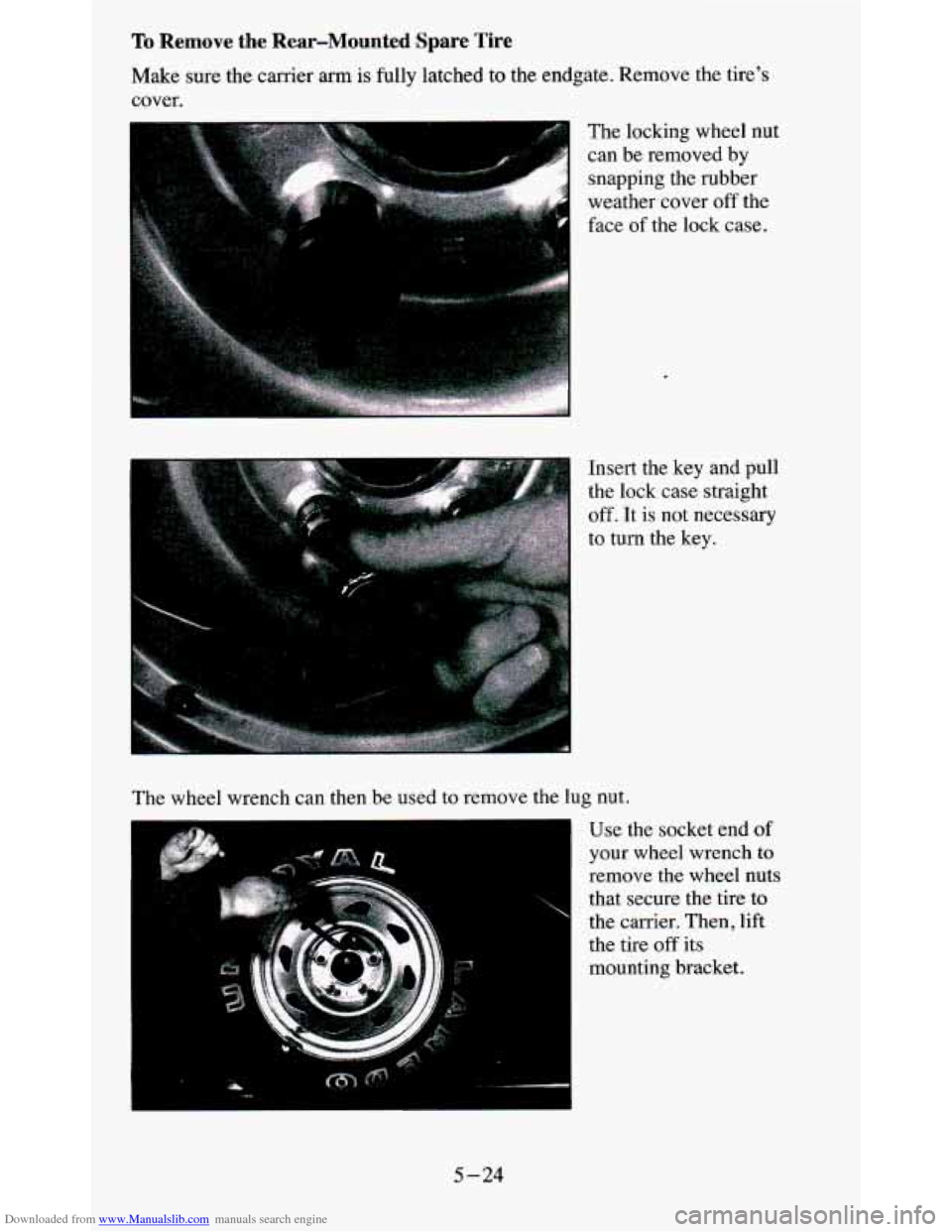
The locking wheel nut
can be removed by snapping the rubber
weather cover off the
face
of the lock case.
Insert the key and pull
the lock case straight
off. It is not necessary
to turn the key.
The wheel wrench can then be used to remove the lug nut.
"
Use the socket end of
your wheel wrench to
remove the wheel nuts
that secure the tire
to
the carrier. Then, lift
the tire
off its
mounting bracket.
5-24
Page 227 of 380
Downloaded from www.Manualslib.com manuals search engine To Remove the Underbody-Mounted Spare Tire (&Door Only)
NOTICE:
Never remove or restow a tire frodto a stowage position under
the vehicle while the vehicle is supported by a jack. Always
tighten the tire fully against the underside
of the vehicle when
restowing.
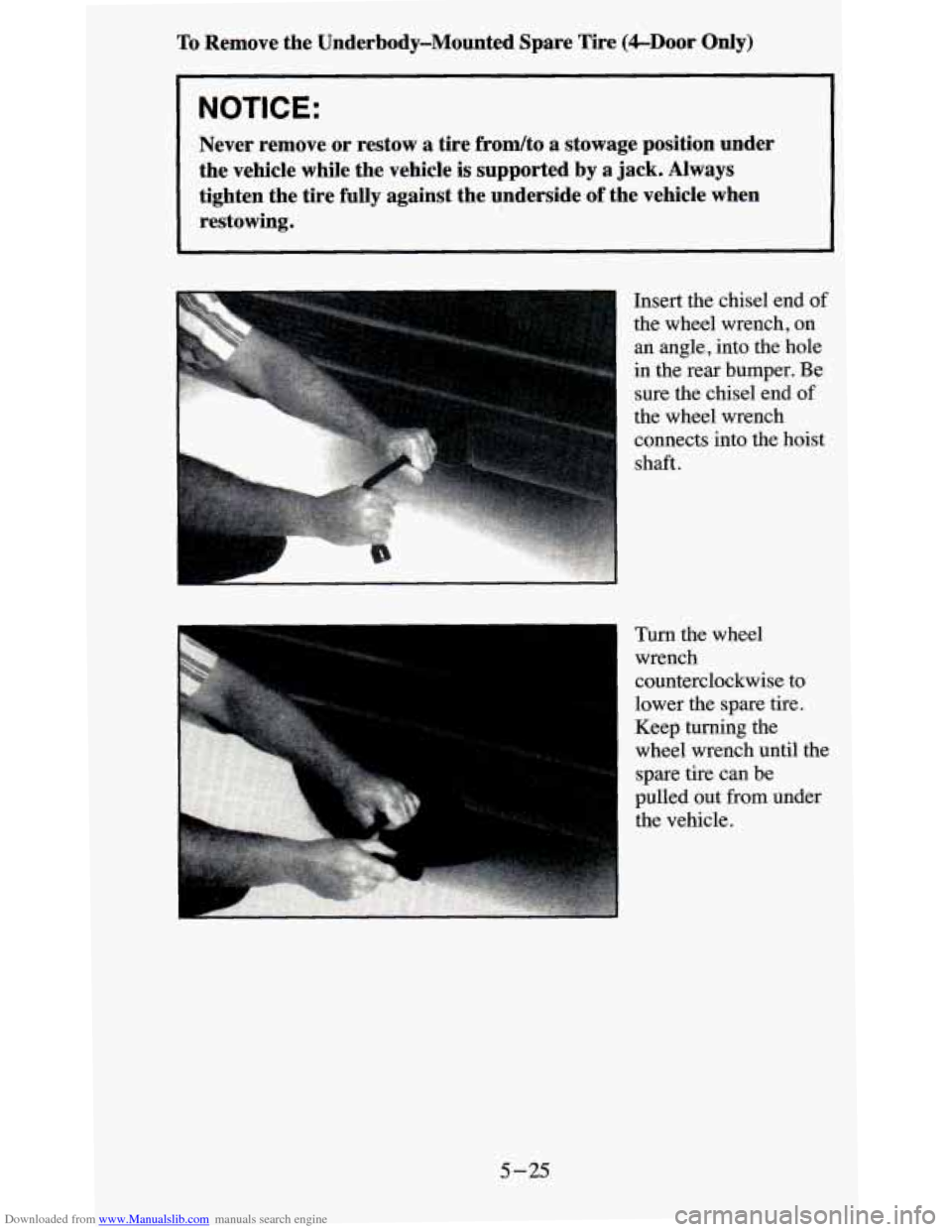
Insert the chisel end of
the wheel wrench, on
an angle, into the hole
in the rear bumper. Be
sure the chisel end
of
the wheel wrench
connects into the hoist
shaft.
Turn the wheel wrench
counterclockwise to
lower the spare tire.
i Keep turning the
wheel wrench until the
spare tire can be
pulled out from under
the vehicle.
5-25
Page 229 of 380
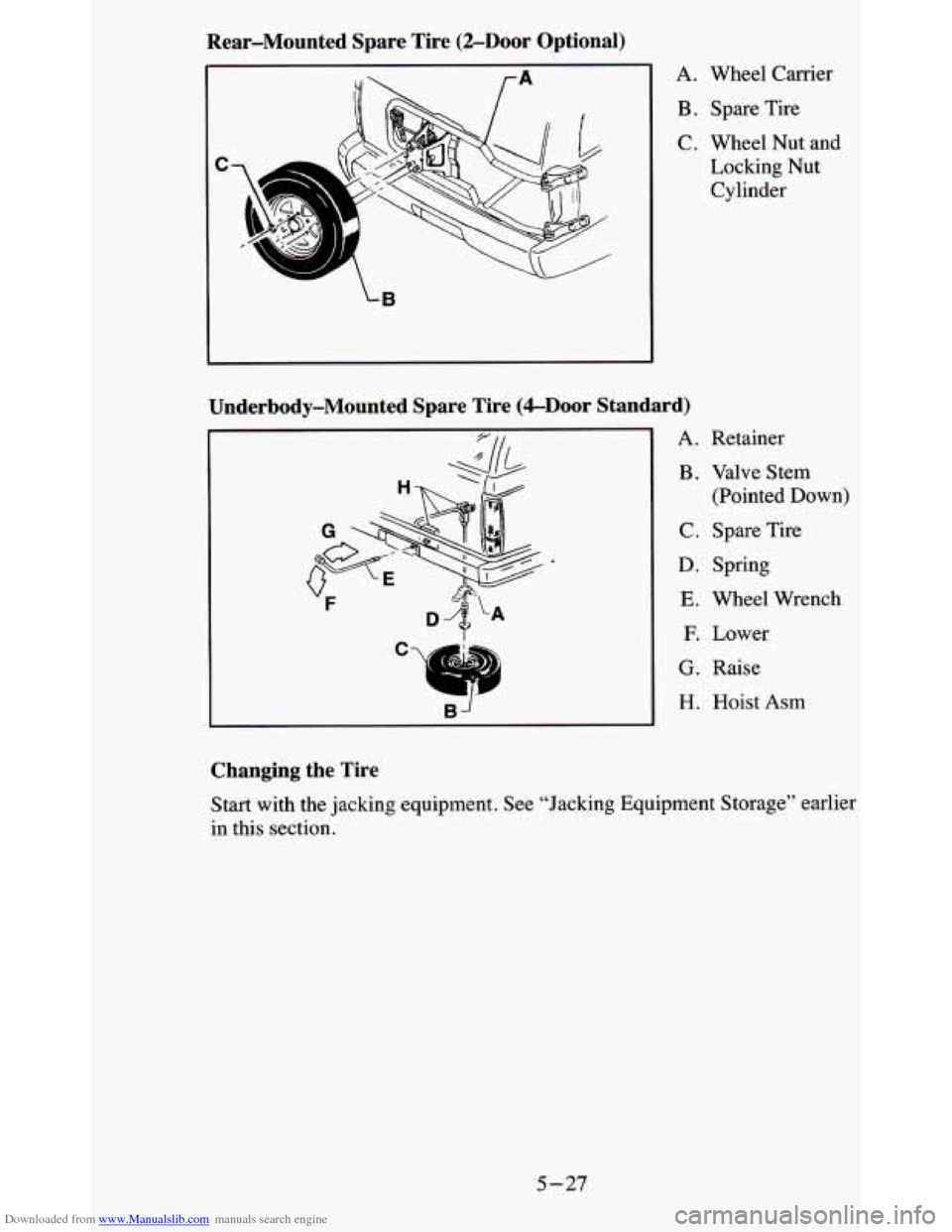
Downloaded from www.Manualslib.com manuals search engine Rear-Mounted Spare Tire (%Door Optional)
A. Wheel Carrier
B. Spare Tire
C. Wheel Nut and
Locking Nut
Cylinder
Underbody-Mounted Spare Tire (&Door Standard)
A. Retainer
B . Valve Stem
(Pointed Down)
C. Spare Tire
D. Spring
E. Wheel Wrench
F. Lower
G. Raise
H. Hoist Asm
Changing the Tire
Start with the jacking equipment. See “Jacking Equipment Storage” earlier
in this section.
5-27