Page 210 of 380
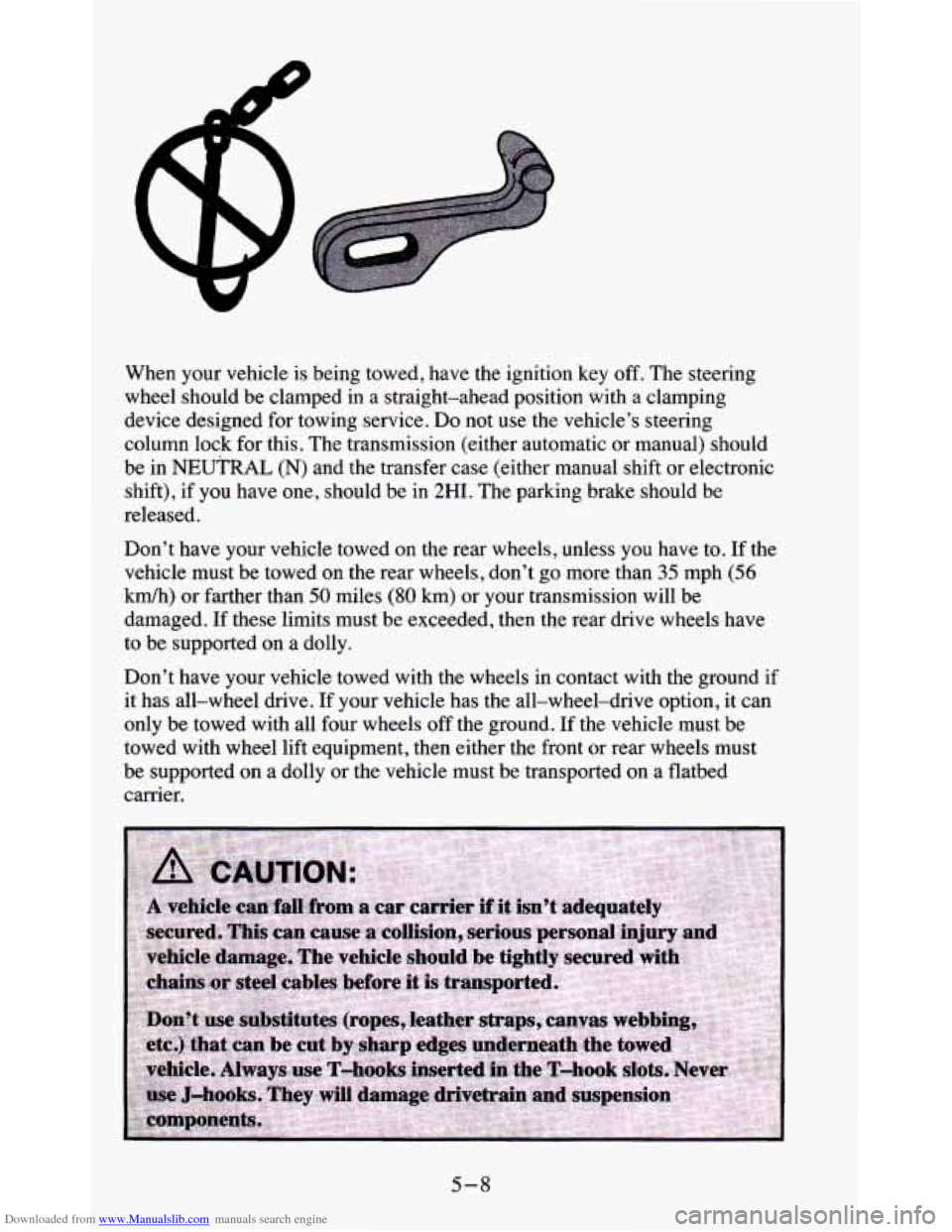
Downloaded from www.Manualslib.com manuals search engine When your vehicle is being towed, have the ignition key off. The steering
wheel should be clamped in a straight-ahead position with a clamping
device designed for towing service. Do not use the vehicle’s steering
column lock
for this. The transmission (either automatic or manual) should
be
in NEUTRAL (N) and the transfer case (either manual shift or electronic
shift), if you have one, should be in
2HI. The parking brake should be
released.
Don’t have your vehicle towed
on the rear wheels, unless you have to. If the
velucle must be towed
on the rear wheels, don’t go more than 35 mph (56
Mh) or farther than 50 miles (80 km) or your transmission will be
damaged. If these limits must be exceeded, then the rear drive wheels have
to be supported on a dolly.
Don’t have your vehicle towed with the wheels in contact with the ground if
it has all-wheel drive. If your vehicle has the all-wheel-drive option,
it can
only be towed with all four wheels off the ground. If the vehicle must be
towed with wheel lift equipment, then either the front or rear wheels must
be supported
on a dolly or the vehicle must be transported on a flatbed
carrier.
5-8
Page 211 of 380
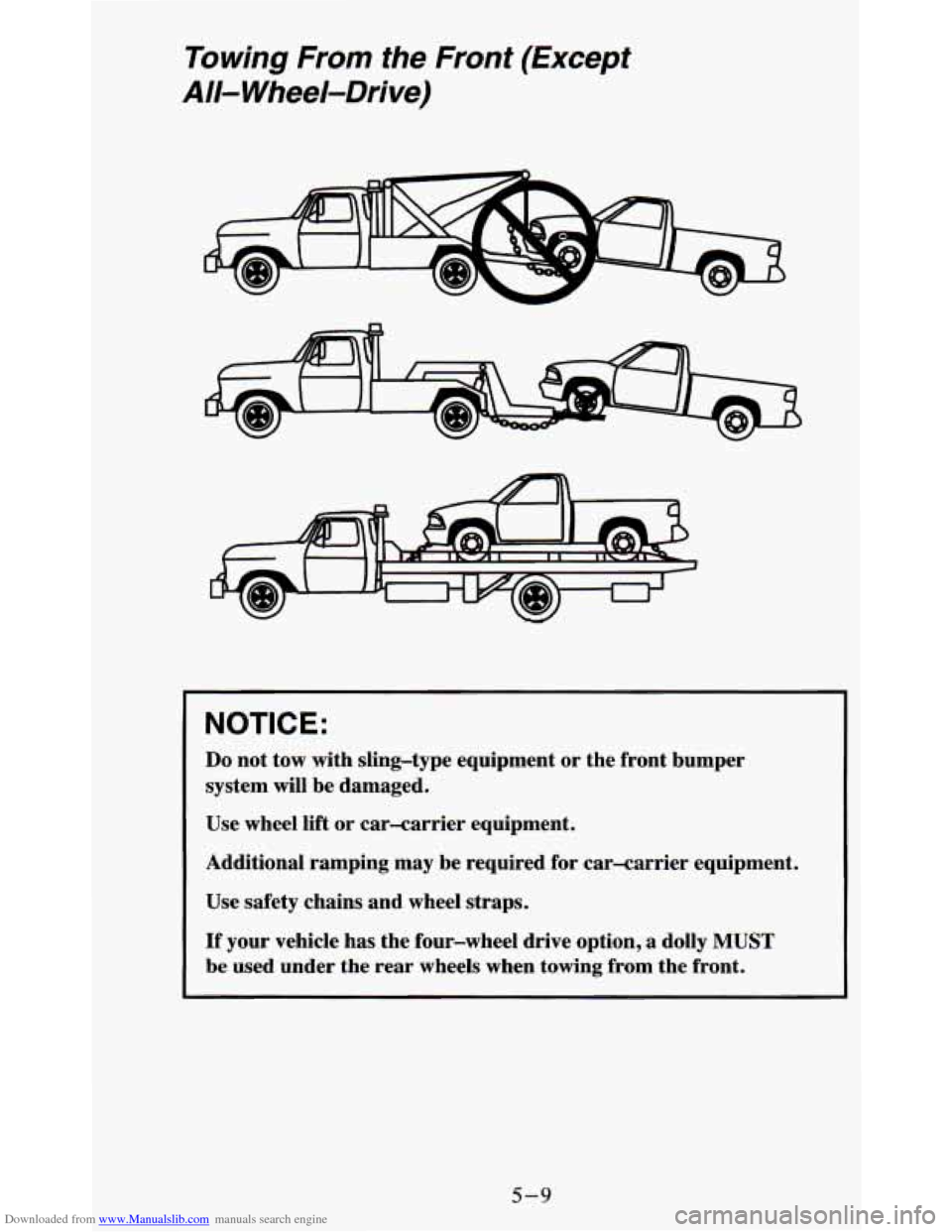
Downloaded from www.Manualslib.com manuals search engine Towing From the Front (Except
All- Wheel-Drive)
NOTICE:
Do not tow with sling-type equipment or the front bumper
system will be damaged.
Use wheel lift or car-carrier equipment.
Additional ramping may be required for car-carrier equipment.
Use safety chains and wheel straps.
If your vehicle has the four-wheel drive option, a dolly MUST
be used under the rear wheels when towing from the front.
5-9
Page 212 of 380
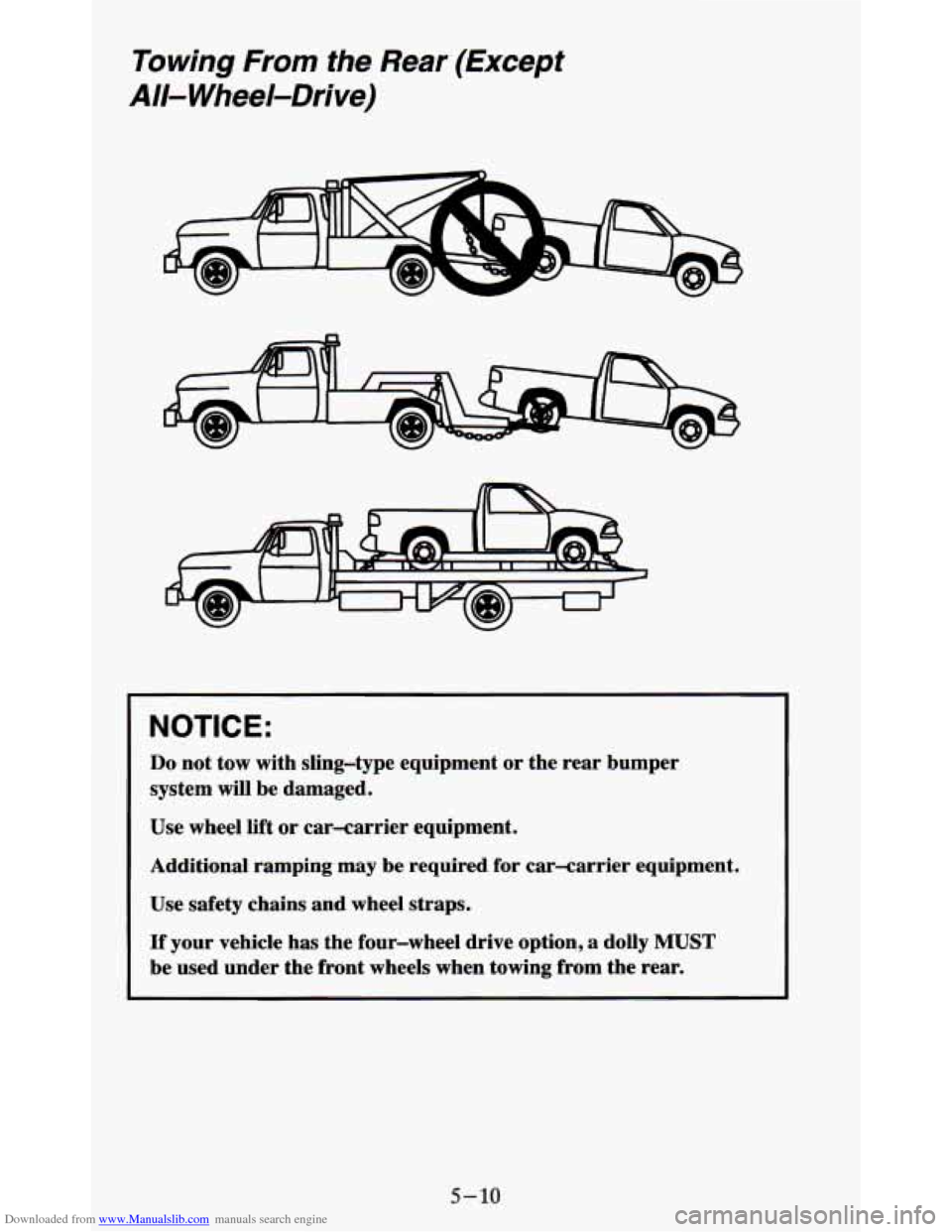
Downloaded from www.Manualslib.com manuals search engine Towing From the Rear (Except
A//' Wheel-Drive)
NOTICE:
Do not tow with sling-type equipment or the rear bumper
system will be damaged.
Use wheel
lift or car-carrier equipment.
Additional ramping may
be required for car-carrier equipment.
Use safety chains and wheel straps.
If your vehicle has the four-wheel drive option, a dolly MUST
be used under the front wheels when towing from the rear.
5-10
Page 213 of 380
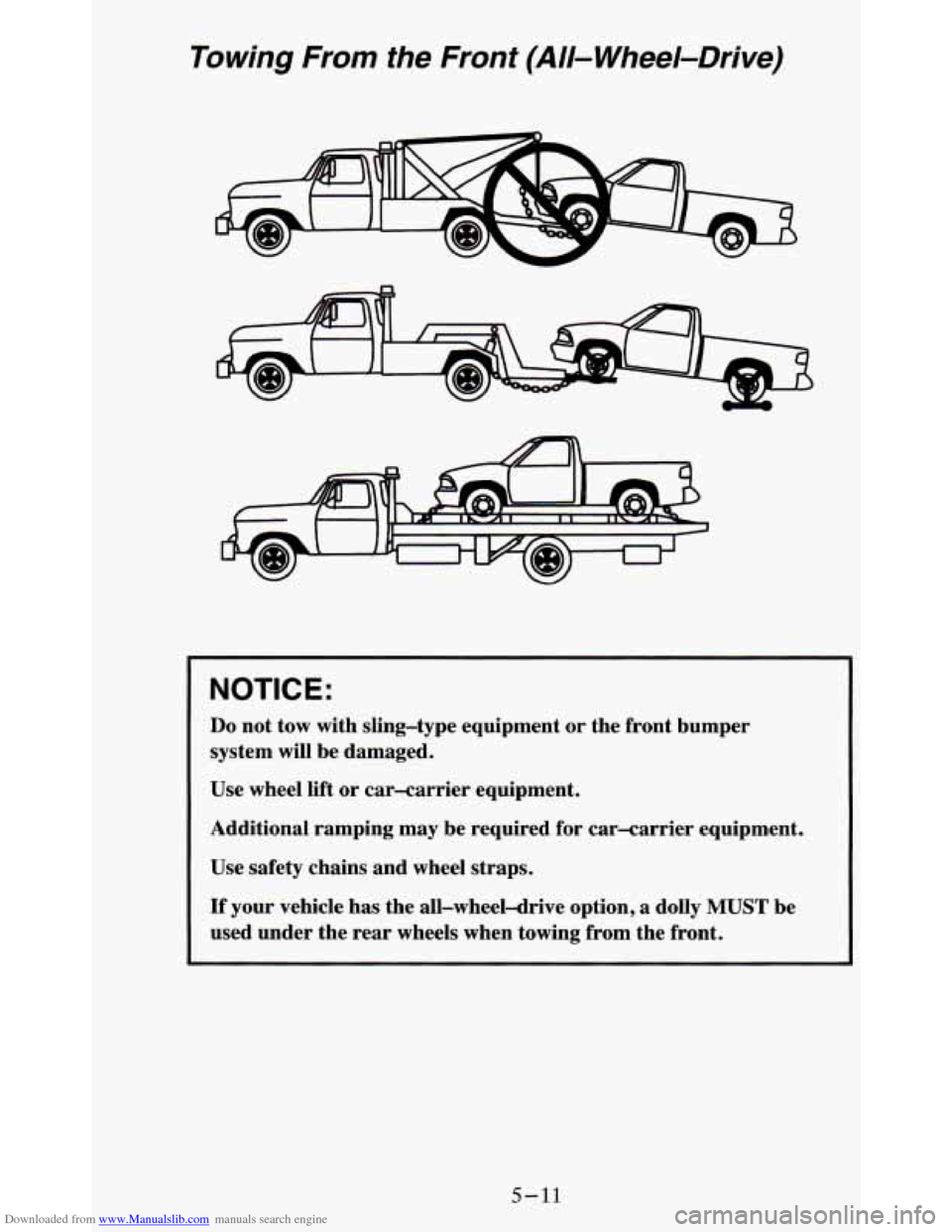
Downloaded from www.Manualslib.com manuals search engine Towing From the Front (All- Wheel-Drive)
NOTICE:
Do not tow with sling-type equipment or the front bumper
system will be damaged.
Use wheel lift or car-carrier equipment.
Additional ramping may be required for car-carrier equipment.
Use safety chains and wheel straps.
If your vehicle has the all-wheel-drive option, a dolly MUST be
used under the rear wheels when towing from the front.
5-11
Page 214 of 380
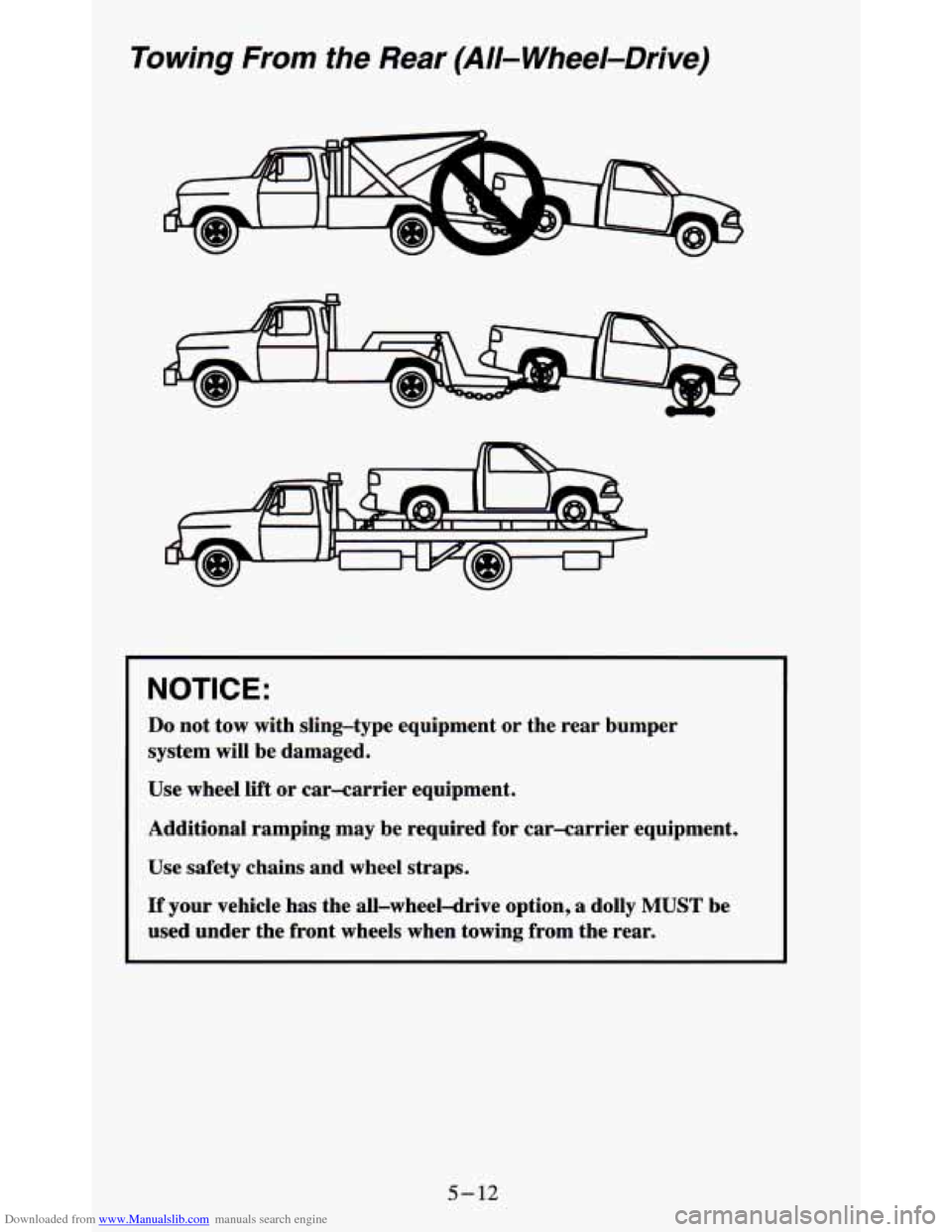
Downloaded from www.Manualslib.com manuals search engine Towing From the Rear (All- Wheel-Drive)
NOTICE:
Do not tow with sling-type equipment or the rear bumper
system will be damaged.
Use wheel lift or car-carrier equipment.
Additional ramping may be required for car-carrier equipment.
Use safety chains and wheel straps.
If your vehicle has the all-wheel-drive option, a dolly MUST be
used under the front wheels when towing from the rear.
5-12
Page 227 of 380
Downloaded from www.Manualslib.com manuals search engine To Remove the Underbody-Mounted Spare Tire (&Door Only)
NOTICE:
Never remove or restow a tire frodto a stowage position under
the vehicle while the vehicle is supported by a jack. Always
tighten the tire fully against the underside
of the vehicle when
restowing.
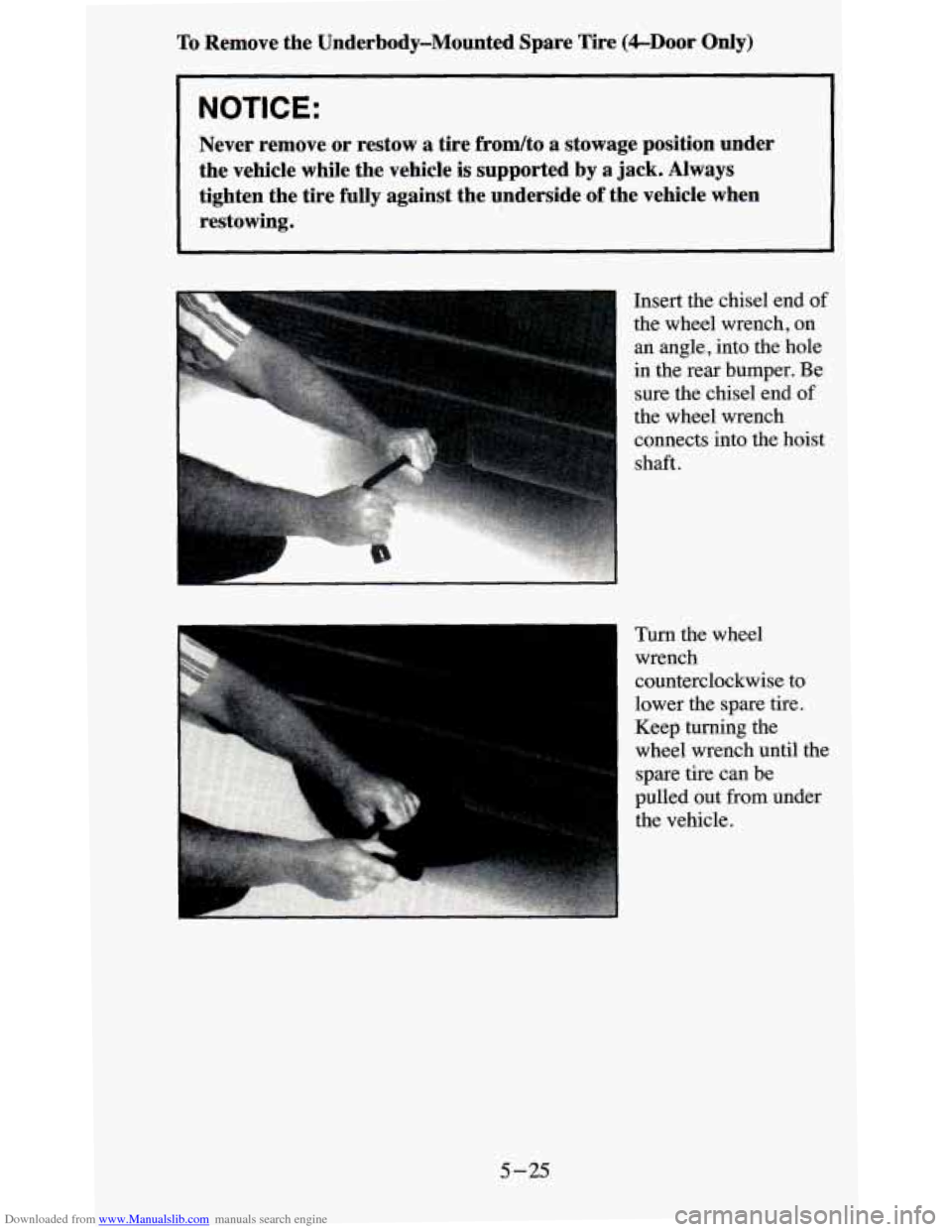
Insert the chisel end of
the wheel wrench, on
an angle, into the hole
in the rear bumper. Be
sure the chisel end
of
the wheel wrench
connects into the hoist
shaft.
Turn the wheel wrench
counterclockwise to
lower the spare tire.
i Keep turning the
wheel wrench until the
spare tire can be
pulled out from under
the vehicle.
5-25
Page 238 of 380

Downloaded from www.Manualslib.com manuals search engine NOTICE:
Spinning your wheels can destroy parts of your vehicle as well\
as
the tires. If
you spin the wheels too fast while shifting your
transmission back
and forth, you can destroy your transmission.
For information about using tire chains on your vehicle, see “Tire Chains”
in the Index.
Rocking your vehicle to get it out:
First, turn your steering wheel left and right. That will clear the area around
your front wheels. Then shift back and forth between REVERSE (R) and a \
forward gear (or with
a manual transmission, between FIRST (1) or
SECOND
(2) gear and REVERSE), spinning the wheels as little as possible.
Release the accelerator pedal while you shift, and press lightly on the
accelerator pedal when the transmission is in gear. If that doesn’t get you
out after
a few tries, you may need to be towed out. Or, you can use your
recovery hooks, if your vehicle has them. If you do need to be towed out,
see “Towing Your Vehicle” in the Index.
Using the Recovery Hooks
I
Your vehicle may be equipped with recovery hooks. The recovery hooks\
are
provided at the front
of your vehicle. You may need to use them if you’re
stuck off-road and need
to be pulled to some place where you can continue
driving.
5-36
Page 242 of 380
Downloaded from www.Manualslib.com manuals search engine Doing Your Own Service Work
If you want to do some of your own service work, you’ll want to get the
proper
GM Service Manual. It tells you much more about how to service
your vehicle than this manual can.
To order the proper service manual, see
“Service Publications” in the Index.
You should keep a record with all parts receipts and list the mileage and the
date
of any service work you perform. See “Maintenance Record” in the
Index.
I NOTICE:
If you try to do your own service work without knowing enough
about it, your vehicle could be damaged.
Fuel
Use regular unleaded gasoline rated at 87 octane or higher. Use premium
unleaded gasoline rated at 91 octane or higher for high power performance,
when towing a trailer or with a high payload requirement.
But when
operating with a light load as a normal condition, you may use middle grade
or regular unleaded gasolines.
6-2 0