1995 CHEVROLET BLAZER engine overheat
[x] Cancel search: engine overheatPage 215 of 380

Downloaded from www.Manualslib.com manuals search engine Engine Overheating
You will find a coolant temperature gage on your vehicle’s instr\
ument
panel.
If Steam Is Coming From Your Engine
NOTICE:
If your engine catches fire because you keep driving with no
coolant, your vehicle can be badly damaged. The costly repairs
would not be covered by your warranty.
5-13
Page 216 of 380
Downloaded from www.Manualslib.com manuals search engine If No Steam IS Coming From Your Engine
If you get the overheat warning but see or hear no steam, the problem may
not be too serious. Sometimes the engine can get a little too hot when you:
0 Climb a long hill on a hot day.
0 Stop after high speed driving.
0 Idle for long periods in traffic.
e Tow a trailer. See "Driving on Grades" in the Index.
If
YOU get the overheat warning with no sign of steam, try this for a minute
or
so:
1. Turn off your air conditioner.
2. Turn on your heater to full hot at the highest fan speed and open the
window as necessary.
3. If you're in a traffic jam, shift to NEUTRAL (N); otherwise, shift to the
highest gear while driving
- AUTOMATIC OVERDRIVE (@) or
DRIVE (D) for automatic transmissions.
If you no longer have the overheat warning, you can drive. Just \
to be safe,
drive slower for about ten minutes.
If the warning doesn't come back on,
you
can drive normally.
If the warning continues, pull over, stop, and park your vehicle \
right away.
If there's still no sign of steam, push the accelerator until the engine speed is
about twice as fast
as normal idle speed. Bring the engine speed back to
normal idle speed after two or three minutes. Now
see if the warning stops.
But then, if you still have the warning,
turn oflthe engine and get everyone
out
of the vehicle until it cools down.
You may decide not to lift the hood but to get service help right away.
ici
5-14
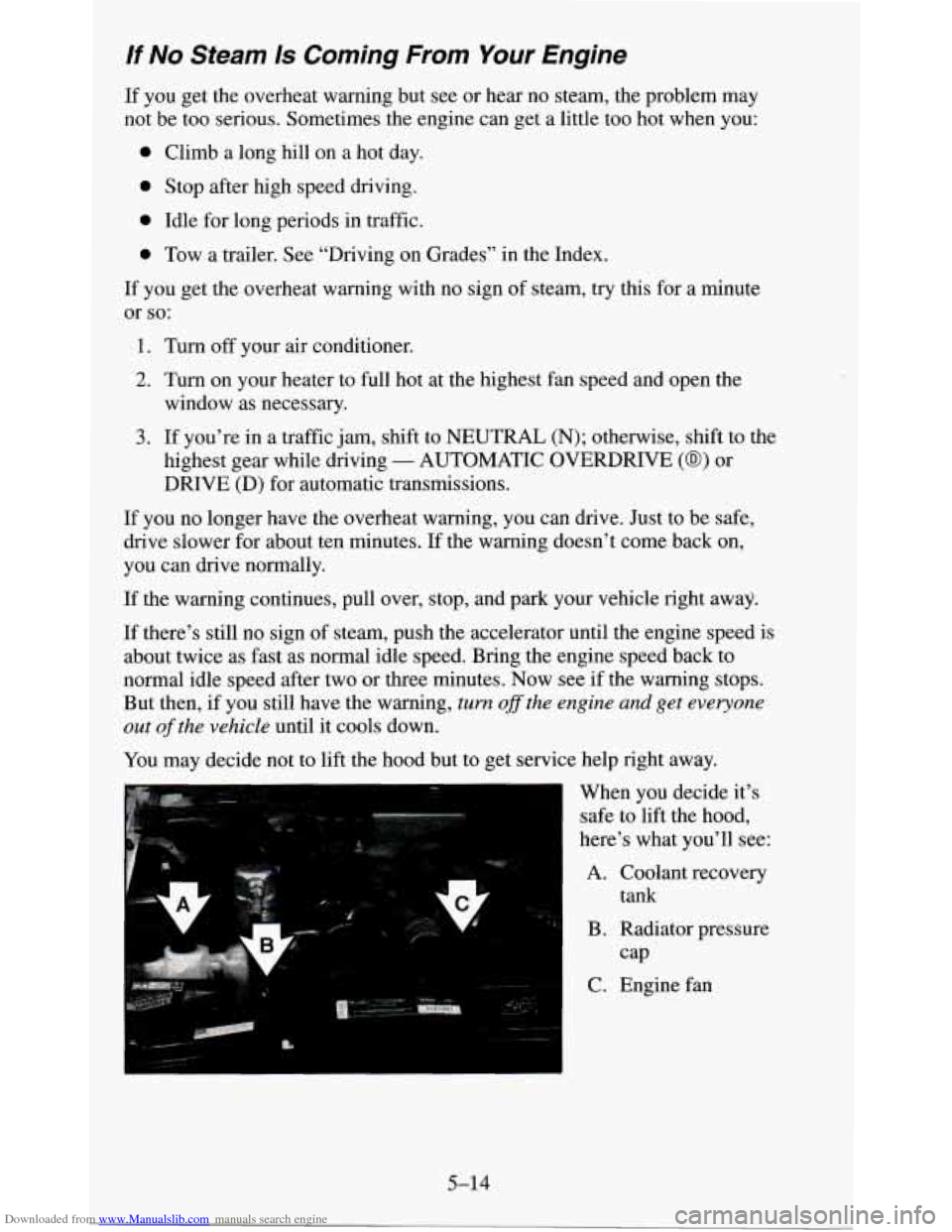
When you decide it's
safe to lift the hood,
here's what you'll
see:
A. Coolant recovery
B. Radiator pressure C. Engine fan tank
cap
Page 219 of 380
Downloaded from www.Manualslib.com manuals search engine When the coolant in the coolant recovery tank is at ADD, start your vehicle.
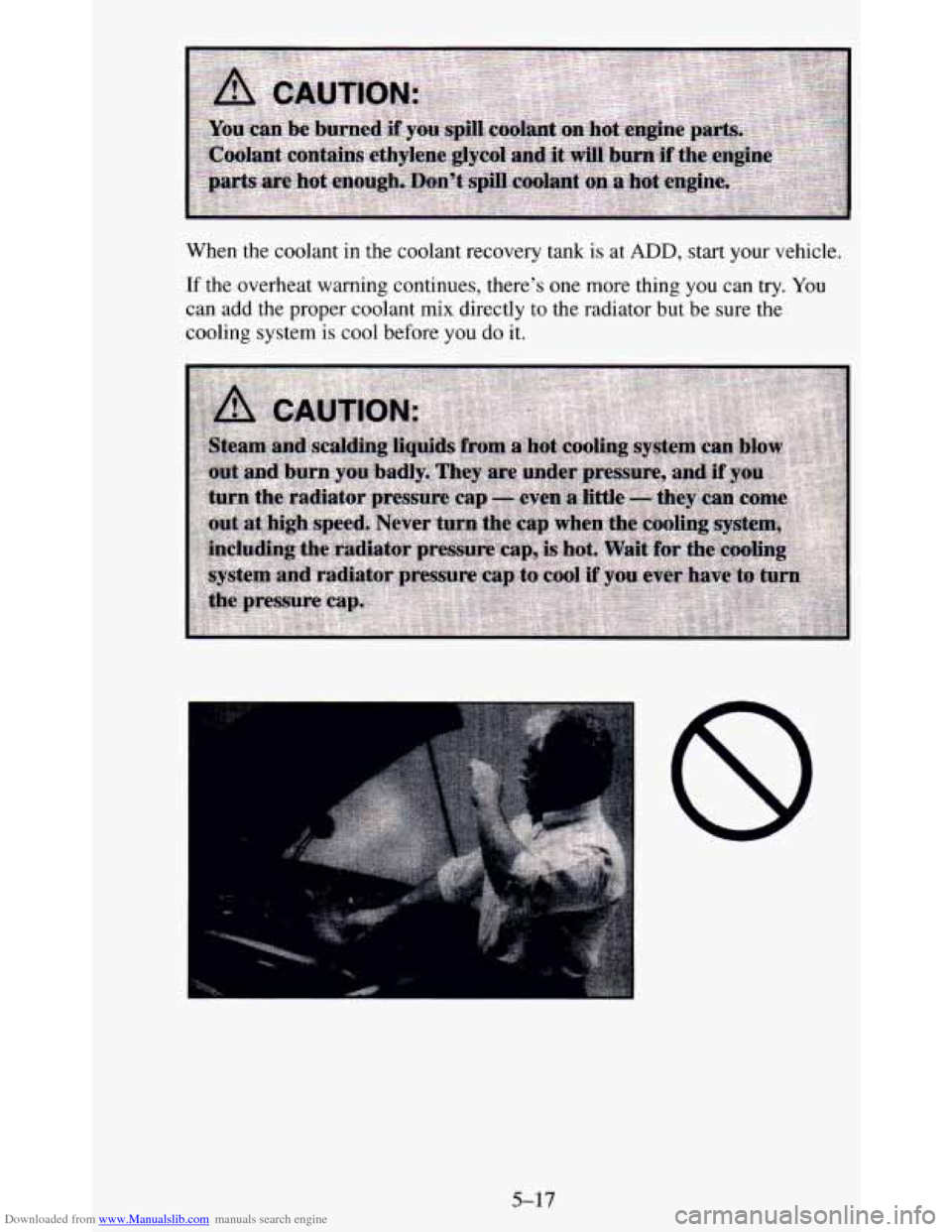
If the overheat warning continues, there’s one more thing you can try. You
can add the proper coolant mix directly to the radiator but be sure the
cooling system
is cool before you do it.
5-17
Page 261 of 380
Downloaded from www.Manualslib.com manuals search engine How to Check Lubricant
,:
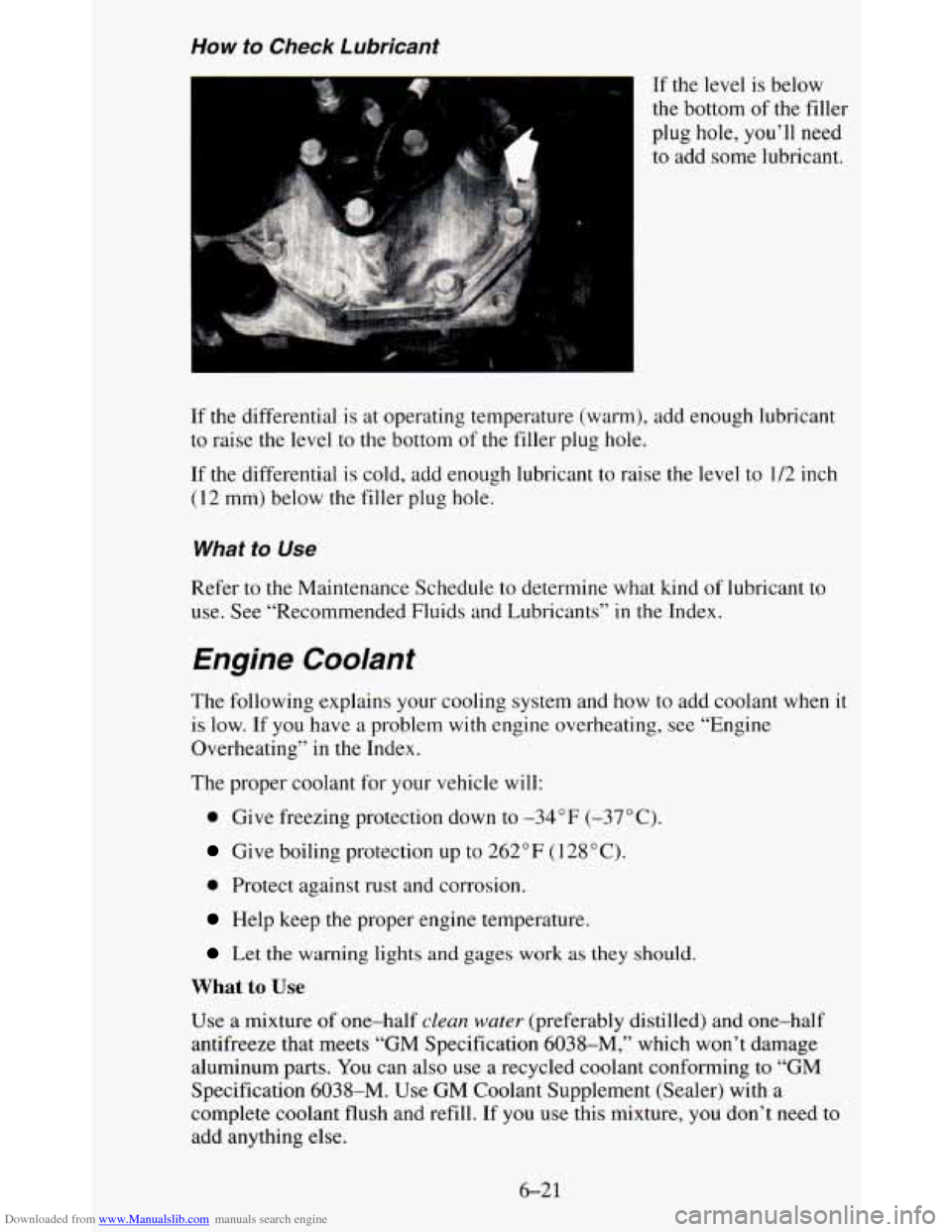
If the level is below
the bottom
of the filler
plug hole, you’ll need
to add some lubricant.
If the differential
is at operating temperature (warm), add enough lubricant
to raise the level to the bottom of the filler plug hole.
If the differential is cold, add enough lubricant to raise the le\
vel to 1/2 inch
(12 mm) below the filler plug hole.
What to Use
Refer to the Maintenance Schedule to determine what kind of lubricant to
use. See “Recommended Fluids and Lubricants”
in the Index.
Engine Coolant
The following explains your cooling system and how to add coolant \
when it
is low. If you have a problem with engine overheating, see “Engine
Overheating”
in the Index.
The proper coolant
for your vehicle will:
0 Give freezing protection down to -34°F (-37°C).
Give boiling protection up to 262°F (128°C).
0 Protect against rust and corrosion.
Help keep the proper engine temperature.
Let the warning lights and gages work as they should.
What to Use
Use a mixture of one-half clean water (preferably distilled) and one-half
antifreeze that meets “GM Specification 6038-M,” which won’t damage
aluminum parts.
You can also use a recycled coolant conforming to “GM
Specification 6038-M.
Use GM Coolant Supplement (Sealer) with a
complete coolant flush and refill. If
you use this mixture, you don’t need to
add anything else.
6-21
Page 262 of 380
Downloaded from www.Manualslib.com manuals search engine NOTICE:
If you use an improper coolant mix, your engine could overheat
and be badly damaged. The repair cost wouldn’t be covered
by
your warranty. Too much water in the mix can freeze and crack
the engine, radiator, heater core and other parts.
Some conditions, such as air trapped in the cooling system, can affect the
coolant level in the radiator. Check the coolant level when the engine is cold
and follow the steps under “Adding Coolant” for the proper way to add
coolant.
If you have to add coolant more than four times a year, have your dealer
check your cooling system.
NOTICE:
If you use the proper coolant, you don’t have to add extra
inhibitors or additives which claim
to improve the system. These
can be harmful.
6-22
Page 264 of 380
Downloaded from www.Manualslib.com manuals search engine Radiator Pressure Cap
NOTICE:
Your radiator cap is a 15 psi (105 kPa) pressure-type cap and
must be tightly installed to prevent coolant loss and possible \
engine damage from overheating. Be sure the arrows on the cap \
line up with the overflow tube on the radiator filler neck.
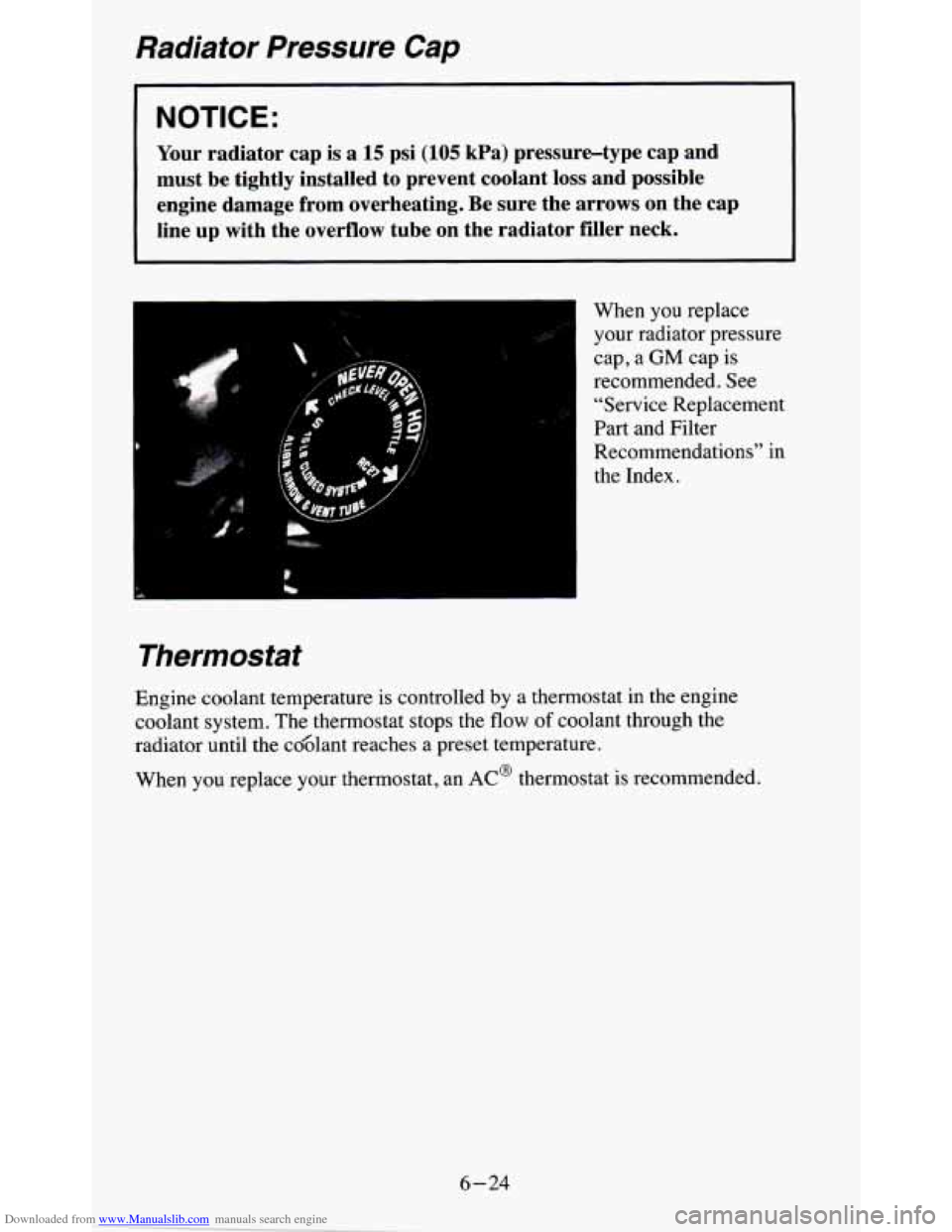
When you replace your radiator pressure
cap, a
GM cap is
recommended. See
“Service Replacement
Part and Filter
Recommendations” in
the Index.
Thermostat
Engine coolant temperature is controlled by a thermostat in the engine
coolant system. The thermostat stops the
flow of coolant through the
radiator until the co6lant reaches a preset temperature.
When you replace your thermostat, an
AC@ thermostat is recommended.
6-24
Page 301 of 380
Downloaded from www.Manualslib.com manuals search engine Headlamps
The headlamp wiring is protected by a circuit breaker in the light switch. An
electrical overload will cause the lights to go on and off, or in some cases to
remain
off. If this happens, have your headlamp wiring checked right away.
Windshield Wipers
The windshield wiper motor is protected by a circuit breaker and a fuse. If
the motor overheats due to heavy snow, etc., the wiper will stop until the
motor cools. If the overload is caused by some electrical problem and not
snow, etc., be sure to get it fixed.
Power Windows and Other Power Options
Circuit breakers in the fuse panel protect the power windows and other
power accessories. When the current load is too heavy, the cir\
cuit breaker
opens and closes, protecting the circuit until the problem is fixed.
Trailer Wiring Harness
The optional seven-wire trailer wiring harness is protected by an in-line
fuse in the battery feed wire. This fuse is near the junction block in the
front, driver’s side fender. See “Trailer Wiring Harness” in the
Features &
Controls section.
Fuse B/ock
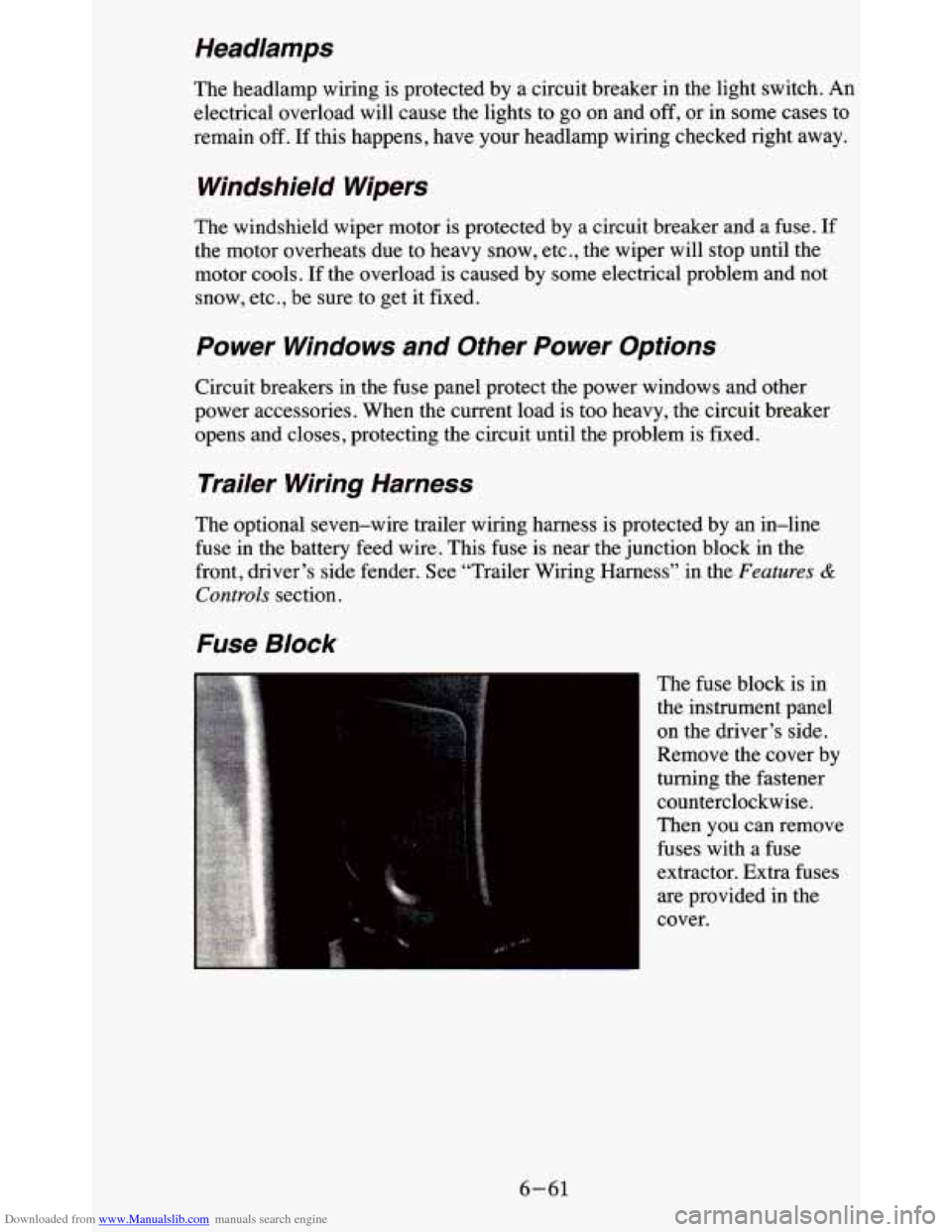
The fuse block is in
the instrument panel
on the driver’s side.
Remove the cover by
turning the fastener
counterclockwise.
Then you can remove
fuses with a fuse
extractor. Extra fuses
are provided in the
cover.
6-61
Page 372 of 380
Downloaded from www.Manualslib.com manuals search engine Engine (continued) FanNoise
................................................... 5-20
Identification
....................................... 6-58.6-59. 6-62
Oil (See “Oil”)
.l
RunningWhileParked ......................................... 2-28
Starting
..................................................... 2-16
Exhaust System
.................................................. 6-40
Overheating .................................................. 5-13
F .
Filter Replacement Chart (See “Service-Replacement Parts and Filter
Recommendations”)
FluidLeakCheck
................................................ 6-31
Fluids (See “Recommended Fluids and Lubricants”)
Four-wheel Drive
.......................................... 2.30. 6-20
Manual Transfer Case
.......................................... 2-30
Electronic Transfer Case
........................................ 2-32
Fuel
. FillingYourTank .............................................. 6-5
Foreign Countries .............................................. 64
Gage (See “Gages”)
Gasolines for Cleaner Air
....................................... :6-4
Tank Capacity ................................................. 6-63
Fuses and Circuit Breakers
................................... 6-60, 6-66
FuseBlock .................................................. 6-61
G
Gages Engine Coolant Temperature Gage
................................ 2-77
Oil Pressure Gage
............................................. 2-77
Trip Odometer
................................................ 247
FuelGage
................................................... 2-78
Odometer
................................................... 2-66
Speedometer
................................................. 2-66
Tachometer
.................................................. 2-67
Voltmeter
.................................................... 2-79
H
Halogen Bulbs (See “Bulb Replacement”)
Head Restraints (See “Seats”) Headlamps Hazard Wqing Flashers
........................................... 5-1
Replacement (See “Bulb Replacement”)
High Beam Indicator Light (See “Lights”)
. High-Low Beam Changer ................................. 2-39. 2-76
Reminder
.................................................... 249
Heater/Air Conditioning Controls
.................................... 3-1
Refrigerant Capacity
............................................ 6-71
Highway Hypnosis (See “Driving-Highway Hypnosis”)
Hitches (See “Towing a Trailer”)
4