Page 11 of 342
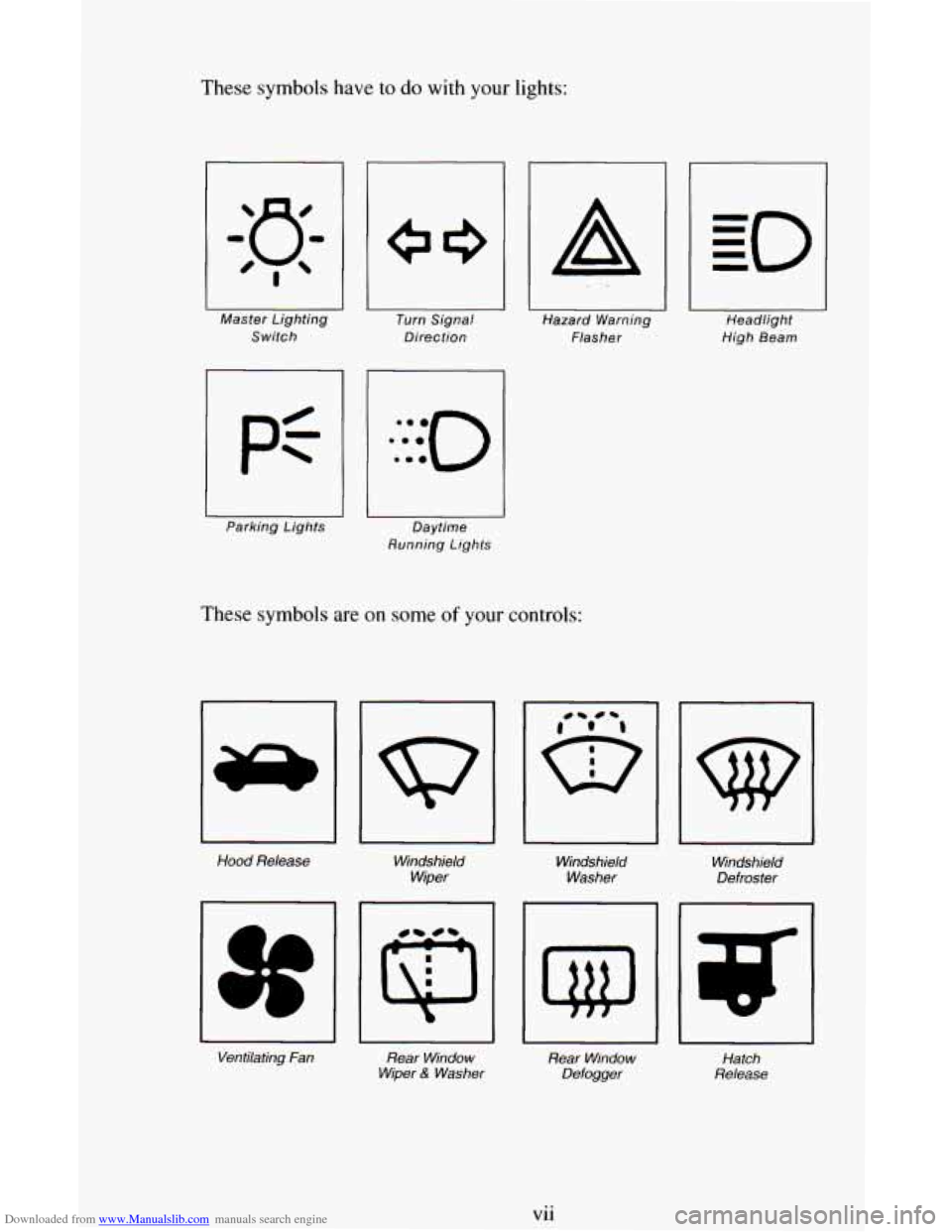
Downloaded from www.Manualslib.com manuals search engine These symbols have to do with your lights:
Master Lighting Switch
1 P=-
Parking Lights
I Turn Signal
Direction
I Daytime
Running Lights
I II I Hazard Warning
Headlight
Flasher High Beam
These symbols are on some of your controls:
Hood
Release
Windshield
Wiper Windshield
Washer
Ventilating
Fan Rear Window
Wiper
6: Washer
rl
Windshield
Defroster
Rear Window
Defogger Hatch
Release
vii
Page 12 of 342
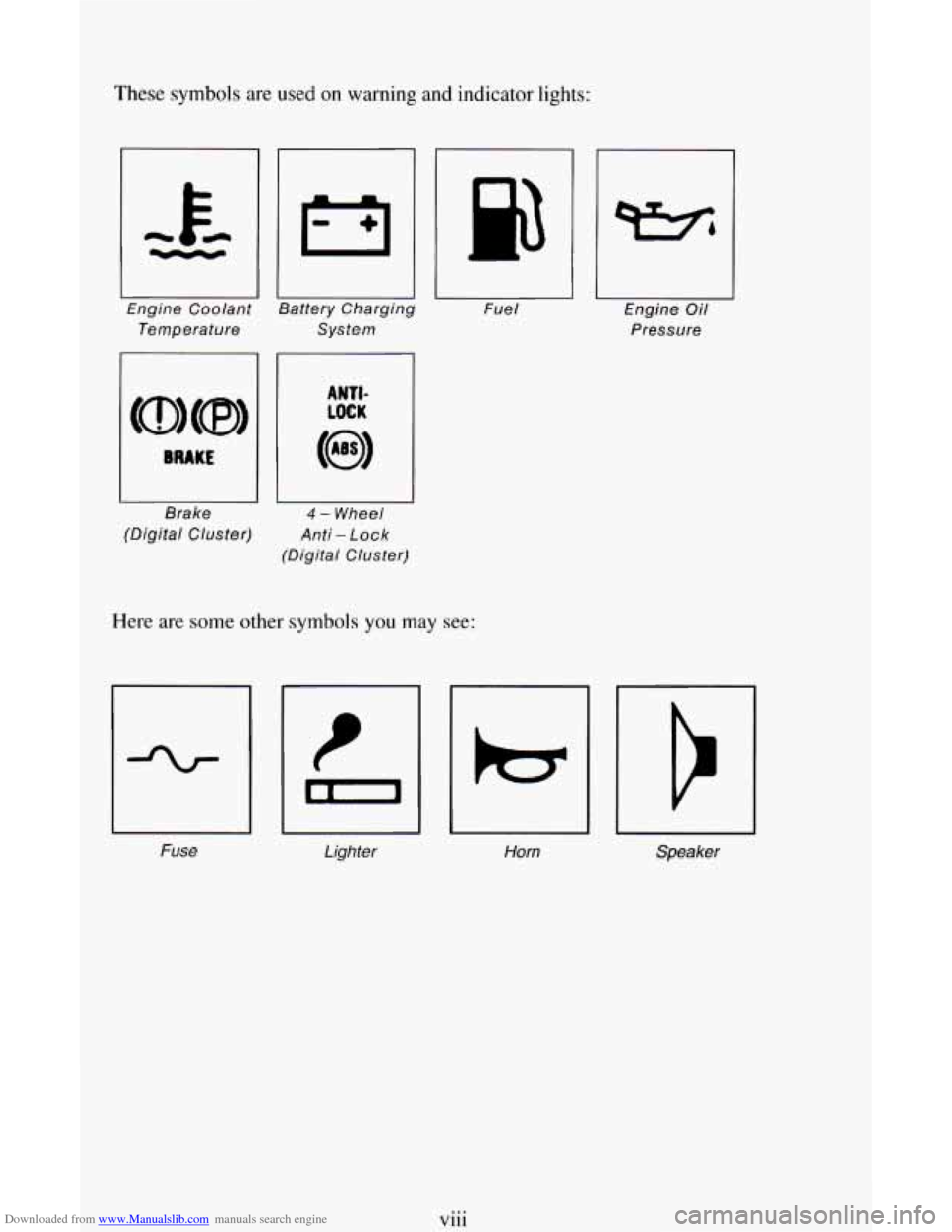
Downloaded from www.Manualslib.com manuals search engine These symbols are used on warning and indicator lights:
Engine Coolant
Temperature System
I I
Fue
I
I II
Brake 4 - Wheel
(Digital Cluster)
Anti - Lock
(Digital Cluster)
Here are some other symbols you may see:
Fuse Lighter
Horn Engine
Oil
Pressure
I
Speaker
viii
Page 23 of 342
Downloaded from www.Manualslib.com manuals search engine A CAUTION:
Don’t let anyone ride where he or she can’t wear a safety belt
properly.
If you are in a crash and you’re not wearing a safety
belt, your injuries
can be much worse. You can hit things inside
the vehicle or be ejected from it. You
can be seriously injured or
killed. In the same crash, you might not be if you are buckled
up. Always fasten your safety belt, and check that your
passengers’ belts are fastened properly too.
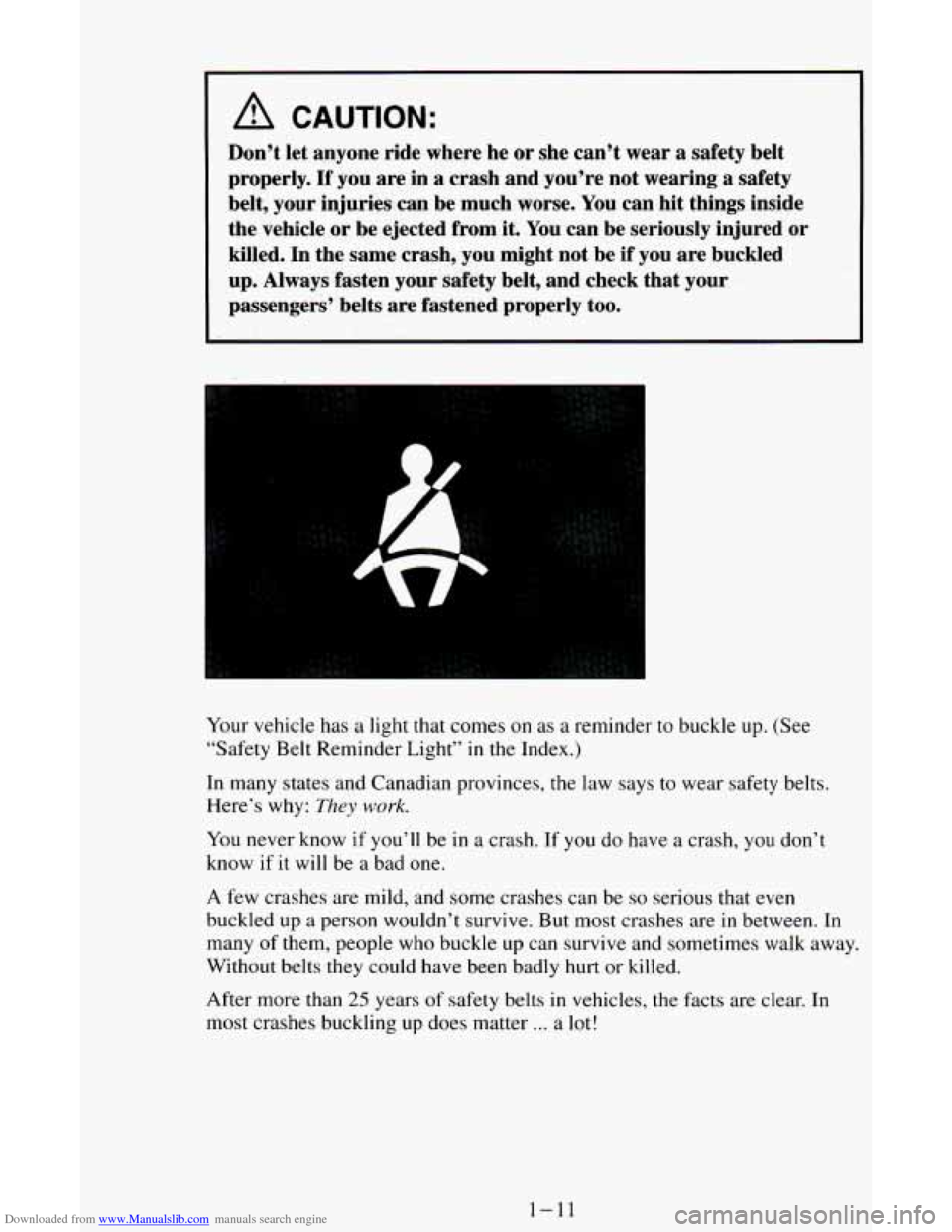
Your vehicle has a light that comes on as a reminder to buckle up. (See
“Safety Belt Reminder Light”
in the Index.)
In many states and Canadian provinces, the law says to wear safety belts.
Here’s why:
They work.
You never know if you’ll be in a crash. If you do have a crash, you don’t
know
if it will be a bad one.
A few crashes are mild, and some crashes can be so serious that even
buckled up a person wouldn’t survive. But most crashes are in between. In
many of them, people who buckle up can survive and sometimes walk away.
Without belts
they could have been badly hurt or killed.
After more than
25 years of safety belts in vehicles, the facts are clear. In
most crashes buckling up does matter ... a lot!
1-11
Page 34 of 342
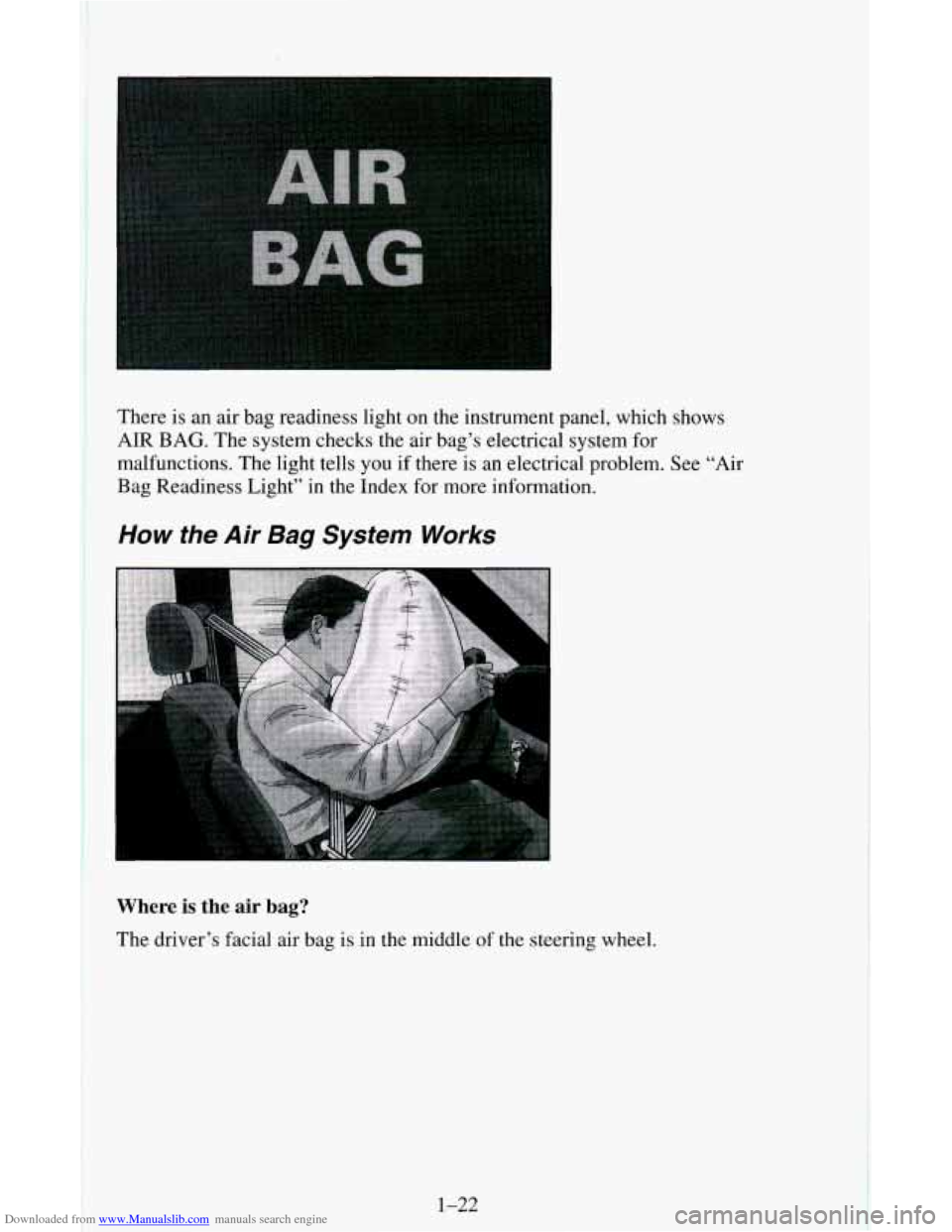
Downloaded from www.Manualslib.com manuals search engine There is an air bag readiness light on the instrument panel, which shows
AIR
BAG. The system checks the air bag’s electrical system for
malfunctions. The light tells you if there is an electrical problem. See
“Air
Bag Readiness Light” in the Index for more information.
How the Air Bag System Works
Where is the air bag?
The driver’s facial air bag is in the middle of the steering wheel.
1-22
Page 70 of 342
Downloaded from www.Manualslib.com manuals search engine 3. If your engine still won’t start, wait 15 seconds to let the starter motor
cool down and do it all again.
When the engine starts,
let go of the key and the accelerator pedal.
NOTICE:
Your engine is designed to work with the electronics in your
vehicle.
If you add electrical parts or accessories, you could
change the
way the fuel injection system operates. Before adding
electrical equipment, check with your dealer. If you don’t, your
engine might not perform properly.
If you ever have to have your vehicle towed, see the part of this
manual that tells how to do it without damaging your vehicle.
See “Towing Your Vehicle” in the Index.
Fuel Regulator
You have a fuel regulator that shuts the fuel off when the engine reaches
5,600 rpm.
Driving Through Deep Standing Water
NOTICE:
If you drive too quickly through deep puddles or standing water,
water can come in through your engine’s air intake and badly
damage your engine. Never drive through water that is slightly \
lower than the underbody
of your vehicle. If you can’t avoid
deep puddles or standing water, drive through them very slowly.
2-16
Page 75 of 342
Downloaded from www.Manualslib.com manuals search engine Parking Brake
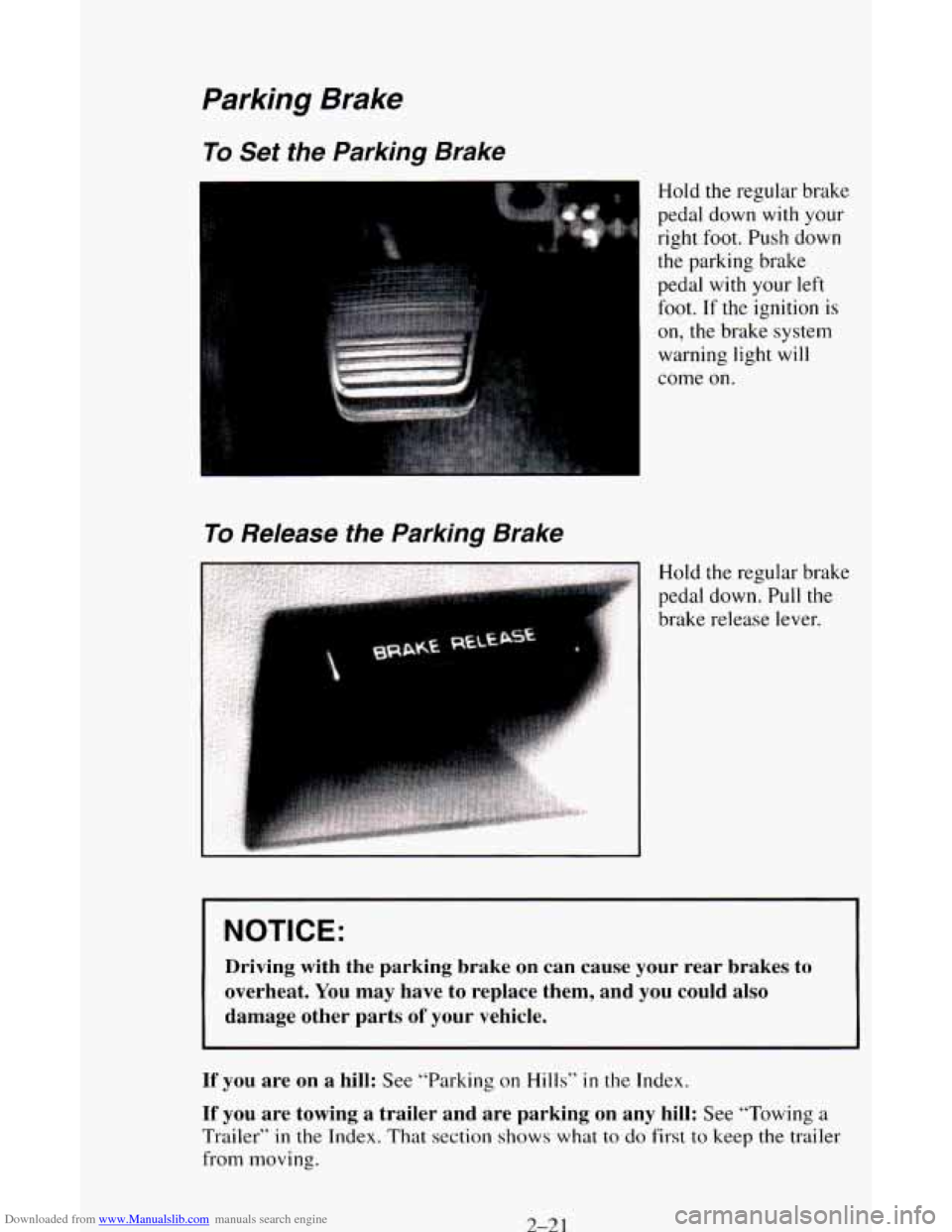
To Set the Parking Brake
Hold the regular brake
To Release the Parking Brake
pedal down with your
right foot. Push down
the parking brake
pedal with your left
foot.
If the ignition is
on, the brake system
warning light
will
come on.
Hold the regular brake
pedal down. Pull the
brake release lever.
NOTICE:
Driving with the parking brake on can cause your rear brakes to
overheat. You may have to replace them, and you could also
damage other parts
of your vehicle.
If you are on a hill: See “Parking on Hills” in the Index.
If you are towing a trailer and are parking on any hill: See “Towing a
Trailer” in the Index. That section shows what to do first to keep the trailer
from moving.
2-21
Page 85 of 342
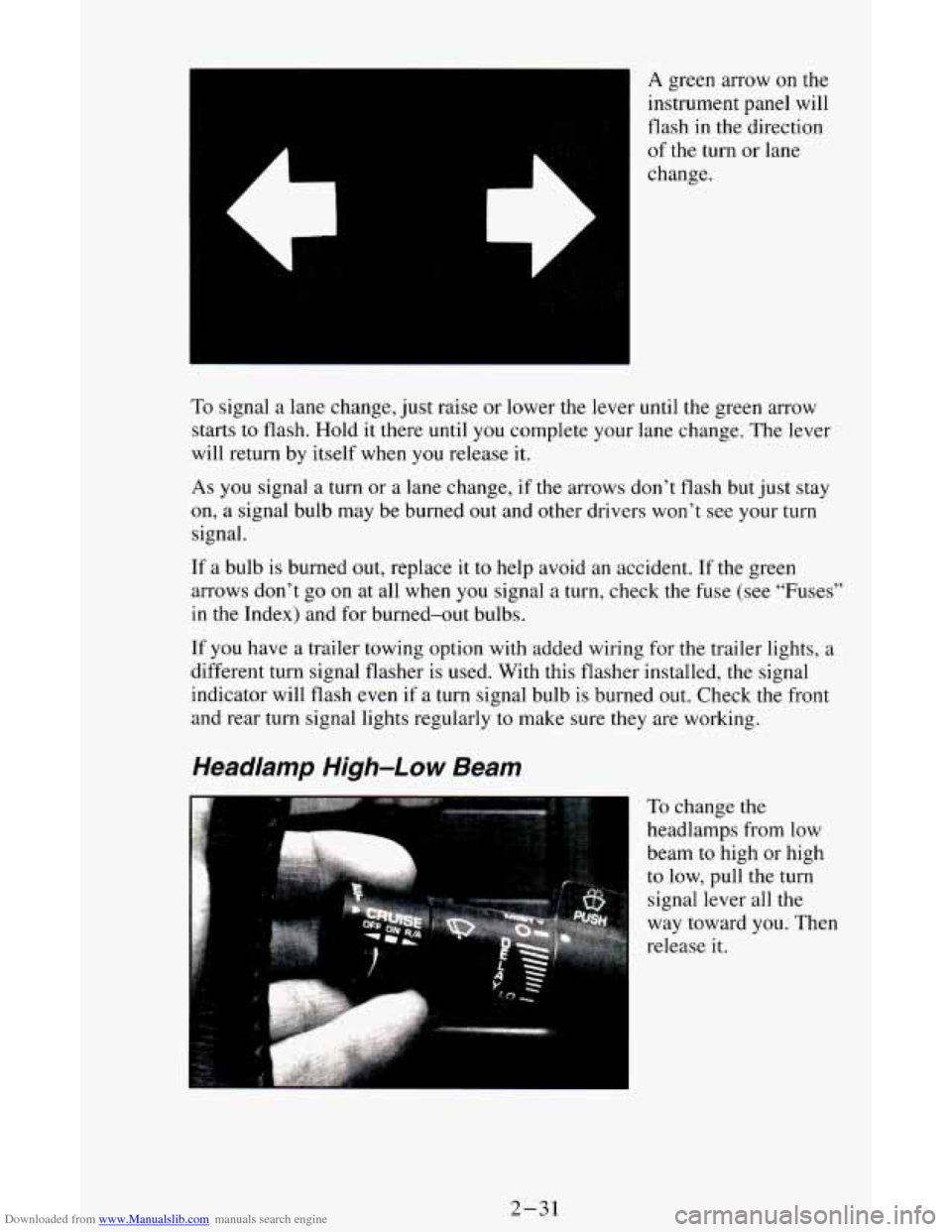
Downloaded from www.Manualslib.com manuals search engine A green arrow on the
instrument panel will
flash
in the direction
of the turn or lane
change.
To signal a lane change, just raise or lower the lever until the green arrow
starts to flash. Hold it there until
you complete your lane change. The lever
will return by itself when
you release it.
As you signal a turn or a lane change, if the arrows don’t flash but just stay
on, a signal bulb may be burned out and other drivers won’t see your turn
signal.
If a bulb is burned out, replace it to help avoid an accident. If the green
arrows don’t go
on at all when you signal a turn, check the fuse (see “Fuses”
in the Index) and for burned-out bulbs.
If you have a trailer towing option with added wiring for the trailer lights, a
different turn signal flasher is used. With this flasher installed, the signal
indicator will flash even if a turn signal bulb
is burned out. Check the front
and rear turn signal lights regularly
to make sure they are working.
Headlamp High-Low Beam
f ,.
To change the
headlamps from low
beam to high or high
to low, pull the turn
signal lever all the
way toward you. Then
release it.
2-31
Page 86 of 342
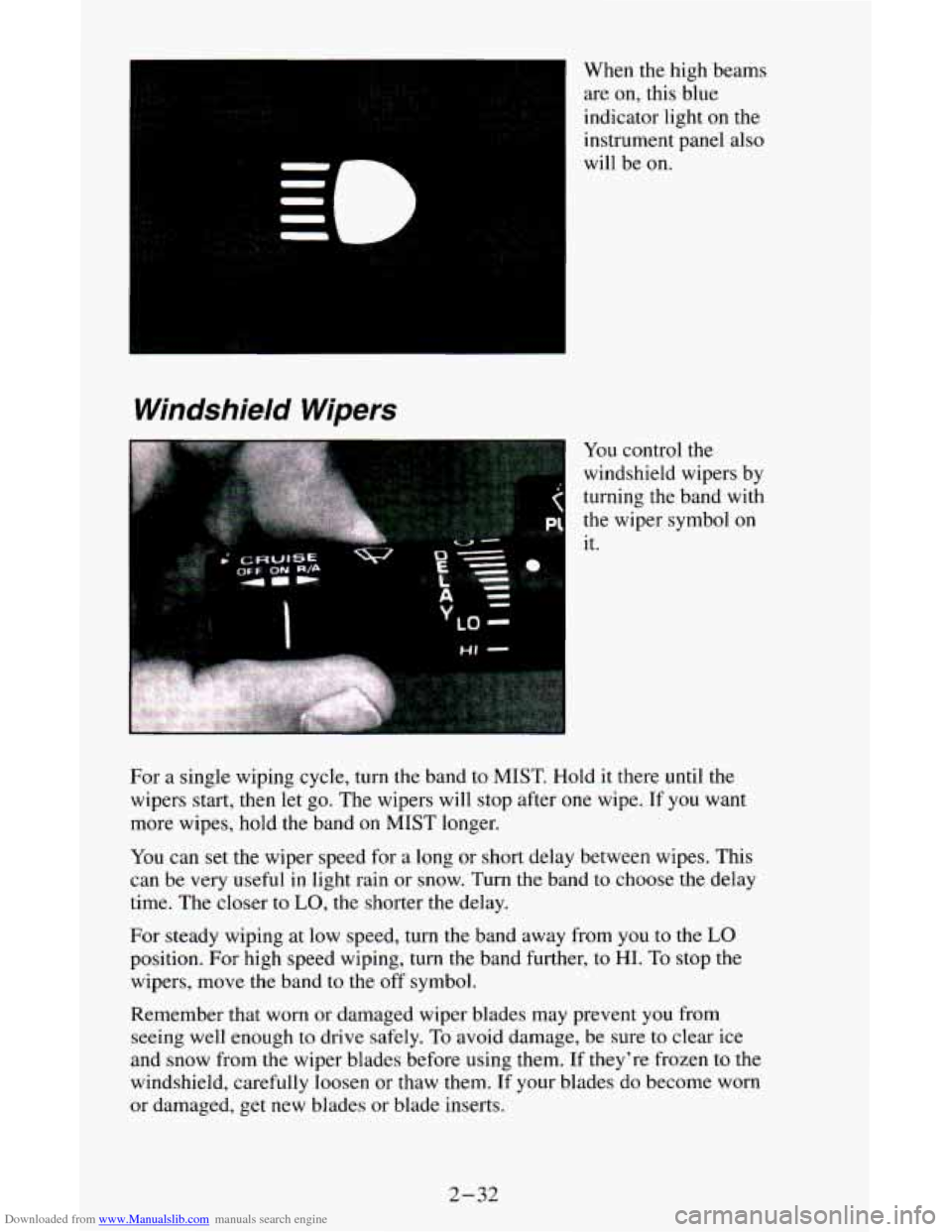
Downloaded from www.Manualslib.com manuals search engine When the high beams
are on, this blue
indicator light
on the
instrument panel also
Windshield Wipers
I will be on.
You control the
windshield wipers by
turning the band with
the wiper symbol on
it.
For a single wiping cycle, turn the band to MIST. Hold it there until the
wipers start, then let go. The wipers will stop after one wipe. If
you want
more wipes, hold the band
on MIST longer.
You can set the wiper speed for a long
or short delay between wipes. This
can be very useful in light rain or snow. Turn
the band to choose the delay
time. The closer to
LO, the shorter the delay.
For steady wiping at low speed, turn the band away from
you to the LO
position. For high speed wiping, turn the band further, to HI. To stop the
wipers, move the band
to the off symbol.
Remember that worn or damaged wiper blades may prevent you from
seeing well enough
to drive safely. To avoid damage, be sure to clear ice
and snow from the wiper blades before using them. If they're frozen to the
windshield, carefully loosen
or thaw them. If your blades do become worn
or damaged, get new blades or blade inserts.
2-32