1995 CHEVROLET ASTRO CARGO VAN light
[x] Cancel search: lightPage 108 of 342
Downloaded from www.Manualslib.com manuals search engine This light should come on briefly as you start the vehicle. If it doesn’t come
on then, have it fixed
so it will be ready to warn you if there’s a problem.
If the light comes on while you are driving, pull off the road and stop
carefully. You may notice that the pedal
is harder to push. Or, the pedal may
go closer
to the floor. It may take longer to stop. If the light is still on, have
the vehicle towed for service. (See “Towing Your Vehicle’’
in the Index.)
b
A CAUTION:
Your brake system may not be working properly if the brake
system warning light is on. Driving with the brake system warning light on can lead to an accident. If the light is st\
ill on
after you’ve pulled off the road and stopped carefully, have\
the
vehicle towed for service.
The brake system warning light will also come on when you set your
parking brake, and it will stay on if your parking brake doesn’t release fully.
If it stays on after your parking brake is fully released, it means you have a
brake problem.
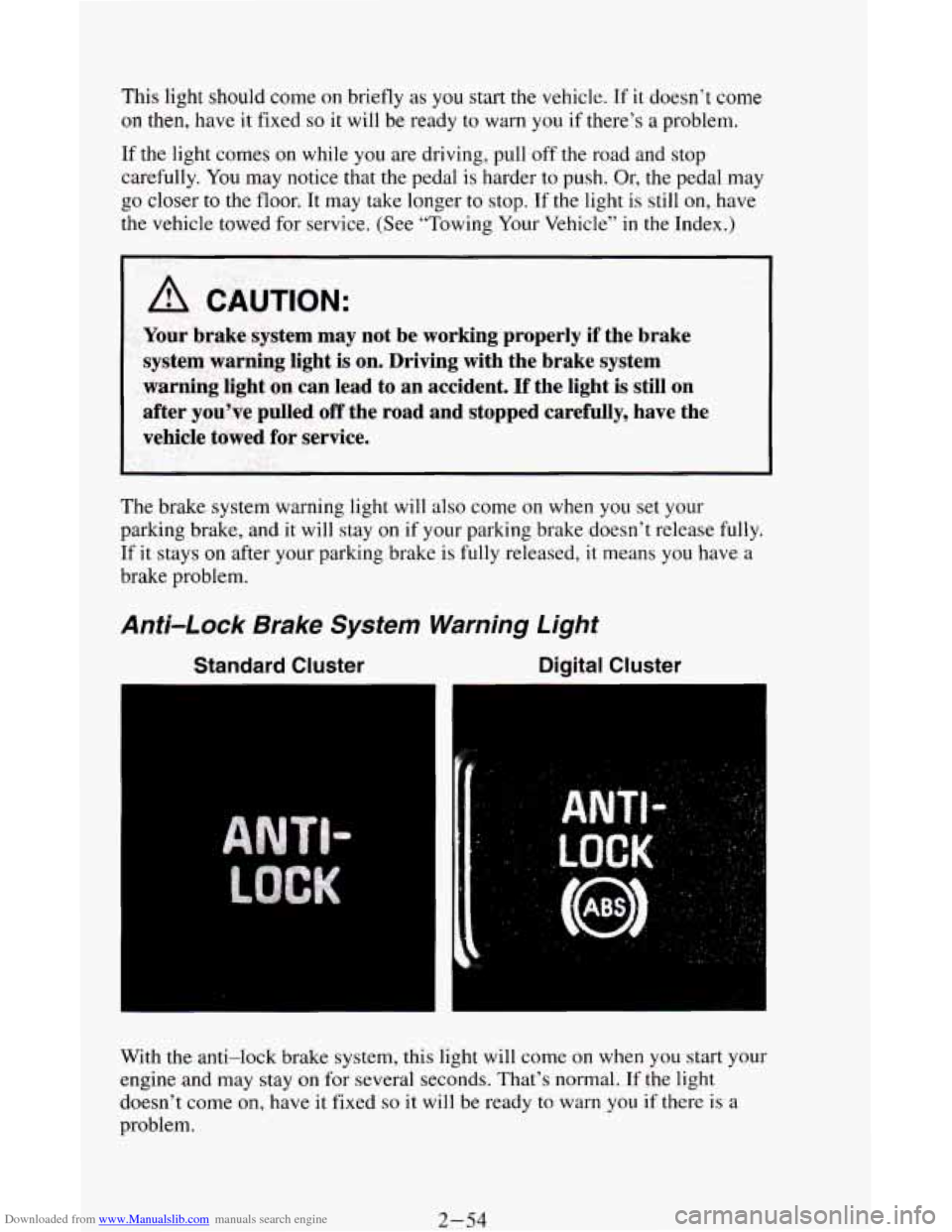
Anti-Lock Brake System Warning Light
Standard Cluster Digital Cluster
With the anti-lock brake system, this light will come on when you start your
engine and may stay on for several seconds. That’s normal. If the light
doesn’t come on, have it fixed
so it will be ready to warn you if there is a
problem.
2-54
Page 109 of 342
Downloaded from www.Manualslib.com manuals search engine If the light stays on, or comes on when you’re driving, your vehicle needs
service.
If the regular brake system warning light isn’t on, you still have
brakes, but you don’t have anti-lock brakes. If the regular brake system
warning light
is also on, you don’t have anti-lock brakes and there’s a
problem with your regular brakes. See “Brake System Warning Light”
earlier in this part.
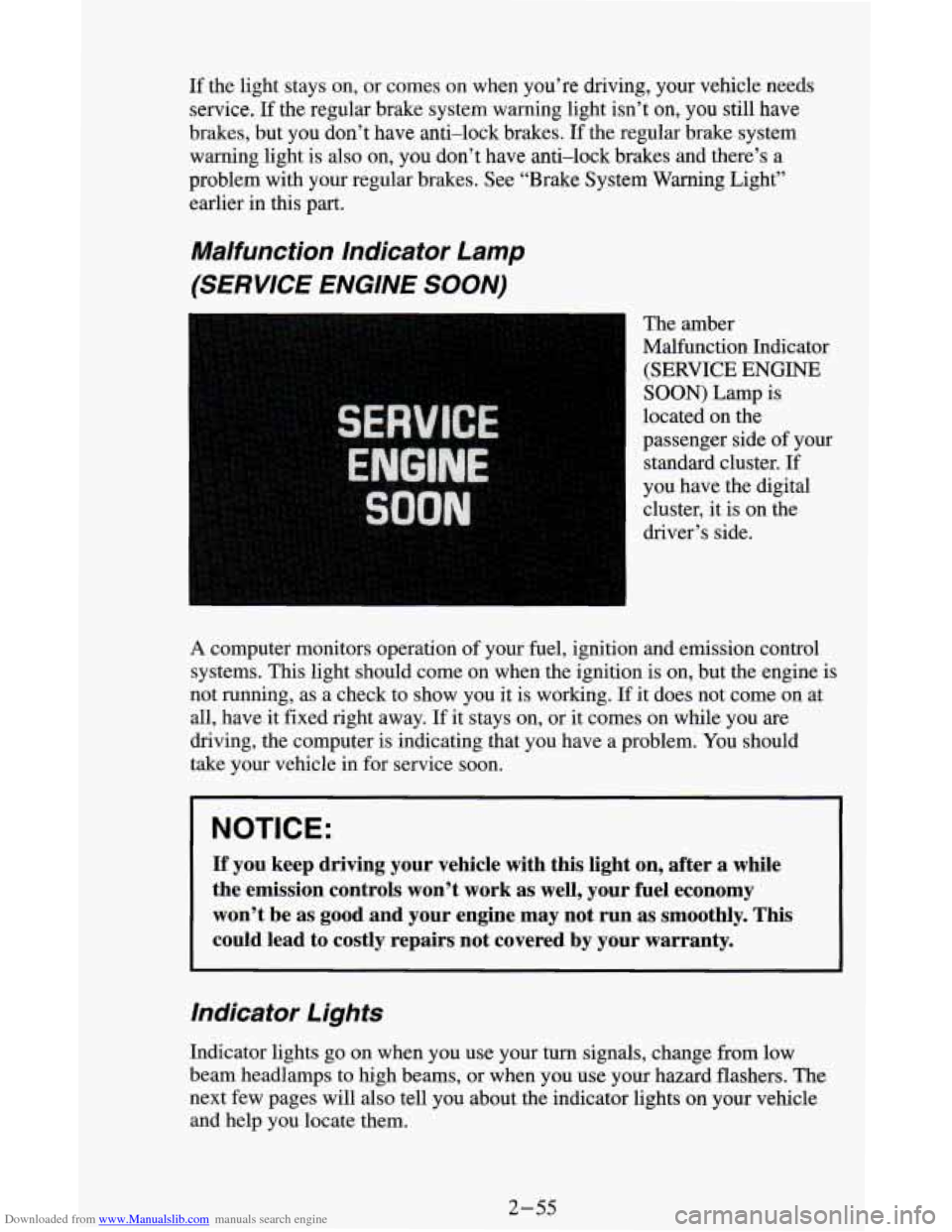
Malfunction Indicator Lamp
(SERVICE ENGINE
SOON)
The amber
Malfunction Indicator
(SERVICE
ENGINE
SOON) Lamp is
located on the
passenger side of your
standard cluster. If
you have the digital
cluster, it is
on the
driver’s side.
A computer monitors operation of your fuel, ignition and emission control
systems. This light should come on when the ignition is
on, but the engine is
not running, as a check to show you it is working.
If it does not come on at
all, have it fixed right away.
If it stays on, or it comes on while you are
driving, the computer is indicating that you have a problem. You should
take your vehicle in for service soon.
NOTICE:
If you keep driving your vehicle with this light on, after a whi\
le
the emission controls won’t work as well, your fuel economy \
won’t be as good and your engine may not run as smoothly. \
This
could lead to costly repairs not covered by your warranty.
Indicator Lights
Indicator lights go on when you use your turn signals, change from low
beam headlamps to high beams, or when you use your hazard flashers.
The
next few pages will also tell you about the indicator lights on your vehicle
and help you locate them.
2-55
Page 110 of 342
Downloaded from www.Manualslib.com manuals search engine Charging System Light
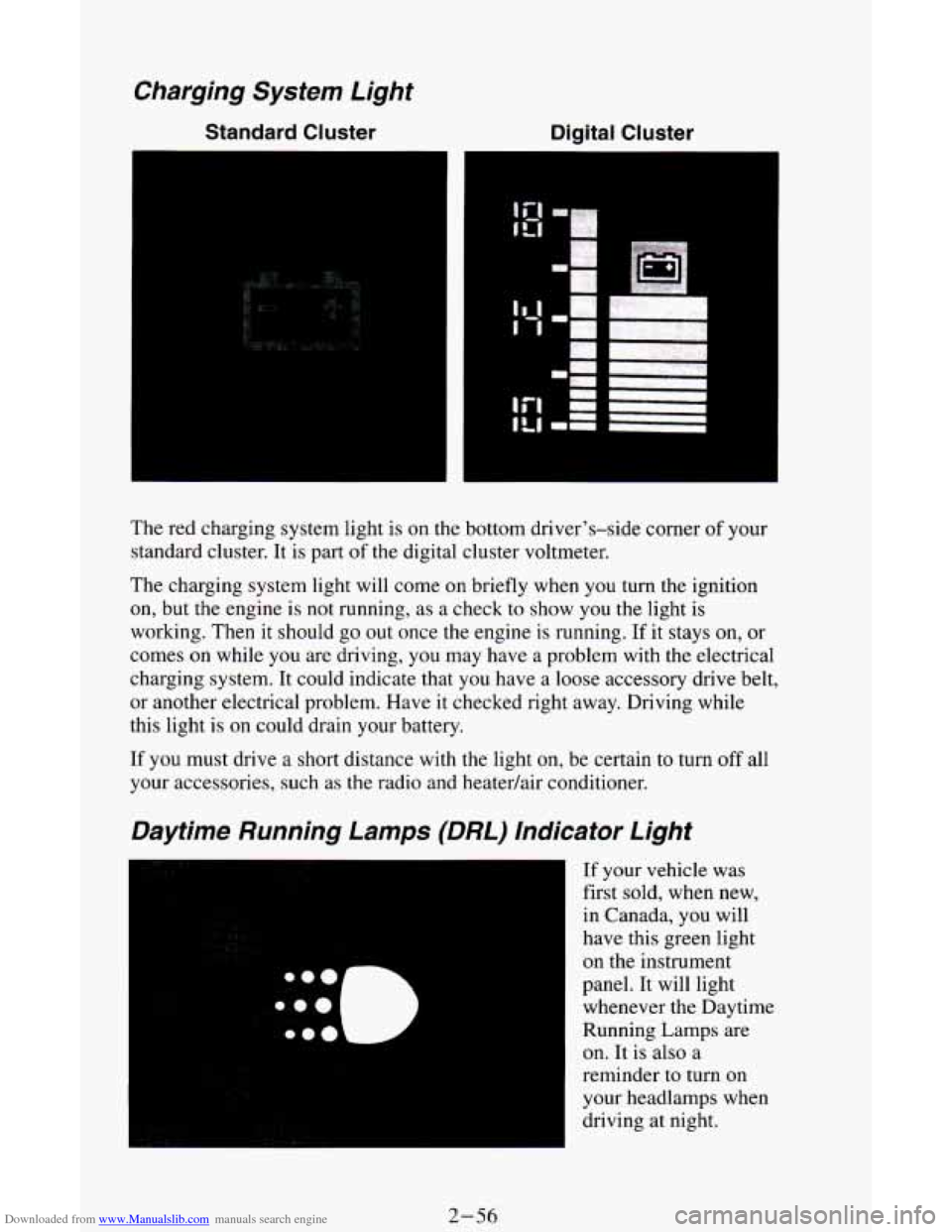
Standard Cluster
m
Digital Cluster
1
I
The red charging system light is on the bottom driver's-side corner of your
standard cluster. It is part
of the digital cluster voltmeter.
The charging system light will come on briefly when you
turn the ignition
on, but the engine is not running, as a check
to show you the light is
working.
Then it should go out once the engine is running. If it stays on, or
comes
on while you are driving, you may have a problem with the electrical
charging system. It could indicate that you have a loose accessory drive belt,
or another electrical problem. Have it checked right away. Driving while
this light is
on could drain your battery.
If you must drive
a short distance with the light on, be certain to turn off all
your accessories, such as the radio and heatedair conditioner.
Daytime Running Lamps (DRL) Indicator Light
If your vehicle was
first sold, when new,
in Canada, you will
have this green light
on the instrument
panel. It will light
whenever the Daytime
Running Lamps are
on.
It is also a
reminder to turn on
your headlamps when
driving at night.
2-56
Page 111 of 342
Downloaded from www.Manualslib.com manuals search engine For more details about DRL, see “Headlamps and Vehicle Lighting” in this
section.
The
DRL indicator light is on whenever the ignition and the headlight
switch and parking brake are
off. For more details about DRL, see “Lights”
in this part.
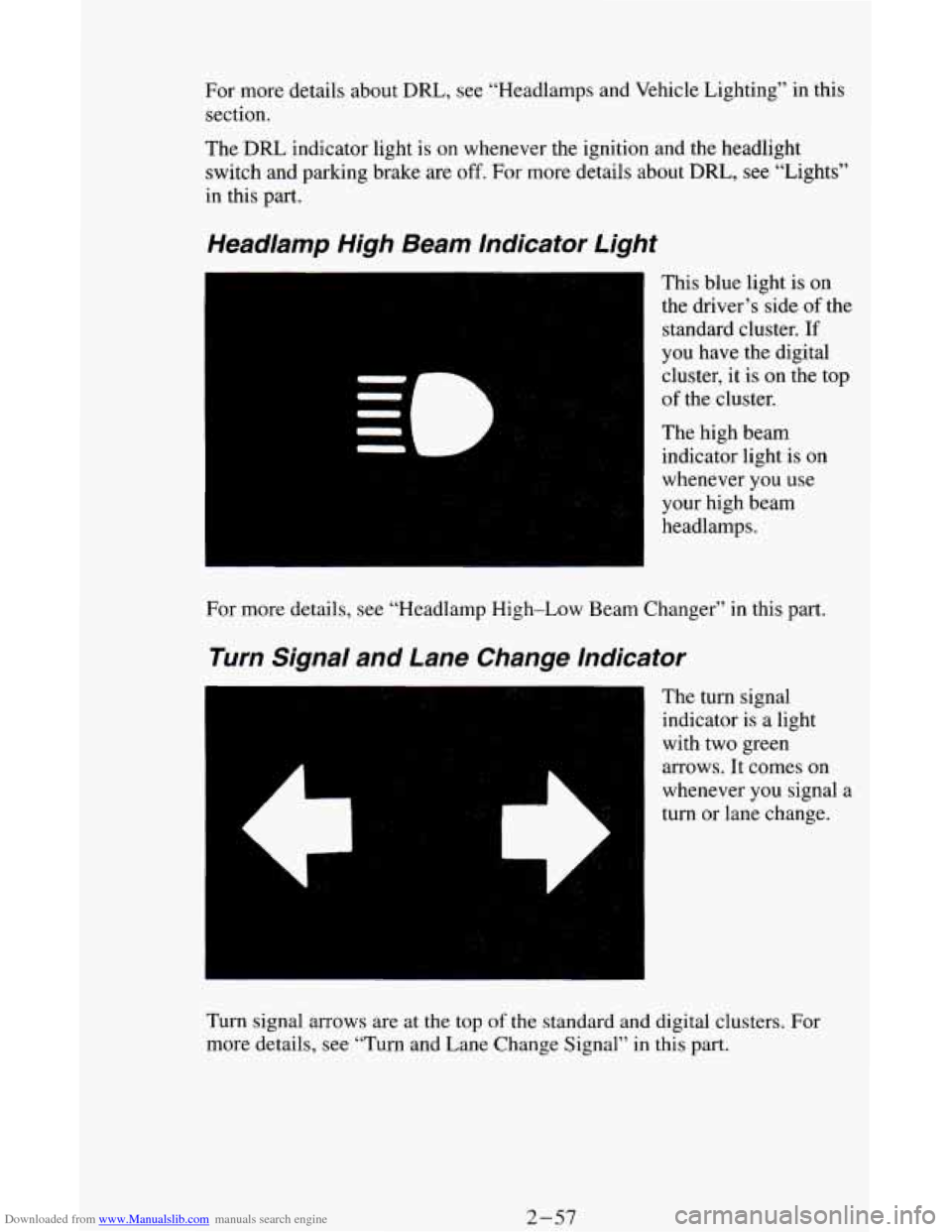
Headlamp High Beam Indicator Light
This blue light is on
the driver’s side
of the
standard cluster.
If
you have the digital
cluster, it
is on the top
of the cluster.
The high beam
indicator light is
on
whenever you use
your high beam
headlamps.
For more details, see “Headlamp High-Low Beam Changer” in this part.
Turn Signal and Lane Change Indicator
The turn signal
indicator is
a light
with two green
arrows. It comes on
whenever you signal
a
turn or lane change.
Turn signal arrows are at the
top of the standard and digital clusters. For
more details, see “Turn and Lane Change Signal”
in this part.
2-57
Page 121 of 342
Downloaded from www.Manualslib.com manuals search engine BLEND - With this setting, the heated outside air comes out both the
heater
vents and defroster vents, with some air coming through the side
window vents. Adjust the temperature lever
for warmer or cooler air. This
setting
is useful for cold weather with a large number of passengers or very
humid conditions
to help keep the windshield clear. The A/C compressor
may operate in this setting
to dehumidify the air.
HTR (Heater)
- Most of the air comes out near the floor. The rest comes
out from the defroster vents under the windshield and at the front side
windows. This
is best for cold weather.
VENT
- The air comes out at the vents on your instrument panel. The air
conditioner will not run. Adjust the temperature lever for warmer or cooler air.
BI-LEV A/C - With this, outside air comes out through the heater floor
vent and the instrument panel vents. If you move your temperature control
lever between cold and hot, cooler air
will come out of the upper vents
while warmer air comes
out of the floor vent. This setting is useful in cool
weather with bright sunlight.
NORM A/C - This setting cools the outside air. If you first used MAX
A/C, use NORM A/C
as soon as the vehicle has cooled down, so outside air
will be going through your vehicle.
MAX A/C -This cools the air the fastest. Move
the other lever all the way to
Cold. MAX A/C lets in only a little air from the outside. You can use MAX A/C
at first when
it's really hot outside and you need to cool off quickly.
When
the air conditioning, defrost or BLEND is on, you may notice a slight
increase or decrease in engine speed, due
to compressor operation.
Engine Coolant Heater (Option)
If you use the optional engine coolant heater before starting your engine,
your heating system will produce warmer air faster to heat the passenger
compartment
in cold weather. See "Engine Coolant Heater" in the Index.
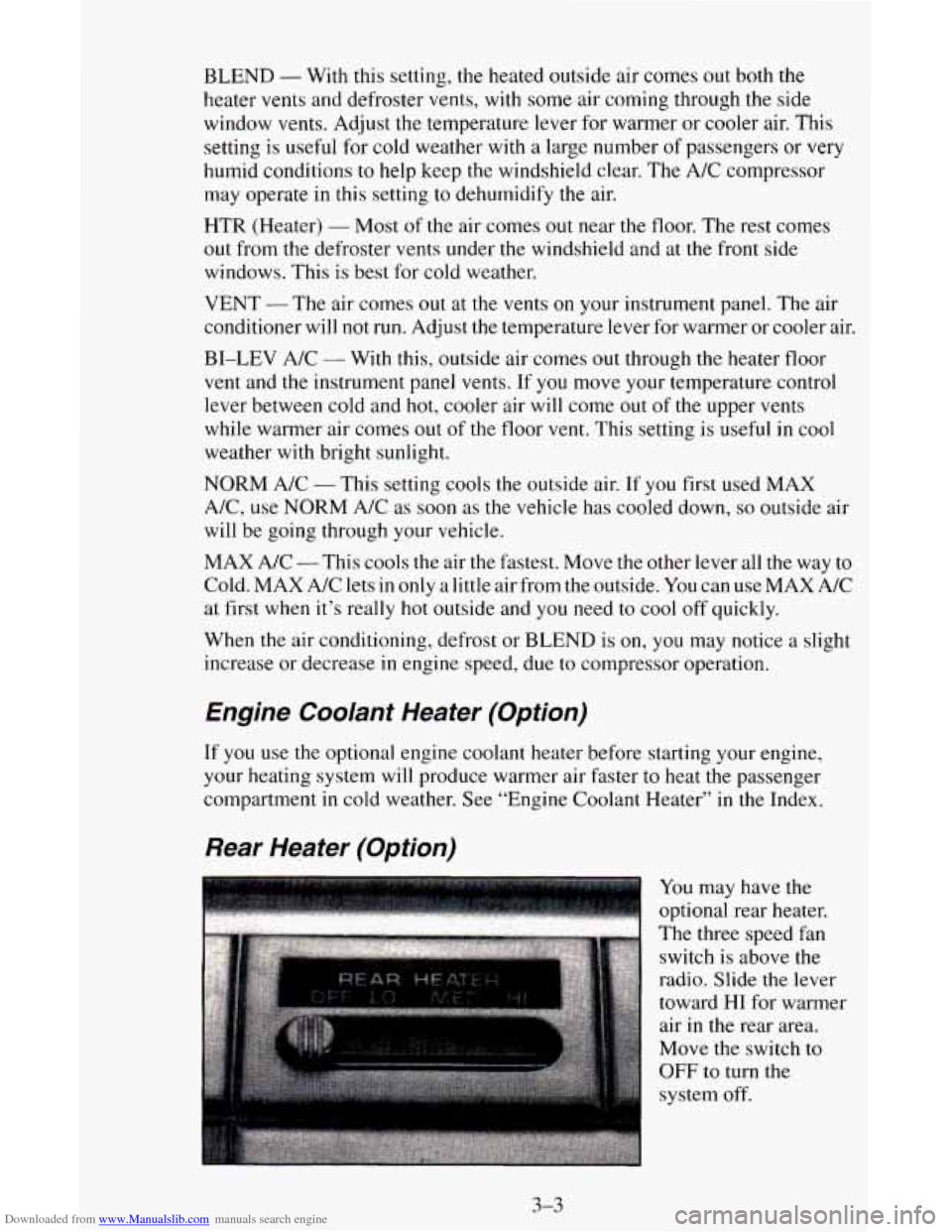
Rear Heater (Option)
You may have the
optional rear heater.
The three speed fan
switch is above the
radio. Slide
the lever
toward
HI for warmer
air in the rear area.
Move the switch to
OFF to turn the
system off.
3-3
Page 122 of 342
Downloaded from www.Manualslib.com manuals search engine Rear Air Conditioning (Option)
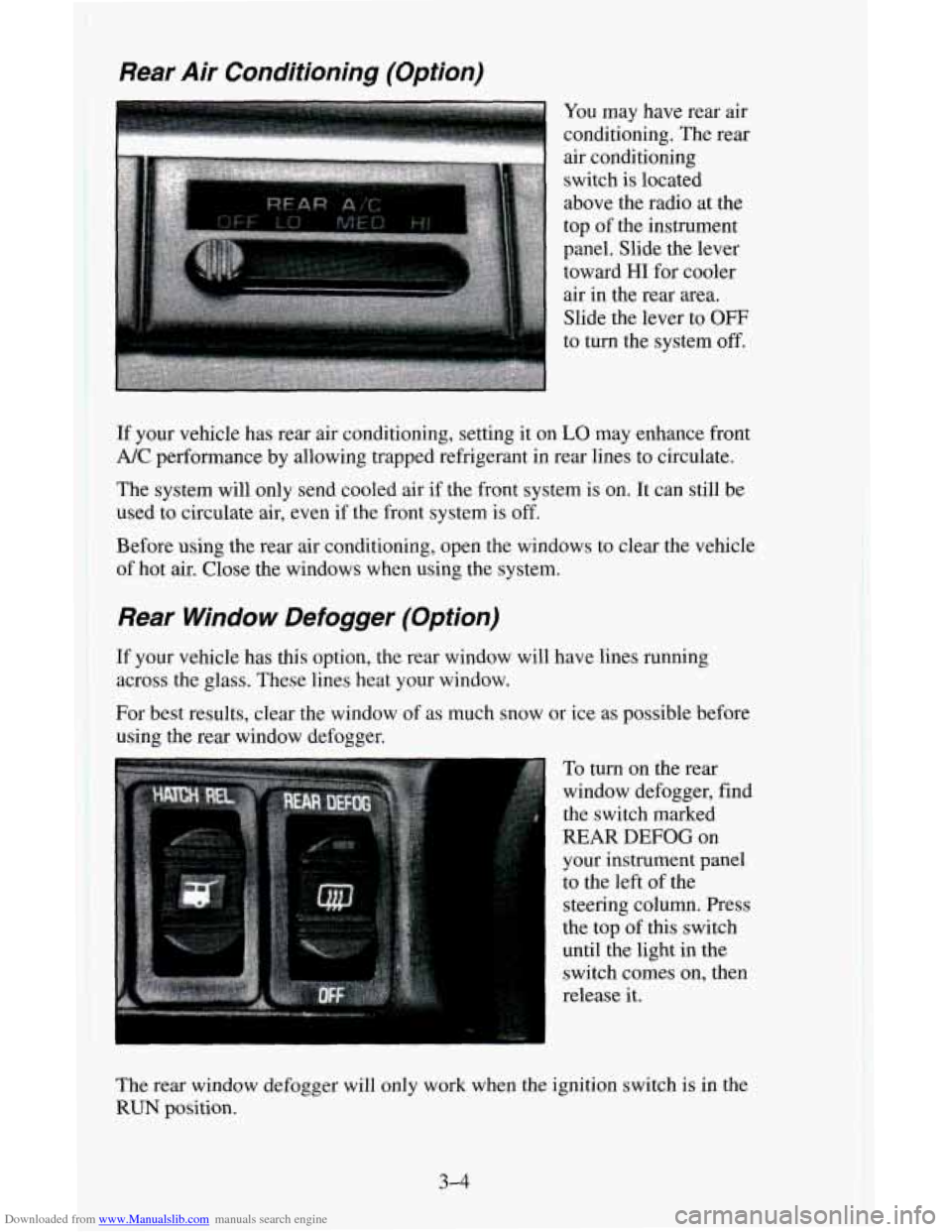
You may have rear air
conditioning. The rear
air conditioning
switch
is located
above the radio at the
top
of the instrument
panel. Slide the lever
toward
HI for cooler
air in the rear
area.
Slide the lever to OFF
to turn the system off.
If your vehicle has rear air conditioning, setting it on LO may enhance front
A/C performance by allowing trapped refrigerant in rear lines to circulate.
The system will only send cooled air if the front system is on. It can still
be
used to circulate air, even if the front system is off.
Before
using the rear air conditioning, open the windows to clear the vehicle
of hot air. Close the windows when using the system.
Rear Window Defogger (Option)
If your vehicle has this option, the rear window will have lines running
across the glass. These lines heat your window.
For best results, clear the window of as much snow or ice as possible before
using the
rear window defogger.
To
turn on the rear
window defogger, find
the switch marked
REAR DEFOG on
your instrument panel
to the left of the
steering column. Press
the top
of this switch
until the light in the
switch comes on, then
release it.
The rear window defogger will only work when the ignition switch
is in the
RUN position.
3-4
Page 129 of 342
Downloaded from www.Manualslib.com manuals search engine To PIay A Cassette
Your tape player is built to work best with tapes that are 30 to 45 minutes
long on each side. Tapes longer than that are
so thin they may not work well
in this player.
Once the tape is playing, use the upper and lower knobs for volume, balance
and fade just as you do for the radio. A lighted arrow shows which direction
the tape is being played.
FORWARD
- To rapidly advance the tape, press 4 or b in the direction
that the amber arrow points and the tape will rapidly go forward until
you
press the STOP-EJECT button lightly.
REVERSE
- To rapidly reverse the tape, press 4 or b in the opposite
direction that the amber arrow points and the tape will rapidly reverse until
you press the STOP-EJECT button lightly.
PROGRAM
- To go from one side of the tape to the other, press the
VOL-PROG-RCL knob.
STOP-EJECT
- To remove the tape or stop the tape and switch to radio,
press the STOP-EJECT button.
If a tape
is inserted with side “1” (or “A”) up, then the right arrow means
that that side is being played. Likewise,
a left arrow would indicate that side
“2” (or “B”) had been selected. The player will automatically switch to the
other side
of the tape when the first side ends.
If “Cln” (Clean) appears
on the display when you insert your cassette tape,
your cassette player needs to be cleaned. It will
still play cassette tapes but it
should be cleaned to prevent damage to your cassette tapes and the cassette
tape player. See “Care
of Your Cassette Tape Player” later in this section.
After you have cleaned the cassette tape player, press and hold
STOP-EJECT for
5 seconds to reset the the “Cln” indicator. The radio will
display
“- - -” to show the clean feature has been reset.
3-1 1
Page 131 of 342
Downloaded from www.Manualslib.com manuals search engine Pushbuttons - The four pushbuttons let you return to favorite stations. To
set the pushbuttons for up to fourteen favorite stations
(7 AM and 7 FM):
1. Tune in the desired station.
2. Push the SET button. “SET” appears in the display for about 5 seconds.
3. Within the 5 seconds, push one of the four pushbuttons. Whenever you
press that button, the preset station will return.
In addition to the four stations set as above, up to three additional stations
may be preset
on each band by pressing two adjoining pushbuttons at the
same time. Then do the following:
1. Tune in the desired station.
2. Press the SET button.
3. Within 5 seconds, press any two adjoining pushbuttons at the same time.
(The station will return when the same two buttons are pressed again.)
To Adjust the Tone - Use the levers in the upper middle left corner to set the
bass, midrange, and treble until you get the sound you want. The 60 and 250
levers adjust the bass,
1 K is midrange, and 3.5K and 1 OK control the treble.
We suggest
you start with the center lever (1K) in the midpoint position,
then move the others up until
you get the amount of bass and treble you like.
Am-St Button
- Push the Am-St button when you tune to an AM station
that broadcasts in stereo. Your STEREO light will come on when you’re
receiving AM stereo. If you push Am-St and there is
no more noise, it
means the station is weak. You’ll hear the station better if you don’t use
Am-St. Just push the Am-St button again to delete stereo.
To Play A Cassette
Your tape player is built to work best with tapes that are 30 to 45 minutes long on
each side. Tapes longer than that are so thin they may not work well in this player.
Once the tape is playing, use
the upper and lower knobs for volume, balance
and fade just as
you do for the radio. A lighted arrow shows which direction
the tape
is being played.
CrO2
- The CrO2 button lets you set the system for the type of cassette
being used. If you are using chrome
or metal tapes, push the Cr02 button in.
FWD - To rapidly advance the tape, press 4 or in the direction that the
amber arrow points and the tape will rapidly go forward until you press the
STOP-EJECT button lightly.
REV - To rapidly reverse the tape, press 4 or b in the opposite direction
that
the amber arrow points and the tape will rapidly reverse until you press
the STOP-EJECT button lightly.
APS
- Press the APS button to the recessed position.
Press
4 or b in the direction that the amber arrow points to go to the
beginning
of the next selection.
3-13