1995 CHEVROLET ASTRO CARGO VAN transmission
[x] Cancel search: transmissionPage 192 of 342
Downloaded from www.Manualslib.com manuals search engine 7. By this time the coolant level inside the radiator filler neck may be
lower.
If the level is lower, add more of the proper mix through the
filler neck until the level reaches the base
of the filler neck.
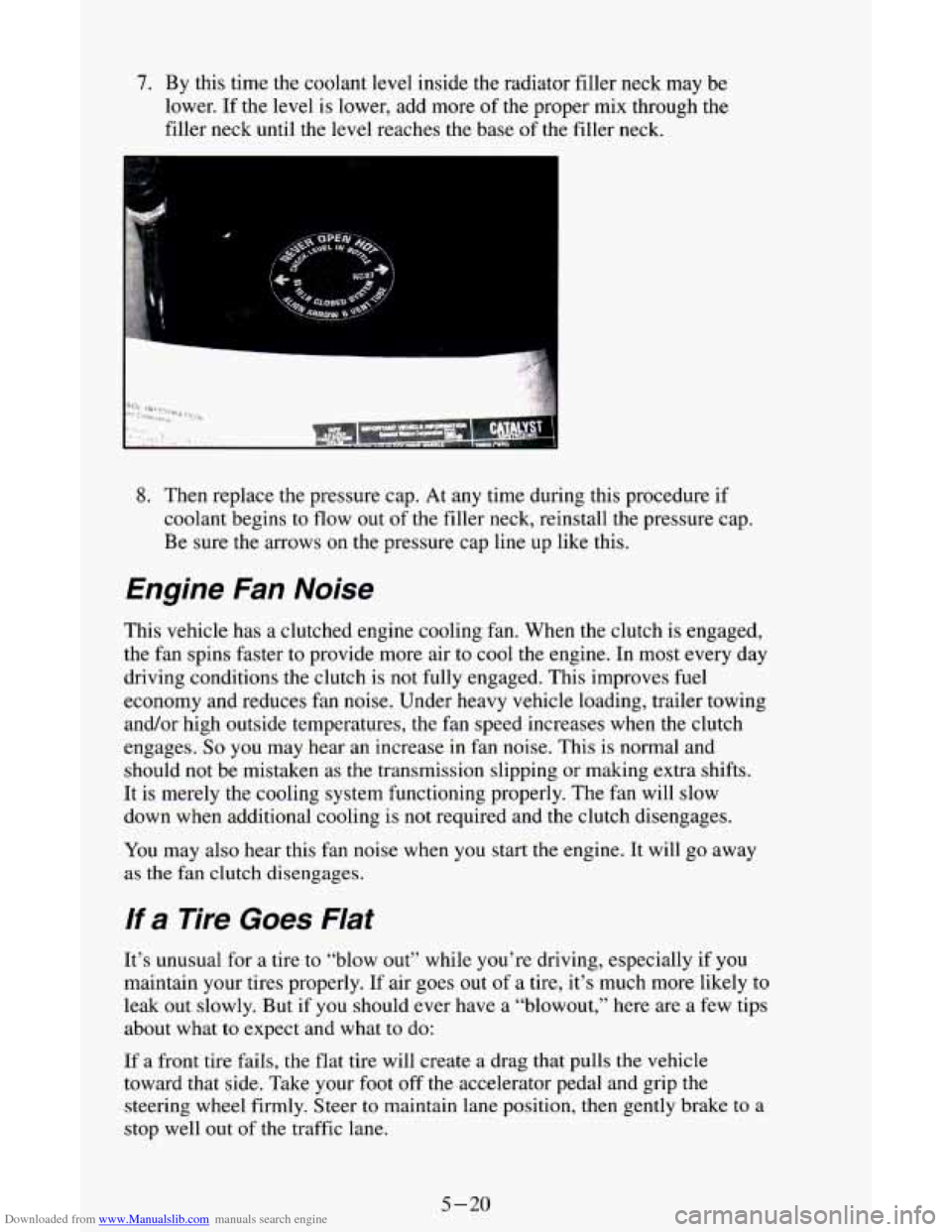
8. Then replace the pressure cap. At any time during this procedure if
coolant begins to flow out of the filler neck, reinstall the pressure cap.
Be sure the arrows on the pressure cap line
up like this.
Engine Fan Noise
This vehicle has a clutched engine cooling fan. When the clutch is engaged,
the fan spins faster to provide more air to cool the engine. In most every day
driving conditions the clutch is not fully engaged. This improves fuel
economy and reduces fan noise. Under heavy vehicle loading, trailer towing
and/or high outside temperatures, the fan speed increases when the clutch
engages.
So you may hear an increase in fan noise. This is normal and
should not be mistaken
as the transmission slipping or making extra sh
It is merely the cooling system functioning properly. The fan will slow
down when additional cooling is not required and the clutch disengage .ifts.
S.
You may
also hear this fan noise when you start the engine. It will go away
as the fan clutch disengages.
If a Tire Goes Flat
It’s unusual for a tire to “blow out” while you’re driving, especially if you
maintain your tires properly.
If air goes out of a tire, it’s much more likely to
leak out slowly. But if you should ever have a “blowout,” here are a few tips
about what
to expect and what to do:
If
a front tire fails, the flat tire will create a drag that pulls the vehicle
toward that side. Take your foot off the accelerator pedal and grip the
steering wheel firmly. Steer
to maintain lane position, then gently brake to a
stop well out of the traffic lane.
5-20
Page 207 of 342
Downloaded from www.Manualslib.com manuals search engine And don’t mix your compact spare or wheel with other wheels or tires. They
won’t fit. Keep your spare and its wheel together.
NOTICE:
Tire chains won’t fit your compact spare. Using them will
damage your vehicle and destroy the chains too. Don’t use tire
chains on your compact spare.
If You’re Stuck: In Sand, Mud, Ice or Snow
What you don’t want to do when your vehicle is stuck is to spin your wheels
too fast. The method known as “rocking” can help you get out when you’re
stuck, but
you must use caution.
I A CAUTION:
I NOTICE:
Spinning your wheels can destroy parts of your vehicle as well as
the tires. If you spin the wheels too fast while shifting your
transmission back and forth, you can destroy your transmission.
For information about using tire chains on your vehicle, see “Tire Chains”
in the Index.
Rocking your vehicle to get it out:
First, turn your steering wheel left and right. That will clear the area around
your front wheels. Then shift back and forth between REVERSE
(R) and a
forward gear, spinning the wheels as little as possible. Release
the
accelerator pedal while you shift, and press lightly on the accelerator pedal
when the transmission is in gear. If that doesn’t get
you out after a few tries,
you may need
to be towed out. If you do need to be towed out, see “Towing
Your Vehicle” in the Index.
5-35
Page 226 of 342
Downloaded from www.Manualslib.com manuals search engine NOTICE:
If the air cleaner is off, a backfire can cause a damaging engine
fire. And, dirt can easily get into your engine, which will damage
it. Always have the air cleaner in place when you’re driving.
Automatic Transmission Fluid
When to Check and Change
A good time to check your automatic transmission fluid level is when the
engine oil
is changed. Refer to the Maintenance Schedule to determine
when
to change your fluid. See “Scheduled Maintenance Services” in the
Index.
How to Check
Because this operation can be a little difficult, you may choose to have this
done at your
GM dealer Service Department.
If you do it yourself, be sure to follow all the instructions here, or you could
get a false reading
on the dipstick.
NOTICE:
Too much or too little fluid can damage your transmission. Too
much can mean that some of the fluid could come out and fall on
hot engine parts or exhaust system parts, starting
a fire. Be sure
to get an accurate reading if you check your transmission fluid.
Wait at least
30 minutes before checking the transmission fluid level if you
have been driving:
When outside temperatures are above 90°F (32” C).
0 At high speed for quite a while.
0 In heavy traffic - especially in hot weather.
While pulling a trailer.
To get the right reading, the fluid should be at normal operating
temperature, which is 180°F to
200°F (82°C to 93°C).
6- 18
Page 227 of 342
Downloaded from www.Manualslib.com manuals search engine To check transmission fluid hot: Get the vehicle warmed up by driving
about
15 miles (24 km) when outside temperatures are above 50°F (10°C).
If it's colder than
50°F (lO°C), drive the vehicle in DRIVE (D) until the
engine temperature gage moves and then remains steady for ten minutes.
Then follow the hot check procedures.
To check transmission fluid cold: A cold check is made after the vehicle
has been sitting for eight hours or more with the engine off and is used only
as a reference. Let the engine run at idle for five minutes if outside
temperatures are
50°F (10°C) or more. If it's colder than 50°F (lO"C), you
may have to idle the engine longer. Should the fluid level be low during a
cold check, you
must perform a hot check before adding fluid. This will
give you a more accurate reading of the fluid level.
To check the fluid hot or cold
Park your vehicle on a level place. Keep the engine running.
With the parking brake applied, place the shift lever in PARK (P).
With your foot on the brake pedal, move the shift lever through each
gear range, pausing for about three seconds
in each range. Then,
position the shift lever in
PARK (P).
Let the engine run at idle for three minutes or more.
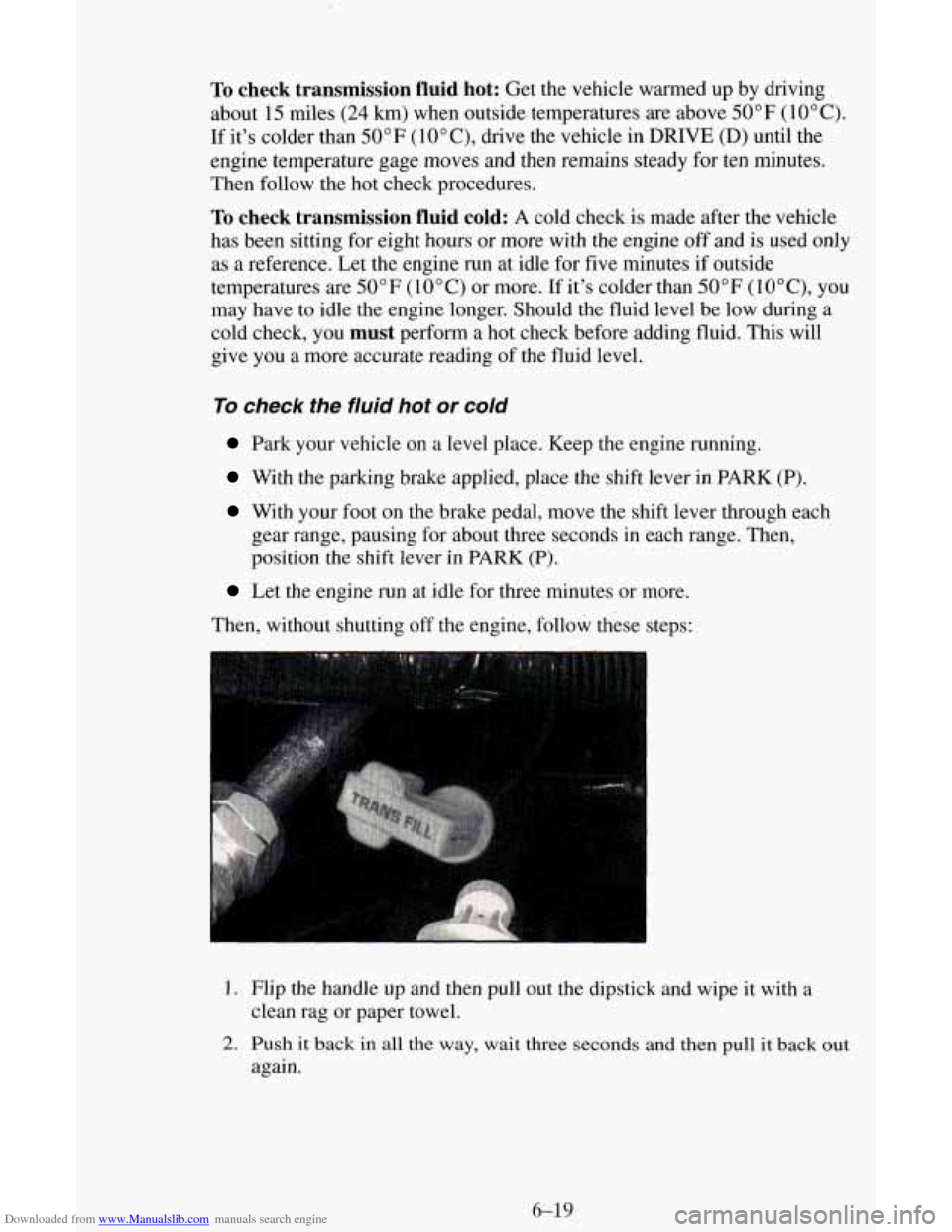
Then, without shutting off the engine, follow these steps:
1. Flip the handle up and then pull out the dipstick and wipe it with a
2. Push it back in all the way, wait three seconds and then pull it back out
clean rag or
paper towel.
again.
6-19
Page 228 of 342
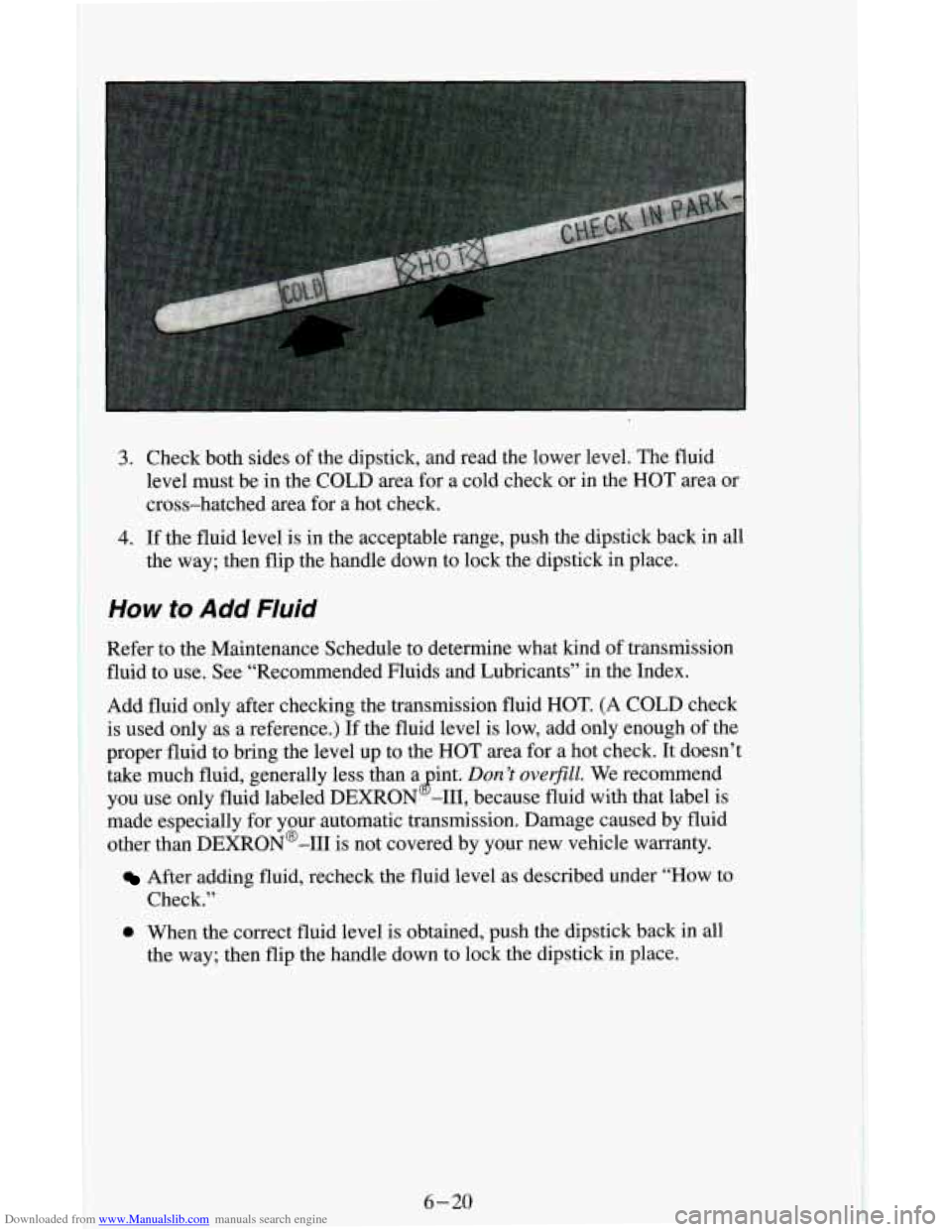
Downloaded from www.Manualslib.com manuals search engine 3. Check both sides of the dipstick, and read the lower level. The fluid
level must be in the COLD area for a cold check or in the
HOT area or
cross-hatched area for a hot check.
4. If the fluid level is in the acceptable range, push the dipstick back in all
the way; then flip the handle down to lock the dipstick in place.
How to Add Fluid
Refer to the Maintenance Schedule to determine what kind of transmission
fluid to use., See “Recommended Fluids and Lubricants” in the Index.
Add fluid only after checking the transmission fluid
HOT. (A COLD check
is used only’ as a reference.) If the fluid level is low, add only enough of the
proper fluid to bring the level up to the
HOT area for a hot check. It doesn’t
take much fluid, generally less than a int.
Don ’t overjill. We recommend
you use only fluid labeled DEXRON
8 -111, because fluid with that label is
made especially for your automatic transmission. Damage caused by fluid
other than DEXRON@-I11 is not covered by your new vehicle warranty.
After adding fluid, recheck the fluid level as described under “How to
Check.”
0 When the correct fluid level is obtained, push the dipstick back in all
the way; then flip the handle down to lock the dipstick in place.
6-20
Page 272 of 342
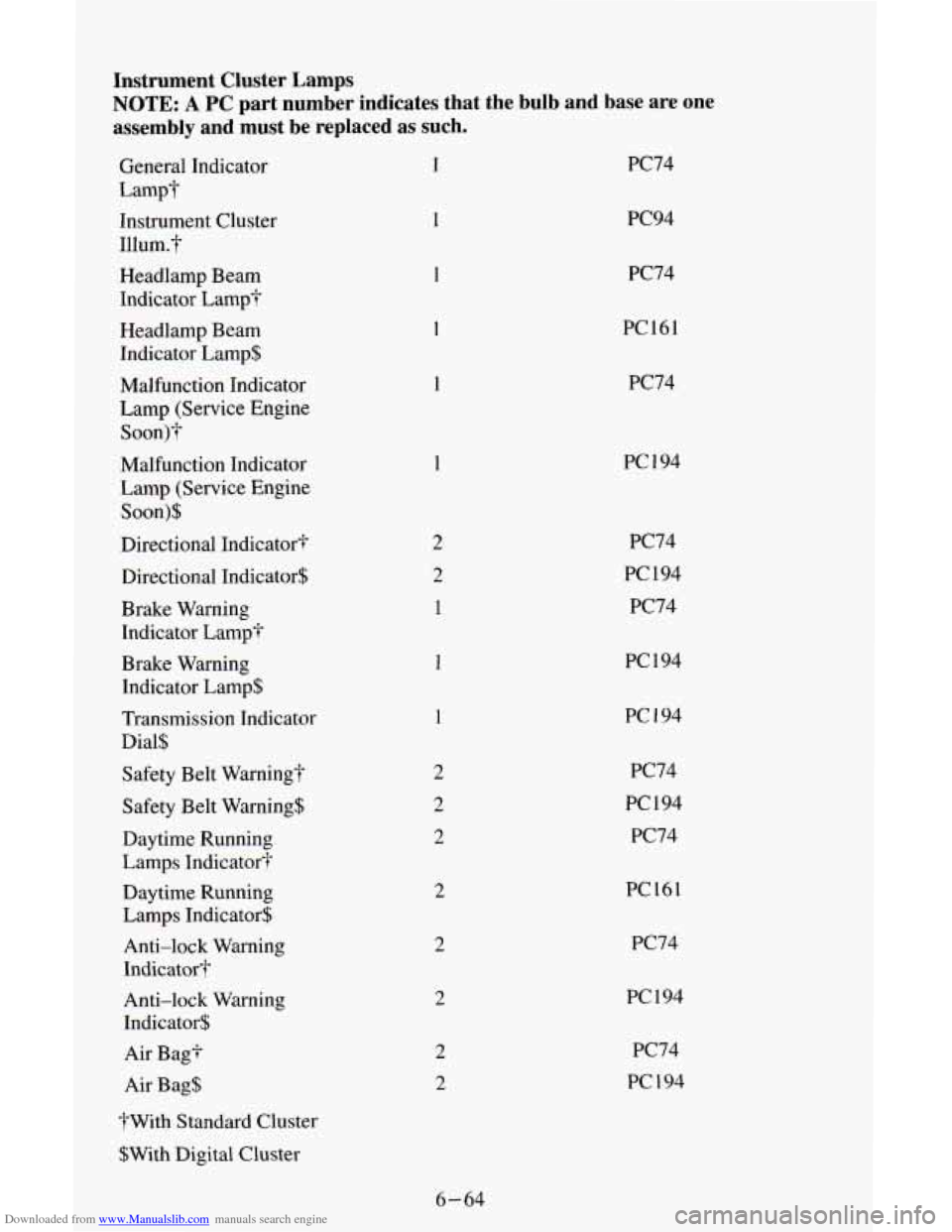
Downloaded from www.Manualslib.com manuals search engine Instrument Cluster Lamps
NOTE: A PC part number indicates that the bulb and base are one
assembly and must be replaced
as such.
General Indicator
Lamp?
Instrument Cluster
1llum.T
Headlamp Beam
Indicator Lamp?'
Headlamp Beam
Indicator Lamp$
Malfunction Indicator
Lamp (Service Engine Soon)?
Malfunction Indicator
Lamp (Service Engine Soon)$
Directional Indicator? Directional Indicator$ Brake Warning
Indicator Lamp?
Brake Warning
Indicator Lamp$
Transmission Indicator
Dial$
Safety Belt Warning?
Safety Belt Warning$
Daytime Running
Lamps Indicator?
Daytime Running Lamps Indicator$
Anti-lock Warning
Indicator?
Anti-lock Warning Indicator$
Air Bag?
Air Bag$
?With Standard Cluster
$With Digital Cluster 1
1
1
1
2
2
2
2
2
PC74
PC94
PC74
PC161
PC74
PC 194
PC74
PC 194
PC74
PC 194
PC 194 PC74
PC194 PC74
PC161
PC74
PC 194 PC74
PC 194
6-64
Page 280 of 342
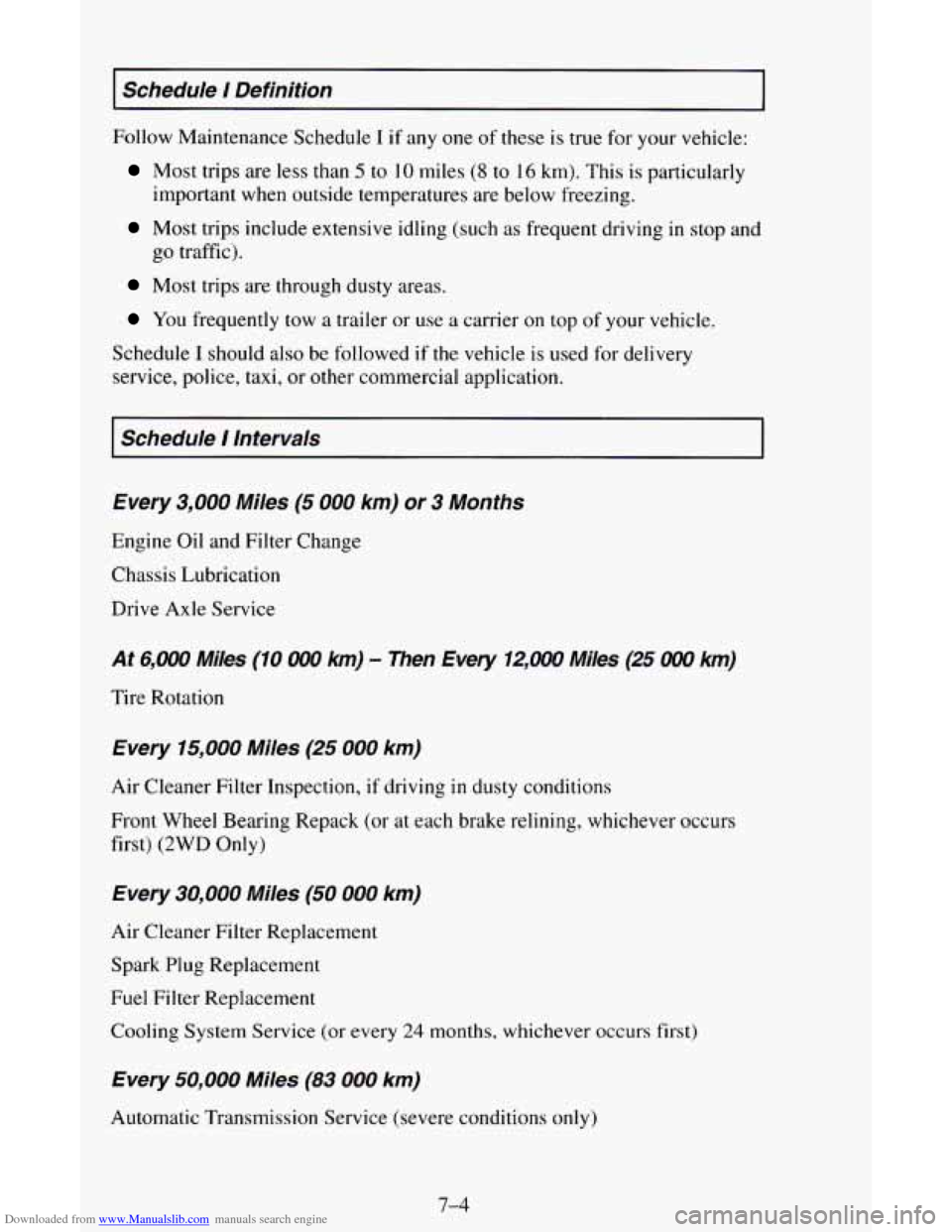
Downloaded from www.Manualslib.com manuals search engine I Schedule I Definition I
Follow Maintenance Schedule I if any one of these is true for your vehicle:
Most trips are less than 5 to 10 miles (8 to 16 km). This is particularly
important when outside temperatures are below freezing.
Most trips include extensive idling (such as frequent driving in stop and
Most trips are through dusty areas.
go traffic).
You frequently tow a trailer or use a carrier on top of your vehicle.
Schedule
I should also be followed if the vehicle is used for delivery
service, police, taxi,
or other commercial application.
I Schedule I Intervals I
Every 3,000 Miles (5 000 km) or 3 Months
Engine Oil and Filter Change
Chassis Lubrication
Drive Axle Service
At 6,000 Miles (10 OOO km) - Then Every 12,000 Miles (25 OOO km)
Tire Rotation
Every 15,000 Miles (25 000 km)
Air Cleaner Filter Inspection, if driving in dusty conditions
Front Wheel Bearing Repack
(or at each brake relining, whichever occurs
first)
(2WD Only)
Every 30,000 Miles (50 000 km)
Air Cleaner Filter Replacement
Spark Plug Replacement
Fuel Filter Replacement
Cooling System Service (or every
24 months, whichever occurs first)
Every 50,000 Miles (83 000 km)
Automatic Transmission Service (severe conditions only)
7-4
Page 281 of 342
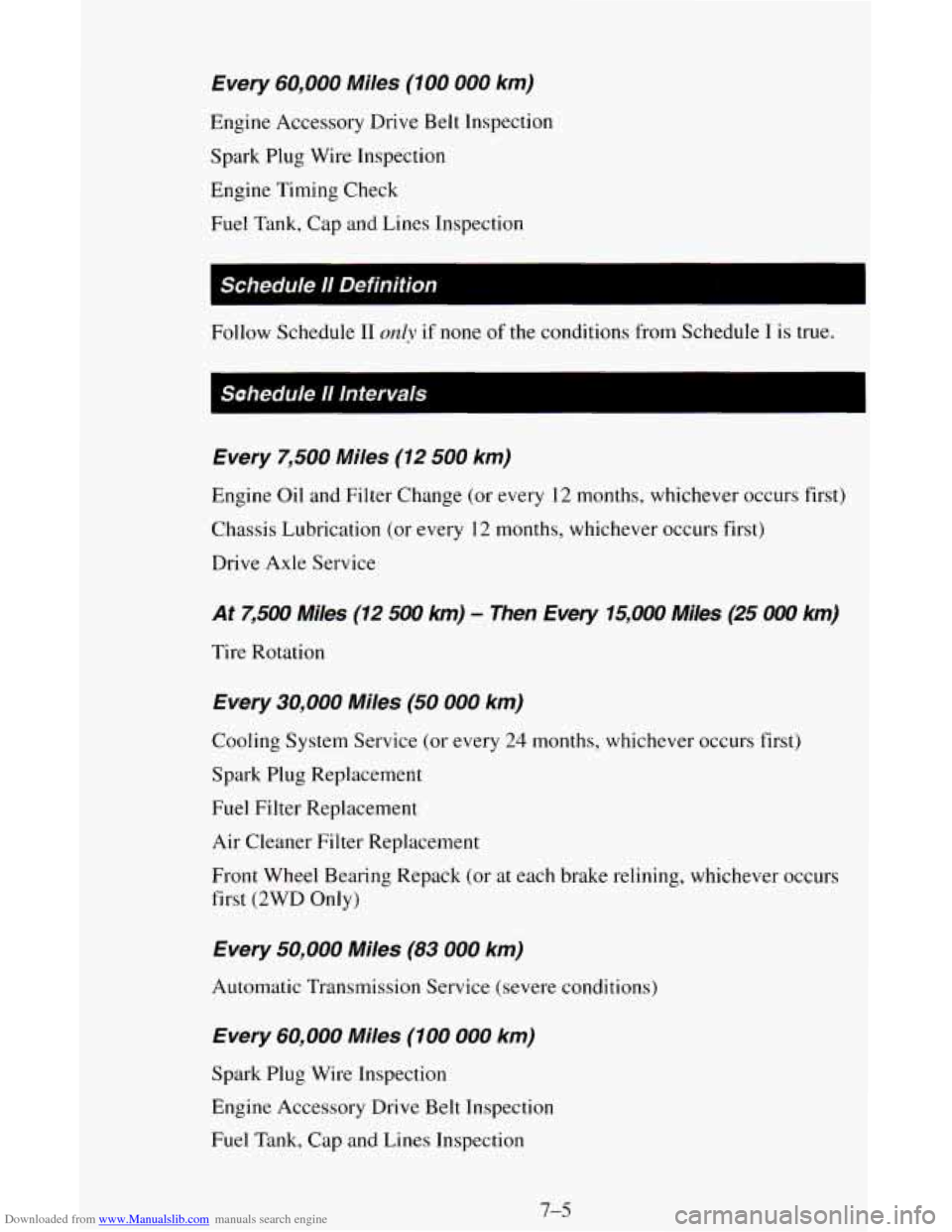
Downloaded from www.Manualslib.com manuals search engine Every 60,000 Miles (100 000 km)
Engine Accessory Drive Belt Inspection
Spark Plug Wire Inspection
Engine Timing Check
Fuel Tank. CaD and Lines Inspection
Schedule 11 Definition I
Follow Schedule I1 only if none of the conditions from Schedule I is true.
Sohedule I1 Intervals
Every
7,500 Miles (12 500 km)
Engine Oil and Filter Change (or every 12 months, whichever occurs first)
Chassis Lubrication (or every 12 months, whichever occurs first)
Drive Axle Service
At 7,500 Miles (12 500 km) - Then Every 15,000 Miles (25 000 km)
Tire Rotation
Every 30,000 Miles (50 000 km)
Cooling System Service (or every 24 months, whichever occurs first)
Spark Plug Replacement
Fuel Filter Replacement
Air Cleaner Filter Replacement
Front Wheel Bearing Repack (or at each brake relining, whichever occurs
first
(2WD Only)
Every 50,000 Miles (83 000 km)
Automatic Transmission Service (severe conditions)
Every 60,000 Miles (100 000 km)
Spark Plug Wire Inspection
Engine Accessory Drive Belt Inspection
Fuel Tank, Cap and Lines Inspection
7-5