1995 CHEVROLET ASTRO CARGO VAN coolant level
[x] Cancel search: coolant levelPage 72 of 342
Downloaded from www.Manualslib.com manuals search engine How long should you keep the coolant heater plugged in? The answer
depends
on the weather, the kind of oil you have, and some other things.
Instead
of trying to list everything here, we ask that you contact your GM
dealer in the area where you’ll be parking your vehicle. The dealer can give
you the best advice for that particular area.
Automatic Transmission
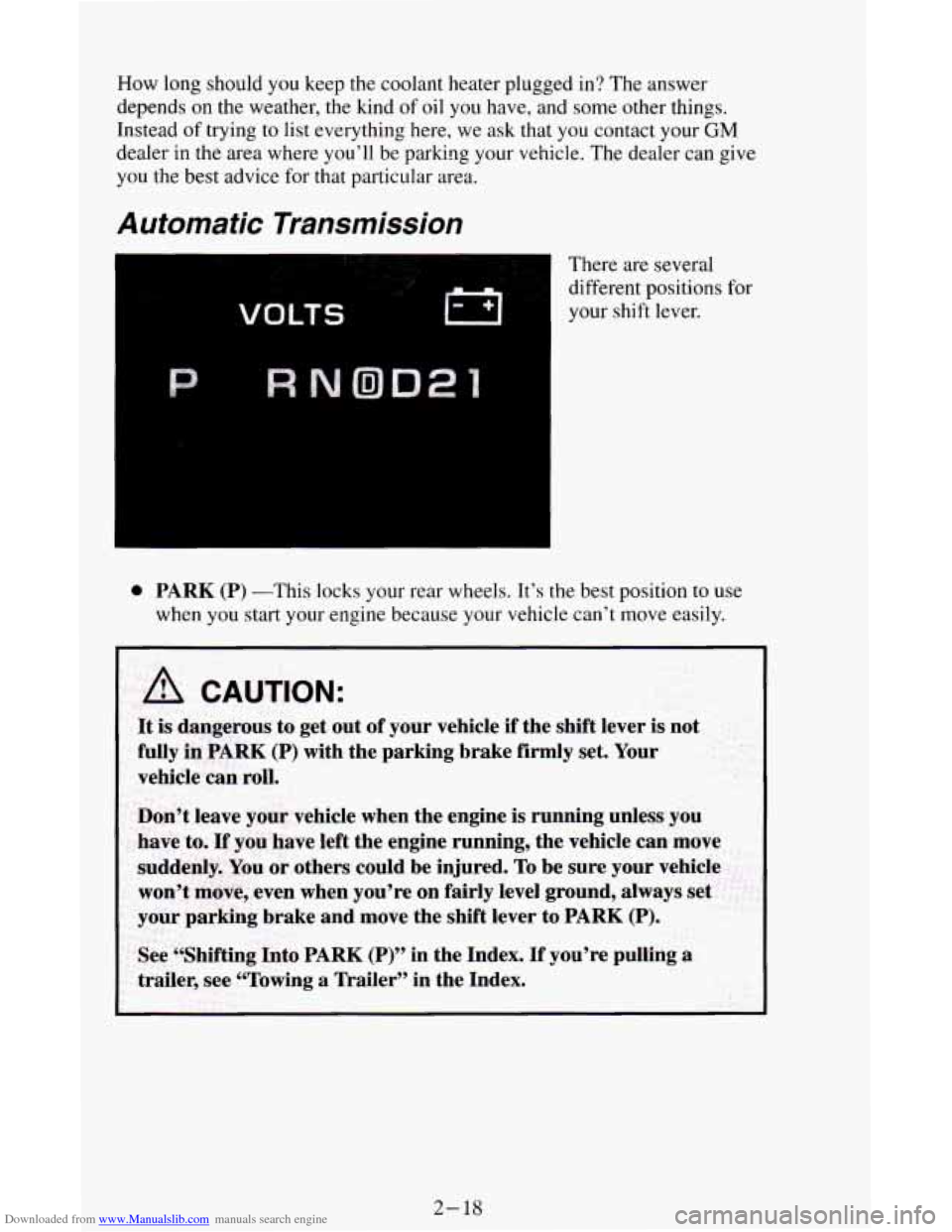
There are several
different positions for
your shift lever.
0 PARK (P) -This locks your rear wheels. It’s the best position to use
when you start your engine because your vehicle can’t move easily.
A CAUTION:
It is dangerous to get out of your vehicle if the shift lever is not I
fully in PARK (P) with the parking brake firmly set. Your
vehicle can roll.
Don’t leave your vehicle when the engine is running unless you
have to.
If you have left the engine running, the vehicle can move
suddenly.
You or others could be injured. To be sure your vehicle
won’t move, even when you’re on fairly level ground, always set
your parking brake and move the shift lever to PARK
(P). I
See “Shifting Into PARK (P)” in the Index. If you’re pulling a
trailer,
see “Towing a Trailer” in the Index.
2- 18
Page 170 of 342
Downloaded from www.Manualslib.com manuals search engine Driving On Grades
Reduce speed and shift to a lower gear before you start down a long or steep
downgrade. If
you don’t shift down, you might have to use your brakes so
much that they would get hot and no longer work well.
On a long uphill grade, shift down and reduce your speed to around
45 mph
(70 km/h) to reduce the possibility of engine and transmission overheating.
When towing at high altitude
on steep uphill grades, consider the following:
Engine coolant will boil at
a lower temperature than at normal altitudes. If
you turn your engine off immediately after towing at high altitude on steep
uphill grades, your vehicle may show signs similar to engine overheating.
To avoid this, let the engine run while parked (preferably on level ground)
with the automatic transmission
in PARK (P) for a few minutes before
turning the engine off. If you do get the overheat warning, see “Engine
Overheating”
in the Index.
Parking on Hills
You really should not park your vehicle, with a trailer attached, on a hill. If
something goes wrong, your rig could start to move. People can be injured,
and both your vehicle and the trailer can be damaged.
But if
you ever have to park your rig on a hill, here’s how to do it:
1. Apply your regular brakes, but don’t shift into PARK (P) yet. Turn your
wheels into the curb when facing downhill and away from the curb
when facing uphill.
2. Have someone place chocks under the trailer wheels.
3. When the wheel chocks are in place, release the regular brakes until the
chocks absorb the load.
4. Reapply the regular brakes, Then apply your parking brake, and shift to
5. Release the regular brakes.
PARK (P).
When You Are Ready to Leave After Parking on a Hill
1. Apply your regular brakes and hold the pedal down while you:
Start your engine;
Shift into a gear; and
0 Release the parking brake.
2. Let up on the brake pedal.
3. Drive slowly until the trailer is clear of the chocks.
4. Stop and have someone pick up and store the chocks.
4-32
Page 187 of 342
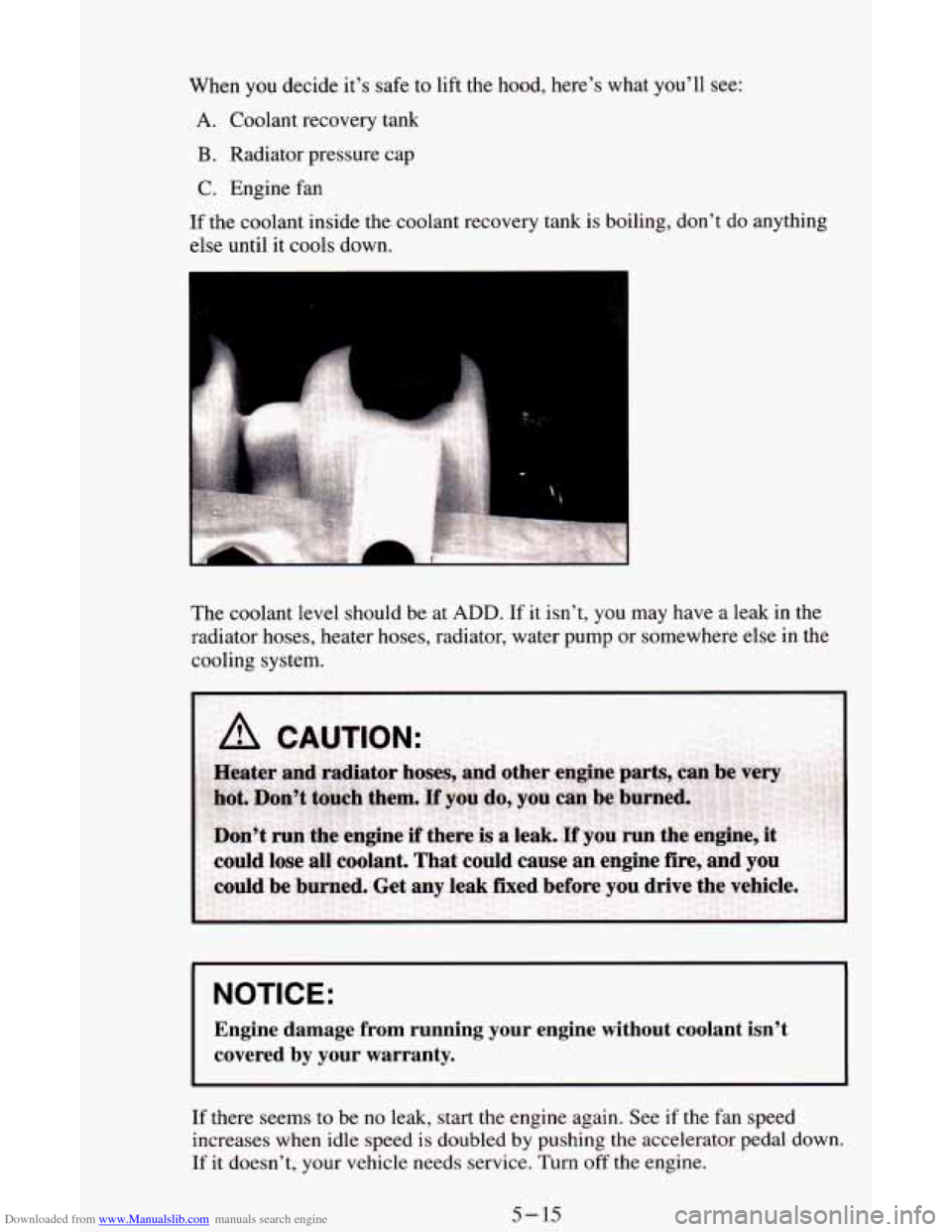
Downloaded from www.Manualslib.com manuals search engine When you decide it’s safe to lift the hood, here’s what you’ll see:
A. Coolant recovery tank
B. Radiator pressure cap
C. Engine fan
If the coolant inside the coolant recovery tank is boiling, don’t do anything
else until it cools down.
The coolant level should be at
ADD. If it isn’t, you may have a leak in the
radiator hoses, heater hoses, radiator, water pump
or somewhere else in the
cooling system.
NOTICE:
Engine damage from running your engine without coolant isn’t \
covered by your warranty.
If there seems to be no leak, start the engine again. See if the fan speed
increases when idle speed is doubled
by pushing the accelerator pedal down.
If it doesn’t, your vehicle needs service. Turn off the engine.
5-15
Page 188 of 342
Downloaded from www.Manualslib.com manuals search engine How to Add Coolant to the Coolant Recovery Tank
If you haven’t found a problem yet, but the coolant level isn’t at ADD , add
a
50/50 mixture of clean water (preferably distilled) and a proper antifreeze
at the coolant recovery tank. (See “Engine Coolant” in the Index
for more
information about the proper coolant mix.)
NOTICE:
In cold weather, water can freeze and crack the engine, radiat\
or,
heater core and other parts. Use the recommended coolant.
I I
When the coolant in the coolant recovery tank is at ADD , start your
vehicle.
If
the overheat warning continues, there’s one more thing you can try. You
can add the proper coolant
mix directly to the radiator, but be sure the
cooling system is
cool before you do it.
5-14
Page 192 of 342
Downloaded from www.Manualslib.com manuals search engine 7. By this time the coolant level inside the radiator filler neck may be
lower.
If the level is lower, add more of the proper mix through the
filler neck until the level reaches the base
of the filler neck.
8. Then replace the pressure cap. At any time during this procedure if
coolant begins to flow out of the filler neck, reinstall the pressure cap.
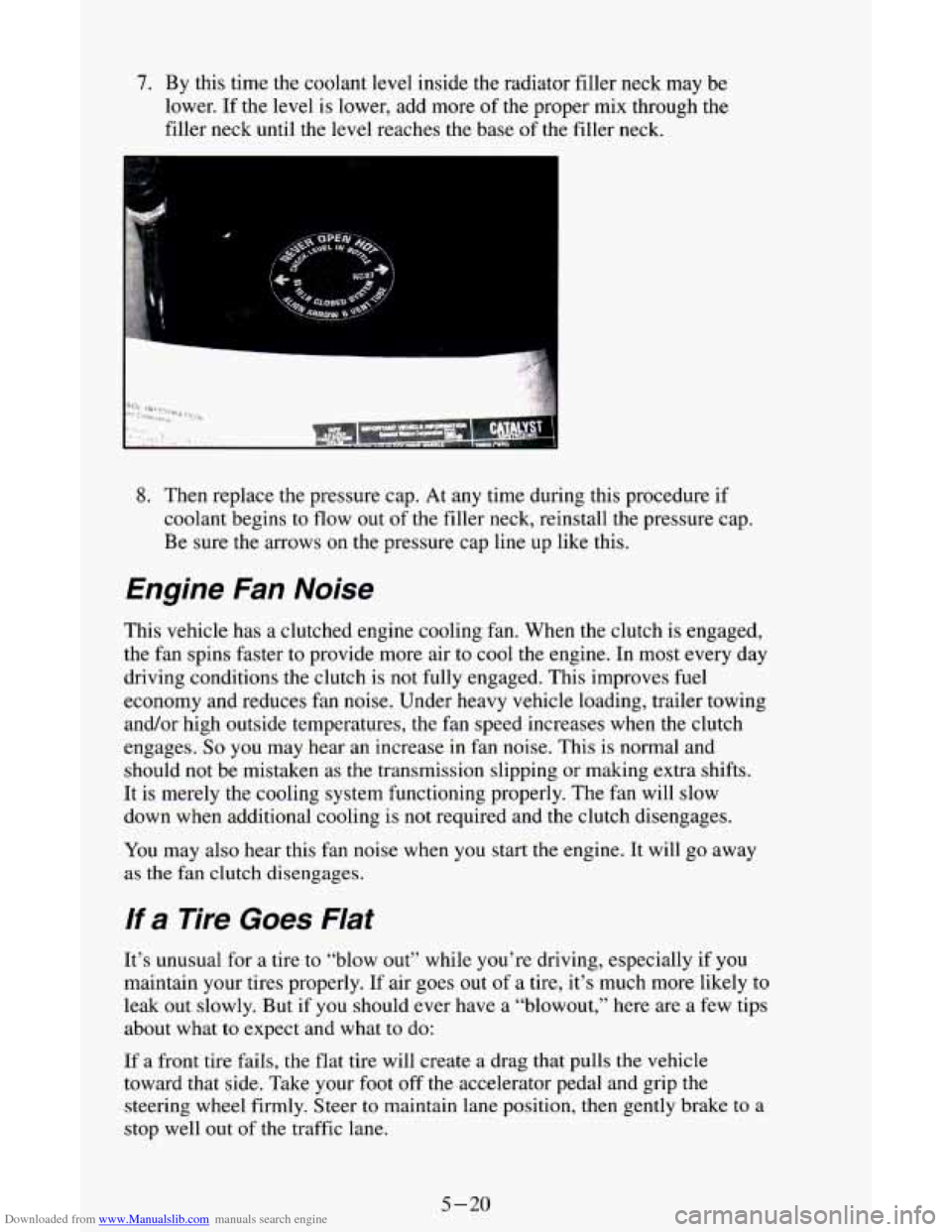
Be sure the arrows on the pressure cap line
up like this.
Engine Fan Noise
This vehicle has a clutched engine cooling fan. When the clutch is engaged,
the fan spins faster to provide more air to cool the engine. In most every day
driving conditions the clutch is not fully engaged. This improves fuel
economy and reduces fan noise. Under heavy vehicle loading, trailer towing
and/or high outside temperatures, the fan speed increases when the clutch
engages.
So you may hear an increase in fan noise. This is normal and
should not be mistaken
as the transmission slipping or making extra sh
It is merely the cooling system functioning properly. The fan will slow
down when additional cooling is not required and the clutch disengage .ifts.
S.
You may
also hear this fan noise when you start the engine. It will go away
as the fan clutch disengages.
If a Tire Goes Flat
It’s unusual for a tire to “blow out” while you’re driving, especially if you
maintain your tires properly.
If air goes out of a tire, it’s much more likely to
leak out slowly. But if you should ever have a “blowout,” here are a few tips
about what
to expect and what to do:
If
a front tire fails, the flat tire will create a drag that pulls the vehicle
toward that side. Take your foot off the accelerator pedal and grip the
steering wheel firmly. Steer
to maintain lane position, then gently brake to a
stop well out of the traffic lane.
5-20
Page 232 of 342
Downloaded from www.Manualslib.com manuals search engine NOTICE:
If you use an improper coolant mix, your engine could overheat
and be badly damaged. The repair cost wouldn’t be covered by
your warranty.
Too much water in the mix can freeze and crack
the engine, radiator, heater core and other parts.
Some conditions, such as air trapped in the cooling system, can affect the
coolant level in the radiator. Check the coolant level when the engine is cold
and follow the steps under “Adding Coolant” for the proper way to add
coolant.
If you have to add coolant more than four times a year, have your dealer
check your cooling system.
NOTICE:
If YOU use the proper coolant, you don’t have to add extra
inhibitors or additives which claim to improve the system. These
can be harmful.
Adding Coolant
6-24
Page 233 of 342
Downloaded from www.Manualslib.com manuals search engine To Check Coolant
When your engine is cold, the coolant level should be at ADD, or a little
higher. When your engine is warm,
the level should be up to FULL HOT, or
a little higher.
To Add Coolant
If you need more coolant, add the proper mix at the coolant recovery tank.
~~ ~
Add coolant mix at the recovery tank, but be careful not to spill it.
6-25
Page 287 of 342
Downloaded from www.Manualslib.com manuals search engine Maintenance Schedule I
30,000 Miles (50 000 km)
0
0
0
0
0
0
Change engine oil and filter (or every 3 months, whichever occurs
first).
An Emission Control Service.
Lubricate the front suspension, ball joints and king pin bushings,
steering linkage and transfer case shift linkage, parking brake cable
guides, and brake pedal springs at every
oil change (or every 6 months,
whichever occurs first).
Check redfront axle fluid
level and add fluid as needed. Check
constant velocity joints and
axle seals for leaking.**
Drain, flush and refill cooling system
(or every 24 months, whichever
occurs first). See “Engine Coolant’’
in the Index for what to use.
Inspect hoses. Clean radiator, condenser, pressure cap and neck.
Pressure test
the cooling system and pressure cap. An Emission
Control Service.
For 2-Wheel Drive vehicles only: Clean and repack the front wheel
bearings (or at each brake relining, whichever occurs first).
Replace spark plugs.
An Emission Control Service.
Replace fuel filter. An Emission Control Service.
Replace air cleaner filter. Replace filter more often under dusty
conditions. An Emission Control Service.
Rotate tires. See “Tire Inspection and Rotation” in the Index for proper
rotation pattern and additional information.
I DATE I ACTUALMILEAGE I SERVICED BY: I
7-1 1