Page 202 of 342
Downloaded from www.Manualslib.com manuals search engine 5
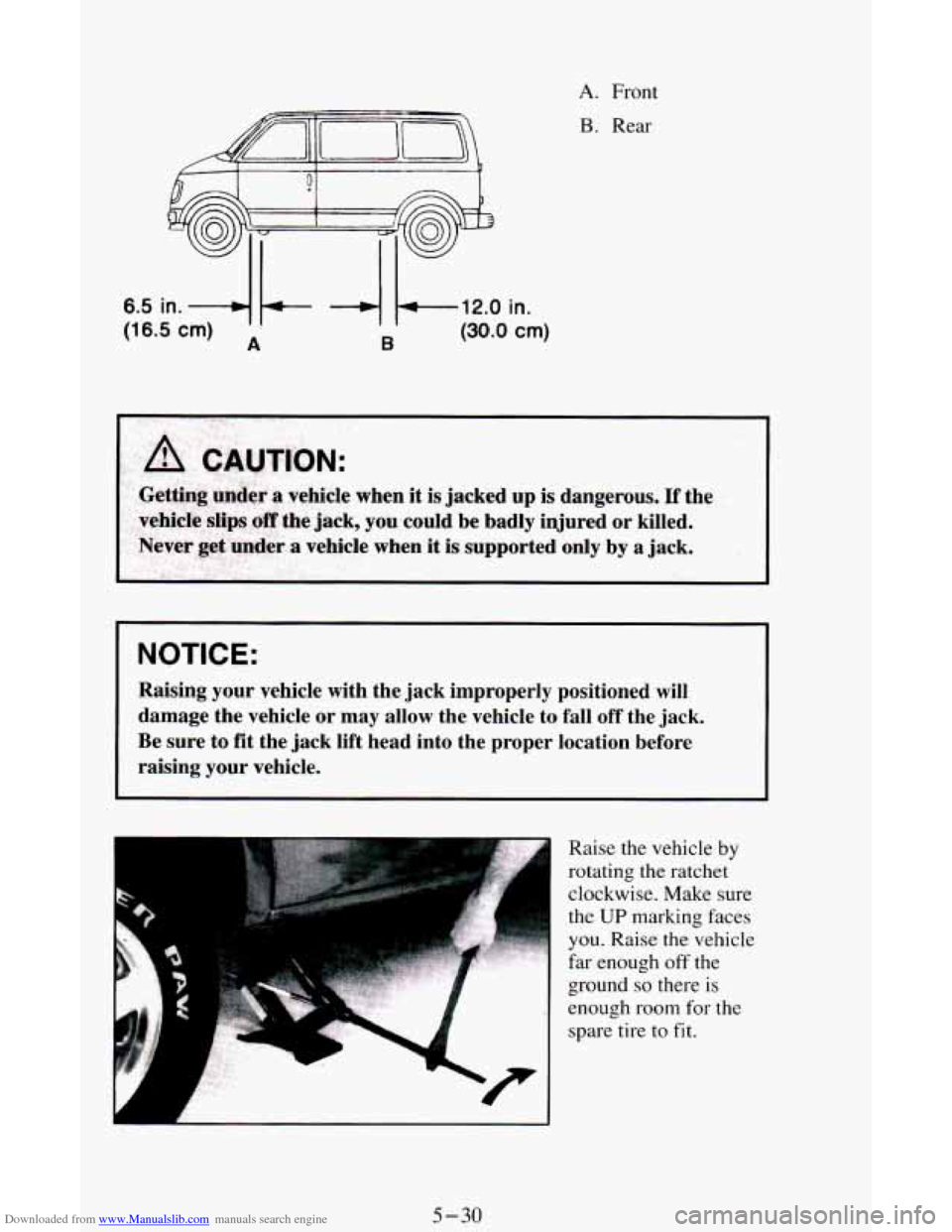
6.5 in. -4 b- -4 k-,l2.0 in.
(16.5 cm) A B (30.0 em)
A. Front
B. Rear
NOTICE:
Raising your vehicle with the jack improperly positioned will
damage the vehicle or may allow the vehicle to fall off the \
jack.
Be sure to fit the jack lift head into the proper location b\
efore
raising your vehicle.
I
Raise the vehicle by
rotating the ratchet
clockwise. Make sure
the
UP marking faces
you. Raise the vehicle
far enough
off the
ground
so there is
enough room for the
spare tire
to fit.
5-30
Page 204 of 342
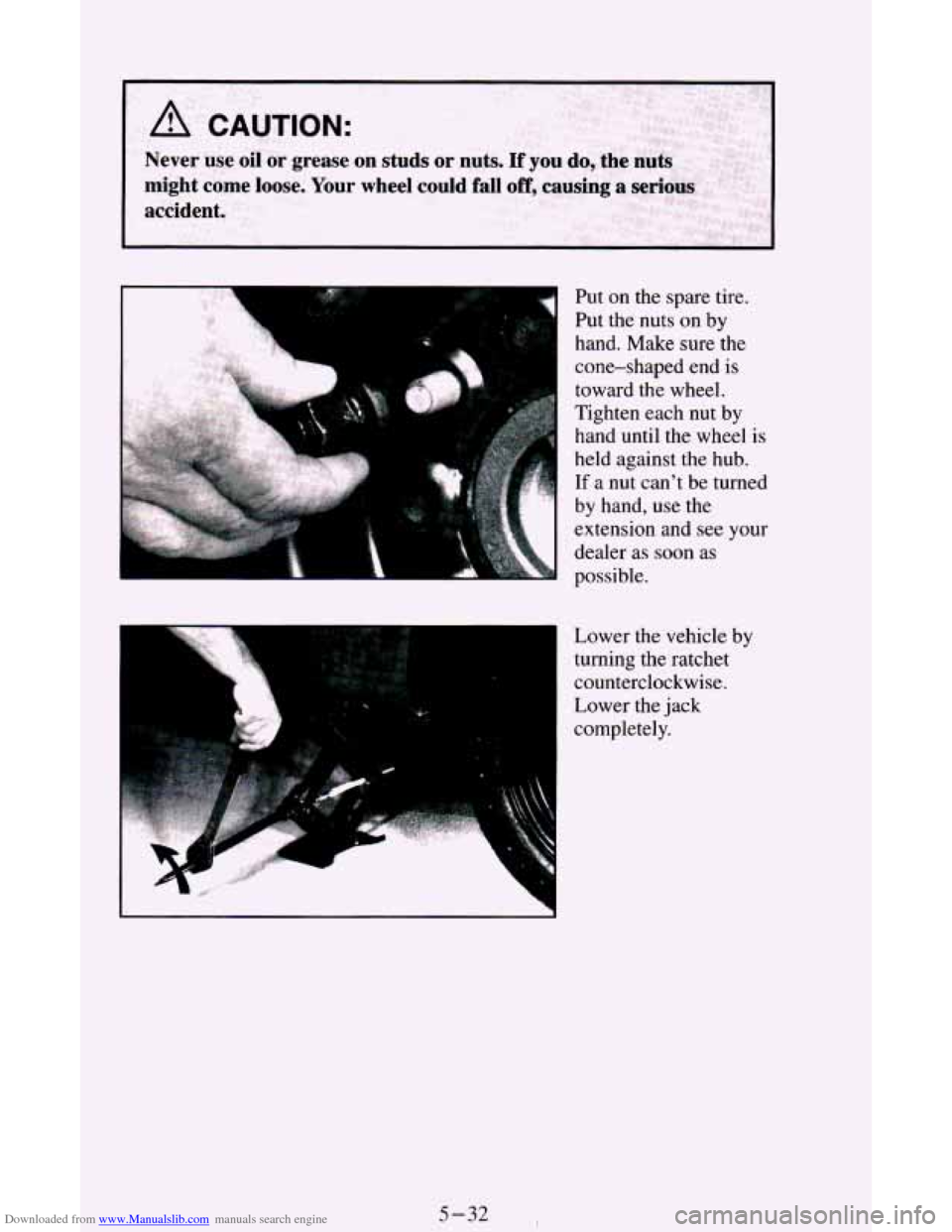
Downloaded from www.Manualslib.com manuals search engine Put on the spare tire.
Put the nuts
on by
hand. Make sure the
cone-shaped end
is
toward the wheel.
Tighten each nut by
hand until the wheel
is
held against the hub.
c If a nut can't be turned
by hand, use the
extension
and see your
dealer as soon
as
possible.
Lower the vehicle by
turning the ratchet
counterclockwise.
Lower the jack
completely.
5-32
Page 212 of 342
Downloaded from www.Manualslib.com manuals search engine By doing so, you can help clean the air, especially in those parts of the
country that have high ozone levels.
You should ask your service station operators
if their gasolines contain
deposit control additives and oxygenates, and if they have been
reformulated to reduce vehicle emissions.
Fuels in Foreign Countries
If you plan on driving in another country outside the U.S. or Canada,
unleaded fuel may be hard
to find. Do not use leaded gasoline. If you use
even one tankful, your emission controls won’t work well or at all. With
continuous
use, spark plugs can get fouled, the exhaust system can corrode,
and your engine oil can deteriorate quickly. Your vehicle’s oxygen sensor
will be damaged. All
of that means costly repairs that wouldn’t be covered
by your warranty.
To check on fuel availability, ask an auto club, or contact a major oil
company that does business
in the country where you’ll be driving.
You can also write us at the following address for advice. Just tell us where
you’re going and give your Vehicle Identification Number (VIN).
General Motors Overseas Distribution Corporation,
North American Export Sales (NAES)
1908 Colonel Sam Drive
Oshawa, Ontario
LlH
8P7
Filling Your Tank
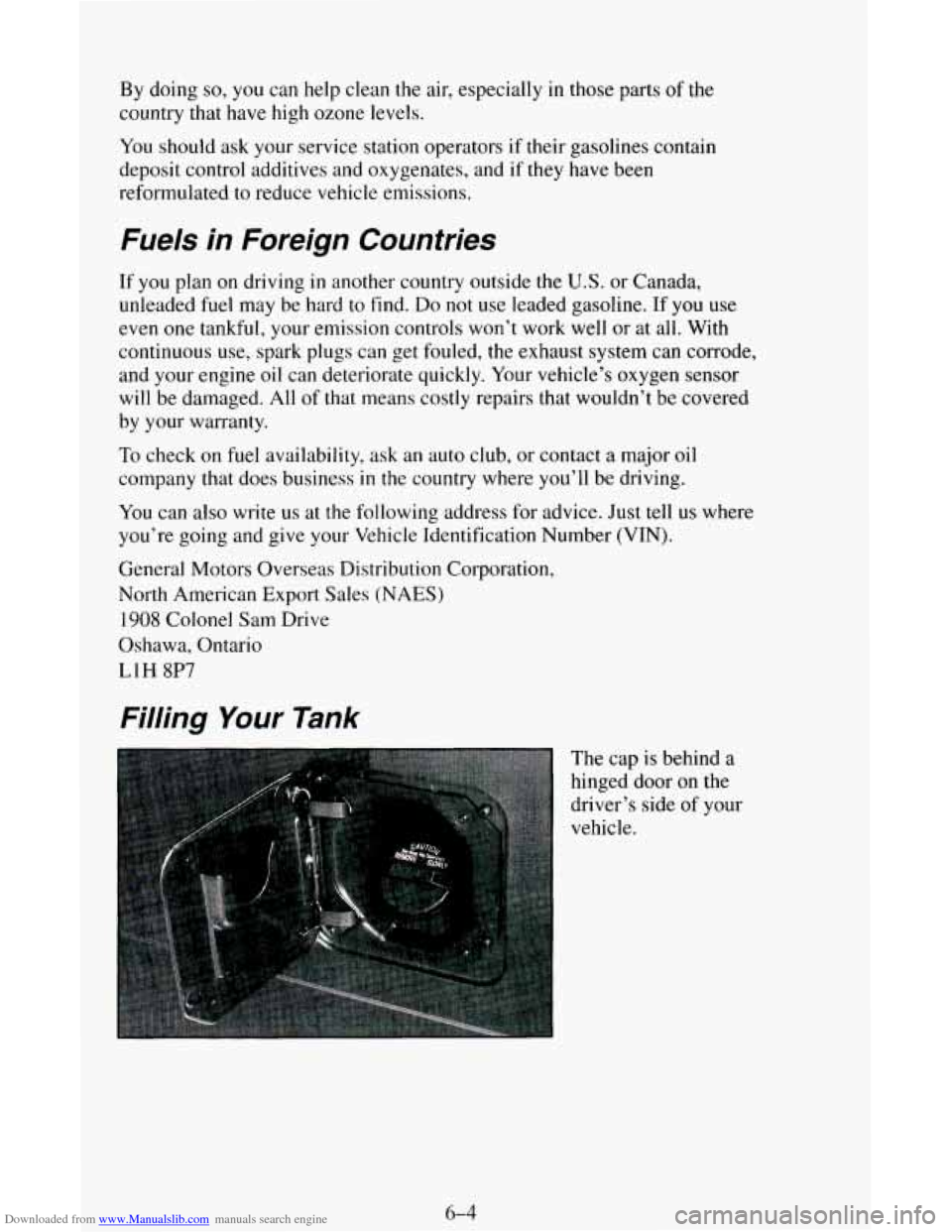
The cap is behind a
hinged door
on the
driver’s side
of your
vehicle.
6-4
Page 213 of 342
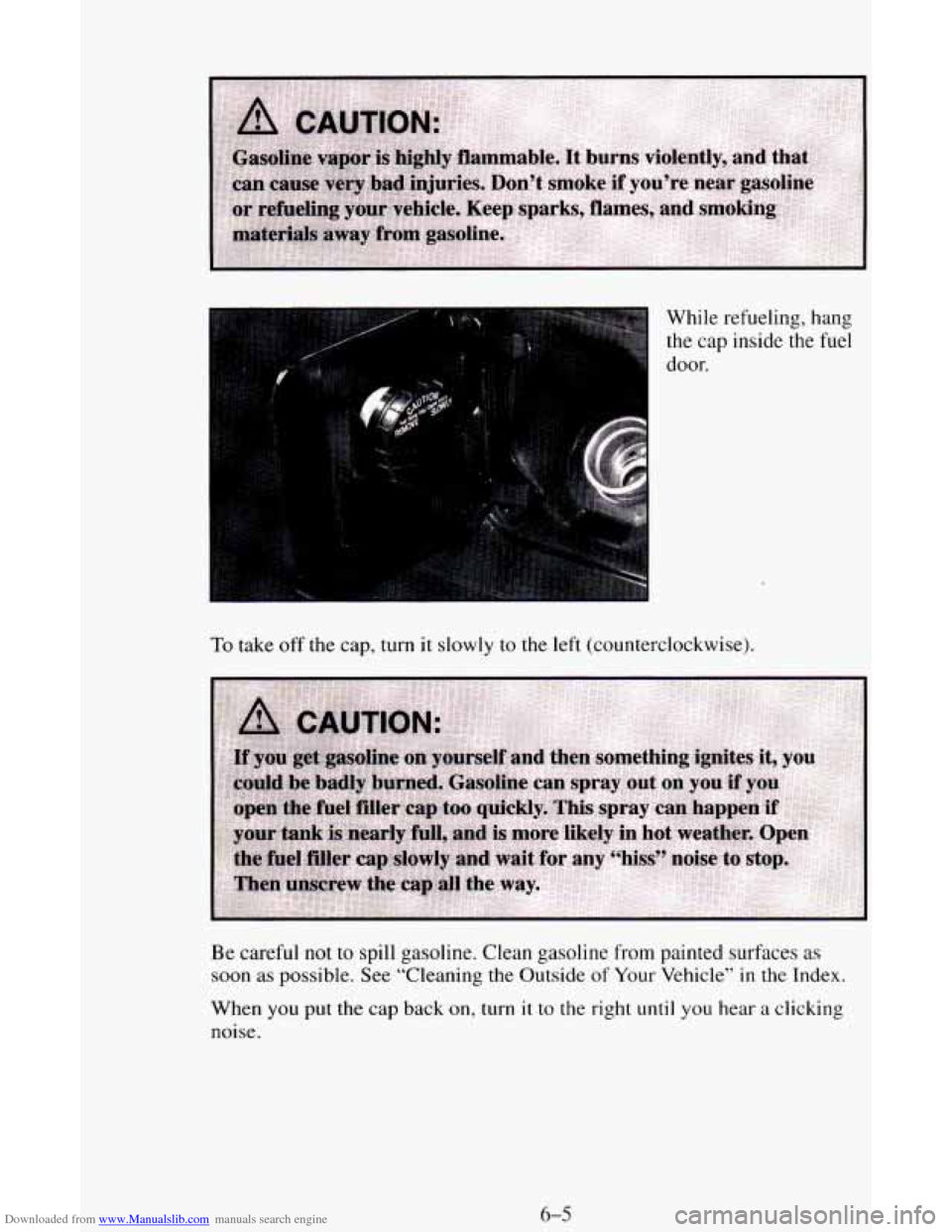
Downloaded from www.Manualslib.com manuals search engine While refueling, hang
the cap inside the fuel
door.
To take off the cap, turn it slowly to the left (counterclockwise).
Be careful not to spill gasoline. Clean gasoline from painted surfaces as
soon
as possible. See “Cleaning the Outside of Your Vehicle” in the Index.
When you put the cap back
on, turn it to the right until you hear a clicking
noise.
6-5
Page 214 of 342
Downloaded from www.Manualslib.com manuals search engine NOTICE:
If you need a new cap, be sure to get the right type. Your dea\
ler
can get one
for you. If you get the wrong type, it may not fit or
have proper venting, and your fuel tank and emissions system
might be damaged.
Checking Things Under the Hood
Hood Release
To open the hood, first
pull the handle inside
the vehicle on the
lower driver’s side of
the instrument panel.
Then
go to the front of
the vehicle and release
the secondary hood
release.
6-6
Page 217 of 342
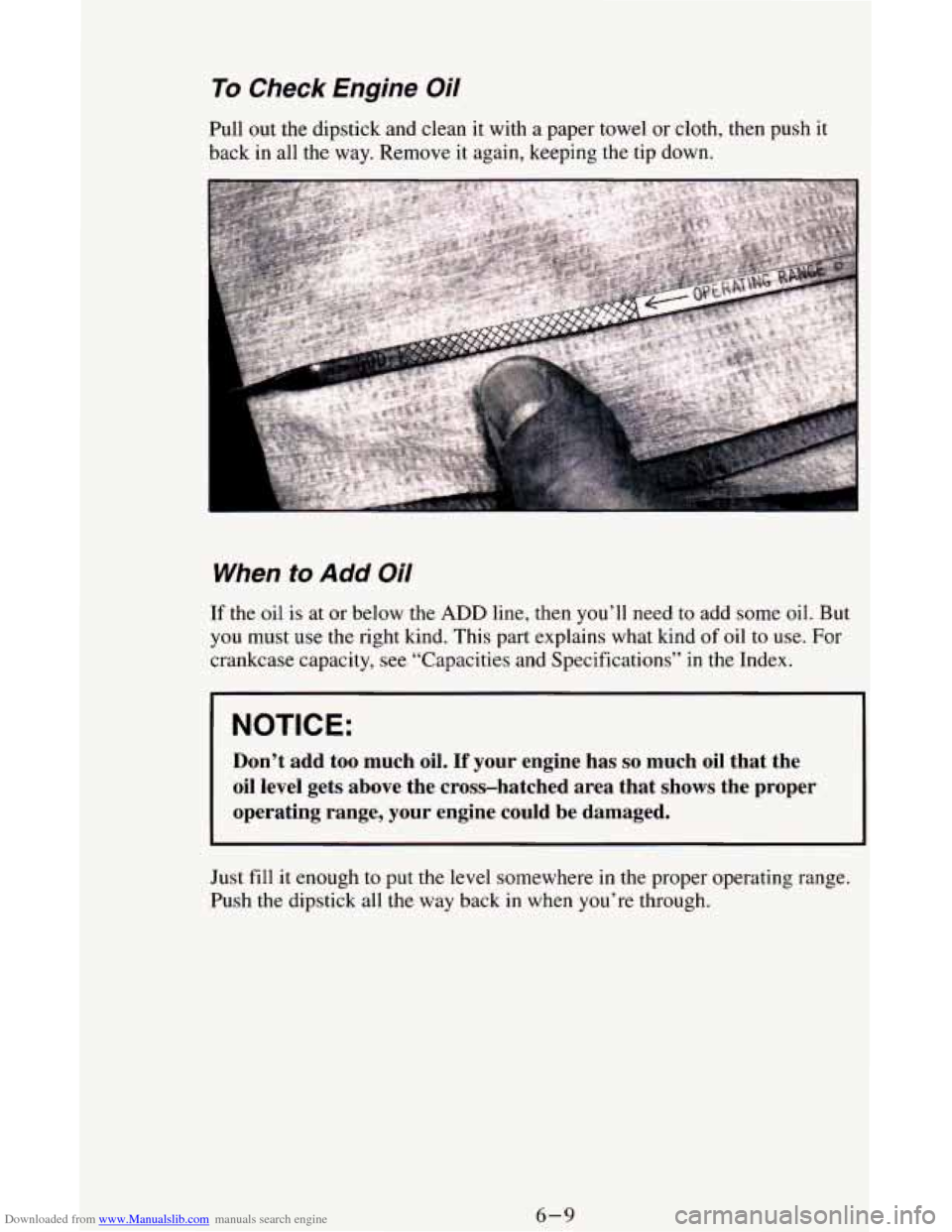
Downloaded from www.Manualslib.com manuals search engine To Check Engine Oil
Pull out the dipstick and clean it with a paper towel or cloth, then push it
back in all the way. Remove it again, keeping the tip down.
When to Add Oil
If the oil is at or below the ADD line, then you’ll need to add some oil. But
you must use the right kind. This part explains what kind
of oil to use. For
crankcase capacity,
see “Capacities and Specifications” in the Index.
NOTICE:
Don’t add too much oil. If your engine has so much oil that the
oil level gets above the cross-hatched area that shows the pro\
per
operating range, your engine could be damaged.
Just fill it enough to put the level somewhere in the proper operating range.
Push the dipstick all the way back in when you’re through.
6-9
Page 219 of 342
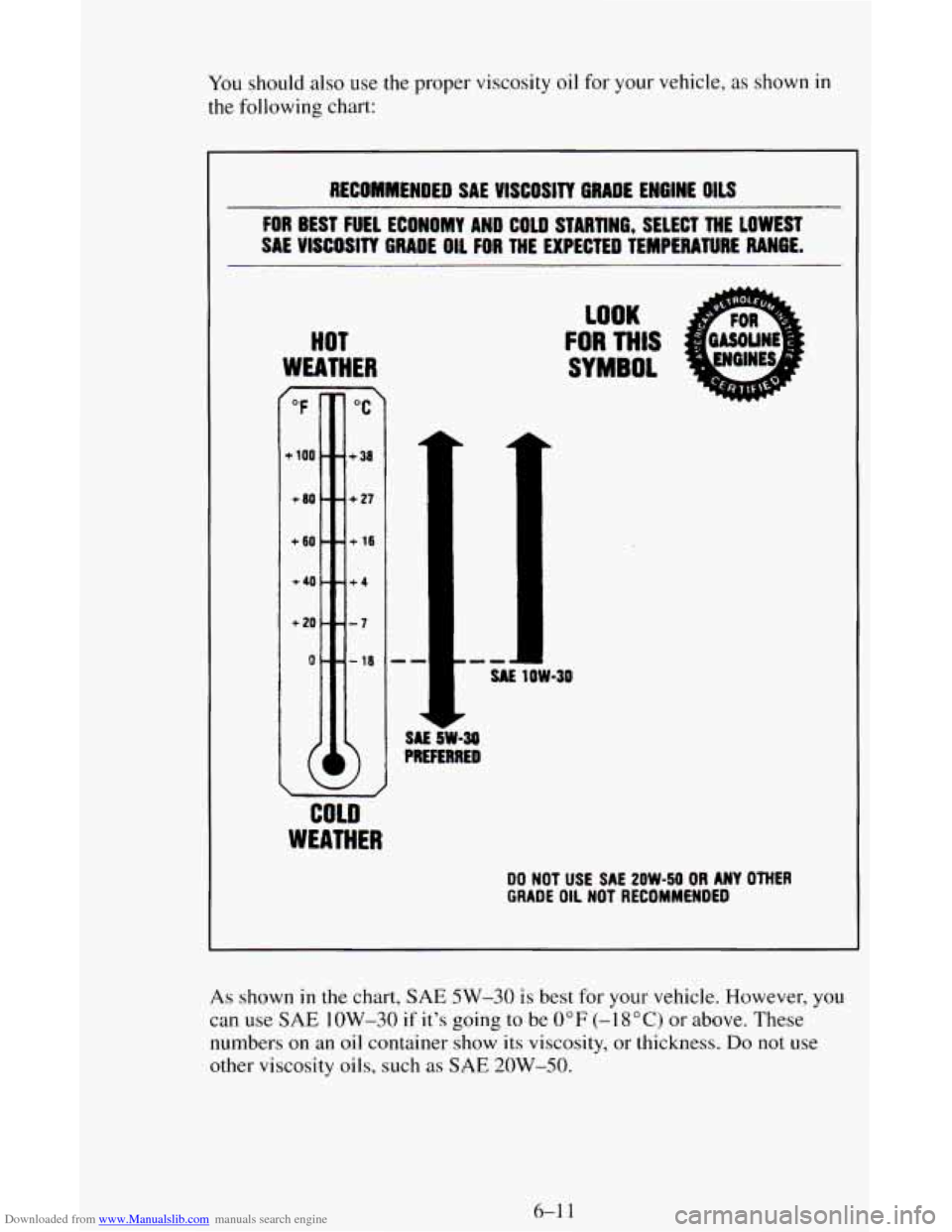
Downloaded from www.Manualslib.com manuals search engine You should also use the proper viscosity oil for your vehicle, as shown in
the following chart:
RECOMMENDED SAE VISCOSITY QRADE ENGINE OILS
FOR BEST FUEL ECONOMY AND COW STARTING, SELECT THE LOWEST
SAP VISCOSITY GRADE OIL FOR THE EXPECTED TEMPERATURE RANGE. ~~
LOOK
FOR THtS
SYMBOL
HOT
WEATHER
t
1
COLD
WEATHER
DO NOT USE SAE 2OW-50 OR ANY OTHER
GRADE OIL NOT RECOMMENDED
As shown in the chart, SAE 5W-30 is best for your vehicle. However, you
can use SAE 1 OW-30 if it's going to be 0°F (-1 SOC) or above. These
numbers on an oil container show
its viscosity, or thickness. Do not use
other viscosity oils, such as SAE 2OW-50.
6-1 1
Page 220 of 342
Downloaded from www.Manualslib.com manuals search engine I NOTICE:
Use only engine oil with the American Petroleum Institute Certified For Gasoline Engines “Starburst” symbol. Failure \
to
use the proper oil can result in engine damage not covered by\
your warranty.
GM Goodwrench@ oil (in Canada, GM Engine Oil) meets all the
requirements for your vehicle.
Engine Oil Additr’ves
Don’t add anything to your oil. Your GM dealer is ready to advise if you
think something should be added.
When to Change Engine Oil
See if any one of these is true for you:
Most trips are less than 5 to 10 miles (8 to 16 km). This is particularly
Most trips include extensive idling (such as frequent driving in stop and
important
when outside temperatures are below freezing.
go traffic).
0 Most trips are through dusty areas.
You frequently tow a trailer or use a carrier on top of your vehicle.
If any one of these is true for your vehicle, then you need to change your oil
and filter every
3,000 miles (5 000 km) or 3 months - whichever comes
first.
If
none of them is true, change the oil and filter every 7,500 miles (12 500
km) or 12 months - whichever comes first.
Engine Coolant Heater
An engine coolant heater can be a big help if you have to park outside in
very cold weather,
0 OF (-1 8 O C) or colder. If your vehicle has this option,
see “Engine Coolant Heater’’ in the Index.
What to Do with Used Oil
Did you know that used engine oil contains certain elements that may be
unhealthy for your skin and could even cause cancer? Don’t
let used oil stay
on your skin for very long. Clean your skin and nails with soap and water,
or a good hand cleaner. Wash or properly throw away clothing or rags
containing used engine oil. (See the manufacturer’s warnings about the use
and disposal of oil products.)
6- 12