Page 251 of 410
Downloaded from www.Manualslib.com manuals search engine Don’t have your vehicle towed on the front wheels, unless you must. If the
vehicle must be towed
on the front wheels, don’t go more than 35 mph
(56 kmih) or farther than 25 miles (40 km) or your transaxle will be
damaged. If these limits must be exceeded, then the front wheels have to
be supported on a dolly.
ENGINE OVERHEATING
The Driver Information Center will display either ENGINE COOLANT
HOT-IDLE ENGINE
or STOP ENGINE ENGINE OVERHEATING.
In addition you will find the warning light about a hot engine
on your
instrument panel
on Canadian vehicles.
6-4
Overheated Engine Protection Operating Mode
Should a low coolant condition exist and the message STOP ENGINE
ENGINE OVERHEATING is displayed, an overheat protection mode
which alternates firing groups
of four cylinders helps prevent engine
damage. This operating mode allows your vehicle
to be driven to a safe
place in an emergency; you may drive
up to 50 miles (80 km). Towing a
trailer
in the overheat protection mode should be avoided.
5-12
Page 253 of 410
Downloaded from www.Manualslib.com manuals search engine NOTICE:
-
If your engine catches fire because you keep driving with no
coolant, your vehicle can be badly damaged. The costly repairs
I-
would not be covered by your warranty. See “Overheated Engine
Protection Operating Mode” in the Index.
I‘
lj?Nu Steam Is Coming From Your Engine
If you get the overheat warning but see or hear no steam, the problem may
not be too serious. Sometimes the engine can get
a little too hot when you:
-
0 Climb a long hill on a hot day.
Stop after high speed driving.
Idle for long periods in traffic.
0 Tow a trailer.
If you get the overheat warning with no sign
of steam, try this for a minute
or
so:
1. Turn off your air conditioner.
2. Dial temperature control to the highest heat setting and open the
window, as necessary.
3. If you’re in a traffic jam, shift to NEUTRAL (N); otherwise, shift to
the highest gear while driving
-- AUTOMATIC OVERDRIVE (@) or
THIRD
(3). -
If you no longer have the overheat warning, you can drive. Just to be safe,
drive slower for about
10 minutes. If the warning doesn’t come back on,
you can drive normally.
L
c4
If the warning continues, pull over, stop, and park your vehicle right away.
If there’s still no sign of steam, you can idle the engine for two or three
minutes while you’re parked, to see if the warning stops. But then, if you
still have the warning,
turn ofithe engine and get everyone out of the vehicle
until it cools down. Also see “Overheated Engine Protection Operating
Mode” listed previously
in this section.
You may decide not to lift the hood but to get service help right away.
5-14
Page 261 of 410
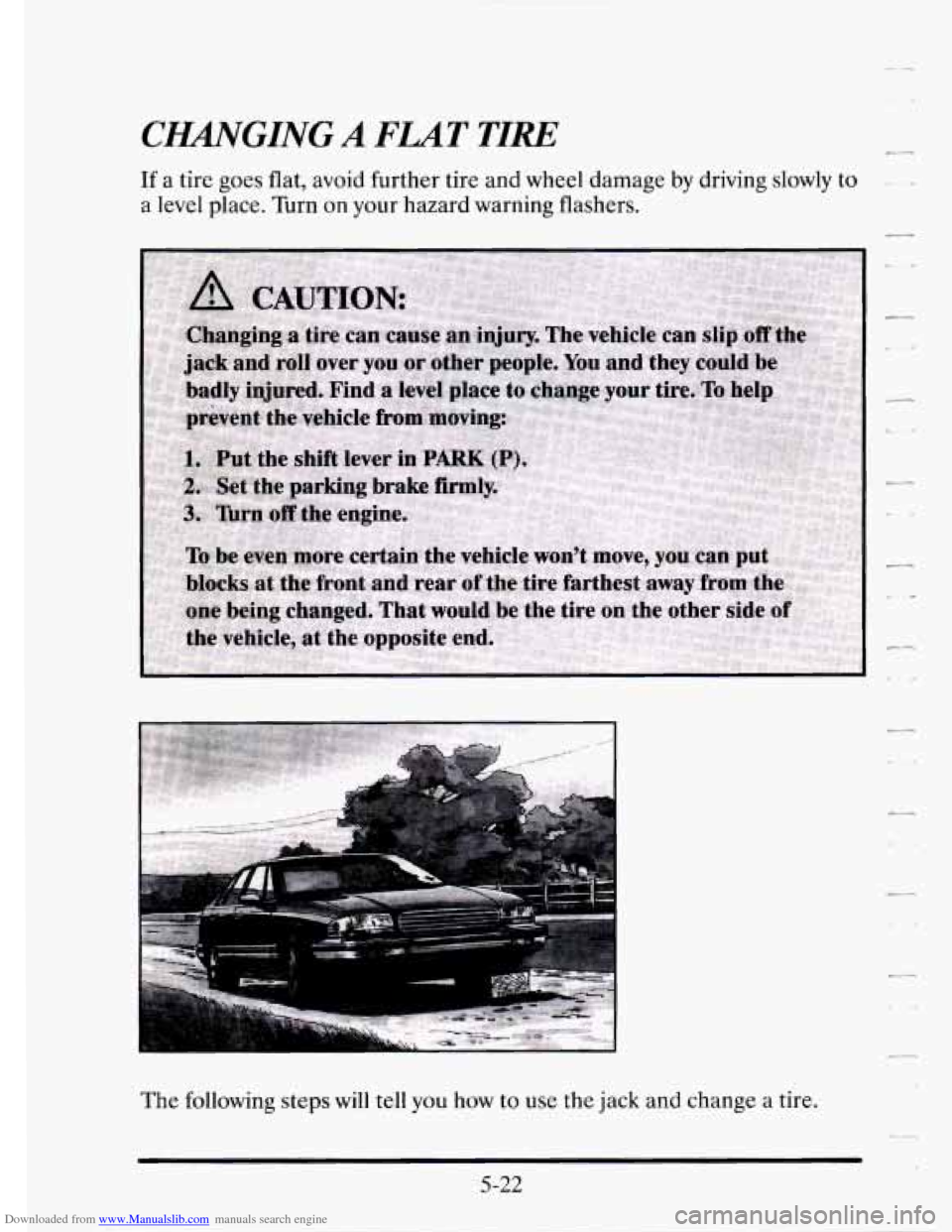
Downloaded from www.Manualslib.com manuals search engine C.GING A FLAT TIRE
If a tire goes flat, avoid further tire and wheel damage by driving slowly to
a level place. Turn on your hazard warning flashers.
The following steps will tell you how
to use the jack and change a tire.
5-22
Page 286 of 410
Downloaded from www.Manualslib.com manuals search engine - Engine Coolant Heater
An engine coolant heater can be a big help if you have to park outside in
very cold weather,
O°F (-HOC) or colder. If your vehicle has this option,
c- see “Engine Coolant Heater” in the Index.
What to Do with Used Oil
Did you know that used engine oil contains certain elements that may be
unhealthy for your skin and could even cause cancer? Don’t let used oil
stay on your skin
for very long. Clean your skin and nails with soap and
:water, or a good hand cleaner. Wash or properly throw away clothing or
rags containing used engine oil. (See the manufacturer’s warnings about
the use and disposal
of oil products.)
-
-__+
Used oil can be a real threat to the environment. If you change your own
oil, be sure
to drain all free-flowing oil from the filter before disposal.
Don’t ever dispose of oil by putting it in the trash, pouring it on the
ground, into sewers, or
into streams or bodies of water. Instead, recycle it
by taking it to a place that collects used oil. If you have a problem
properly disposing
of your used oil, ask your dealer, a service station or a
local recycling center for help.
6-15
Page 294 of 410
Downloaded from www.Manualslib.com manuals search engine -- ENGINE COOLANT
The following explains your cooling system and how to add coolant when
it
is low. If you have a problem with engine overheating, see “Engine
The proper coolant
for your Cadillac will:
Give freezing protection down to -34OF (-37OC).
m_ Overheating” in the Index.
Give boiling protection up to 262°F (128°C).
Protect against rust and corrosion.
Help keep the proper engine temperature.
Let the warning lights work as they should.
What to Use
Use a mixture of one-half clean water (preferably distilled) and one-half
antifreeze that meets
“GM Specification 1825M,” which won’t damage
aluminum parts. You can also use a recycled coolant conforming to GM
Specification 1825M with a complete coolant flush and refill. Use GM
Engine Coolant Supplement (sealer) with any complete coolant flush and
refill. If you use this mixture,
you don’t need to add anything else.
6-23
Page 301 of 410
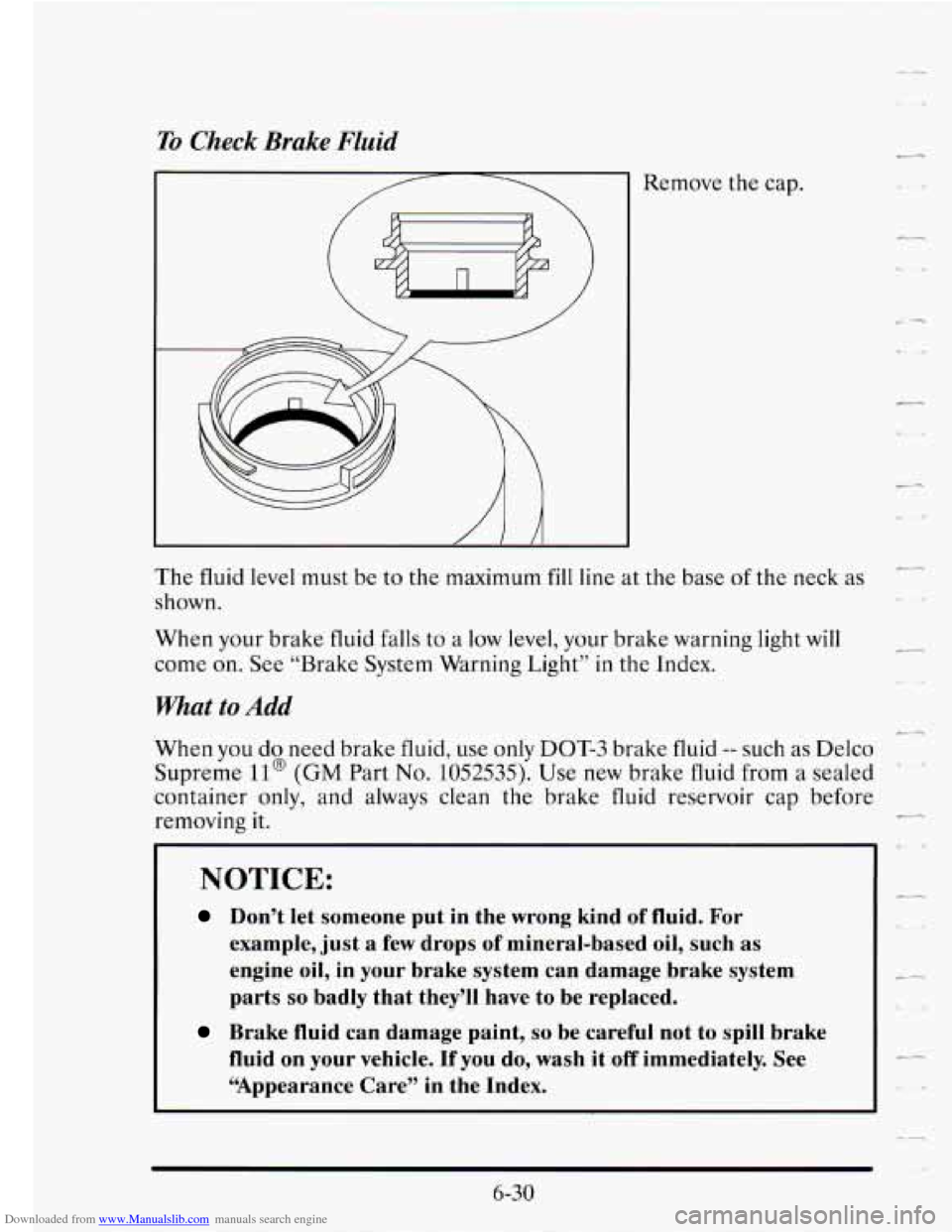
Downloaded from www.Manualslib.com manuals search engine To Check Brake Fluid
Remove the cap.
The fluid level must be to the maximum
fill line at the base of the neck as
shown. c_
When your brake fluid falls to a low level, your brake warning light will
come on. See “Brake System Warning Light”
in the Index.
Wat to Add
When you do need brake fluid, use only DOT-3 brake fluid -- such as Delco
Supreme
ll@ (GM Part No. 1052535). Use new brake fluid from a sealed
container only, and always clean the brake fluid reservoir cap before
removing
it.
NOTICE:
Don’t let someone put in the wrong kind of fluid. For
example, just
a few drops of mineral-based oil, such as
engine oil, in your brake system can damage brake system
parts
so badly that they’ll have to be replaced.
Brake fluid can damage paint, so be careful not to spill brake
fluid on your vehicle.
If you do, wash it off immediately. See
‘!Appearance Care” in the Index.
I-
--
I-
6-30
Page 302 of 410
Downloaded from www.Manualslib.com manuals search engine Brake Wear
C
Your Cadillac has four-wheel disc brakes.
Disc brake pads have built-in wear indicators that make a high-pitched
warning sound when the brake pads are worn and new pads are needed.
The sound may come and go or be heard all the time your vehicle is
moving (except when you are pushing on the brake pedal firmly).
NOTICE:
Continuing to drive with worn-out brake pads could result in
costly brake repair.
Some driving conditions or climates may cause a brake squeal when the
brakes are first applied or lightly applied. This does not mean somethine
is wrong with your brakes.
Brake linings should always be replaced as complete axle sets.
r Brake Pedal Travel
See your dealer if the brake pedal does not return to normal height, or if
there is a rapid increase in pedal travel. This could be a sign of brake
trouble.
Brake Adjustment
Every time you apply the brakes, with or without the vehicle moving, your
brakes adjust for wear.
P
6-3 1
Page 319 of 410
Downloaded from www.Manualslib.com manuals search engine Uniform Tire Quality Grading
The following information relates to the system developed by the United
States National Highway Traffic Safety Administration which grades tires
by treadwear, traction and temperature performance. (This applies only
to vehicles sold
in the United States.)
Treadwear
The treadwear grade is a comparative rating based on the wear rate of the
tire when tested under controlled conditions on a specified government
test course. For example,
a tire graded 150 would wear one and a half
(1 1/2) times as well on the government course as a tire graded 100. The
relative performance
of tires depends upon the actual conditions of their
use, however, and may depart significantly from the norm due to
variations in driving habits, service practices and differences in road
characteristics and climate.
Traction - A, B, C
The traction grades, from highest to lowest are: A, B, and C. They
represent the tire’s ability to stop on wet pavement as measured under
c_
controlled conditions on specified government test surfaces of asphalt and
concrete.
A tire marked C may have poor traction performance.
-
L-
Warning: The traction grade assigned to this tire is based on braking
(straight-ahead) traction tests and does not include cornering (turning)
traction.
Temperature - A, B, C
The temperature grades are A (the highest), B, and C, representing the
tire’s resistance to the generation
of heat and its ability to dissipate heat
when tested under controlled conditions
on a specified indoor laboratory .
test wheel. Sustained high temperature can cause the material of the tire
to degenerate and reduce tire life, and excessive temperature can lead
to -
sudden tire failure. The grade C corresponds to a level of performance
which all passenger car tires must meet under the Federal Motor Vehicle
Safety Standard
No. 109. Grades B and A represent higher levels of
performance on the laboratory test wheel than the minimum required
by law.
6-48