1995 CADILLAC SEVILLE mirror
[x] Cancel search: mirrorPage 175 of 410
Downloaded from www.Manualslib.com manuals search engine DEFROSTER
Press this button to remove
fog
or frost from the
windshield.
This setting sends most
of the airflow to the winds
amount to the floor outlets. ,hield
with only a small
6(
The fan speed will work automatically to maintain your requested interior
temperature. If you need more air directed to your windshield, you should
select a higher fan speed.
f4
In some cold start conditions, the AUTO blower fan speed may be limited
until the engine cooling system warms up. This is normal to prevent
windshield fogging.
a
It will help if you first clear any ice and snow from the hood and the air
inlet (it’s between the hood and the windshield).
EAR DEFOGGER
n Press this button to
@ defogger. turn on the rear
With it, your rear window and both outside rearview mirrors are heated,
The system will automatically shut off after 10 minutes. If further
defogging
is desired, simply press the button again.
NOTICE:
Scraping the inside of your rear window could cut and damage
the heating
grids. Your warranty would not cover this damage.
And don’t put decals there; you might have to
scrape them off. 1
I
13
a
a
c1
Page 207 of 410
Downloaded from www.Manualslib.com manuals search engine When it looks like a chance to pass is coming up, start to accelerate
but stay in the right lane and don’t get too close. Time your move
so
you will be increasing speed as the time comes to move into the other
lane. If the way is clear to pass, you
will have a “running start” that
more than makes up
for the distance you would lose by dropping back.
And if something happens
to cause you to cancel your pass, you need
only slow down and drop back again and wait for another opportunity.
take care that someone isn’t trying
to pass you as you pull out to pass
the slow vehicle. Remember
to glance over your shoulder and check
the blind spot.
Check your mirrors, glance over your shoulder, and start your left lane
change signal before moving
out of the right lane to pass. When you
are far enough ahead
of the passed vehicle to see its front in your
inside mirror, activate your right lane change signal and move back
into the right lane. (Remember that your right outside mirror is
convex. The vehicle you just passed may seem to be farther away from
you than it really is.)
Reconsider before passing the next vehicle.
If other cars are lined up to pass a slow vehicle, wait your turn. But
Try not to pass more than one vehicle at a time on two-lane roads.
Don’t overtake a slowly moving vehicle too rapidly. Even though the
brake lights are not flashing, it may be slowing down or starting to
turn.
0 If you’re being passed, make it easy for the following driver to get
ahead
of you. Perhaps you can ease a little to the right.
4-1 6
-4
.-
--J
Page 209 of 410
Downloaded from www.Manualslib.com manuals search engine If your vehicle starts to slide, ease your foot off the accelerator pedal and
quickly steer the way you want the vehicle
to go. If you start steering
quickly enough, your vehicle may straighten out. Always be ready for a
second skid
if it occurs.
Of course, traction is reduced when water, snow, ice, gravel, or other
material is on the road. For safety, you’ll want to
slow down and adjust
your driving to these conditions. It is important to slow down on slippery
surfaces because stopping distance will be longer and vehicle control
-
more limited.
r
While driving on a surface with reduced traction, try your best to avoid
sudden steering, acceleration, or braking (including engine braking by
shifting to a lower gear). Any sudden changes could cause the tires to
slide. You may not realize the surface is slippery until your vehicle is
skidding. Learn to recognize warning clues
-- such as enough water, ice or --
packed snow on the road to make a “mirrored surface” -- and slow down .
when you have any doubt.
Remember: Any anti-lock brake system
(ABS) helps avoid only the
braking skid.
4-18
c
Page 210 of 410
Downloaded from www.Manualslib.com manuals search engine h-
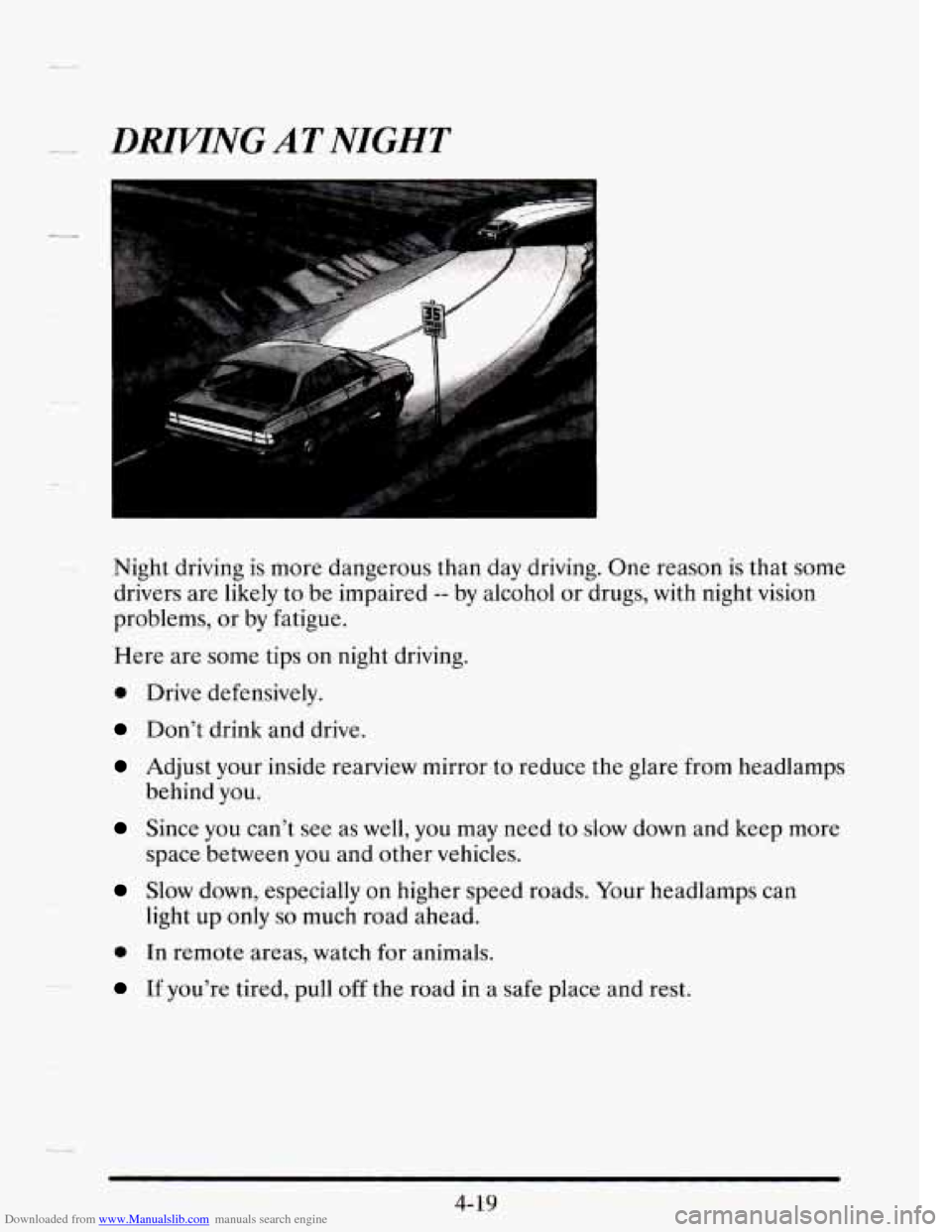
DRIPTNG AT NIGHT
Night driving is more dangerous than day driving. One reason is that some
drivers are likely to be impaired
-- by alcohol or drugs, with night vision
problems, or by fatigue.
Here are some tips on night driving.
0 Drive defensively.
Don’t drink and drive.
Adjust your inside rearview mirror to reduce the glare from headlamps
behind you.
Since you can’t see as well, you may need to slow down and keep more
space between you and other vehicles.
Slow down, especially on higher speed roads. Your headlamps can
light up
only so much road ahead.
0 In remote areas, watch for animals.
If you’re tired, pull off the road in a safe place and rest.
Page 217 of 410
Downloaded from www.Manualslib.com manuals search engine At the entrance there is usually a ramp that leads to the freeway. If you
have a clear view of the freeway as you drive along the entrance ramp, you
should begin to check traffic.
Try to determine where you expect to blend
with the
flow. Try to merge into the gap at close to the prevailing speed.
Switch on your turn signal, check your mirrors and glance over your
shoulder as often as necessary.
Try to blend smoothly with the traffic flow.
CI
Once you are on the freeway, adjust your speed to the posted limit or to
the prevailing rate if it’s slower. Stay in the right lane unless you want to
pass. -.
Before changing lanes, check your mirrors. Then use your turn signal.
Just before you leave the lane, glance quickly over your shoulder to make
sure there isn’t another vehicle in your “blind” spot.
Once you are moving
on the freeway, make certain you allow a reasonable -
following distance. Expect to move slightly slower at night.
When you want to leave the freeway, move to the proper lane well in
advance.
If you miss your exit do not, under any circumstances, stop and
back up. Drive
on to the next exit.
The exit ramp can be curved, sometimes quite sharply.
The exit speed
is usually posted.
Reduce your speed according to your speedometer, not to your sense of
motion. After driving for any distance at higher speeds, you may tend to
think you are going slower than you actually are.
4-26
Page 219 of 410
Downloaded from www.Manualslib.com manuals search engine HIGAWKAY HYPNOSIS
Is there actually such a condition as “highway hypnosis”? Or is it just plain
falling asleep at the wheel? Call it highway hypnosis, lack
of awareness, or
whatever.
There is something about an easy stretch
of road with the same scenery,
along with the hum of the tires on the road, the drone of the engine, and
the rush
of the wind against the vehicle that can make you sleepy. Don’t
let it happen to you! If it does, your vehicle can leave the road in
less than
a second, and you could crash and be injured.
What can you do about highway hypnosis? First,
be aware that it can
happen.
Then here are some tips:
Make sure your vehicle is well ventilated, with a comfortably cool
interior.
Keep your eyes moving. Scan the road ahead and to the sides. Check
your rearview mirrors and your instruments frequently. .--.
..
If you get sleepy, pull off the road into a rest, service, or parking area
and take a nap, get some exercise, or both. For safety, treat drowsiness
on the highway as an emergency.
-
4-28
Page 236 of 410
Downloaded from www.Manualslib.com manuals search engine - Driving with a Trailer
Towing a trailer requires a certain amount of experience. Before setting
out for the open road, you’ll want
to get to know your rig. Acquaint
- yourself with the feel of handling and braking with the added weight of
the trailer. And always keep in mind that the vehicle you are driving is
now a good deal longer and not nearly as responsive as your vehicle is by
itself.
Before you start, check the trailer hitch and platform (and attachments),
safety chains, electrical connector, lights, tires and mirror adjustment.
If
the trailer has electric brakes, start your vehicle and trailer moving and
then apply the trailer brake controller by hand to be sure the brakes are
working. This lets you check your electrical connection at the same time.
During your trip, check occasionally to be sure that the load is secure, and
that the lights and any trailer brakes are still working.
Following Distance
Stay at least twice as far behind the vehicle ahead as you would when
driving your vehicle without a trailer. This can help you avoid situations
that require heavy braking and sudden turns.
You’ll need more passing distance up ahead when you’re towing a trailer.
And, because you’re a good deal longer, you’ll need to go much farther
beyond the passed vehicle before
you can return to your lane.
Backing Up
Hold the bottom of the steering wheel with one hand. Then, to move the
trailer to the left, just move that hand to the left.
To move the trailer to
the right, move your hand to
the right. Always back up slowly and, if
possible, have someone guide you.
4-45
Page 332 of 410
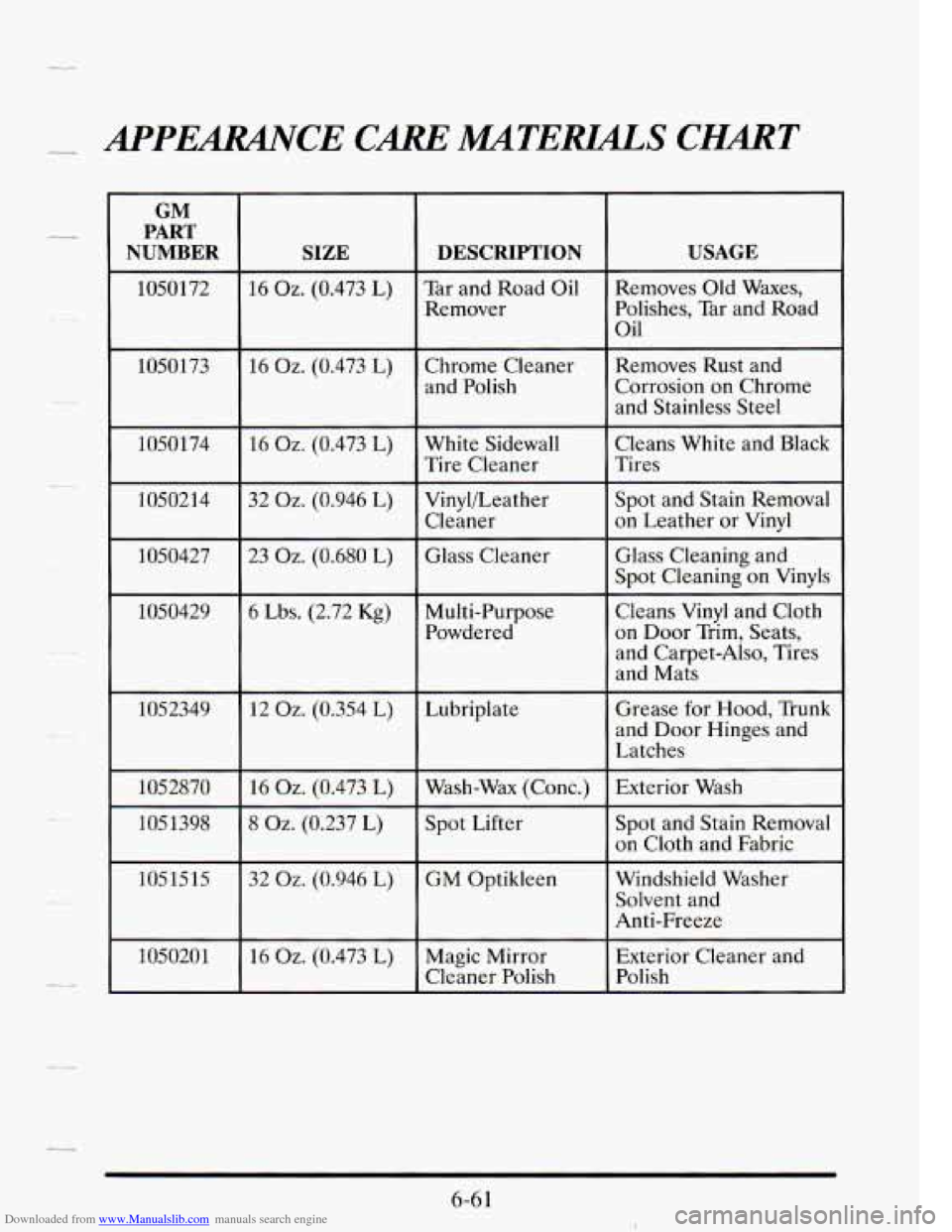
Downloaded from www.Manualslib.com manuals search engine - 4PPEARANCE CAREiWTERLU,S CIiART
GM
PART
NUMBER f- DESCRIPTION USAGE
I 1050172 I 16 Oz. (0.473 L) Tar and Road Oil
Remover Removes Old
Waxes,
Polishes, Tar and Road
Oil
___~ ~
Chrome Cleaner
and Polish Removes
Rust and
Corrosion on Chrome
and Stainless Steel
1050173 16 Oz. (0.473 L)
1050174 16 Oz. (0.473 L)
1050214
32 Oz. (0.946 L)
1050427 23 Oz. (0.680 L)
-
White Sidewall
Tire Cleaner Cleans
White and Black
Tires
Vinyb'Leather Cleaner Spot
and Stain Removal
on Leather or Vinyl
Glass Cleaner
~ ~~
Glass Cleaning and
Spot Cleaning on Vinyls
Cleans Vinyl and Cloth
on Door Trim, Seats,
and Carpet-Also, Tires
and Mats
Multi-Purpose
Powdered
1050429
6 Lbs. (2.72 Kg)
1052349 12
Oz. (0.354 L) Lubriplate Grease for Hood, Trunk
and Door Hinges and
Latches
I 1052870 I 16 Oz. (0.473 L) Wash-Wax
(Conc.)
Spot Lifter Spot and Stain Removal
on Cloth and Fabric
1051398
32
Oz. (0.946 L) 1051515
8 02. (0.237 L)
1050201 16
Oz. (0.473 L)
GM Optikleen Windshield Washer
Solvent and
Anti-Freeze
Magic Mirror
Cleaner Polish Exterior Cleaner and
Polish
6-61