1995 CADILLAC SEVILLE brake fluid
[x] Cancel search: brake fluidPage 162 of 410
Downloaded from www.Manualslib.com manuals search engine BATTERY VOLTS LOW - 06
_L-.
This message will appear when the electrical system is charging less than
10 volts or if the battery has been drained. If this message appears
immediately after starting, it is possible that the generator can still
recharge the battery. The battery should recharge after driving a few miles
and the message should go out.
If this message appears while driving or
after starting your vehicle and stays on, have it checked immediately to
-~ determine the cause of this problem. To help the generator recharge the
battery quickly you can reduce the load on the electrical system by turning
off your accessories. You can monitor battery voltage on the Driver
Information Center by toggling the INFORMATION button. The normal
range is
11.5 to 15.5 volts.
-
CHANGE TRANS FLUID - 47
~- This message will appear when it is time to replace the transaxle fluid. See
your maintenance schedule booklet
for the proper fluid and change
intervals.
CHECK BRAKE FLUID - 37
This message is displayed to inform the driver that the brake reservoir
fluid level
is low. Check the brake reservoir level and add as needed. Have
the brake system serviced by
a Cadillac technician as soon as possible. If
the brake warning light is on, follow the directions in that part.
CHECK COOLANT LEVEL - 04
This message will appear when there is a low level of engine coolant.
Have the cooling system serviced by a Cadillac technician
as soon as
possible.
CHECK FUEL GAGE - 39
This message will appear when your fuel supply is less than four gallons
and your display
is turned off.
Page 220 of 410

Downloaded from www.Manualslib.com manuals search engine P
c1 HILL AND MOUNTMN ROADS
- Driving on steep hills or mountains is different from driving in flat or r* I rolling terrain.
If you drive regularly in steep country, or if you're planning to visit there,
p- here are some tips that can make your trips safer and more enjoyable.
r
,-
Keep your vehicle in good shape. Check all fluid levels and also the
brakes, tires, cooling system and transaxle. These parts can work hard
on mountain roads.
Know how to go 'down hills. The most important thing to know is this:
let your engine do some
of the slowing down. Shift to a lower gear
when you
go down a steep or long hill.
r
4-29
Page 239 of 410
Downloaded from www.Manualslib.com manuals search engine Adahtenance When Trailer Towing
Your vehicle will need service more often when you're pulling a trailer.
See the Maintenance Schedule for more
on this. Things that are especially
important in trailer operation are automatic transaxle fluid (don't
overfill), engine oil, belt, cooling system, and brake adjustment. Each
of
these is covered in this manual, and the Index will help you find them
quickly. If you're trailering, it's a good idea to review these sections before
you start your trip.
--
Check periodically to see that all hitch nuts and bolts are tight.
Engine Coding When Trailering
Your cooling system may temporarily overheat during severe operating
conditions such as:
Climbing grades steeper than 4% at ambient temperatures above
90°F (32" C) with a loaded vehicle and trailer.
Stopping after high-speed driving.
Idling for long periods in stop-and-go traffic.
If the ENGINE HOT-A/C COMPRESSOR OFF message appears on the
Driver Information Center, do
not be alarmed. This is a normal function
designed to reduce the load on the engine and cooling system. You can
continue to drive your vehicle.
If the ENGINE COOLANT HOT-IDLE ENGINE message appears on
the Driver Information Center, pull
off to the side of the road as soon as
it is safe to do
so. When the vehicle is at a complete stop, shift the
transaxle selector to PARK
(P) and allow the engine to idle. Do not turn
off the engine or increase engine speed above a normal idle. After several
minutes, resume driving at a reduced speed. Return
to normal driving
after
10 minutes if the ENGINE COOLANT HOT-IDLE ENGINE
message is not displayed.
4-48
Page 280 of 410

Downloaded from www.Manualslib.com manuals search engine c
Then go to the front of
the vehicle and lift the
secondary hood release
to open the hood.
Fluid Usage Label
The fluid usage label is a color coded label identifying the various fluids
used in your vehicle.
Colors represented on the label match the lettering or handle color of the
fluid you want to check.
GREEN: Engine Coolant
ORANGE: Power Steering Fluid
0 YELLOW. Engine Oil
RED: Transmission Fluid
WHITE: Brake Fluid
0 BLUE: Washer Fluid
P--+
6-9
Page 292 of 410

Downloaded from www.Manualslib.com manuals search engine To check the fluid level
;c-
Park your vehicle on a level place. Keep the engine running.
With the parking brake applied, place the shift lever in PARK (P).
With your foot on the brake pedal, move the shift lever through each
gear range, pausing for about three seconds
in each range. Then,
position the shift lever
in PARK (P).
Let the engine run at idle for three to five minutes.
Then, without shutting off the engine, follow these steps:
Turn the cap
counterclockwise
to unlock it.
1. Pull out the dipstick and wipe it with a clean rag or paper towel.
2. Push it back in all the way, wait three seconds and then pull it back out
again.
3. Check both sides of the dipstick, and read the lower level. The fluid
4. If the fluid level is in the acceptable range, push the dipstick back in all
level
must be in the cross-hatched area.
the way.
6-2 1
Page 300 of 410

Downloaded from www.Manualslib.com manuals search engine Brake Master Cylinder
- Your brake master cylinder is here. It is filled with DOT-3 brake fluid.
r There are only two reasons why the brake fluid level in your master
cylinder might go down. The first is that the brake fluid goes down to an
acceptable level during normal brake lining wear. When new linings are
put in, the fluid level goes back
up. The other reason is that fluid is
leaking out of the brake system.
If it is, you should have your brake system
fixed, since a leak means that sooner or later your brakes won’t work well,
or won’t work at all.
So, it isn’t a good idea to “top off’’ your brake fluid.
are worn, then you’ll have too much fluid when you get new brake linings.
You should add (or remove) brake fluid, as necessary, only when work
is
done on the brake hydraulic system.
-
.c-- Adding brake fluid won’t correct a leak. If you add fluid when your linings
6-29
Page 301 of 410
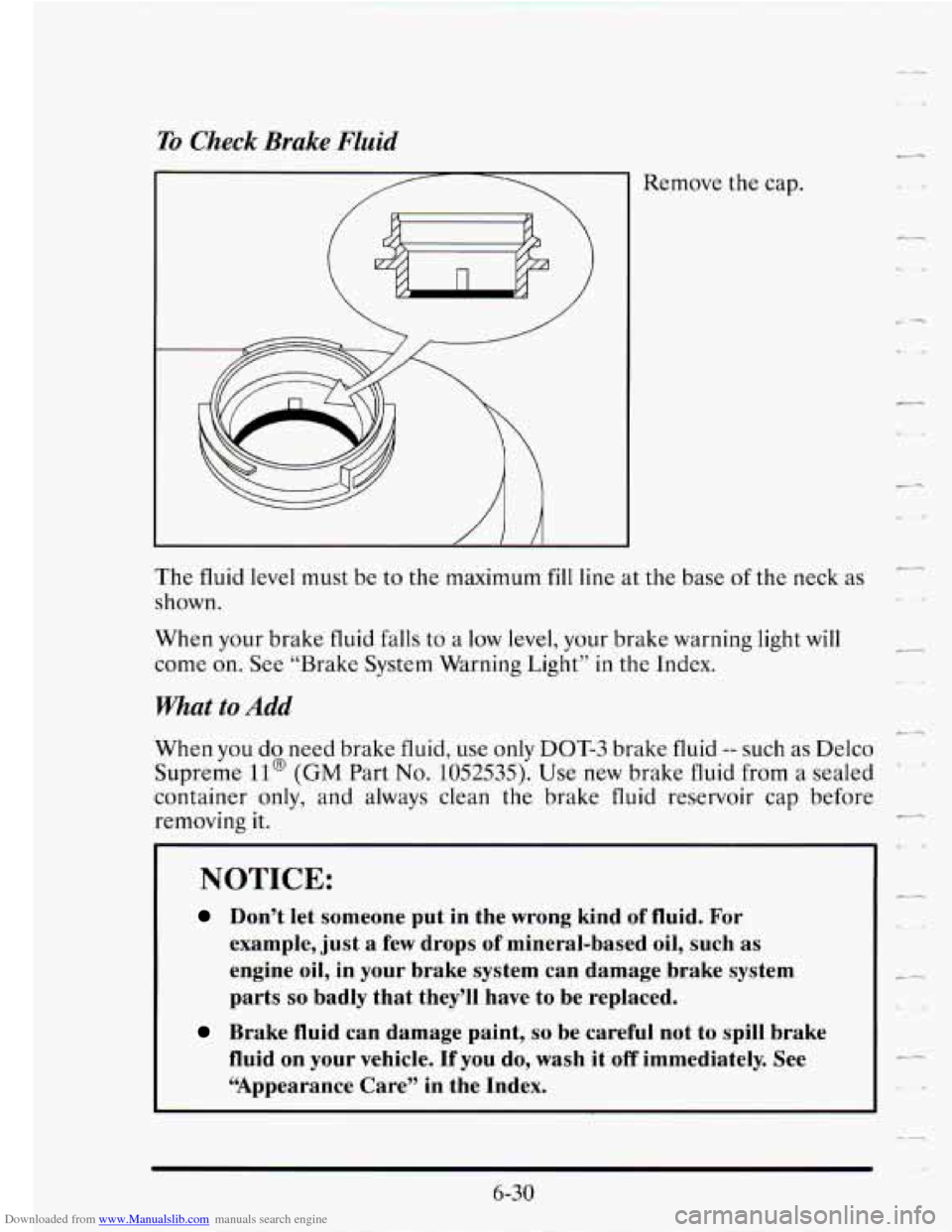
Downloaded from www.Manualslib.com manuals search engine To Check Brake Fluid
Remove the cap.
The fluid level must be to the maximum
fill line at the base of the neck as
shown. c_
When your brake fluid falls to a low level, your brake warning light will
come on. See “Brake System Warning Light”
in the Index.
Wat to Add
When you do need brake fluid, use only DOT-3 brake fluid -- such as Delco
Supreme
ll@ (GM Part No. 1052535). Use new brake fluid from a sealed
container only, and always clean the brake fluid reservoir cap before
removing
it.
NOTICE:
Don’t let someone put in the wrong kind of fluid. For
example, just
a few drops of mineral-based oil, such as
engine oil, in your brake system can damage brake system
parts
so badly that they’ll have to be replaced.
Brake fluid can damage paint, so be careful not to spill brake
fluid on your vehicle.
If you do, wash it off immediately. See
‘!Appearance Care” in the Index.
I-
--
I-
6-30
Page 393 of 410

Downloaded from www.Manualslib.com manuals search engine .
.
..
.
.
.
3 .
SEVILLE INDEX
A
AC Overheat-AC Off Message ....................... 2-90
Adding Automatic Transaxle Fluid
........................ 6-22
Brake Fluid
..................................... 6-30
Electrical Equipment
.................... 2.22. 3.19. 6-63
Engine Coolant
............................ 6.24. 6.25
Engine Oil
...................................... 6-11
Power Steering Fluid
............................. 6-27
Sound Equipment
............................... 3-19
Windshield Washer Fluid
.................... 2.46. 6.28
Air Bag
........................................... 1-22
How
Does It Restrain ............................ 1-26
How It Works
................................... 1-24
Location
....................................... 1-25
Readiness Light
............................ 1.24, 2.77
Servicing
....................................... 1-28
What Makes It Inflate
............................ 1-26
What Will
You See After It Inflates ................. 1-27
When Should It Inflate
........................... 1-26
Aircleaner
....................................... 6-16
Air Conditioning .................................... 3-4
Air Conditioning Refrigerants
........................ 6-76
Air Outlets
......................................... 3-1
Alarm. Theft Deterrent System ....................... 2-3.6
Alignment and Balance. Tires
........................ 6-49
Aluminum Wheels. Cleaning
......................... 6-59
AM Radio
......................................... 3-9
Antenna. Care ..................................... 3-21
Antifreeze
............................... 6.23.6.24. 6.25
Anti-Lock Brakes
................................... 4-8
Anti-Lock Brake System Warning Light ............ 2.80. 4.8
Anti-Lockout Feature
................................ 2-7
Appearance Care
................................... 6-52
Appearance Care Materials Chart
..................... 6-61
Apply Brake to Shift Message
........................ 2-90
Armrest. Rear Storage
.............................. 2-14
Ashtrays
..................................... 2.71. 2.72
1
.