Page 12 of 395
Downloaded from www.Manualslib.com manuals search engine .., ,-. I..C .,
This Cadillac Manual is divided into major sections.
Introduction - How to Use this Manual .......................... iii I
This section tells you how to use your manual and includes safety
and vehicle damage warnings and symbols.
Section 1 - Seats and Restraint Systems ......................... 1-1 I
This section tells you how to use your seats and safety
belts properly. It also explains the
“SIR’ system.
Section 2 - Features and Controls ............................. .2-1 I
This section explains how to start and operate your Cadillac.
Section 3 - Comfort Controls and Audio Systems ................. 3-1 I
This section tells you how to adjust the ventilation and
comfort controls and
how to operate your audio system.
Section 4 - Your Driving and the Road ......................... .4-1 I
Here you’ll find helpful information and tips about the
road and
how to drive under different conditions.
Section 5 - Problems on the Road ............................. .5-1 I
This section tells you what to do if you have a problem
while driving, such as a flat tire,
or engine overheating, etc.
Section 6 - Service and Appearance Care ....................... .6-1 I
Here the manual tells you how to keep your Cadillac
running properly and looking good.
For more information on “Reporting Safety Defects”, see Owner
Assistance, Page
4.
First Edition
i
Page 209 of 395
Downloaded from www.Manualslib.com manuals search engine Just before you leave the lane, glance quickly over your shoulder to make
sure there
isn’t anothcr vehicle in your “blind” spot.
Once you are moving on the freeway, make certain
you allow a reasonable
following distance. Expect
to move slightly slower at night.
When you want to leave the freeway, move to the proper lane well in
advance. If you miss your exit do not, under any circumstances, stop and
back up. Drive on to the next exit.
The exit ramp can be curved, sometimes quite sharply.
The
exit speed is usually posted.
Reduce your speed according
to your speedometer, not to your sense of
motion. After driving for any distance at higher speeds, you may tend to
think you are going slower than you actually are.
BEFORE LEAVTNG ONA LONG TRlP
Make sure you’re ready. Try to be well rested. If you must start when
you’re not fresh
-- such as after a day’s work -- don’t plan to make too
many
miles that first part of the journey. Wear comfortable clothing and
shoes
you can easily drive in.
Is your vehicle ready for a long trip? If you keep it serviced and
maintained, it’s ready
to go. If it needs service, have it done before
starting out.
Of course, you’ll find experienced and able service experts in
Cadillac dealerships all across North America. They’ll be ready and
willing
to help if you need it.
Here are some things you can check before a trip:
a
0
a
0
a
WindshieEd Wusher Fluid: Is the reservoir full? Are all windows clean
inside and outside?
Wiper. Blades: Are they in good shape‘?
Fzd, Engine Oil, Other Fluids: Have you checked all levels?
Lnmnps: Are they all working? Are the lenses clean?
Tires: They are vitally important to a safe, trouble-free trip. Is the tread
good enough for long-distance driving? Are the tires all inflated to the
recommended pressure?
4-22
Page 211 of 395
Downloaded from www.Manualslib.com manuals search engine HILL AND MOUNTMN ROADS
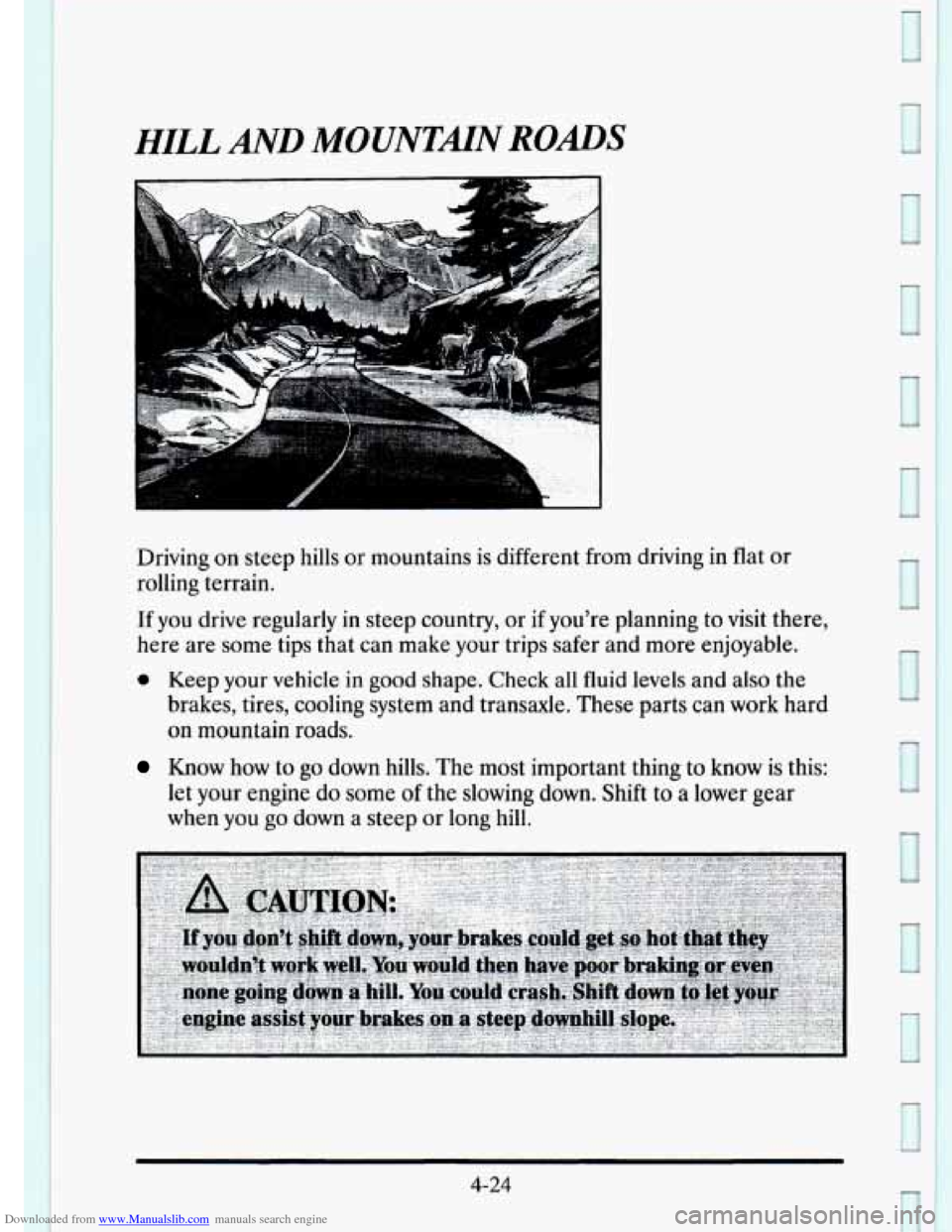
Driving on steep hills or mountains is different from driving in flat or
rolling terrain.
If you drive regularly in steep country, or if you’re planning to visit there,
here are some tips that can make your trips safer and more enjoyable.
0 Keep your vehicle in good shape. Check all fluid levels and also the
brakes, tires, cooling system and transaxle. These parts can work hard
on mountain roads.
Know how to go down hills. The most important thing to know is this:
let your engine do some
of the slowing down. Shift to a lower gear
when you
go down a steep or long hill.
4-24
Page 217 of 395
Downloaded from www.Manualslib.com manuals search engine Preserve the fuel as long as you can. To help keep warm, you can get out
of the vehicle and do some fairly vigorous exercises every half hour or
SO
until help comes.
LOmING YOUR VEHICLE
~~
( TIRE-LOADING INFORMATION
OCCUPANTS VEHICLE CAP.
WT.
FRT. CTR. RR. TOTAL LBS. KG
MAX. LOADING
& GVWR SAME AS VEHICLE
CAPACITY WEIGHT XXX
COLD TIRE
TIRE SIZE SPEED PRESSURE
RTG PSVKPa
F
RT.
RR.
SPA.
IF TIRES ARE HOT. ADD 4PSV28KPa SEE
OWNER’S MANUAL FOR ADDITIONAL
INFORMATION
-_ - - - GEN GME,
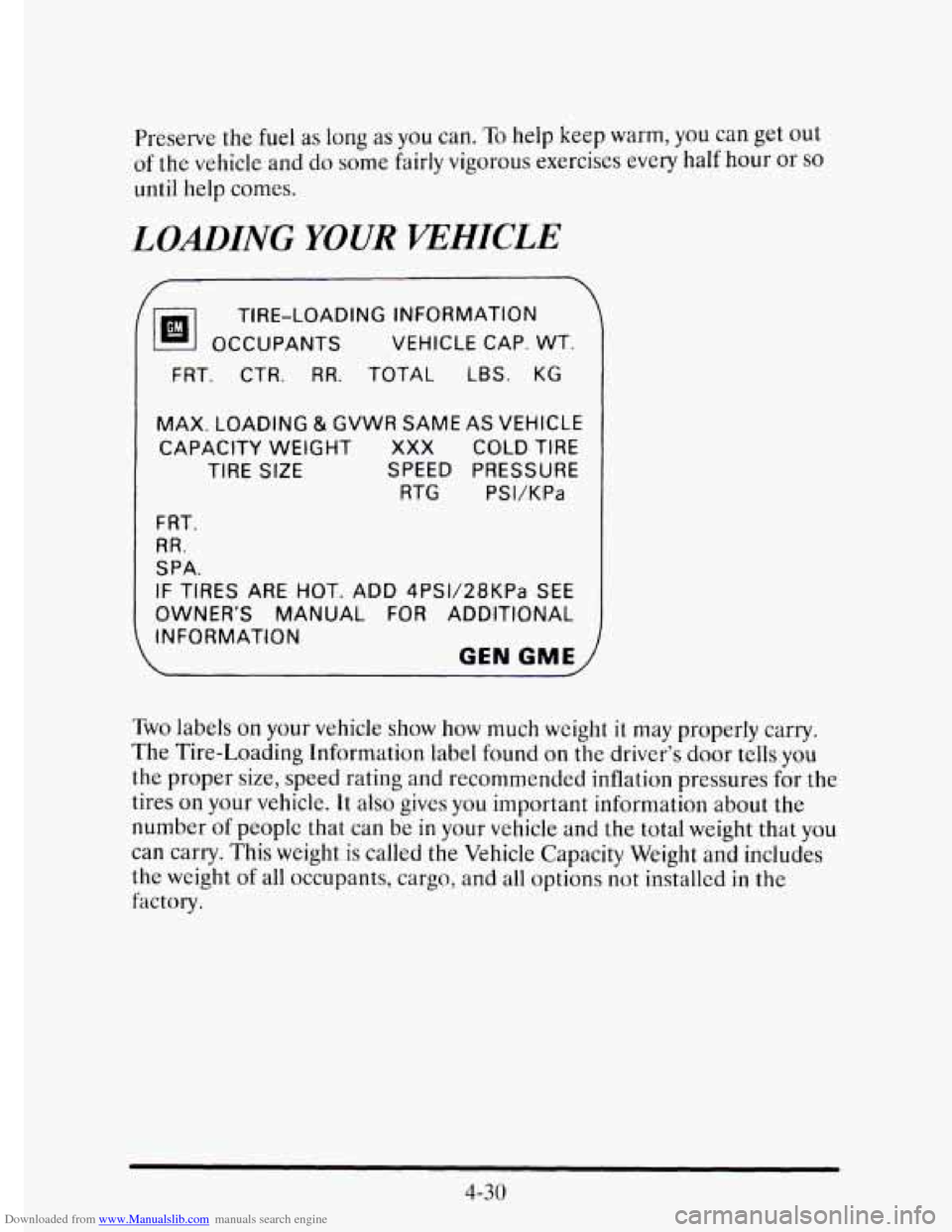
Two labels on your vehicle show how much weight it may properly carry.
The Tire-Loading Information label found
on the driver’s door tells you
the proper size, speed rating and recommended inflation pressures for the
tires
on your vehicle. It also gives you important information about the
number
of peoplc that can be in your vehicle and the total weight that you
can carry. This weight
is called the Vehicle Capacity Weight and includes
the weight
of all occupants, cargo, and all options not installed in the
factory.
4-30
Page 223 of 395
Downloaded from www.Manualslib.com manuals search engine Total Weight on Your khicle’s Tires
Be sure your vehicle’s tires are inflated to the recommended pressure for
cold tires. You’ll find these numbers on the Certification label
at the rear
edge
of the driver’s door or see “Loading Your Vehicle” in the Index.
Then be sure
you don’t go over the GVW limit for your vehicle, including
the weight of the trailer tongue.
Hitches
It’s important to have the correct hitch equipment. Crosswinds, large
trucks going by, and rough roads are a
few reasons why you’ll need the
right hitch. Here are some rules
to follow:
0 Will you have to makc any holes in the body of your vehicle when you
install a trailer hitch?
if you do, then be sure to seal the holes later
whcn
you remove the hitch. If you don’t seal them, deadly carbon
monoxide
(CO) from your exhaust can get into your vehicle (see
“Carbon Monoxide”
in the Index). Dirt and water can, too.
Safety Chains
You should always attach chains between your vehicle and your trailer.
Cross the safety chains under
the tongue of the trailer so that the tongue
will not drop to thc road if it becomes separated from the hitch.
Instructions about safety chains may be provided by the hitch
manufacturer or by the trailer manufacturer. Follow the manufacturcr’s
recommendation for attaching safety chains and do not attach them to the
bumper. Always leave
just enough slack so you can turn with your rig.
And, never allow safety chains to drag on the ground.
Trailer Brakes
Because you have anti-lock brakes, don’t try to tap into your vehicle’s
hydraulic brake system.
If you do, both brake systems won’t work well, or
at all.
Be sure to read and follow thc instructions for the trailer brakes so you’ll
be able to install, adjust and maintain them properly.
4-36
Page 248 of 395
Downloaded from www.Manualslib.com manuals search engine .. i
k
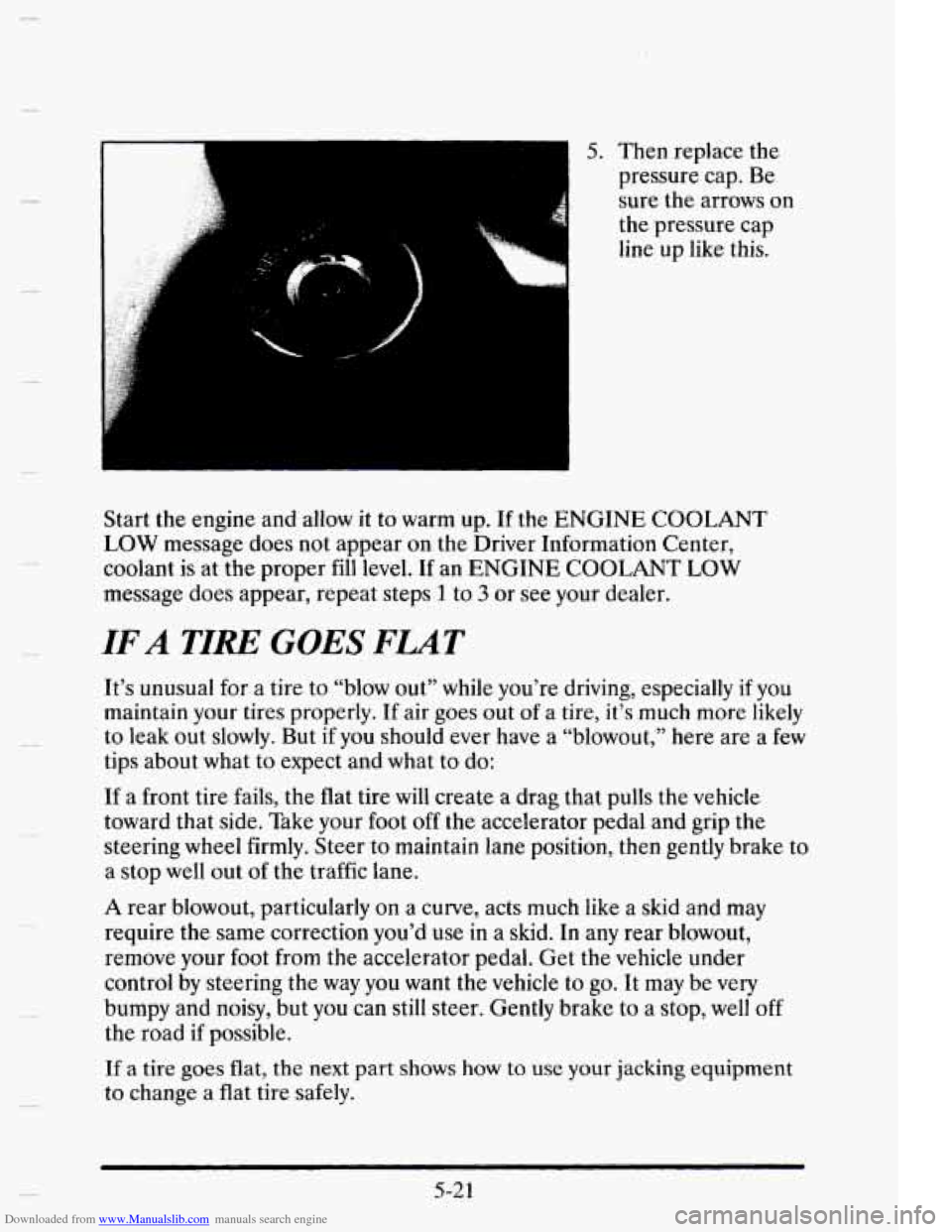
5. Then replace the
pressure cap. Be
sure
the arrows on
the pressure cap
line up
like this.
Start the engine and allow
it to warm up. If the ENGINE COOLANT
LOW message does not appear on the Driver Information Center,
coolant
is at the proper fill level. If an ENGINE COOLANT LOW
message does appear, repeat steps 1 to 3 or see your dealer.
IF A TIRE GOES FLAT
It’s unusual for a tire to “blow out” while you’re driving, especially if you
maintain your tires properly.
If air goes out of a tire, it’s much more likely
to leak out slowly. But
if you should ever have a “blowout,” here are a few
tips about what to expect and what to do:
If a front tire fails, the flat tire will create a drag that pulls the vehicle
toward that side. Take your foot
off the accelerator pedal and grip the
steering
wheel firmly. Steer to maintain lane position, then gently brake to
a stop well out of
the traffic lane.
A rear blowout, particularly on a curve, acts much like a skid and may
require the same correction you’d use
in a skid. In any rear blowout,
remove your foot from the accelerator pedal. Get the vehicle under
control by steering
the way you want the vehicle to go. It may be very
bumpy and noisy, but you can still steer. Gently brake to a stop, well off
the road if possible.
If a tire goes flat, the next part shows how to use your jacking equipment
to change a flat tire safely.
5-2 1
Page 249 of 395
Downloaded from www.Manualslib.com manuals search engine CHANGING A FLAT TIRE
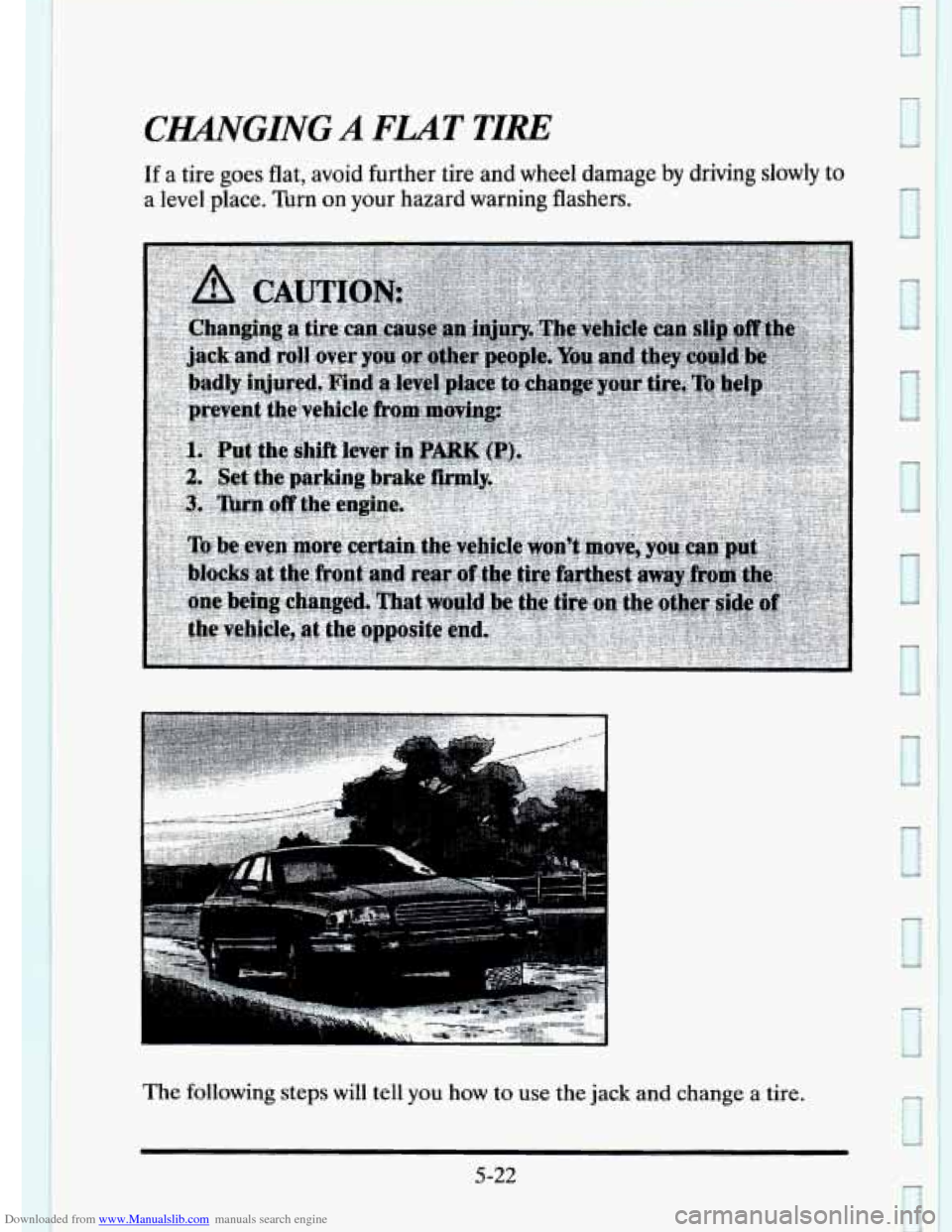
If a tire goes flat, avoid further tire and wheel damage by driving slowly to
a level place. Turn on your hazard warning flashers.
p.
The following steps will tell you how to use the jack and change a tire.
5-22
Page 252 of 395
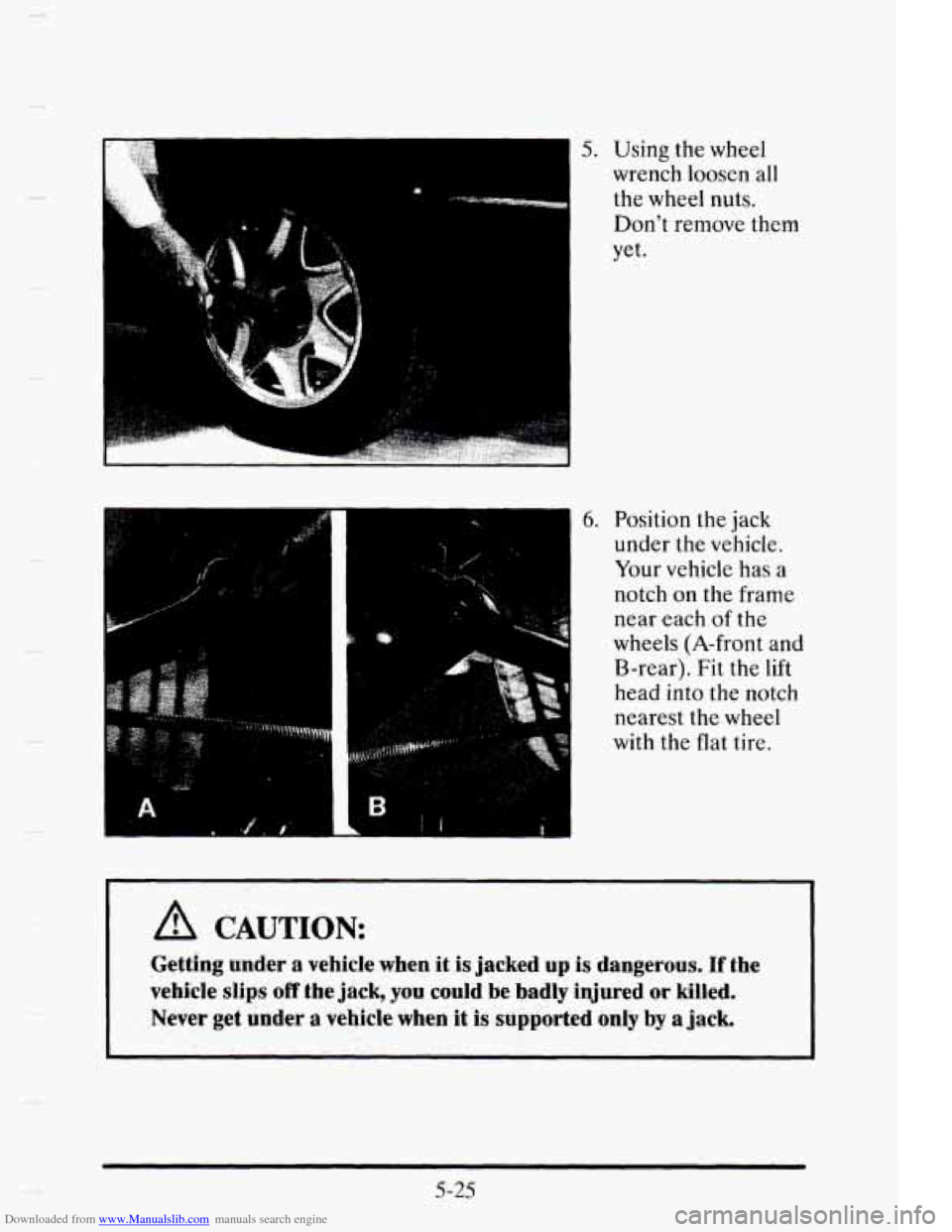
Downloaded from www.Manualslib.com manuals search engine 5. Using the wheel
wrench loosen all
the wheel nuts.
Don't remove them
yet.
6. Position the jack
under the vehicle.
Your vehicle has a
notch on the frame
near each
of the
wheels (A-front and
B-rear). Fit the lift
head into the notch
nearest the wheel
with the flat tire.
A CAUTION
Getting under a vehicle when it is jacked up is dangerous. If the
vehicle
slips off the jack, you could be badly injured or killed.
Never get under
a vehicle when it is supported only by a jack.
5-25