1995 CADILLAC ELDORADO turn signal
[x] Cancel search: turn signalPage 173 of 395
Downloaded from www.Manualslib.com manuals search engine Heated Windshield (Option)
Front De-Ice
Here’s how to use your heated windshield in cold weather to remove ice
or frost quickly:
1. If any snow is piled up on the windshield, brush it away.
2. Start your Cadillac and leave it in PARK (P).
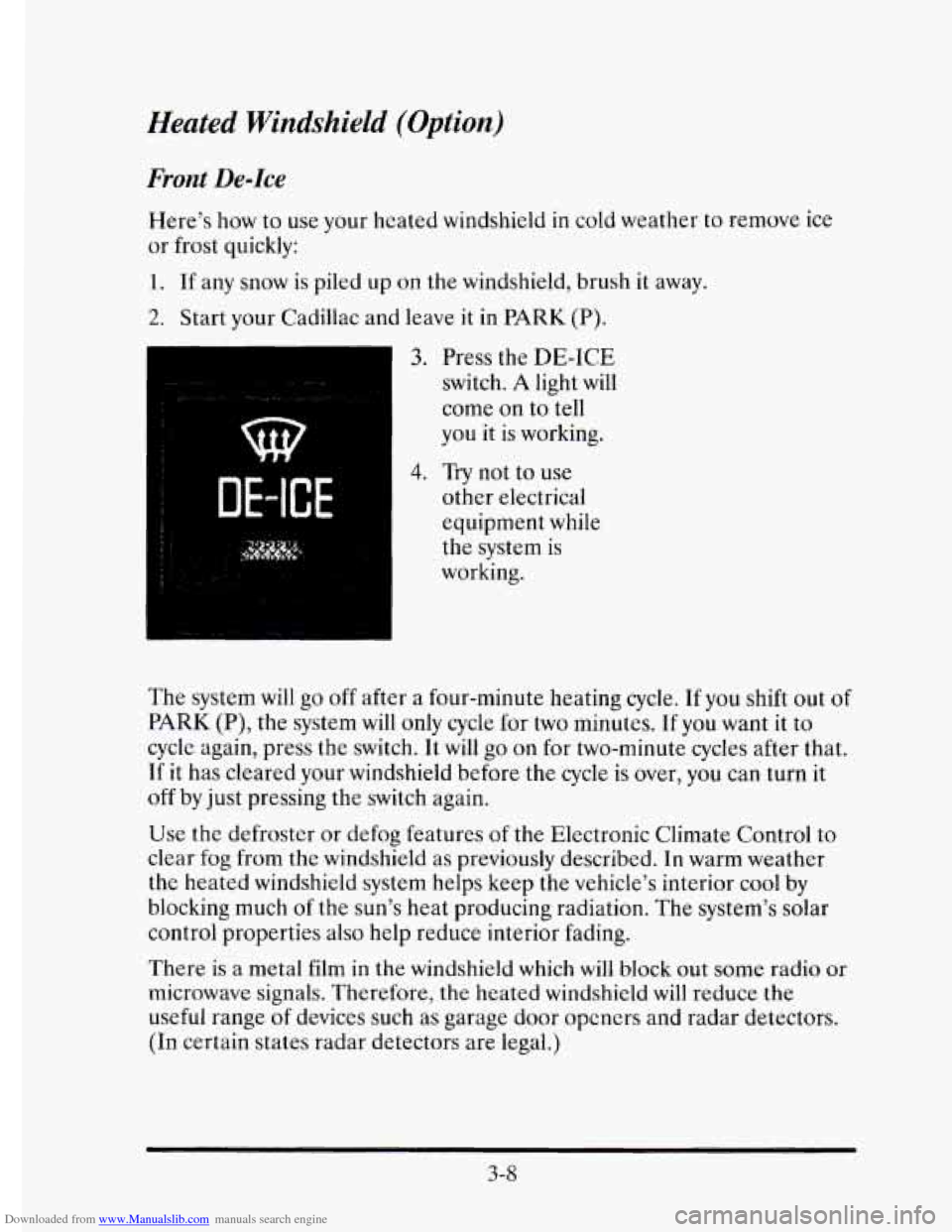
3. Press the DE-ICE
switch. A light will
come on to tell
you it is working.
DE-ICE
4. Try not to use
other electrical
equipment while
the system
is
working.
The system will
go off after a four-minute heating cycle. If you shift out of
PARK (P), the system will only cycle for two minutes. If you want it to
cycle again, press the switch. It will go on for two-minute cycles after that.
If it has cleared your windshield before the
cycle is over, you can turn it
off by just pressing the switch again.
Use the defroster or defog features of the Electronic Climate Control to
clear fog from the windshield as previously described. In warm weather
the heated windshield system helps keep the vehicle’s interior cool by
blocking much
of the sun’s heat producing radiation. The system’s solar
control properties also
help reduce interior fading.
There
is a metal film in the windshield which will block out some radio or
microwave signals. Therefore, the heated windshield
will reduce the
useful range
of devices such as garage door opcners and radar detectors.
(In certain states radar detectors are legal.)
3-8
Page 185 of 395
Downloaded from www.Manualslib.com manuals search engine Care of Your Cassette Tupe Player
A tape player that is not cleaned regularly can cause reduced sound
quality, ruined cassettes or a damaged mechanism. Cassette tapes should
be stored
in their cases away from contaminants, direct sunlight and
extreme heat. If they aren’t, they may not operate properly or cause
failure
of the. tape player.
Your tape player should be cleaned regularly each month or after every
SO hours of use. If you notice a reduction in sound quality, try a known
good cassette to see
if the tape or the tape player is at fault. If this other
cassette
has no improvement in sound quality, clean the tape player.
Cleaning may be done
with a scrubbing action, non-abrasive cleaning
cassette. This system uses a cleaning cassette
with pads which scrub the
tape head as the hubs
of the cleaner cassette turn. It is normal for the
cartridge to eject while cleaning. Insert the cassette at least three times
to
ensure thorough cleaning. A scrubbing action cleaning cassette is
available through your Cadillac dealership.
You may also choose
a non-scrubbing action, wet-type cleaner which uses
a cassette
with a fabric belt to clean the tape head. This type of cleaning
cassette
will not eject. It may not clean as thoroughly as the scrubbing type
cleaner.
Cassette tapes are subject to wear
and the sound quality may degrade
over time. Always make sure that the cassette tape
is in good condition
before you have your tape player serviced.
Care of Your Compact Discs
Handle discs carefully. Store them in their original cases or other
protective cases and away from direct sunlight and dust. If the surface
of a
disc is soiled, dampen a clean, soft cloth
in a mild, neutral detergent
solution and clean
it, wiping from the centcr to the edge.
Be sure never to touch the signal surface when handling discs. Pick up discs
by grasping the outer edges or the edge of the hole and the outer edge.
3-20
Page 200 of 395
Downloaded from www.Manualslib.com manuals search engine 0
0
c
0
0
0
0
0 0
0
“Drive ahead.” Look down the road, to the sides, and to crossroads for
situations that might affect your passing patterns.
If you have any doubt
whatsoever about making a successful pass, wait for a better time.
Watch for traffic signs, pavement markings, and lines. If you can see a
sign up ahead that might indicate a turn or an intersection, delay your
pass.
A broken center line usually indicates it’s all right to pass
(providing the road ahead is clear). Never cross a solid line
on your
side of the lane or a double solid line, even
if the road seems empty of
approaching traffic.
Do not get too close to the vehicle
you want to pass while you’re
awaiting an opportunity.
For one thing, following too closely reduces
your area of vision, especially
if you’re following a larger vehicle. Also,
you won’t have adequate space if the vehicle ahead suddenly slows or
stops. Keep back a reasonable distance.
When it looks like a chance to pass
is coming up, start to accelerate
but stay in the right lane and don’t get too close. Time your move
so
you will be increasing speed as the time comes to move into the other
lane.
If the way is clear to pass, you will have a “running start” that
more than makes up for the distance you would lose
by dropping back.
And
if something happens to cause you to cancel your pass, you need
only slow down and drop back again and wait for another opportunity.
If other cars are lined up to pass a slow vehicle, wait your turn. But
take care that someone isn’t trying to pass
you as you pull out to pass
the
slow vehicle. Remember to glance over your shoulder and check
the blind spot.
Check your mirrors, glance over your shoulder, and start your left lane
change signal before moving out
of the right lane to pass. When you
are far enough ahead
of the passed vehicle to see its front in your
inside mirror, activate your right lane change signal and move back
into the right lane. (Remember that your right outside mirror is
convex. The vehicle
you just passed may seem to be farther away from
you than it really is.)
Try not to pass more than one vehicle at a time on two-lane roads.
Reconsider before passing the next vehicle.
Don’t overtake a slowly moving vehicle too rapidly. Even though the
brake lights are not flashing, it may be slowing down or starting to turn.
If you’re being passed, make it easy for the following driver to get
ahead
of you. Perhaps you can ease a little to the right.
4-13
Page 204 of 395
Downloaded from www.Manualslib.com manuals search engine DMNG IN THE RAIN
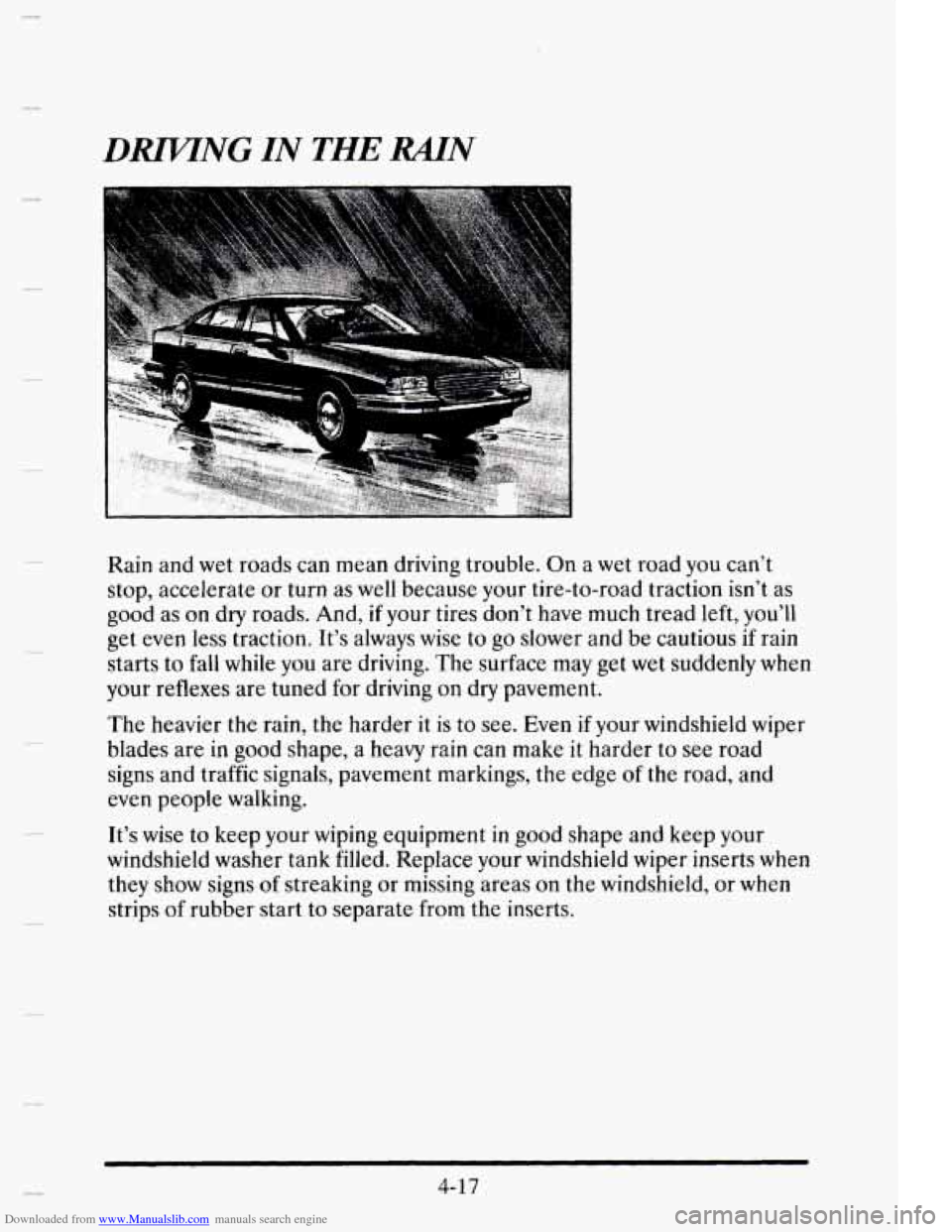
Rain and wet roads can mean driving trouble. On a wet road you can’t
stop, accelerate or turn as well because your tire-to-road traction isn’t as
good as
on dry roads. And, if your tires don’t have much tread left, you’ll
get even
less traction. It’s always wise to go slower and be cautious if rain
starts to fall
while you are driving. The surface may get wet suddenly when
your reflexes are tuned for driving on dry pavement.
The heavier
the rain, the harder it is to see. Even if your windshield wiper
blades are
in good shape, a heavy rain can make it harder to see road
signs and traffic signals, pavement markings, the edge
of the road, and
even people walking.
It’s wise
to keep your wiping equipment in good shape and keep your
windshield washer tank filled. Replace your windshield wiper inserts when
they show signs of streaking or missing areas on the windshield, or when
strips of rubber start to separate from the inserts.
4-17
Page 207 of 395
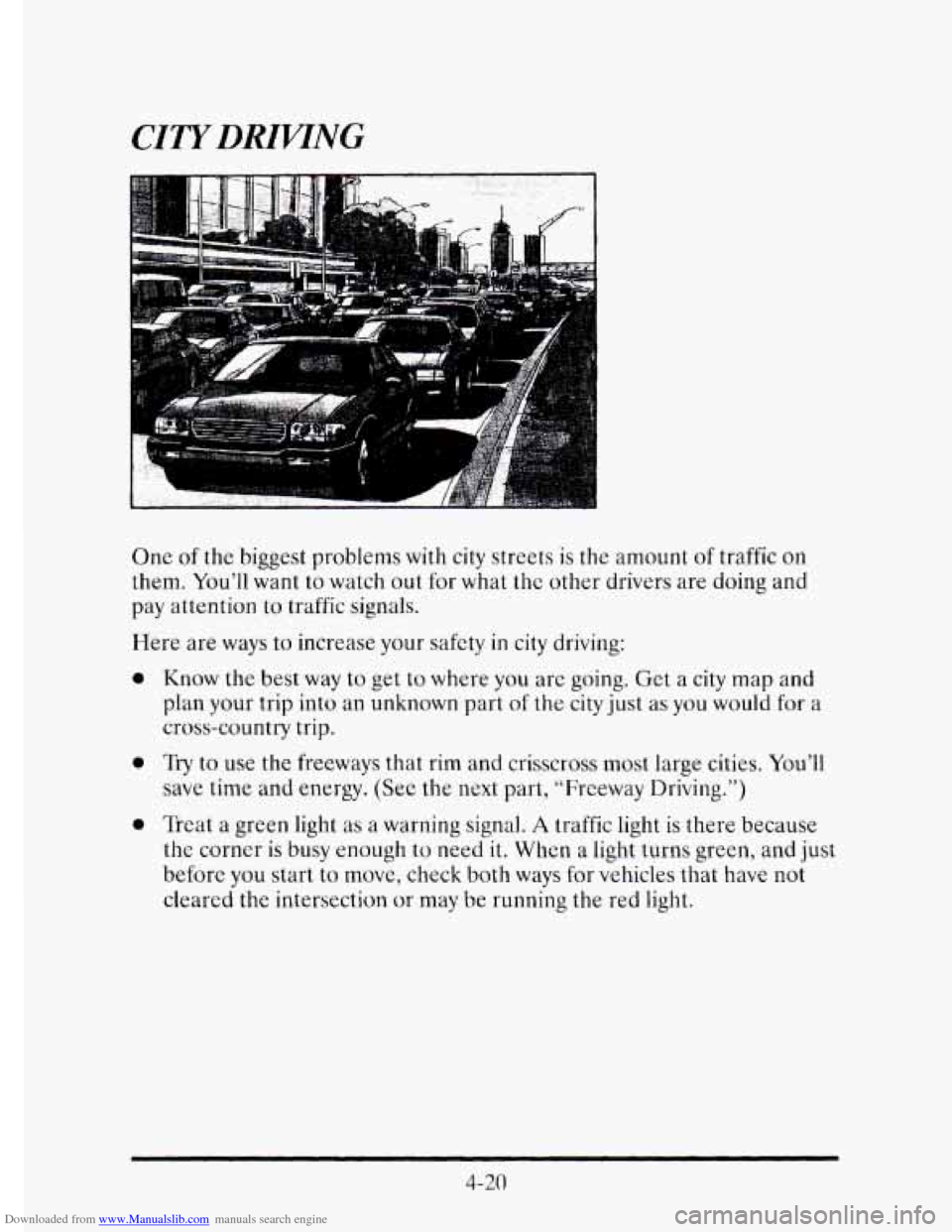
Downloaded from www.Manualslib.com manuals search engine One of the biggest problems with city streets is the amount of traffic on
them. You’ll want to watch out for what the other drivers are doing and
pay attention
to traffic signals.
Here are ways to increase your safety
in city driving:
0
0
a
Know the best way to get to where you are going. Get a city map and
plan your trip into an unknown part of the city just as you would for a
cross-country trip.
Try to use the freeways that rim and crisscross most large cities. You’ll
save time and energy. (See the next part, “Freeway Driving.”)
Treat a green light
as a warning signal. A traffic light is there because
the corner is busy enough to need it. When a light turns green, and just
before you start to tnove, check both ways €or vehicles that have not
cleared the intersection or may be running the red light.
4-20
Page 208 of 395
Downloaded from www.Manualslib.com manuals search engine c
Mile for mile, freeways (also called thruways, parkways, expressways,
turnpikes, or superhighways) are the safest
of all roads. But they have
their own special rules.
The most important advice on freeway driving is: Keep up with traffic and
keep to the right. Drive at the same speed most
of the other drivers are
driving. Too-fast
or too-slow driving breaks a smooth traffic flow. Treat
the left lane
on a freeway as a passing lane.
At the entrance there is usually
a ramp that leads to the freeway. If you
have a clear view
of the freeway as you drive along the entrance ramp, you
should begin to check traffic.
Try to determine where you expect to blend
with the
flow. Try to merge into the gap at close to the prevailing speed.
Switch
on your turn signal, check your mirrors and glance over your
shoulder as often as necessary.
Try to blend smoothly with the traffic flow.
Once
you are on the freeway, adjust your speed to the posted limit or
to the prevailing rate if it's slower. Stay in the right lane unless you want
to pass.
Before changing lanes, check your mirrors. Then use your turn signal.
4-21
Page 225 of 395
Downloaded from www.Manualslib.com manuals search engine Making Turns
NOTICE:
Making very sharp turns while trailering could cause the trailer
to come in contact with the vehicle. Your vehicle could be
damaged. Avoid making very sharp turns while trailering.
When you’re turning with a trailer, make wider turns than normal. DO this
so your trailer won’t strike soft shoulders, curbs, road signs, trees, or other
objects. Avoid jerky or sudden maneuvers. Signal well in advance.
Turn Signals When Towing a Trailer
When you tow a trailer, your vehicle has to have a different turn signal
flasher and extra wiring. The green arrows on your instrument panel will
flash whenever you signal
a turn or lane change. Properly hooked up, the
trailer lamps
will also flash, telling other drivers you’re about to turn,
change lanes or stop.
When towing a trailer, the green arrows on your instrument panel
will
flash for turns even if the bulbs on the trailer are burned out. Thus, you
may think drivers behind you are seeing your
signal when they are not. It’s
important to
che.ck occasionally to be sure the trailer bulbs are still
working.
Driving On Grades
Reduce speed and shift to a lower gear before you start down a long or
steep downgrade.
If you don’t shift down, you might have to use your
brakes
so much that they would get hot and no longer work well.
4-38
Page 228 of 395
Downloaded from www.Manualslib.com manuals search engine PROBLEMS ON THE ROAD
Here you’ll find what to do about some problems that can occur on the
road.
HAZARD WMING FLASHERS
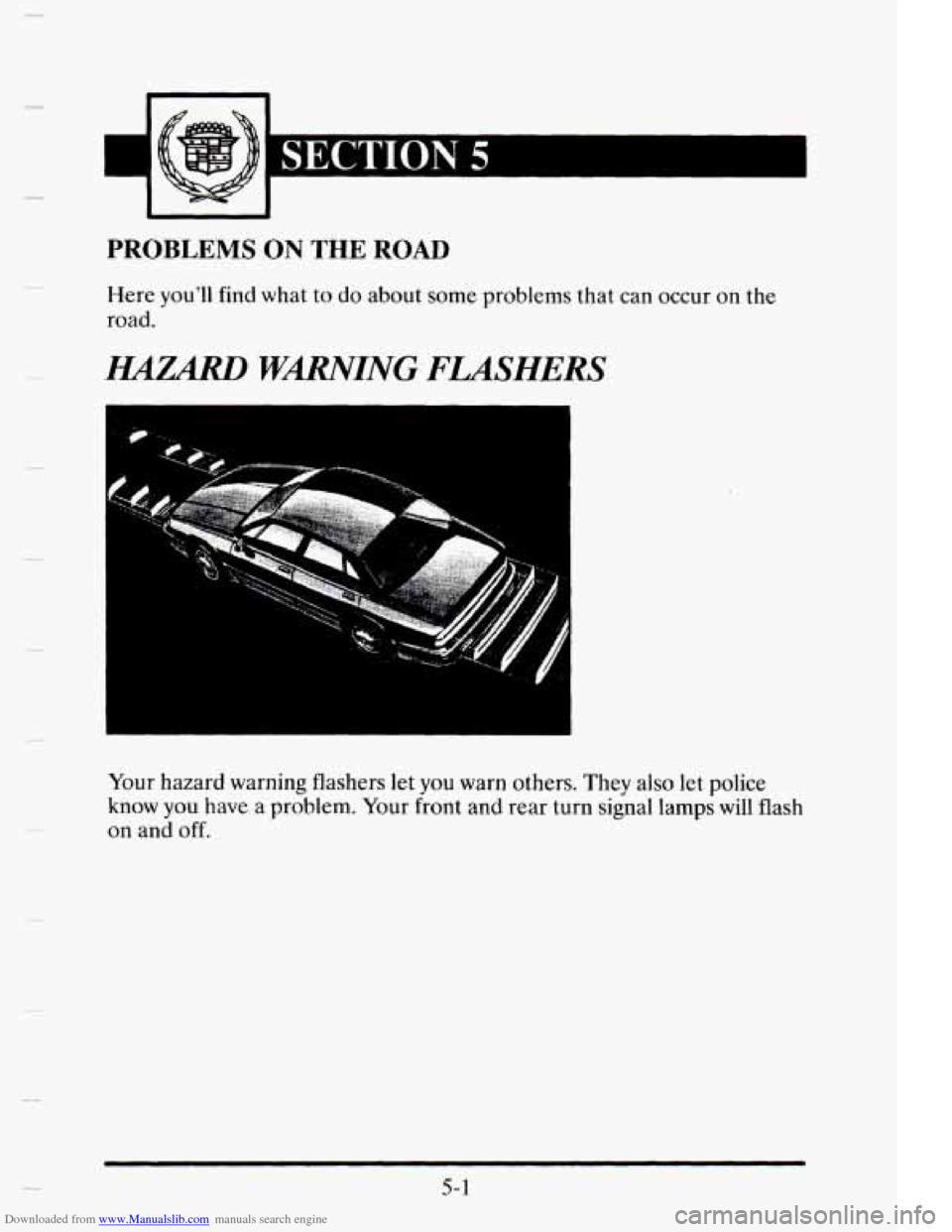
Your hazard warning flashers let you warn others. They also let police
know you have a problem. Your front and rear turn signal lamps will flash
on and off.
5- 1.