Downloaded from www.Manualslib.com manuals search engine When to Check
Check your tires once a month or more.
Don’t forget your compact sparc tire.
It should be at 60 psi (420 kPa).
How to Check
Use a good quality pocket-type gage to check tire pressure. Simply
looking at the tires
will not tell you the pressure, especially ii you have
radial tires
-- which may look properly inflated even if they’re
underinflated.
If your tires have valve caps, be sure to put them back on. They help
prevent leaks
by keeping out dirt and moisture.
Tire Inspection and Rotation
Tires should be inspected every 6,000 to 8,000 miles (10 000 to ‘13 000 km)
for any signs
of unusual wear. If unusual wear is present, rotate your tires
as
soon as possible and check wheel alignment. Also check for damaged
tires or wheels. See “When it’s Time for
New Tires” and “Wheel
Replacement” later in this section
for more information.
The purpose of regular rotation is to achieve more uniform wear for all tires
on the vehicle. The first rotation is the most important. See “Scheduled
Maintenance Services”
in the Index for scheduled rotation intervals.
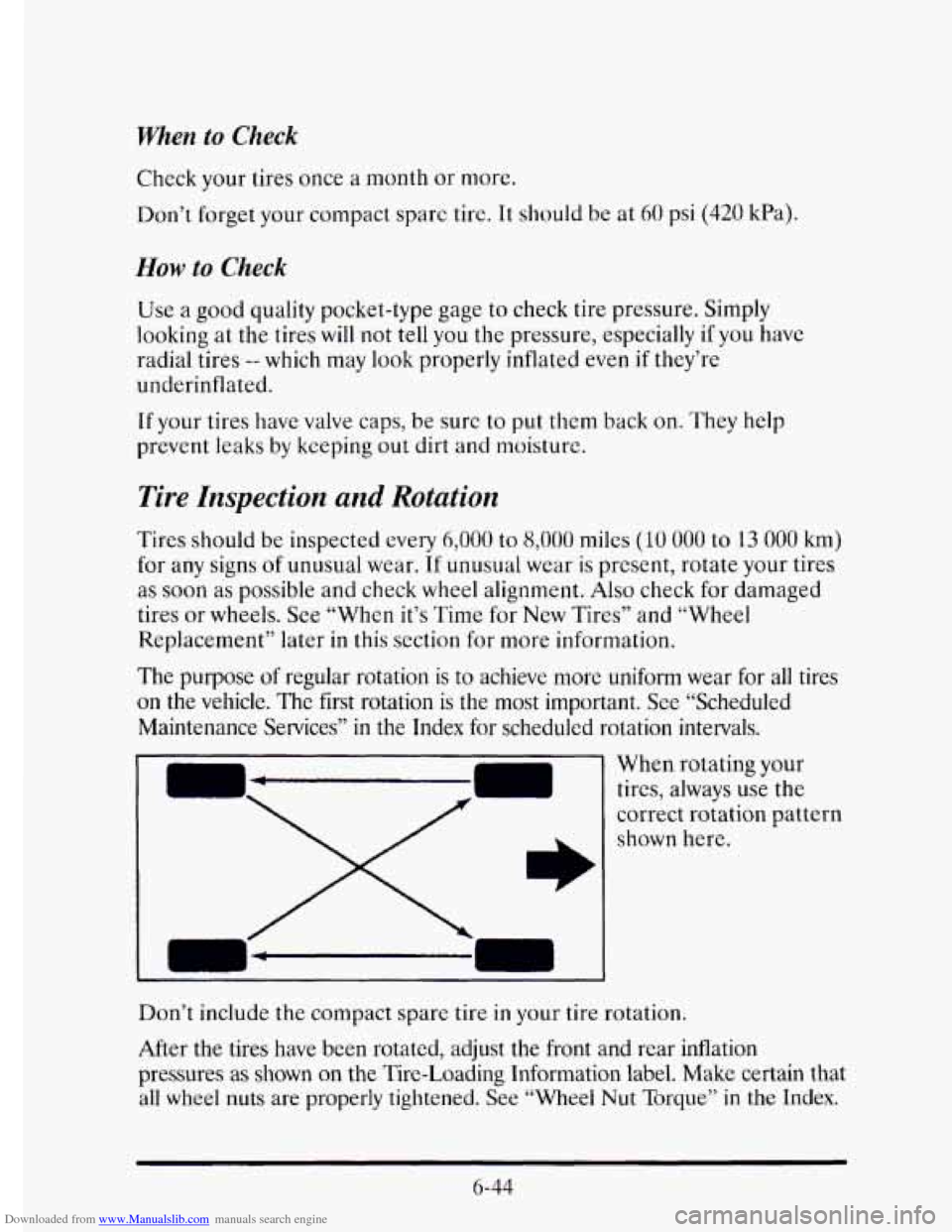
When rotating your
tires, always use
the
correct rotation pattern
shown here.
Don’t include the compact spare tire
in your tire rotation.
After the tires have been rotated, adjust
the front and rear inflation
pressures as
shown on the Tire-Loading Information label. Make certain that
all wheel nuts are properly tightened. See “Wheel Nut Torque” in the Index.
6-44
Downloaded from www.Manualslib.com manuals search engine Temperature - A, B, C
The temperature grades are A (the highest), B, and C, representing the
tire’s resistance to the generation of heat and its ability to dissipate heat
when tested under controlled conditions on a specified indoor laboratory
test wheel. Sustained high temperature can cause the material
of the tire
to degenerate and reduce tire life, and excessive temperature can lead to
sudden tire failure. The grade
C corresponds to a level of performance
which all passenger car tires must meet under
the Federal Motor Vehicle
Safety Standard
No. 109. Grades B and A represent higher levels of
performance on the laboratory test wheel than the minimum required by
law.
Warning:
The temperature grade for this tire is established for a tire that
is properly inflated and not overloaded. Excessive speed, underinflation,
or excessive loading, either separately or
in combination, can cause heat
buildup and possible tire failure.
These grades are molded on the sidewalls
of passenger car tires.
While the
tires available as standard or optional equipment on General
Motors vehicles may vary with respect
to these grades, all such tires meet
General Motors performance standards and have been approved for use
on General Motors vehicles. All passenger type
(P Metric) tires must
conform to Federal safety requirements
in addition to these grades.
wheel Alignment and Tire Balance
The wheels on your vehicle were aligned and balanced carefully at the
factory to give
you the longest tire life and best overall performance.
In most cases, you
will not need to have your wheels aligned again.
However,
if you notice unusual tire wear or your vehicle pulling one way
or the other, the alignment may need to be reset.
If you notice your
vehicle vibrating when driving on
a smooth road, your wheels may need to
be rebalanced.
6-48
Downloaded from www.Manualslib.com manuals search engine Sunglasses Storage ................................. 2-62
Supplemental Inflatable Restraint (SIR)
............... 1-22
Surge Tank Pressure Cap
............................ 6-25
Suspension. Road Sensing
........................... 2-92
Symbols. Vehicle
...................................... v
T
Fdchometer (Analog Cluster) ......................... 2-80
Taillamps. Bulb Replacement ......................... 6-38
Temperature
........................................ 3-3
Theft
............................................. 2-14
Theft Deterrent Alarm System
....................... 2-15
Theft System Problem/Car May Not Restart Message .... 2-90
Thermostat
........................................ 6-26
Third (3) Position. Automatic Transaxle
................ 2-25
Tilt Steering Wheel ................................. 2-37
Time. Setting the
................................... 3-10
Epe
Player Care
................................... 3-20
Timer Button. Driver Information Center .............. 2-84
Tire Chains
........................................ 6-50
Tire Inspection and Rotation
......................... 6-44
Tires
............................................. 6-42
Tire Loading
...................................... 4-30
Alignment and Balance
........................... 6-48
Buying New
..................................... 6-46
Changing
a Flat ................................. 5-22
Inspection and Rotation
.......................... 6-44
Sparc. Compact
................................. 5-30
Temperature
.................................... 6-48
Traction
........................................ 6-47
Treadwear ...................................... 6-47
Uniform Quality Grading
......................... 6-47
Wear lndicators
................................. 6-45
Wheel Replacement .............................. 6-49
Top Strap
......................................... 1-40
Torque. Wheel Nut ................................. 5-29
Towing a Trailer
.................................... 4-32
Towing
Your Vehicle ................................. 5-9
Traction Active Message
..................... 2-77. 2-90. 4-9
Traction Control System .............................. 4-9
Trailer Tongue Weight
............................... 4-35
Inflation
....................................... 6-43
Torque Lock
....................................... 2-31
14