1994 PONTIAC GRAND-AM tow
[x] Cancel search: towPage 197 of 274

Service & Appearance Care
Taillight Bulb
Replacement
For the type of bulb, see “Replacement
Bulbs” in the Index.
1. Pull back the trunk trim.
2. Carefully push one end of the plastic
taillight brace in while pulling the
brace toward the front of the vehicle.
3. Gently wiggle the bulb out of the
socket.
4. Replace the bulb.
5. Reverse the steps to reassemble the
taillight.
Fog Light Bulb
Replacement
Don’t change your fog light bulbs unless
you have the proper aiming equipment.
See your Pontiac dealer
if you have any
further questions.
Windshield Wiper Blade
Replacement
Replacement blades come in different
types and are removed in different ways.
Here’s how to remove the type with a
release clip:
1. Pull the windshield wiper arm away
from the windshield.
2. Lift the release clip with a screwdriver
and pull the blade assembly off the
wiper arm.
3. Push the new wiper blade securely on
the wiper arm.
. . . 196
ProCarManuals.com
Page 206 of 274
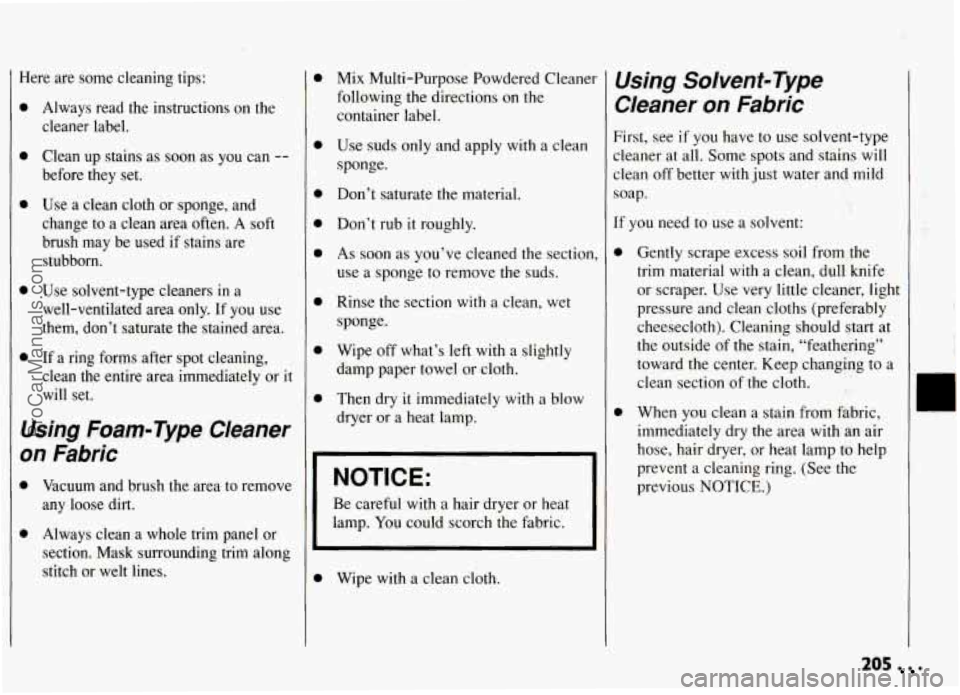
Here are some cleaning tips:
0
0
0
0
0
Always read the instructions on the
cleaner label.
Clean up stains as soon as you can
--
before they set.
Use a clean cloth or sponge, and
change to a clean area often. A soft
brush may be used if stains are
stubborn.
Use solvent-type cleaners in a
well-ventilated area only. If you use
them, don’t saturate the stained area.
If a ring forms after spot cleaning,
clean the entire area immediately or
it
will set.
Using Foam-Type Cleaner
on Fabric
0 Vacuum and brush the area to remove
any loose dirt.
0 Always clean a whole trim panel or
section. Mask surrounding trim along
stitch or welt lines.
0
0
0
0
0
0
0
0
Mix Multi-Purpose Powdered Cleaner
following .the directions on the
container label.
Use suds only and apply with a clean
sponge.
Don’t saturate the material.
Don’t rub
it roughly.
As soon as you’ve cleaned the section,
use a sponge to remove the suds.
Rinse
the section with a clean, wet
sponge.
Wipe off what’s left with a slightly
damp paper towel
or cloth.
Then dry it immediately with a blow
dryer or
a heat lamp.
NOTICE:
Be careful with a hair dryer or heat
lamp. You could scorch the fabric. ~
0 Wipe with a
clean cloth.
Using Solvent-Type
Cleaner on Fabric
First, see if you have to use solvent-type
cleaner at all. Some spots and stains will
clean off better
with just water and mild
soap.
If you need to use a solvent:
0
0
Gently scrape excess soil from the
trim material with a clean, dull knife
or scraper. Use very little cleaner, light
pressure and clean cloths (preferably
cheesecloth). Cleaning should start at
the outside
of the stain, “feathering”
toward the center. Keep changing to a
clean section of the cloth.
When you clean a stain from fabric,
immediately dry the area with an air
hose, hair dryer, or heat lamp to help
prevent a cleaning ring. (See the
previous NOTICE.)
205 .
ProCarManuals.com
Page 209 of 274
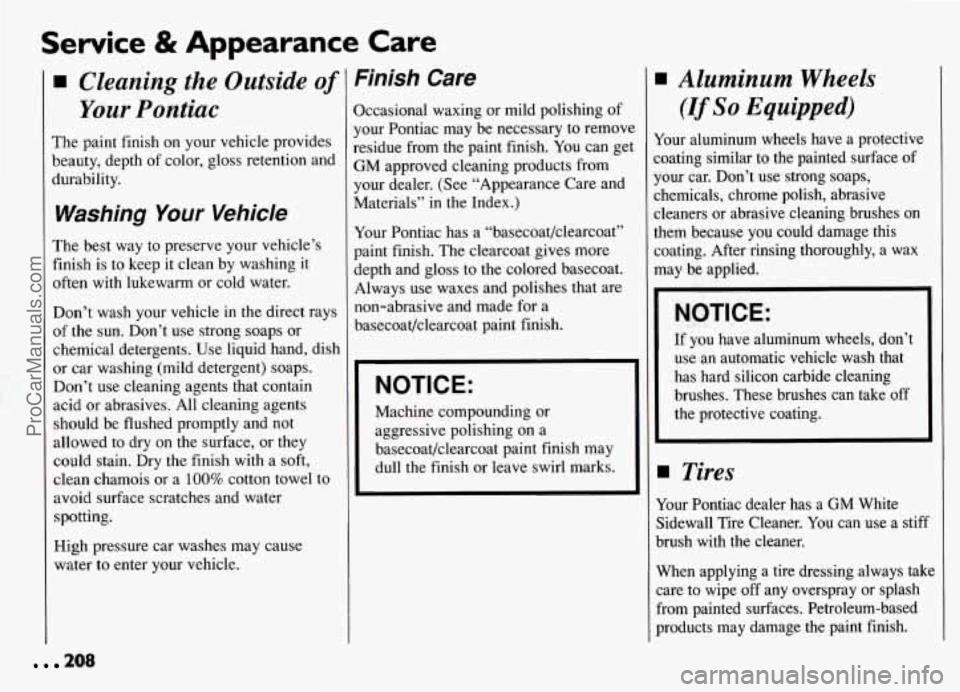
Service & Appearance Care
Cleaning the Outside of
Your Pontiac
The paint finish on your vehicle provides
beauty, depth of color, gloss retention and
durability.
Washing Your Vehicle
The best way to preserve your vehicle’s
finish is to keep it clean by washing it
often with ‘lukewarm or cold water.
Don’t wash your vehicle in the direct rays
of the sun. Don’t use strong soaps or
chemical detergents. Use liquid hand, dish
or car washing (mild detergent) soaps.
Don’t use cleaning agents that contain
acid or abrasives. All cleaning agents
should be flushed promptly and not
allowed to dry on the surface, or they
could stain. Dry the finish with a soft,
clean chamois or a 100% cotton towel to
avoid surface scratches and water
spotting.
High pressure car washes may cause
water to enter your vehicle.
Finish Care
Occasional waxing or mild polishing of
your Pontiac may be necessary to remove
residue from the paint finish. You can get
GM approved cleaning products from
your dealer. (See “Appearance Care and
Materials” in the Index.)
Your Pontiac has a “basecoat/clearcoat”
paint finish. The clearcoat gives more
depth and gloss to the colored basecoat.
Always use waxes and polishes that are
non-abrasive and made for a
basecoat/clearcoat paint finish.
NOTICE:
Machine compounding or
aggressive polishing on a
basecoat/clearcoat paint finish may
dull the finish or leave swirl marks.
I
’I
1
1
Aluminum Wheels
(If So Equipped)
Your aluminum wheels have a protective
:eating similar to the painted surface of
your car. Don’t use strong soaps,
zhernicals, chrome polish, abrasive
:leaners
or abrasive cleaning brushes on
them because you could damage this
coating. After rinsing thoroughly, a wax
may be applied.
NOTICE:
If you have aluminum wheels, don’t
use an automatic vehicle wash that
has hard silicon carbide cleaning brushes. These brushes can take
off
the protective coating.
Tires
Your Pontiac dealer has a GM White
Sidewall Tire Cleaner. You can use a stiff
brush with the cleaner.
When applying a tire dressing always take
care to wipe
off any overspray or splash
from painted surfaces. Petroleum-based
products may damage the paint finish.
208
ProCarManuals.com
Page 226 of 274
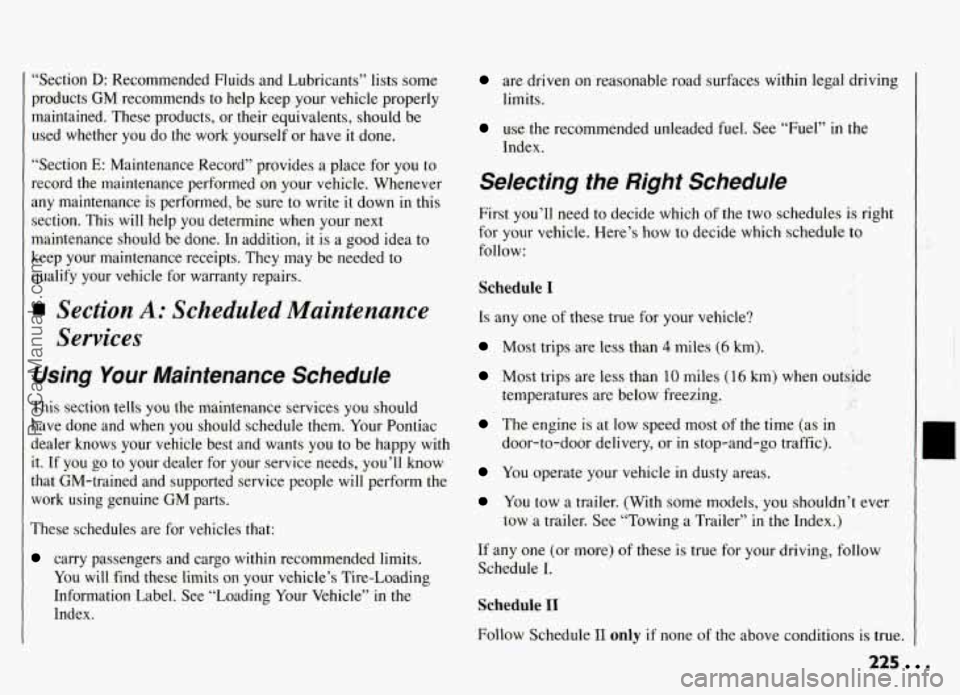
“Section D: Recommended Fluids and Lubricants” lists some
products
GM recommends to help keep your vehicle properly
maintained. These products,
or their equivalents, should be
used whether you do the work yourself or have it done.
‘Section E: Maintenance Record” provides a place for you to
record the maintenance performed on your vehicle. Whenever
any maintenance is performed,
be sure to write it down in this
section. This will help you determine when your next
maintenance should be done. In addition, it
is a good idea to
keep your maintenance receipts. They may be needed to
qualify your vehicle for warranty repairs.
Section A: Scheduled Maintenance
Sewices
Using Your Maintenance Schedule
This section tells you the maintenance services you should
have done and when you should schedule them.
Your Pontiac
dealer knows your vehicle best and wants you to be happy with
it. If you
go to your dealer for your service needs, you’ll know
that GM-trained and supported service people will perform the
work using genuine
GM parts.
These schedules are for vehicles that:
carry passengers and cargo within recommended limits.
You will find these limits on your vehicle’s Tire-Loading
Information Label. S’ee “Loading Your Vehicle” in the
Index.
are driven on reasonable road surfaces within legal driving
limits.
use the recommended unleaded fuel. See “Fuel” in the
Index.
Selecting the Right Schedule
First you’ll need to decide which of the two schedules is right
for your vehicle. Here’s how to decide which schedule to
follow:
Schedule I
Is any one of these true for your vehicle?
Most trips are less than 4 miles (6 km).
Most trips are less than 10 miles (16 km) when outside
temperatures are below freezing.
The engine is at low speed most of the time (as in
door-to-door delivery, or in stop-and-go traffic).
You operate your vehicle in dusty areas.
You tow a trailer. (With some models, you shouldn’t ever
tow a trailer. See “Towing a Trailer” in the Index.)
If any one (or more) of these is true for your driving, follow
Schedule I.
Schedule I1
Follow Schedule I1 only if none of the above conditions is true.
225
ProCarManuals.com
Page 227 of 274
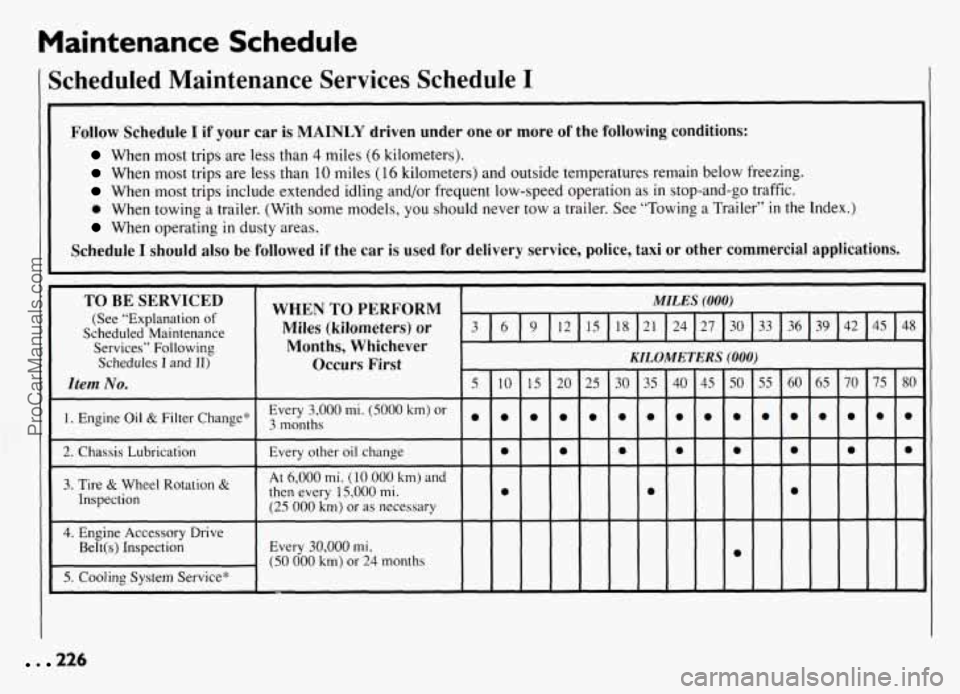
Maintenance Schedule
Scheduled Maintenance Services Schedule I
Follow Schedule I if your car is MAINLY driven under one or more of the following conditions:
When most trips are less than 4 miles (6 kilometers).
When most trips are less than 10 miles (16 kilometers) and outside temperatures remain below freezing.
When most trips include extended idling and/or frequent low-speed operation as in stop-and-go traffic.
i When towing a trailer. (With some models, you should never tow a trailer. See “Towing a Trailer” in the Index.)
When operating in dusty areas.
Schedule I should also be followed if the car is used for delivery service, police, taxi or other commercial applications.
. 226
ProCarManuals.com
Page 232 of 274

6. Transaxle Service -- For manual transaxles, fluid doesn’t
require changing. See “Periodic Maintenance Inspections.”
For automatic transaxles, change both the fluid and filter
every
15,000 miles (25 000 km) if the vehicle is mainly
driven under one or more of these conditions:
* In heavy city traffic where the outside temperature
regularly reaches 90°F (32°C) or higher.
0 In hilly or mountainous terrain.
0 When doing frequent trailer towing.
0 Uses such as found in taxi, police car or delivery
service.
If you -do not use your vehicle under any of these
conditions, change both the fluid and filter every
100,000 miles ( 166 000 km).
7. Spark Plug Replacement* -- Replace spark plugs with
the proper type. See “Replacement Parts” in the Index.
8. Spark Plug Wire Inspection (3.1L Code M engine
only)*?
-- Inspect for burns, cracks or other damage.
Check
the boot fit at the coils and at the spark plugs.
Replace wires as needed.
9. Air Cleaner Filter Replacement* -- Replace every
30,000 miles (50 000 km) or more often under dusty
conditions.
Ask your dealer for the proper replacement
intervals for your driving conditions.
1 O.Fuel Tank, Cap and Lines Inspection”? -- Inspect fuel
tank, cap and
lines (including fuel rails and injection
assembly) for damage or leaks. Inspect
fuel cap gasket for
an even filler neck imprint or any damage. Replace parts as
needed. Periodic replacement of the fuel filter is
not
required.
* An Emission Control Service.
3- The U.S. Environmental Protection Agency or the California Air Resources Board has determined that the failure to perform this maintenance item will not nullify the
emission warranty or limit recall liability prior to the completion of vehicle useful life. General Motors, however, urges that all recommended maintenance services be performed at the indicated intervals and the maintenance be recorded in “Section E: Maintenance Record”.
ProCarManuals.com
Page 249 of 274
Customer Assistance Information
rn REPORTING SAFETY
DEFECTS TO
GENERAL MOTORS
In addition to notifying NHTSA (or
Transport Canada)
in a situation like this,
we certainly hope you’ll notify
us. Please
call us at 1-800-PM-CARES
, or write:
Pontiac Division
Customer Assistance Center
One Pontiac Plaza
Pontiac, MI 48340
In Canada, please call us at
1-800-263-3777 (English) or
1-800-263-7854 (French). Or, write:
General Motors of Canada Limited
Customer Assistance Center 1908 Colonel Sam Drive
Oshawa, Ontario L
1 H 8P7
Pontiac Roadside
Assistance Program
Security While You Travel
-800-ROADSIDE 1-800-762-3743
1s the proud owner of a new Pontiac
lehicle, you are automatically enrolled in
he Pontiac Roadside Assistance Program
?his value-added service is intended to
,rovide you with peace of mind as you
lrive in
the city or travel the open road.
Pontiac’s Roadside Assistance toll-free
number is staffed by a team of trained
technical advisors who are available
24 hours
a day, 365 days a year.
We take anxiety out of uncertain
situations by providing minor repair
information over
the phone or making
arrangements to tow your vehicle to the
nearest Pontiac dealer.
We will provide the following services for
3 yearS/36,000 miles, at no expense to
you:
Vehicle out of fuel
Keys locked in vehicle
Tow to nearest dealer for warranty
Change a flat tire
Jump starts
ProCarManuals.com
Page 264 of 274

Index
Adding
Brake Fluid ................. 192
Electrical Equipment
..... 107. 2 11
Engine Coolant
.......... 159. 189
Engine Oil
.................. 18 1
Hydraulic Clutch Fluid ........ 187
Power Steering Fluid
..... 190. 216
Transaxle Fluid
Automatic ........... 185. 215
Manual
.............. 187. 215
Windshield Washer Fluid
...... 191
Air Bag Readiness Light .......... 22
Air Bag (Supplemental Restraint
System - SRS) ................. 21
Air Cleaner .................... 183
Air Conditioner
................ 103
Alcohol. Driving Under the
Influence of .................. 120
Alcohol
in Gasoline ......... 17 1. 172
Aluminum Wheels. Cleaning ...... 208
Antenna. Fixed
Mast ............ 118
Antifreeze
..................... 188
Anti-Lock Brake System (ABS)
... 123
Anti-Lock Brake System
Warning Light ................. 99
Appearance Care and Materials
.... 204
Ashtray and Lighter
.............. 86
Audio Systems
................. 106
AM/FM Stereo Radio ......... 108
AM/FM Stereo Radio
with
Cassette Player ............. 109
AM/FM Stereo Radio with
Cassette Player and Graphic
Equalizer
.................. 11 1
AM/FM Stereo Radio with
Compact Disc Player ........ 11 3
Care of Audio Systems
........ 11 7
Delco LOC II@
.............. 115
Radio Reception. For the Best
. . 117
Setting the Clock
............. 107
Automatic Door Locks ............ 48
Automatic Lap-Shoulder Belt
(see “Safety Belts”)
Automatic Transaxle
Adding Fluid ............ 185. 215
Checking Fluid
.............. 184
Shifting
..................... 59
Starting Your Engine
........... 56
Battery .................. 148. 194
Jump Starting
........... 148. 194
Rundown Protection
........... 80
Voltmeter
.................... 97
BBB Auto Line
................ 245
Blizzard. If You’re Caught In a
.... 137
Block Heater. Engine
......... 58. 182
Blowout. Tire
.................. 16 1
Brakes
....................... 123
Adjustment ................. 193
Anti-Lock Brake System (ABS)
. 123
Brake Pedal Travel
........... 193
Fluid
...................... 191
Master Cylinder ............. 191
Parking
..................... 66
Rear Drums
................. 192
Replacement
................ 193
Warning Light
................ 98
Wear Indicators
.............. 192
Brakes. Anti-Lock .............. 123
Brake System Warning Light
....... 98
Anti-Lock Brake System
....... 99
Standard Brakes
.............. 99
Brakenramaxle Shift Interlock
..... 69
Warning Light
................ 99
Braking
....................... 123
Braking in Emergencies
.......... 125
,‘Break-in", New Vehicle
Braking Technique .............. 123
Normal Driving ............... 54
When Towing a Trailer ........ 141
Buckling Up (see “Safety Belts”)
Bulb Replacement
Fog Lights .............. 196. 217
Headlight
............... 195. 217
Taillight
................ 196. 217
Capacities & Specifications ...... 215
Carbon Monoxide
in Exhaust . . 70. 138
Cassette Tape Player (see “Audio
Center Passenger Position ......... 27
Chains. Safety
................. 143
Chains. Tire
................... 203
Systems”) C
263 ...
ProCarManuals.com