1994 PONTIAC GRAND-AM ignition
[x] Cancel search: ignitionPage 73 of 274
Features & Controls
Windows
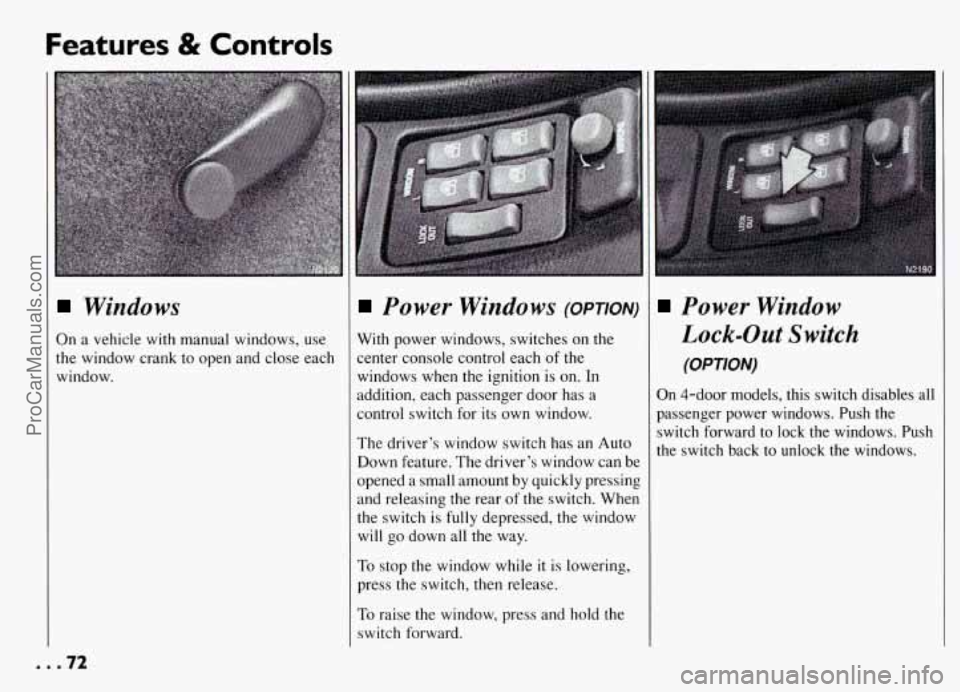
On a vehicle with manual windows, use
the window crank to open and close each
window.
Power Windows (OPTION)
With power windows, switches on the
center console control each of the
windows when the ignition is on. In
addition, each passenger door has a
control switch for its own window.
The driver’s window switch has an Auto
Down feature. The driver’s window can be
opened a small amount
by quickly pressing
and releasing the rear
of the switch. When
the switch is fully depressed, the window
will go down all the way.
To stop the window while it is lowering,
press the switch, then release.
To raise the window, press and hold the
switch forward.
Power Window
Lock-Out Switch
(OPTION)
On 4-door models, this switch disables all
passenger power windows.
Push the
switch forward to lock the windows. Push
the switch back to unlock the windows.
... 72
ProCarManuals.com
Page 77 of 274
Features & Controls
To Reduce Speed While
Using Cruise Control
There are two ways to reduce your speed
while using cruise control:
0 Push in the button at the end of the
lever until you reach the lower speed
you want, then release
it.
0 To slow down in very small amounts,
push the button for less than half a
second. Each
time you do this, you’ll
go
1 mph (1.6 km/h) slower.
Passing Another Vehicle
While Using Cruise
Control
Use the accelerator pedal to increase your
speed. When you take your foot off the
pedal, your vehicle
will slow down to the
Cruise Control speed you set earlier.
Using Cruise Control on
Hills
How well your Cruise Control will work
on hills depends upon your speed, load,
and the steepness of the hills. When going
up steep hills, you may have to step on
the accelerator pedal to maintain your
speed. When going downhill, you may
have to brake or shift to
a lower gear to
keep your speed down. Of course,
applying the brake takes you out of
Cruise Control. Many drivers find this
to
be too much trouble and don’t use Cruise
Control on steep hills.
To Get Out of Cruise
Control
There are two ways to turn off the Cruise
Control:
0 Step lightly on the brake pedal or push
the clutch pedal,
if you have a manual
transaxle;
OR
Move the Cruise switch to OFF.
To Erase Cruise Speed
Memory
When you turn off the Cruise Control or
the ignition, your Cruise Control set speed
memory
is erased.
ProCarManuals.com
Page 78 of 274

rn Light Controls
Parking Lights:
Rotate the switch up to PC to turn on:
Parking Lights
0 Side Marker Lights
Taillights
Instrument Panel Lights
Headlights:
Rotate the switch to ’ , to turn on:
0 Headlights
0 Parking Lights
0 Side Marker Lights
0 Taillights
0 Instrument Panel Lights
Rotate the switch
to OFF to turn all the
lights off.
-‘a-
Operation of Lights
Although your vehicle’s lighting system
(headlights, parking lights, fog lamps,
side marker lights and taillights)
meet all
applicable federal lighting requirements,
certain states and provinces may apply
their own lighting regulations that may
require special attention before you
operate these lights.
For example, some jurisdictions may
require that you operate your lower beam
lights with fog lamps at all times, or that
headlights be turned
on whenever you
must use your windshield wipers.
In
addition, most jurisdictions prohibit
driving solely with parking lights,
especially at dawn or dusk.
It is
recommended that you check with your
own state or provincial highway authority
for applicable lighting regulations.
Lights On Reminder
If you open the driver’s door while
leaving the lights
on, you will hear a
warning chime.
Daytime Running Lights
(CANADA ONLY)
Your DRL work with a light sensor on top
of the instrument panel. Don’t cover
it up.
The high beam headlights will come
on at
reduced brightness in daylight when:
0 The ignition is on
0 The headlight switch is off, and
0 The parking brake is released on a
manual transaxle; or
77 a I
ProCarManuals.com
Page 79 of 274

Features & Controls
Daytime Running Lights
(CANADA ONLY) (CONT.)
The shift lever is shifted out of PARK
(P) or NEUTRAL (N) on an automatic
transaxle.
At dusk, the exterior lights and headlights
will come on automatically. At dawn, the
exterior lights will go out and the high
beams will change to the reduced
brightness of DRL again (if the headlight
switch is off).
Of course, you may still turn on the
headlights any time you need to.
To idle your vehicle with the DRL off, set
the parking brake
on a manual transaxle
or put the vehicle
in PARK (P) or
NEUTRAL
(N) on an automatic
transaxle, while the ignition is in the OFF
or LOCK position. Then start the vehicle.
The DRL will stay off until
you release
the parking brake on a manual transaxle
or shift out of PARK (P) or NEUTRAL
(N) on an automatic transaxle.
Yeadlight High-Low Beam
%anger
To change the headlights from low beam
o high or high to low, pull the turn signal
ever all the way toward you. Then
elease it. When the high beams are on,
his blue light on the instrument panel
dso will be on.
Flash-To-Pass
(EXCEPT CANADA)
Flash-to-pass lets you use your high
beam headlights to signal a driver
in front
of you that you want to pass.
To use it, pull the turn signal/
multifunction lever toward you.
If Your Headlights are Off
Your high beam headlights will turn on.
They’ll stay on as long as you hold the
lever there. Release the lever to turn them
off.
If Your Headlights are On:
No flash-to-pass. Use the lever to change
between high and low beams.
mm.78
ProCarManuals.com
Page 81 of 274
Features & Controls
Rear Reading Lights
(OPTION)
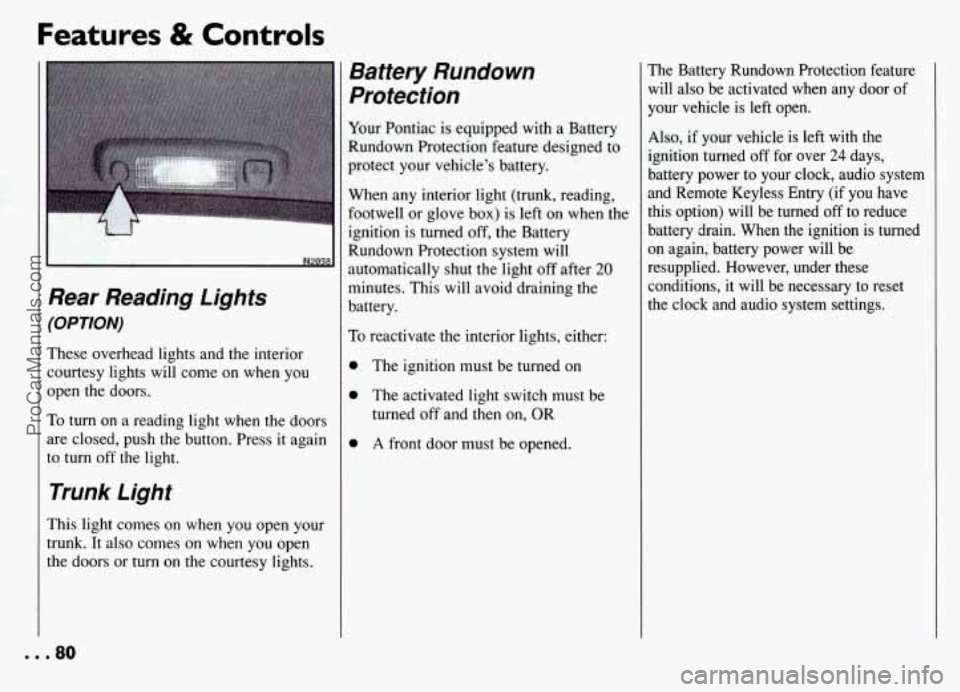
These overhead lights and the interior courtesy lights will come on when you
open the doors.
To turn on a reading light when the doors
are closed, push the button. Press it again
to turn
off the light.
Trunk Light
This light comes on when you open your
trunk. It also comes on when you open
the doors or
turn on the courtesy lights.
Battery Rundown
Protection
Your Pontiac is equipped with a Battery
Rundown Protection feature designed to
protect your vehicle's battery.
When any interior light (trunk, reading,
footwell or glove
box) is left on when the
ignition is turned
off, the Battery
Rundown Protection system will
automatically shut the light
off after 20
minutes. This will avoid draining the
battery.
To reactivate the interior lights, either:
0 The ignition must be turned on
0 The activated light switch must be
turned off and then on, OR
0 A front door must be opened.
The Battery Rundown Protection feature
will also be activated when any door of
your vehicle is left open.
Also, if your vehicle is left with the
ignition turned
off for over 24 days,
battery power to your clock, audio system
and Remote Keyless Entry (if you have
this option) will be turned
off to reduce
battery drain. When
the ignition is turned
on again, battery power will be
resupplied. However, under these
conditions, it will be necessary to reset
the clock and audio system settings.
... 80
ProCarManuals.com
Page 90 of 274

The Instrument
Panel-Your Information System
Your instrument panel is designed to let
you know at a glance how
your vehicle is
running. You’ll know how fast you’re
going, how much fuel you’re using, and
many other things you’ll need to drive
safely and economically.
The main components of your instrument
panel are:
1. Fog Light Switch
2. Instrument Panel Intensity Control,’
Interior Lights Switch
3. Side Vent
4. Turn Signal/Multifunction Lever
5. Hazard Warning Flashers Switch
6. Instrument Cluster
7. Windshield Wipersmasher Stalk
8. Center Vent
9. Audio System
10. Side Vent
11. Side Window Defogger Vent
12. Glove Box
13. Climate Control System
14. Ashtraybighter
15. Gear Shift Lever
16. Rear Window Defogger (Option)
17. Ignition Switch
18. SRS - Supplemental Restraint
System (Air Bag)
19. Horns
20. Tilt Steering Wheel Lever (Option)
21. Parking Brake Release Lever
22. Hood Release Handle
23. Fuse Panel
ProCarManuals.com
Page 94 of 274
Warning Lights, Gages
and Indicators
This section describes the warning lights
and gages that may be on your vehicle. The pictures will help you locate them.
Warning lights and gages can signal that
something is wroug before it becomes
serious enough to cause an expensive
repair or replacement. Paying attention to
your warning lights and gages could also
save you
or others from injury.
Warning lights go on when there may be
Dr is a problem with one of your vehicle’s
functions. As you will see
in the details
on the next few pages, some warning
lights come on briefly
when you turn the
ignition key just to let you know they’re
working. If you are familiar with this
section, you should not be alarmed when
this happens.
Gages can indicate when there may be or
is a problem with one of your vehicle’s
functions. Often gages and warning lights
work together to let you know when
there’s a problem with your vehicle.
When one of the warning lights comes on
and stays on when you are driving, or
when one of the gages shows there may
be a problem, check the section that tells
you what to do about
it. Please follow the
manual’s advice. Waiting to do repairs
can
be costly -- and even dangerous. So
please get to know your warning lights
and gages. They’re
a big help.
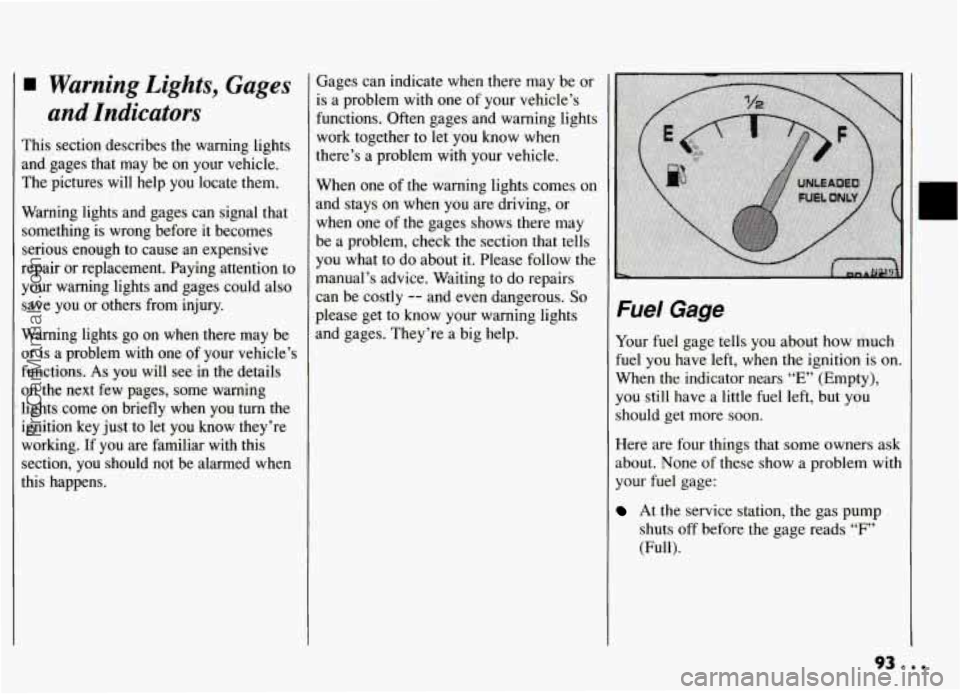
Fuel Gage
Your fuel gage tells you about how much
fuel you have left, when the ignition is on.
When
the indicator nears “E” (Empty),
you still have a little
fuel left, but you
should get more soon.
Here are four things that some owners ask
about. None of these show a problem with
your fuel gage:
At the service station, the gas pump
shuts off before the gage reads “F”
(Full).
c
93...
ProCarManuals.com
Page 95 of 274

Features & Controls
Fuel Gage (CONT.)
0 It takes a little more or less fuel to fill
up than the gage indicated. For
example, the gage may have indicated
the tank was half full, but it actually
took a little more or less than half the
tank’s capacity to fill the tank.
0 The gage moves a little when you turn
a corner or speed up.
0 The gage doesn’t go back to “E” when
you turn off the ignition.
For your fuel tank capacity, see “Service
Station Information”
on the last page of
this manual.
Engine Coolant Temperature Warning
Light
This light tells you that your engine
coolant has overheated or your radiator
cooling fan is not working.
If you have been operating your vehicle
under normal driving conditions, you should pull
off the road, stop your vehicle
and
turn the engine off as soon as possible
HOT COOLANT CAN BURN YOU
BADLY!
In “Problems on the Road”, this manual
shows what to do. See “Engine
Overheating” in the Index.
Engine Coolant
Temperature Gage
This gage shows the engine coolant
temperature. If the gage pointer moves
into the red area, your engine is too hot!
That reading means the same thing as the
warning light. It means that your engine
coolant has overheated.
If you have been operating your vehicle
under normal driving conditions, you
should pull
off the road, stop your vehicle
and
turn off the engine as soon as possible.
HOT COOLANT CAN BURN YOU
BADLY!
In “Problems on the Road”, this manual shows what to do. See “Engine
Overheating” in the Index.
ProCarManuals.com