1994 PONTIAC BONNEVILLE wheel alignment
[x] Cancel search: wheel alignmentPage 228 of 290
Uniform Tire Quality
Grading
The following information relates to the
system developed by the United States
National Highway Traffic Safety
Administration which grades tires by
treadwear, traction and temperature
performance. (This applies only to
vehicles sold
in the United States.)
Treadwear
The treadwear grade is a comparative
rating based on the wear rate of the tire
when tested under controlled conditions
on a specified government test course. For
example, a tire graded
150 would wear
one and a half
(1 1/2) times as well on the
government course as a tire graded 100.
The relative performance of tires depends
upon the actual conditions of their use,
however, and may depart significantly
from the norm due to variations in driving
habits, service practices and differences
in
road characteristics and climate.
Traction - A, B, C
The traction grades, from highest to
lowest are: A,
B, and C. They represent
i the tire's ability to stop on wet pavement as measured under controlled conditions
on specified government test surfaces
of
asphalt and concrete. A tire marked
C
may have poor traction performance.
Warning: The traction grade assigned to
this tire is based on braking (straight-ahead) traction tests and does
not include cornering (turning) traction.
Temperature - A, B, C
The temperature grades are A (the
highest),
B, and C, representing the tire's
resistance to the generation of heat and its
ability
to dissipate heat when tested under
controlled conditions on a specified
indoor laboratory test wheel. Sustained
high temperature can cause the material
of the tire to degenerate and reduce tire
life, and excessive temperature can lead
to
sudden tire failure. The grade C
corresponds to a level of performance
which all passenger car tires must meet
under the Federal Motor Vehicle Safety
Standard No.
109. Grades B and A
represent higher levels of performance on
the laboratory test wheel than the minimum required by law. Warning:
The temperature grade for this
tire
is established for a tire that is properly
inflated and not overloaded. Excessive
speed, underinflation, or excessive
loading, either separately or in
combination, can cause heat buildup and
possible tire failure.
These grades are molded on the sidewalls
of passenger car tires.
While the tires available as standard or
optional equipment on General Motors
vehicles may vary with respect to these
grades, all such tires meet General Motors
performance standards and have been
approved for use on General Motors
vehicles. All passenger type
(P Metric)
tires must conform
to Federal safety
requirements in addition
to these grades.
Wheel Alignment and Tire
Balance
The wheels on your vehicle were aligned
and balanced carefully at the factory to
give you the longest tire life and best
overall performance.
ProCarManuals.com
Page 229 of 290
Service & Appearance Care
Wheel Alignment and Tire
Balance
(CONT)
In most cases, you will not need to have
your wheels aligned again. However,
if
you notice unusual tire wear or your
vehicle pulling one way or the other, the
alignment may need to be reset.
If you
notice your vehicle vibrating when
driving on
a smooth road, your wheels
may need to be rebalanced.
Wheel Replacement
Replace any wheel that is bent, cracked or
badly rusted. If wheel nuts keep coming
loose, the wheel, wheel bolts, and wheel
nuts should be replaced. If the wheel
leaks air, replace
it (except some
aluminum wheels, which can sometimes
be repaired). See your Pontiac dealer
if
any of these conditions exist.
Your dealer
will know the kind of wheel
you need.
Each new wheel should have
the same
load carrying capacity, diameter, width,
offset, and be mounted the same way as
the one it replaces.
If you need to replace any of your wheels,
wheel bolts, or wheel nuts, replace them
only
with new GM original equipment
parts. This way, you will be sure to have
the right wheel, wheel bolts, and wheel
nuts
for your Pontiac model.
NOTICE:
The wrong wheel can also cause
problems with bearing life, brake cooling, speedometer/odometer
calibration, headlight aim, bumper
height, vehicle ground clearance,
and tire or tire chain clearance to the
body and chassis.
Used Replacement Wheels
, . .228
ProCarManuals.com
Page 255 of 290
Maintenance Schedule
Explanation of Scheduled Maintenance
Services
Following are explanations of the services listed in Schedule I
and Schedule
11.
The proper fluids and lubricants to use are listed in Section D.
Make sure whoever services your vehicle uses these. All parts
should be replaced and all necessary repairs done before you or
anyone else drives the vehicle.
1. Engine Oil and Filter Change* -- Always use SH or SG
Energy Conserving I1 oils
of proper viscosity. The “SH” or
“SG” designation may be shown alone or in combination
with others, such as “SH/CD,” or “SH, SG, CD,” “SG/CD,”
etc. To determine the preferred viscosity for your vehicle’s
engine (e.g., SAE 5W-30 or SAE
10W-30), see “Engine
Oil”
in the Index.
2. Chassis Lubrication -- Lubricate suspension and steering
linkage. Lubricate the transaxle shift linkage, and parking
brake cable guides, underbody contact points and linkage.
3. Tire and Wheel Rotation and Inspection -- For proper
wear and maximum tire
life, rotate your tires following the
instructions in this manual. See “Tires, Inspection &
Rotation” in the Index. Check the tires for uneven wear or
damage. If
you see irregular or premature wear, check the
wheel alignment. Check for damaged wheels also.
4. Engine Accessory Drive Belt(s) Inspection* -- Inspect
the belt(s) for cracks, fraying, wear and proper tension.
Replace as needed. (Belts can have many small cracks
in
individual ribs without affecting performance.)
5. Cooling System Service* -- Drain, flush and refill the
system with new or approved recycled coolant conforming
to GM Specification 1825M. Keep coolant at the proper
mixture as specified. See “Coolant”
in the Index. This
provides proper freeze and boil protection, corrosion inhibitor level and maintains proper engine operating
temperature.
Inspect hoses and replace
if they are cracked, swollen or
deteriorated. Tighten screw-type hose clamps. Clean the
outside of the radiator and air conditioning condenser. Wash
the pressure cap and neck.
To help ensure proper operation, we recommend a pressure
test of both the cooling system and the pressure cap.
ProCarManuals.com
Page 286 of 290
Storing Your Vehicle ............ 220
Stuck:
If You Are ............... 192
Sun Visors
..................... 80
Sunroof. Express Open
........... 81
Supercharger Oil
............... 204
Restraint System
............... 20
Supplemental Inflatable
Tachometer
.................... 90
Tape Player (see “Audio Systems”)
Technical Facts
& Specifications
Bulbs
...................... 244
Electrical Equipment. Add-on
........... 85. 120. 237
Fluid Capacities
& Types . . 242. 261
Fuses
& Circuit Breakers ....... 2.28,
Service Parts Identification Label
..................... 237
Vehicle Identification Number
(VIN) .................... 237
Temperature Warning
......... 92. 101
Theft-Deterrent System ........... 49
Security Light
................ 50
THEFTLOCKB
................ 128
Thermostat
.................... 216
Tilt Steering Wheel
.............. 67
Time. Setting the
............... 120
Tires
......................... 224
Air Inflator System ........... 182
Blowout
.................... 182
Buying New
................ 226
Chains
................. 192. 229 Flat. Changing
............... 182
Inflation
.................... 224
Inspection
& Rotation ......... 225
Loading
.................... 222
Pressure
.................... 224
Quality Grading
............. 227
Spare. Compact
.............. 19 1
Wear Indicators .............. 226
Wheel Alignment
& Tire
Wheel Replacement
.......... 228
When to Replace Wheels
...... 228
Winter Driving
.............. 155
Balance
..................... 227
Torque Lock
.................... 64
Towing a Trailer ................ 158
Towing Your Pontiac
............ 170
Traction Control
................ 143
Traction Control System Warning Light
................. 98
Trailer Towing
................. 158
Transaxle. Automatic (see “Automatic
Transmission. Automatic (see
Transaxle”)
“Automatic Transaxle?’)
Trip Odometer
.................. 90
Trunk
Lock
....................... 50
Release. Remote Power ........ 51
Turn Signal/Multifunction Lever
.... 68
Cruise Control
................ 71
Headlight High-Low Beam
Turn Signal
Indicator
............. 68
Changer
................... 76 Lane Change
Signals
.......... 68
Turn Signal Indicator
.......... 68
Windshield Washer
............ 70
Windshield Wipers
............ 69
Twilight Sentinel ................ 76
Underhood Light
................ 200
Unleaded Gasoline
.............. 195
Upholstery Care
............ 230, 231
Urban Driving
................. 151
Variable Effort Steering
......... 144
Vehicle Identification Number (VIN)
................ 237
Vehicle Loading
................ 222
Vehicle Storage
................ 220
Ventilation 113.
118
VIN ......................... 237
.
.................
Visor Vanity Mirrors ............. 80
Voltmeter
..................... 102
Warning Flashers. Hazard
....... 166
Warning Lights .................. 91
Anti-Lock Brake System ....... 98
Battery
...................... 95
Brake ....................... 97
Check Gages
................ 100
Coolant Temperature
.......... 92
Low Washer Fluid ............. 97
285
ProCarManuals.com
Page 287 of 290
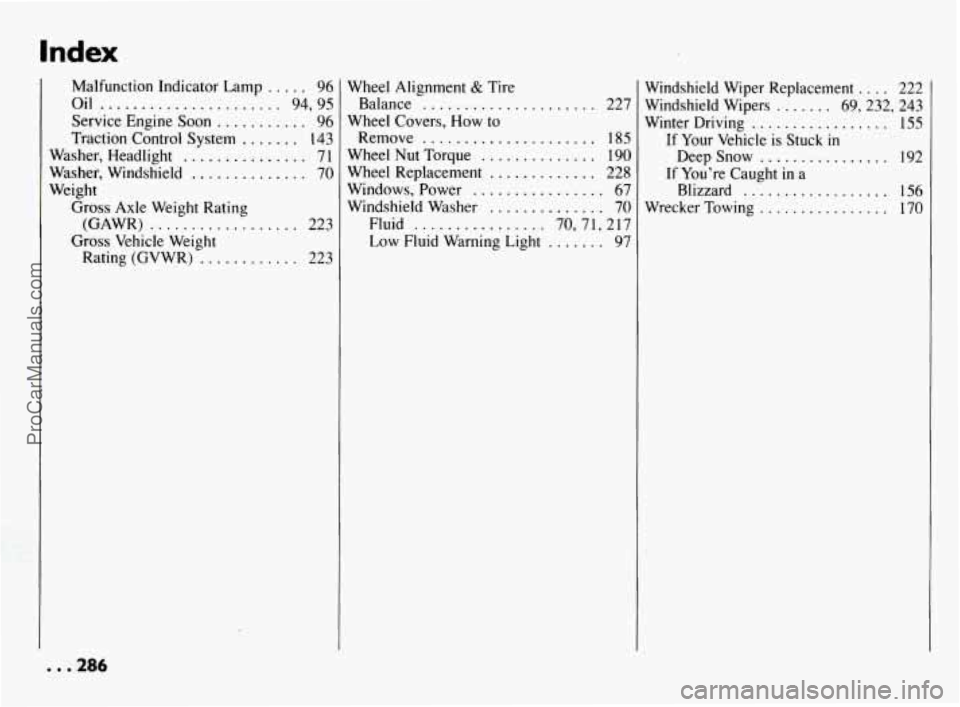
Malfunction Indicator Lamp ..... 96
Oil
...................... 94. 95
Service Engine Soon
........... 96
Traction Control System
....... 143
Washer. Headlight
............... 71
Washei. Windshield
.............. 70
Weight Gross Axle Weight Rating
Gross Vehicle Weight
(GAWR)
.................. 223
Rating (GVWR)
............ 223 Wheel Alignment
& Tire
Balance
..................... 227
Wheel Covers. How
to
Remove ..................... 185
Wheel Nut Torque .............. 190
Wheel Replacement
............. 228
Windows. Power
................ 67
Windshield Washer
.............. 70
Fluid
................ 70. 71. 217
Low Fluid Warning Light
....... 97 Windshield Wiper Replacement
.... 222
Windshield Wipers
....... 69. 232. 243
Winter Driving
................. 155
Deep Snow
................ 192
Blizzard
.................. 156
Wrecker Towing
................ 170
If Your Vehicle is Stuck in
If You’re Caught
in a
ProCarManuals.com