Page 6 of 290
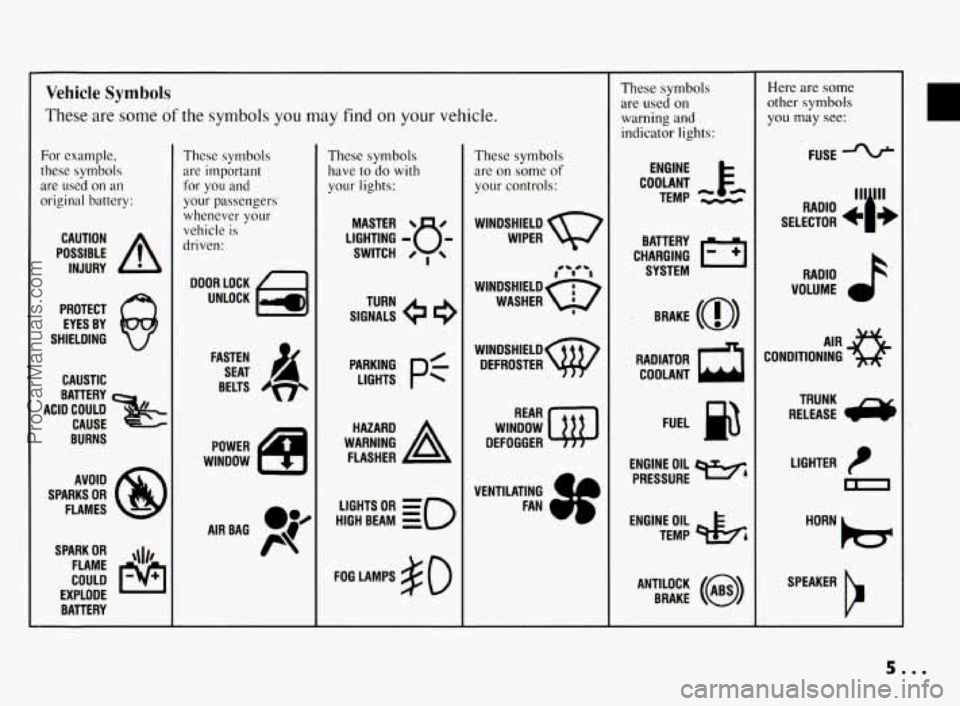
Vehicle Symbols
These are some of the symbols you may find on your vehicle.
For example,
these symbols
are used on an
original battery:
POSSIBLE A
CAUTION
INJURY
PROTECT EYES BY
SHIELDING
CAUSTIC
ACID COULD BATTERY
CAUSE
BURNS
AVOID
SPARKS
OR
FLAMES
SPARK
OR ,111,
COULD FLAME
EXPLODE BATTERY
These symbols
are important
for you and
your passengers
whenever your
vehicle
is
driven:
DOOR LOCK
UNLOCK
FASTEN SEAT
4
BELTS
POWER
WINDOW
'* -- I
These symbols
have to do with
your lights:
SIGNALS e
TURN
HIGH BEAM
OR = =o
FOG LAMPS $0
These symbols
are
on some of
your controls:
WIPER Q7
WINDSHIELD
DEFROSTER
WINDOW
DEFOGGER
VENTILATING
4
FAN (I
These symbols
are used
on
warning and
indicator lights:
COOLANT Fa
TEMP --
ENGINE
CHARGING
I-1
BATTERY SYSTEM
BRAKE
(0)
RADIATOR COOLANT
FUEL
ENGINE OIL
PRESSURE
Wb
TEMP OIL ?b
ANTILOCK (@)
BRAKE
Here are some
other symbols
you may see:
FUSE
11lp RADIO , - -
SELECTOR b I JE
RADIO
VOLUME
CONDITIONING
AIR 43
LIGHTER
m
SPEAKER
b
5.00
ProCarManuals.com
Page 72 of 290
NOTICE:
0
a
When using concentrated
washer fluid, follow the
manufacturer’s instructions
for adding water.
Don’t mix water with
ready-to-use washer fluid.
Water can cause the solution
to freeze and damage your
washer fluid tank and other
parts
of the washer system.
Also, water doesn’t clean as
well as washer fluid.
Fill your washer fluid tank
only
314 full when it’s very
cold. This allows for
expansion, which could
damage the tank
if it is
completely
full.
Don’t use radiator antifreeze
in your windshield washer. It
can damage your washer
system and paint.
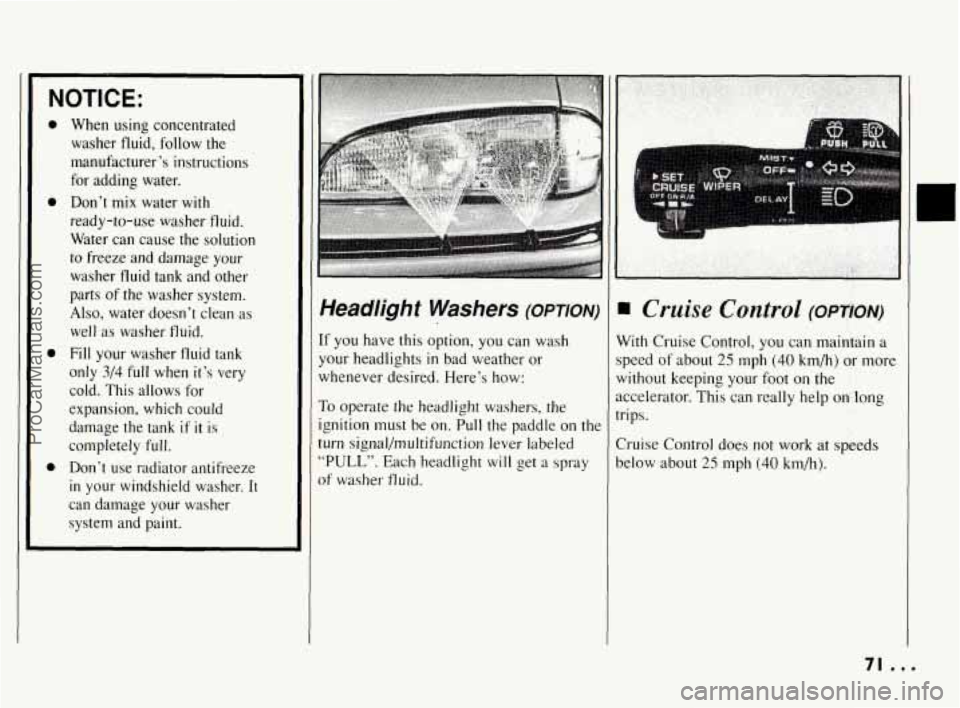
Headlight Washers (OPTION)
If you have this option, you can wash
your headlights
in bad weather or
whenever desired. Here’s how:
To operate the headlight washers, the
ignition must be
on. Pull the paddle on the
turn signal/multifunction lever labeled
“PULL”. Each headlight will get a spray
of washer fluid.
I
Cruise Control (opnoN)
With Cruise Control, you can maintain a
speed of about
25 mph (40 km/h) or more
without keeping
your foot on the
accelerator. This can really help
on long
trips.
Cruise Control does
not work at speeds
below about
25 mph (40 km/h).
71 ...
ProCarManuals.com
Page 93 of 290
Features & Controls
SYSTEMS MONITOR
0
(-J[=zFz]
[HeURlTY][-))
Warning Lights (CONT.)
I
I-] INFORMATION DRIVER
CHECK OIL LEVEL - LAMP
WASHER FLUID
CHECK QAQES LOW
COOLANT
moo DOOR TRUNK AJAR TURN SIONAL
BACK UP TAIL
BRAKE LAMP
MILES TRIP
(][TEiir] ENGINE SOON
[E][--
Engine Coolant Temperature Warning
Light
This light tells you that your engine
coolant has overheated or your radiator
cooling fans are not working.
If you have
been operating your vehicle under normal
driving conditions, you
should pull off the
road, stop your vehicle and
turn the
engine off as soon as possible.
I #..92
ProCarManuals.com
Page 173 of 290
Problems on the Road
Towing Your Vehicle
(COnrT.)
Towing from the
Front-Vehicle
Hook-up
(EXCEPT SSE & SSEi)
Before hooking up to a tow truck, be sure
to read all the information on “Towing
Your Pontiac” earlier in this section.
1. Attach T-hook chains into the bottom
slots in
the cradle behind the front
wheels, on both sides.
2. Across sling chains, position a 4x4
wood beam against the bottom of the
radiator support behind the front
bumper.
ProCarManuals.com
Page 178 of 290

If No Steam Is Coming
From Your Engine
If you get the overheat warning but see or
hear no steam, the problem may not be
too serious. Sometimes the engine can get
a little too hot when you:
0 Climb a long hill on a hot day.
0 Stop after high speed driving.
0 Idle for long periods in traffic.
Tow a trailer.
If you get the overheat warning with
no
sign of steam, try this for a minute or so:
1. Turn off your air conditioner.
2. Turn on your heater to full hot at the
highest fan speed and open the
window as necessary.
3. If you’re in a traffic jam, shift to “N”
(Neutral).
If you no longer have the overheat
warning, you can drive. Just to be safe,
drive slower for about ten minutes. If the
warning doesn’t come back on, you can
drive normally.
If the warning continues, pull over, stop,
and park your vehicle right away.
If there’s still no sign of steam, you can
idle the engine for two or three minutes
while you’re parked, to see
if the warning
stops.
But then,
if you still have the warning,
TURN
OFF THE ENGINE AND GET
EVERYONE OUT
OF THE VEHICLE
until it cools down.
You may decide not to lift the hood but to
get service help right away.
11
Cooling System
When you decide it’s safe to lift the hood,
here’s what you’ll see:
(A) Coolant recovery tank
(B) Radiator pressure cap
(C) Electric engine fan
. 177..
c
ProCarManuals.com
Page 179 of 290

Problems on the Ro,ad
... .
I
Cooling System (CONT.)
If the coolant inside the coolant recovery
tank is boiling, don’t do anything else
until it cools down.
The coolant level should be at or above
the “FULL COLD’ mark. If
it isn’t, you
may have a leak
in the radiator hoses,
heater hoses, radiator, water pump or
somewhere else in the cooling system.
NOTICE:
Engine damage from running your
engine without coolant isn’t covered
by your warranty.
If there seems to be no leak, check to see
if the electric engine fan is running. If the
engine
is overheating, the fan should be
running. If it isn’t, your vehicle needs
service.
How to Add Coolant to the
Coolant Recovery Tank
If you haven’t found a problem yet, but
the coolant level isn’t
at or above the
“FULL COLD’ mark, add
a 50/50
mixture of clean water (preferably
distilled) and
a proper antifreeze at the
coolant recovery tank. (See “Engine Coolant”
in the Index for more
information about the proper coolant
mix.)
... 178
ProCarManuals.com
Page 180 of 290
NOTICE:
In cold weather, water can freeze
and crack the engine, radiator,
heater core and other parts. Use the
recommended coolant. When
the coolant
in the coolant recovery
tank
is at or above the “FULL COLD’
mark, start your vehicle.
If the overheat warning continues, there’s
one more thing you can try.
You can add
the proper coolant
mix directly to the
radiator
but be sure the cooling system is
cool before you do it.
179.
C
ProCarManuals.com
Page 181 of 290
Problems on the Road
How to Add Coolant to the
Radiator:
1. You can remove the radiator pressure
cap when the cooling system,
including the radiator pressure cap and
upper radiator hose, is no longer hot.
Turn the pressure cap slowly to the
left until
it first stops. (Don’t press
down while turning the pressure cap.)
If
you hear a hiss, wait for that to stop.
A hiss means there is still some
pressure left.
. . . 180
2. Then keep turning the pressure cap,
but now push down as you turn it.
Remove the pressure cap. 3. Fill the radiator with the proper mix,
up to the base
of the filler neck.
ProCarManuals.com


