1994 PONTIAC BONNEVILLE instrument panel
[x] Cancel search: instrument panelPage 15 of 290

Seats & Restraint Systems
Why Safety Belts Work
(COrV7y
The person keeps going until stopped by
something.
In a real vehicle,
it could be the
windshield
...
0 0.14
or the instrument panel ... or the safety belts!
With safety belts,
you slow down as the
vehicle does.
You get more time to stop.
You stop over more distance, and your
strongest bones take the forces. That’s
why safety belts make such good sense.
ProCarManuals.com
Page 23 of 290
Seats & Restraint Systems
INFLATABLE
RESTRAINT
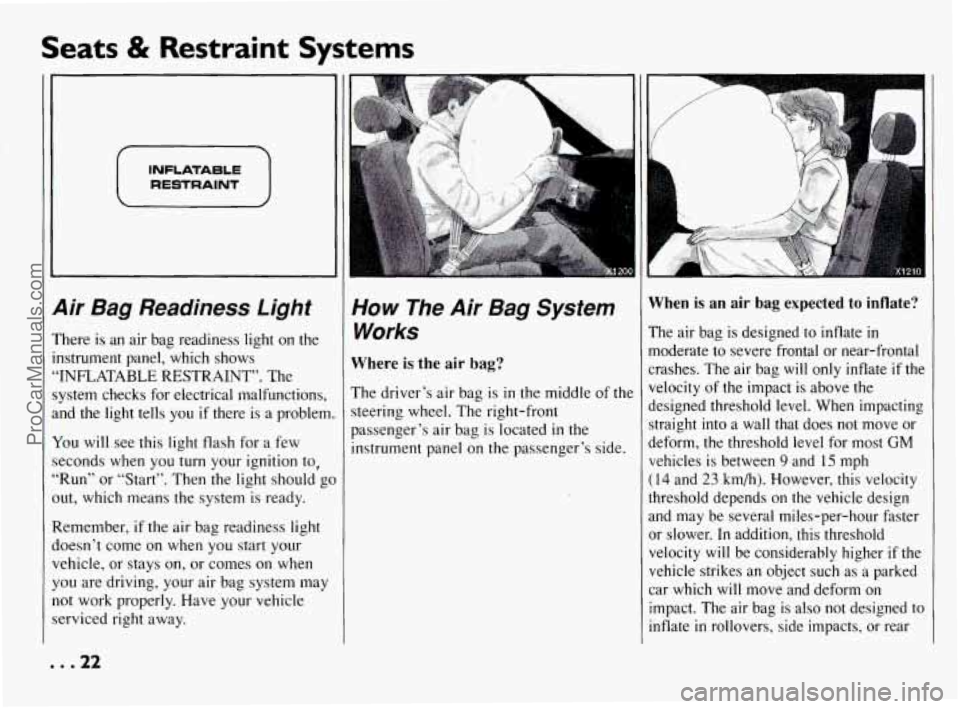
9ir Bag Readiness Light
’here is an air bag readiness light on the
xtrument panel, which shows
INFLATABLE RESTRAINT”. The
ystem checks for electrical malfunctions,
nd the light tells you
if there is a problem.
’ou will see this light flash for a few
xonds when
you turn your ignition to,
Run” or “Start”. Then the light should gc
ut, which means the system is ready.
.emember, if the air bag readiness light
oesn’t come on when you start your
ehicle, or stays on, or comes
on when
ou are driving, your air bag system may
ot work properly. Have your vehicle xviced right away.
. .22
I
HOW The Air Bag System When is an air bag expected to inflate?
moderate to severe frontal or near-frontal
Works The air bag is designed to inflate in
Where is the air bag? crashes. The air bag will only inflate if the
The driver’s air bag is
in the middle of the
steering wheel. The right-front
passenger’s air bag is located
in the
instrument panel
on the passenger’s side. velocity
of the impact is above the
designed threshold level. When impacting straight into a wall that does not move or
deform, the threshold level for most GM
vehicles is between 9 and 15 mph
(14 and 23 km/h). However, this velocity
threshold depends on the vehicle design
and may be several miles-per-hour faster or slower. In addition, this threshold
velocity will be considerably higher
if the
vehicle strikes an object such as a parked
car which will move and deform on impact. The air bag is also not designed to
inflate
in rollovers, side impacts, or rear
ProCarManuals.com
Page 24 of 290

impacts where the inflation would provide
no occupant protection benefit.
It is possible that
in a crash, only one of
the two air bags in your Bonneville will
deploy. This is rare, but can happen
in a
crash just severe enough to make an air
bag inflate.
In any particular crash, the determination
of whether the air bag should have
inflated cannot be based solely on the
level
of damage on the vehicle(s).
Inflation is determined by the angle of the
impact and the vehicle’s deceleration, of
which vehicle damage is only one
indication. Repair cost is not a good
indicator of whether an air bag should
have deployed.
What makes an air bag inflate?
In a frontal or near-frontal impact of
sufficient severity, the air bag sensing
system detects that the vehicle
is suddenly
stopping as a result of a crash. The
sensing system triggers a chemical
reaction of the sodium azide sealed in the
inflator. The reaction produces nitrogen
gas, which inflates a cloth bag. The
inflator, cloth bag, and related hardware
are all part of the air bag inflator modules packed
inside the steering wheel and
in
the instrument panel in front of the
passenger.
How does an air bag restrain?
In moderate to severe frontal or
near-frontal collisions, even belted
occupants can contact the steering wheel or the instrument panel. The air bag
supplements the protection provided by
safety belts. Air bags distribute the force
of the impact more evenly over the
occupant’s upper body, stopping the
occupant more gradually. But air bags
would not provide protection in many
types of collisions, including rollovers
and rear and side impacts, primarily
because an occupant’s motion is not
toward the air bag. Air bags should never
be regarded as anything more than a
supplement to safety belt protection
in
moderate to severe frontal and
near-frontal collisions.
What will you see after an air bag
inflation?
After the air bag has inflated, it will then
quickly deflate. This occurs
so quickly
that some people may not even realize
that the air bag inflated. Some components of the
air bag module in the
steering wheel hub for the driver’s air bag
or the instrument panel for the
passenger’s bag may be hot for a short
time, but the portion of the bag that comes
into contact with you will not be hot to
the touch. There will be small amounts of
smoke and dust coming from vents in the
deflated air bags. The air bag will
not
impede the driver’s vision or ability to
steer the vehicle, nor will it hinder the
occupants from exiting the vehicle.
In many crashes severe enough to inflate
an air bag, windshields are broken by
vehicle deformation. Additional
windshield breakage may occur in
vehicles with passenger air bags because
the windshield acts as a reac’lion surface
for the inflating air bag.
The air bags are designed to inflate
only once. After they inflate, you’ll
need some new parts for your air bag
system. If you don’t get them, the air
bag system won’t be there to help
protect you in anpther crash.
A new
system will include air bag modules
and possibly other parts. The service
manual has information about the
need to replace other parts.
C
23...
ProCarManuals.com
Page 25 of 290
Seats & Restraint Systems
How The Air Bag System
Works (CONK)
e
e
Your vehicle is equipped with a
diagnostic module, which records
information about the air bag system.
The module records information about
the readiness of the system, when the
sensors are activated and whether the
driver’s safety belt was in use.
Let only qualified technicians work on
your air bag system. Improper service
can mean that your air bag system
won’t work properly. See your dealer
for service.
NOTICE:
If you damage the cover for the
driver’s or
the right-front
passenger’s air bag, they may not
work properly. You may have to
replace the air bag on the steering
wheel or both the air bag and the
instrument panel for the passenger’s
air bag.
Do not open or break the air
bag covers.
Is the smoke from an air bag inflation
harmful?
The particles emitted during air bag
inflation are not harmful to most people.
Some people with respiratory ailments
may experience difficulty breathing if they
stay
in the vehicle with the windows
closed after air bag inflation.
So, if your air
bag inflates,
you and any passengers
should exit the vehicle
if and when it is
safe to
do so. If you or your passengers
can’t get out of
the vehicle, try to get fresh
air by opening a window, turning on the
fan, or opening a door.
Servicing Your Air
Bag-Equipped Pontiac
Air bags affect how your Pontiac should
be serviced. There are parts of the air bag
system in several places around xour
vehicle. You don’t want the system to
inflate while someone is working on your
vehicle. Your Pontiac dealer and the
1994
Bonneville Service Manual have
information about servicing your vehicle
and the air bag system. The air bag
system does not need regular
maintenance.
Safety Belt Use During
Pregnancy
Safety belts work for everyone, including
pregnant women. Like all occupants, they
are more likely to be seriously injured if
they don’t wear safety belts.
A pregnant woman should wear a
lap-shoulder belt, and the lap portion should be worn as low as possible
throughout the pregnancy.
... 24
ProCarManuals.com
Page 54 of 290
Ignition Switch (CONK)
Off: Unlocks the steering wheel, ignition,
and transaxle, but does not send electrical
power to any accessories. Use this
position
if your vehicle must be pushed or
towed,
but never try to push-start your
vehicle.
A warning chime will sound if
you open the driver’s door when the
ignition is off and the key is
in the
ignition.
Run: An “on” position to which the
switch returns after you start your engine
and release the switch. The switch stays
in the “Run” position when the engine is
running. But even when the engine is not
running, you can use “Run” to operate
your electrical power accessories, and to
display some instrument panel warning
lights.
Start: Starts the engine. When the engine
starts, release the key. The ignition switch
will return to “Run” for normal driving.
Note
that even if the engine is not
running, the positions “Accessory” and
“Run” are “on” positions that allow you
to operate your electrical accessories,
such as the radio.
Key Reminder Warning:
If you leave your key in the ignition, in
the “Off’ position, you will hear a
warning tone when you open the driver’s
door.
Retained Accessory Power:
If you have this option, after you turn
your ignition
off and even remove the
key, you
will still have electrical power to
such accessories as the radio and power
windows for
up to ten minutes. But if you
open
a door, power is shut off.
NOTICE:
If your key seems stuck in “LOCK”
and you can’t turn it, be sure it is all
the way
in. If it is, then turn the
steering wheel left and right
while
you turn the key hard. But turn the
key only
with your hand. Using a
tool to force it could break the key
or the ignition switch. If none
of this
works,
then your vehicle needs
service.
Starting Your Engine
Engines start differently. The 8th digit of
your Vehicle Identification Number (VIN)
shows the code letter or number for your
engine. You
will find the VIN at the top
left of your instrument panel. (See
“Vehicle Identification Number”
in the
Index.) Follow the proper steps to start
the engine.
Move your shift lever to
“P’ (Park) or
“N” (Neutral). Your engine won’t start in
any other position -- that’s a safety
feature. To restart when you’re already
loving, use
“N” (Neutral) only.
NOTICE:
Don’t try to shift to “P” (Park) if
your Pontiac is moving. If you do,
you could damage the transaxle.
Shift to
“P” (Park) only when your
vehicle is stopped.
ProCarManuals.com
Page 69 of 290
Features & Controls
Turn Signall
Multifunction Lever
The lever on the left side of the steering
column includes your:
Turn Signal and Lane Change Indicator
Windshield Wipers
Windshield Washer
Headlight Washers (SSE and SSEi only)
Cruise Control (Option)
0 Headlight High-Low Beam
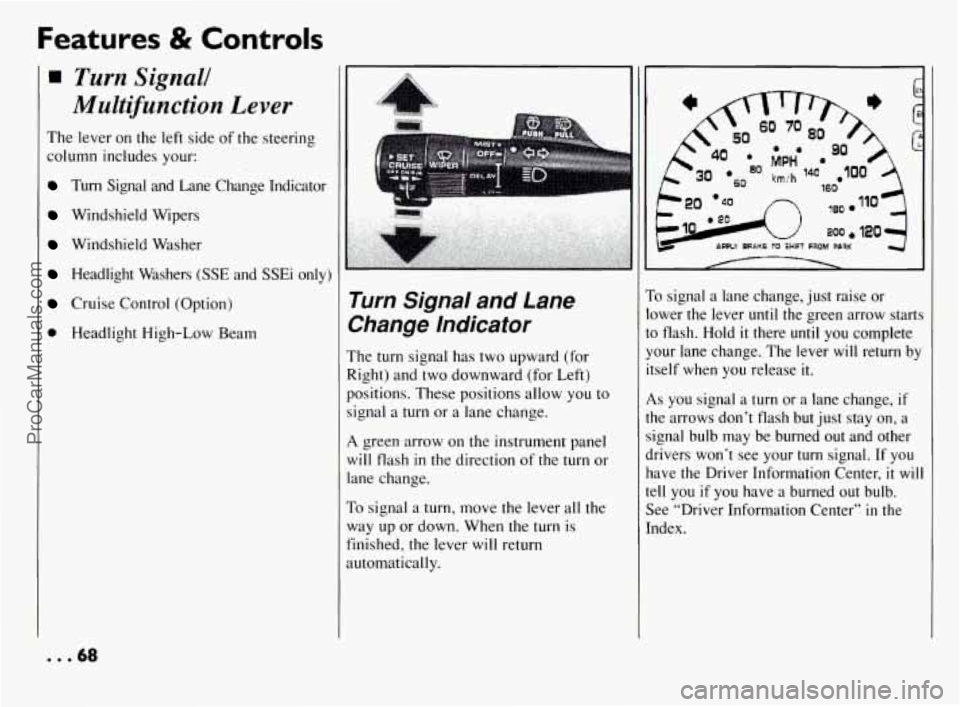
Turn Signal and Lane
Change Indicator
The turn signal has two upward (for
Right) and two downward (for Left)
positions. These positions allow
you to
signal a turn or a lane change.
A green arrow on the instrument panel
will flash
in the direction of the turn or
lane change.
To signal a turn, move the lever all the
way up or down. When the turn is
finished, the lever will return
automatically.
so MPH
30 km/h
/ 1 I
To signal a lane change, just raise or ,
lower the lever until the green arrow starts
to flash. Hold it there until you complete
your lane change. The lever will return by
itself when you release
it.
As you signal a turn or a lane change, if
the arrows don’t flash but just stay on, a
signal bulb may be burned
out and other
drivers won’t see your
turn signal. If you
have the Driver Information Center, it will
tell you if you have a burned out bulb.
See “Driver Information Center”
in the
Index.
... 68
ProCarManuals.com
Page 75 of 290
Features & Controls
Passing Another Vehicle While Using Cruise
Control
Use the accelerator pedal to increase your
speed. When you take your foot off the
pedal, your vehicle will
slow down to the
cruise control speed
you set earlier.
Using Cruise Control on
Hills
How well your Cruise Control will work
on hills depends upon your speed, load,
and the steepness of the hills. When going
up steep hills, you may have to step on
the accelerator pedal to maintain your
speed. When going downhill, you may
have to brake or shift to a lower gear to
keep
your speed down. Of course,
applying the brake takes you out
of
Cruise Control. Many drivers find this to
be too much trouble and don't use Cruise
Control on steep hills.
To Get Out of Cruise
Control
There are two ways to turn off the Cruise
Control:
0 Step lightly on the brake pedal; OR
0 Move the Cruise switch to "OFF".
Cruise Control with
Traction Control Activated
When the Traction Control System is
turned on and becomes activated by
sensors,
it will automatically turn off the
cruise control. See "Traction Control
System"
in the Index.
To Erase Speed Memory
When you turn off the Cruise Control or
the ignition, or shift into "P7 (Park), your
cruise control set speed memory is erased.
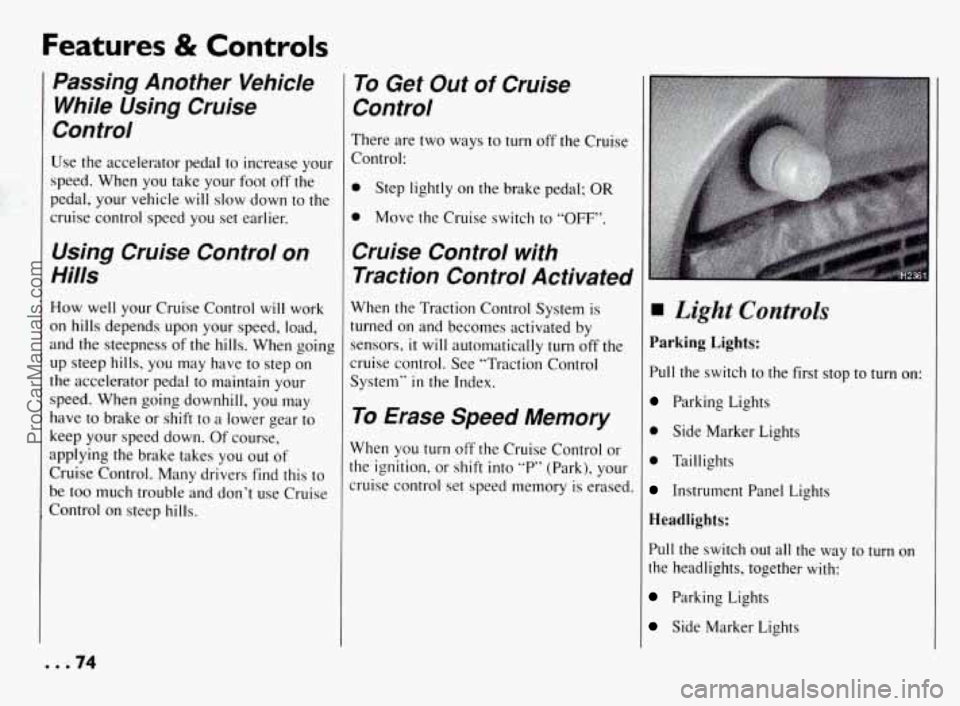
Light Controls
Parking Lights:
Pull the switch to the first stop to turn on:
Parking Lights
0 Side Marker Lights
0 Taillights
Instrument Panel Lights
Headlights:
Pull the switch out all the way to turn on
the headlights, together with:
Parking Lights
Side Marker Lights
ProCarManuals.com
Page 76 of 290
0 Taillights
0 Instrument Panel Lights
Push the switch
in all the way to turn all
the lights off.
Operation of Lights
Although your vehicle’s lighting system
(headlights, parking lights, fog lamps,
side marker lights and taillights) meets all
applicable federal lighting requirements,
certain states and provinces may apply
their own lighting regulations that may
require special attention before you
operate these lights.
For example, some jurisdictions may
require that you operate your fog lamps
only when your lower beam headlights
are also on, or that headlights be turned
on whenever you must use your
windshield wipers. In addition, most
jurisdictions prohibit driving solely
with
parking lights, especially at dawn or dusk.
It is recommended that you check with
your own state or provincial highway
authority for applicable lighting
regulations.
Lights On Reminder
[f you open the driver’s door while
leaving the lights on, you will hear a
warning tone.
Daytime Running Lights
(Canada Only)
The Canadian Federal Government has
decided that Daytime Running Lights
(DRL) are a useful feature,
in that DRL
can make your vehicle more visible to
pedestrians and other drivers during
daylight hours. DRL are required on new
vehicles sold
in Canada.
Your DRL work with a light sensor on top
of the instrument panel. Don’t cover it up.
The low beam headlights will come on at
reduced brightness
in daylight when:
0 The igdition is on
The headlight switch is off, and
The transaxle is not in “P” (Park).
4t dusk, the exterior lights will come on
mtornatically and the low beams will
:hange to full brightness. At dawn, the
:xterior lights will go out and the low
beams will change to the reduced
brightness of DRL (if the headlight switch
is off).
Of course, you may still turn on the
headlights any time you need to.
To idle your vehicle with the DRL ,off,
shift the transaxle into “P’ (Park). The
DRL will stay off until you shift out of
“P” (Park).
At night, you can turn off all exterior
lights when you are
in “P” (Park) by
moving the Twilight Sentinel control all
[he way past
“MIN” to turn it off, if it was
m. If it was off, move the control to the
right to turn it on, then back off. The
lights will come back on when you put
the transaxle
in gear.
75.0.
ProCarManuals.com