Page 174 of 276
Problems on the Road
1 72
Ifa Tire Goes Flat
It’s unusual for a tire to “blow out”
while you’re driving, especially if
you
maintain your tires properly. If air goes
out of a tire, it’s much more likely to
leak out slowly. But
if you should ever
have a “blowout,” here are a few tips
about what to expect and what to do:
If a front tire fails, the flat tire will
create a drag that pulls the vehicle
toward that side. Take your foot
off the
accelerator pedal and grip the steering
wheel firmly. Steer
to maintain lane
position, then gently brake to a stop
well
out of the traffic lane.
A rear blowout, particularly on a curve,
acts much like a skid and may require
the same correction you’d use in a skid.
In any rear blowout, remove your foot
from the accelerator pedal. Get the
vehicle under control by steering the
way
you want the vehicle to go. It may
be very bumpy and noisy, but you can
still steer. Gently brake to a stop, well
off the road if possible.
If a tire goes flat, the next section shows
how to
use your jacking equipment to
change a flat tire safely.
Air Inflator
Your vehicle may have an air inflator
for use in bringing tires up to the proper
pressure.
To learn about it, see the
Index under Air Inflator System.
Changing a Flat Tire
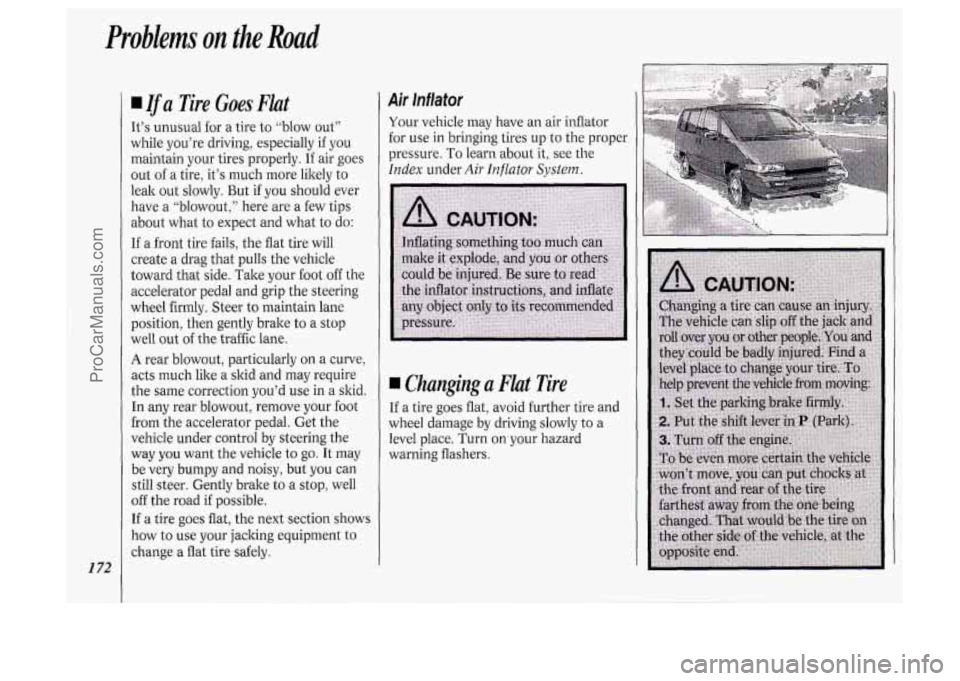
If a tire goes flat, avoid further tire and
wheel damage by driving slowly to a
level place. Turn on your hazard
warning flashers.
ProCarManuals.com
Page 176 of 276
Problems on the Road
I 74
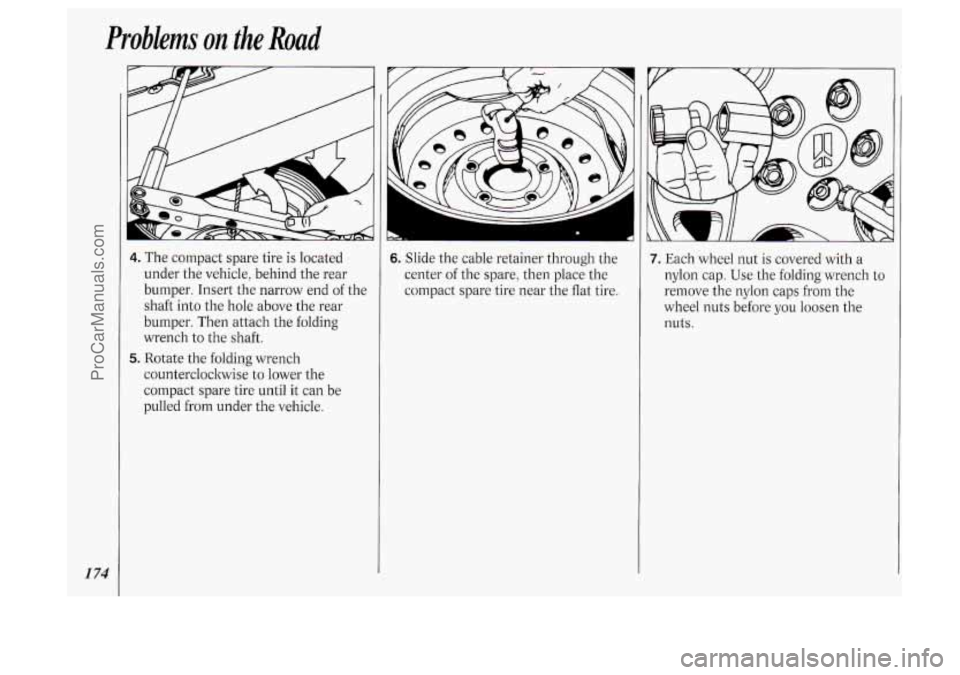
4. The compact spare tire is located
under the vehicle, behind the rear
bumper. Insert the narrow end of the
shaft into the hole above the rear
bumper. Then attach the folding
wrench to the shaft.
counterclockwise to lower the
compact spare tire until
it can be
pulled from under the vehicle.
5. Rotate the folding wrench
I
6. Slide the cable retainer through the
center of the spare, then place the
compact spare tire near the flat tire.
I
7. Each wheel nut is covered with a
nylon cap. Use the folding wrench to
remove the nylon caps from the
wheel nuts before
you loosen the
nuts.
ProCarManuals.com
Page 177 of 276
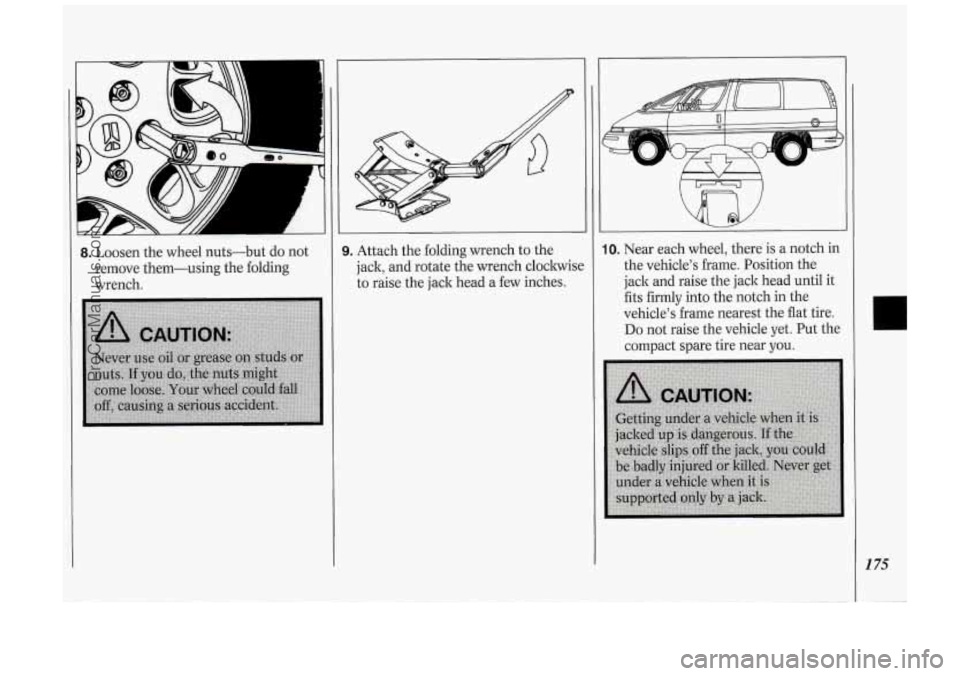
8. Loosen the wheel nuts-but do not
remove them-using the folding
wrench.
I
3. Attach the folding wrench to the
jack, and rotate the wrench cloclwisc
to raise the jack head a few inches. 10. Near each wheel, there is a notch in
the vehicle’s frame. Position the
jack and raise the jack head until it
fits firmly into the notch in the
vehicle’s frame nearest the flat tire.
Do not raise the vehicle yet. Put the
compact spare tire near you.
1 75
ProCarManuals.com
Page 178 of 276
Problems on the Road
1 76
NOTICE:
Raising your vehicle with the jack
improperly positioned will damage
the vehicle or may allow the vehicle
to fall off the jack. Be sure to fit the
jack lift head into the proper
location before raising your vehicle.
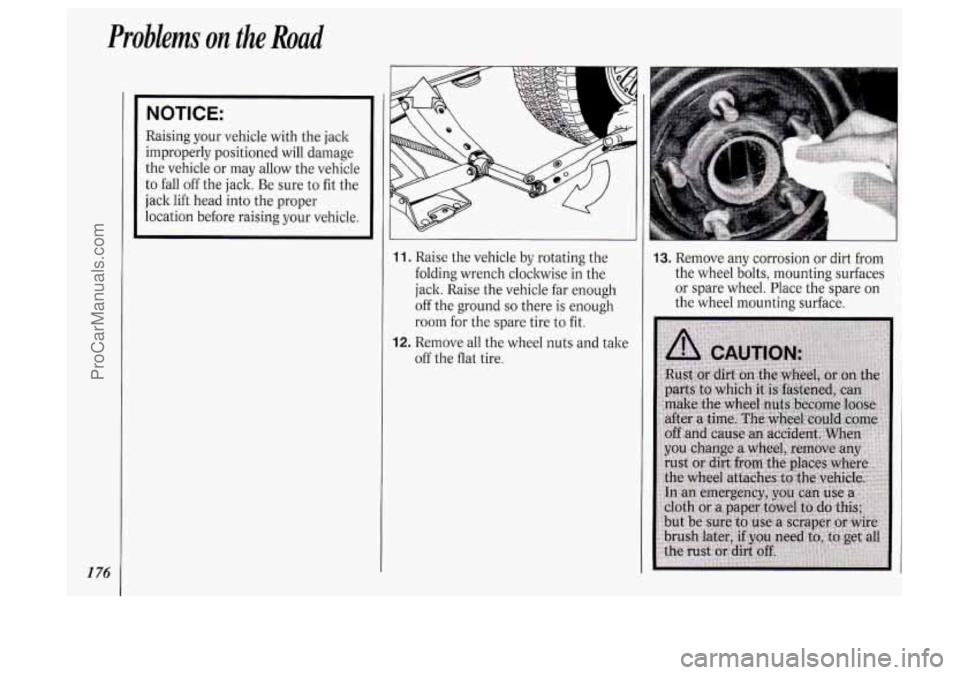
11. Raise the vehicle by rotating the
folding wrench clockwise in the
jack. Raise the vehicle far enough
off the ground
so there is enough
room for the spare tire to fit.
12. Remove all the wheel nuts and take
off the
flat tire.
3. Remove any corrosion or dirt from
the wheel bolts, mounting surfaces
or spare wheel. Place the spare on
the wheel mounting surface.
ProCarManuals.com
Page 179 of 276
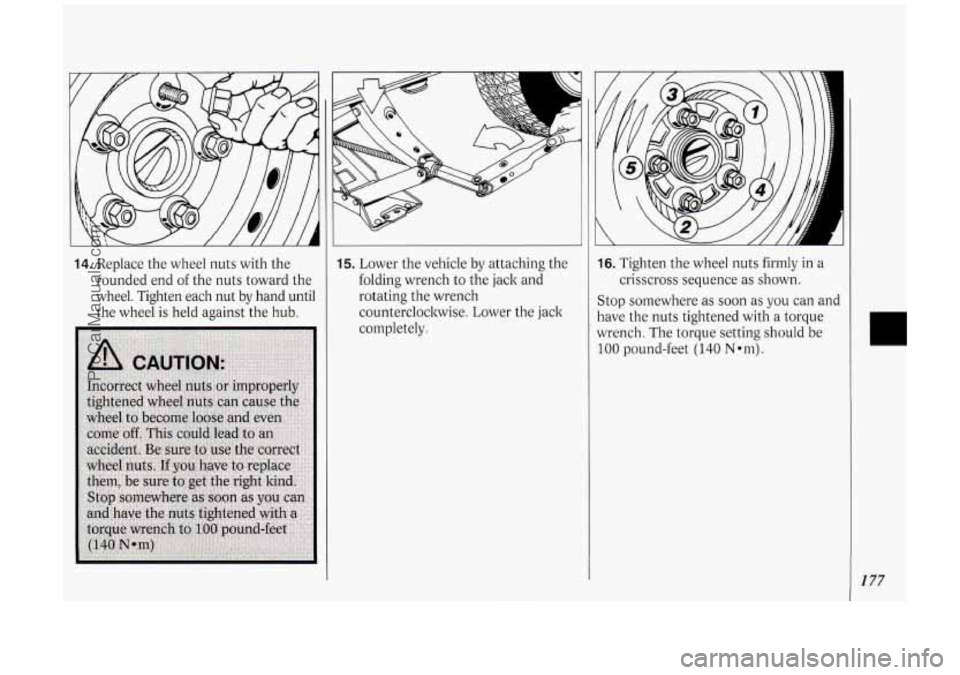
14. Replace the wheel nuts with the
rounded end of the nuts toward the
wheel. Tighten each nut by hand until
the wheel is held against the hub.
I
15. Lower the vehicle by attaching the
folding wrench to the jack and
rotating the wrench
counterclockwise. Lower the jack
completely.
I
16. Tighten the wheel nuts firmly in a
crisscross sequence as shown.
Stop somewhere as soon as you can and
have the nuts tightened with a torque
wrench. The torque setting should be
100 pound-feet (140 Nmm).
177
ProCarManuals.com
Page 180 of 276
Problems on the Road
1 78
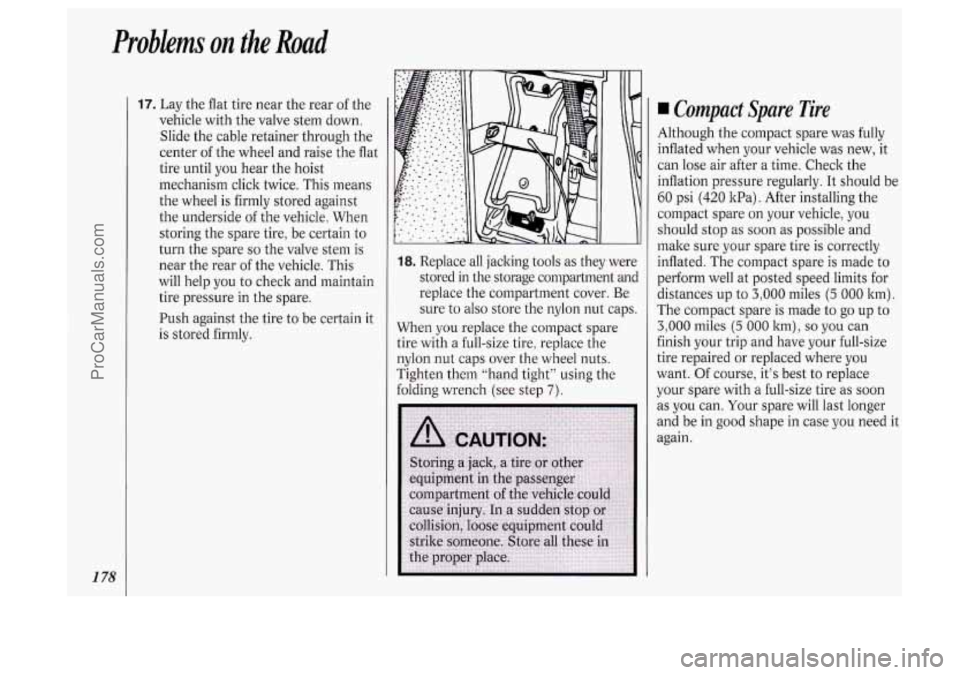
17. Lay the flat tire near the rear of the
vehicle with the valve stem down.
Slide the cable retainer through the
center of the wheel and raise the flat
tire until you hear the hoist
mechanism click twice. This means
the wheel is firmly stored against
the underside of the vehicle. When
storing the spare tire, be certain to
turn the spare
so the valve stem is
near the rear of the vehicle. This
will help you to check and maintain
tire pressure in the spare.
Push against the tire to be certain it
is stored firmly.
18. Replace all jacking tools as they were
stored in the storage compartment and
replace the compartment cover. Be
sure to also store the nylon nut caps.
When
you replace the compact spare
tire with a full-size tire, replace the
nylon nut caps over the wheel nuts.
Tighten them “hand tight” using the
folding wrench (see step
7).
Compact Spare Tire
Although the compact spare was fr .Ill!
inflatedwhen you; vehiile was new, :
can lose air after a time. Check the
jr
it
inflation pressure regularly. It should be
60 psi (420 1tPa). After installing the
compact spare on your vehicle, you
should stop as soon as possible and
make sure your spare tire is correctly
inflated. The compact spare is made to
perform well at posted speed limits for
distances up to
3,000 miles (5 000 ltm).
The compact spare
is made to go up to
3,000 miles (5 000 ltm), so you can
finish your trip and have your full-size
tire repaired
or replaced where you
want. Of course, it’s best to replace
your spare with
a full-size tire as soon
as you can. Your spare will last longer
and be in good shape in case you need it
again.
ProCarManuals.com
Page 181 of 276
I NOTICE:
Don’t take your compact spare
through an automatic car wash
with guide rails. The compact spare
can get caught on the rails. That
can damage the tire and wheel, and
maybe other parts of your vehicle.
~
Don’t use your compact spare on some
other vehicle.
And don‘t mix your compact spare or
wheel with other wheels or tires. They
won’t fit. Keep your spare and its whec
together.
NOTICE:
Tire chains won’t fit your compact
spare. Using them will damage your
vehicle and destroy the chains too.
Don’t use tire chains on your
compact spare.
IfYou%e Stuck: In Sand,
Mud, Ice or Snow
What you don’t want to do when your
vehicle is stuck is to spin your wheels.
The method known as “rocking” can
help
you get out when you’re stuck, but
you must use caution.
I NOTICE:
Spinning your wheels can destroy
parts
of your vehicle as well as the
tires. If you spin the wheels too fast
while shifting your transaxle back
and forth, you can destroy your
transaxle.
Rocking Yowr Vehicle to Get it Out:
First, turn your steering wheel left and
right. That will clear the area around
your front wheels.
If you have the
optional traction control system, you
should turn it off. (See
Traction CorztroZ
System in the Index.) Then shift back
and forth between
R (Reverse) and a
forward gear, spinning the wheels as
little as possible. Release the accelerator
pedal while you shift, and press lightly
on the accelerator pedal when the
transaxle is in gear. If that doesn’t get
you out after a few tries, you may need
to be towed out. If you do need to be
towed out, see
Towing Your Vehicle in
the
Index.
1 79
ProCarManuals.com
Page 210 of 276
Sewice & Appearunce Care
208
Inflation-Tire Pressure
The CertificatiodTire label which is on
the rear edge of the driver’s door shows
the correct inflation pressures for your
tires, when they’re cold. “Cold” means
your vehicle has been sitting for at least
three hours or driven no more than a mile.
NOTICE:
Don’t let anyone tell you that
underinflation
or overinflation is all
right. It’s not. If your tires don’t
have enough air (underinflation)
you can get:
Too much flexing
Too much heat
Tire overloading
Bad wear
Bad handling
Bad fuel economy.
If your tires have too much air
(overinflation) you can get:
Unusual wear
Bad handling
Rough ride
Needless damage from road
hazards.
When to Check
Check your tires once a month or more.
Don’t forget your compact spare tire. It
should be at
60 psi (420 1tPa).
How to Check
Use a good quality pocket-type gage to
check tire pressure. Simply loolting at
the tires will not tell you the pressure,
especially
if you have radial tires -
which may look properly inflated even if
they’re underinflated.
If your tires have valve caps, be sure to
put them back on. They help prevent
leaks by keeping out dirt and moisture.
-
f
x
Tire Inspection and Rotation
To make your tires last longer, have
them inspected and rotated at the
mileages recommended in the
Maintenance Schedule. See
Scheduled
Maintenance Services
in the Index.
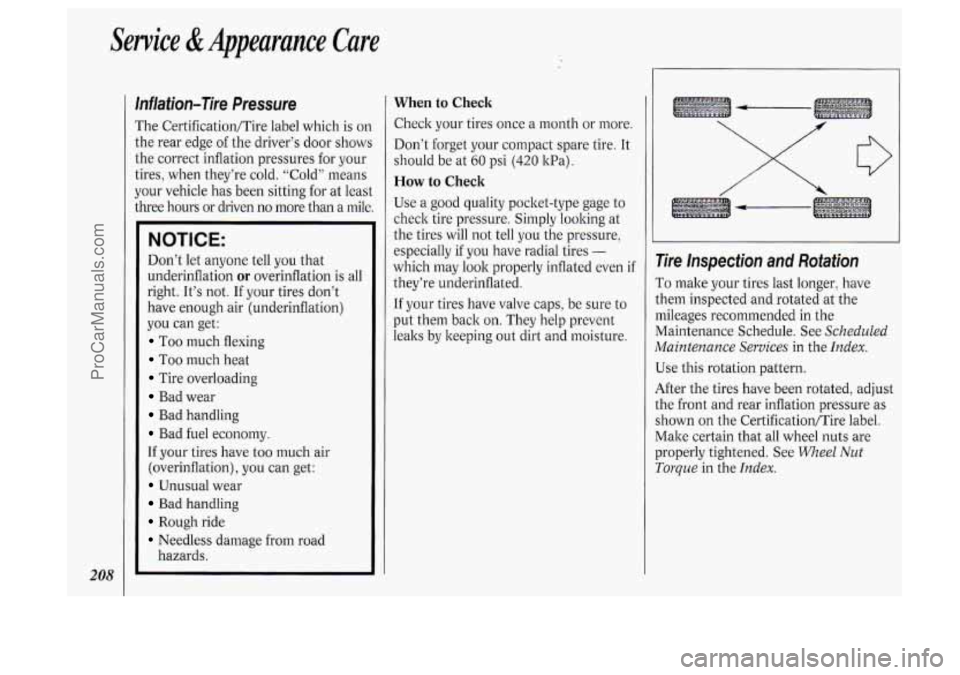
Use this rotation pattern.
After the tires have been rotated, adjust
the front and rear inflation pressure as
shown on the CertificationlTire label.
Make certain that all wheel nuts are
properly tightened. See
Wheel Nut
Toque in the Index.
ProCarManuals.com