1994 JAGUAR XJ6 tow
[x] Cancel search: towPage 178 of 327

E I ect r ical IT
SPEED CONTROL
System Description
0 15.3 15.3.1
The speed control system provides an automatic cruise facility, allowing a constant speed to be maintained without
accelerator pedal operation. The system comprises the following components:
0 Electronic control unit
0 Vacuum dump valve
0 Control valve
0 Vacuum pump
0 Mechanical throttle linkage and bellows
0 Selection switch
0 Brake and clutch pedal switches
On selection of speed control, via the switches mounted on the driver's side fascia, the vacuum dump valve, pump and
control valve will energize, creating
a partial vacuum in the bellows assembly. The bellows assembly acts upon the
throttle linkage to adjust throttle position, maintaining vehicle speed at the value when control is selected.
Speed control is determined by the Speed Control Control Module
(SC CM) which monitors a speed signal delivered
from the instrument pack (initially from the ABS rear LH wheel speed sensor) to determine vehicle speed.
Speedcontrol isdisabled, returning control tothedriver,
byoperationofthevacuumdumpvalve,ifanyofthefollowing situations occur: 0
0 Braking
0 Clutch operation (3.2 / 4.0 litre manual transmission vehicles only)
o Drive de-select ie P, N or R (automatic transmissions only, both electronic and hydraulic)
0 Traction control system (where fitted) in operation
0 Rapid speed reduction without braking input, ie double brake switch failure
0 Actual speed drop to 3/4 of cruise setting (eg when towing excessive loads under adverse conditions)
0 Vehicle speeds below w 25 mph
0 Ignition OFF
0 De-selection at switch controls
15.3.2 COMPONENT DESCRlPTlO NS
15.3.2.1 Electronic Control Module
The Speed Control Control Module (SC CM), located behind the fascia, adjacent to the steering column, provides sys- tem control and an interface to external input signals from the instrument pack, gear selector module, traction control
system, control switches, and foot pedal switches. The set speed value is retained in SC CM memory and continuously
compared to actual vehicle speed. Adjustments are made, as necessary, to maintain set speed by control of the vac- uum pump and control valve. Connections to the SC CM are listed in the table on page 3.
X300 EDM 15.3 - 1 Issue 1 August 1994
Page 181 of 327
I3 E I ect r ical
15.3.2.5 Throttle Linkage and Bellows
The throttle linkage and bellows are located adjacent to the throttle body (below supercharger, where fitted) on 6cylin-
der vehicles, or centrally below the injector cover on 12 cylinder vehicles. The bellows expand I contract according
to the pressure drop created by the pump I control valve module, causing the linkage to act upon the throttle body,
controlling vehicle speed.
15.3.2.6
The brake and clutch pedal switches are mounted below the relevant foot pedals. Operation of a pedal, causes subse- quent switch operation, either interrupting the+12Vsupplytothe pneumaticcircuit, orsignalling tothe SC CMto disen- gage speed control, causing the dump valve to open and vent the system, returning speed control to the driver.
Brake and Clutch Pedal Switches
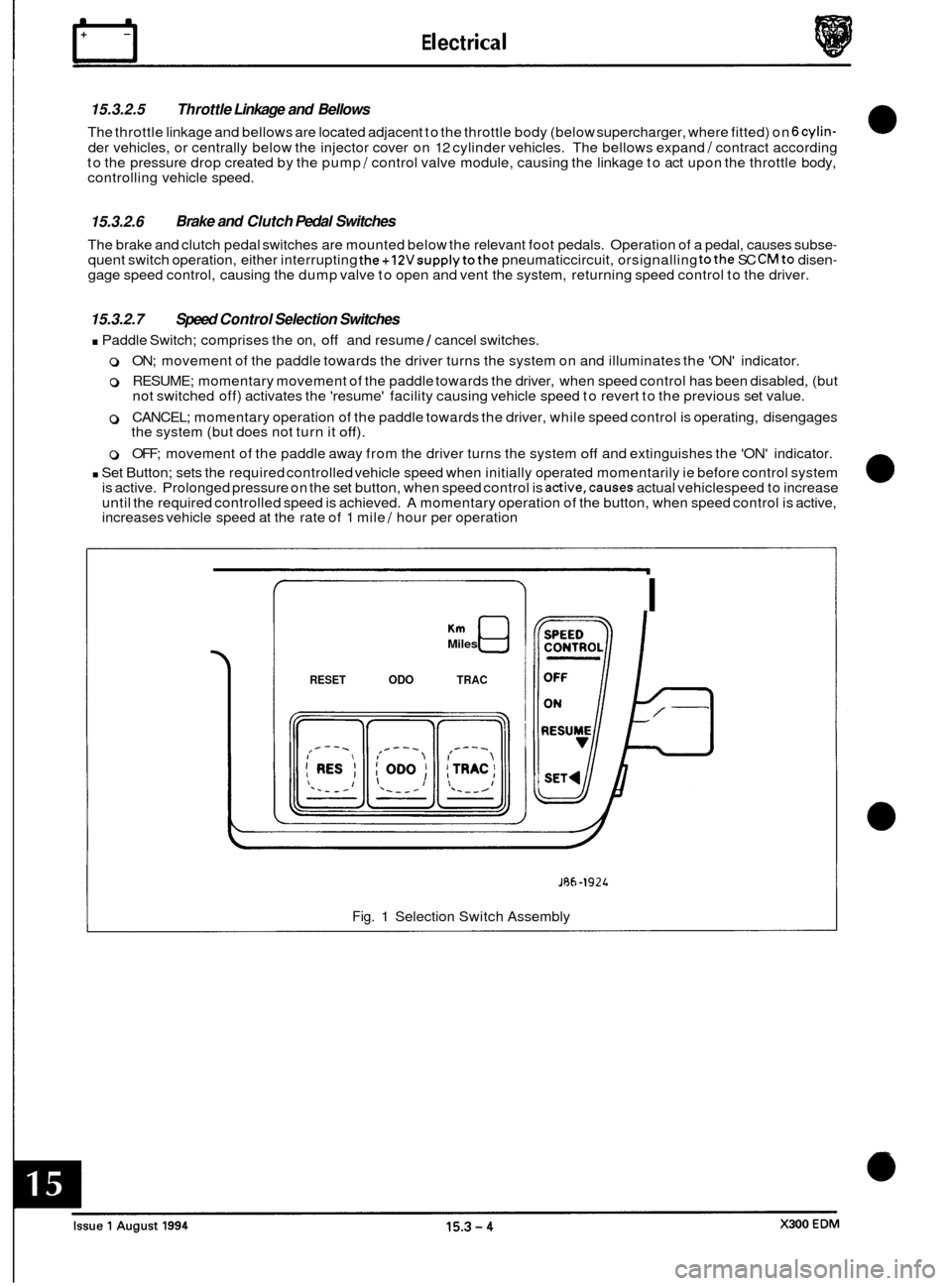
15.3.2.7 Speed Control Selection Switches
. Paddle Switch; comprises the on, off and resume 1 cancel switches.
0 ON; movement of the paddle towards the driver turns the system on and illuminates the 'ON' indicator.
0 RESUME; momentary movement of the paddle towards the driver, when speed control has been disabled, (but
not switched off) activates the 'resume' facility causing vehicle speed to revert to the previous set value.
0 CANCEL; momentary operation of the paddle towards the driver, while speed control is operating, disengages
the system (but does not turn it off).
0 OFF; movement of the paddle away from the driver turns the system off and extinguishes the 'ON' indicator.
. Set Button; sets the required controlled vehicle speed when initially operated momentarily ie before control system
is active. Prolonged pressure on the set button, when speed control is active,causes actual vehiclespeed to increase
until the required controlled speed is achieved. A momentary operation of the button, when speed control is active,
increases vehicle speed at the rate of 1 mile
/ hour per operation
Miles
RESET ODO TRAC
I
JRh-1924
Fig. 1 Selection Switch Assembly
Page 211 of 327

Rear view mirror position adjustments
1. Locate mirror select switch on driver's door switch pack and select driver's side mirror, ie
rotate switch towards the door.
2. Locate rear view mirror joystick switch on driver's door pack.
Operate the switch to give left
/ right and up / down movement. Does the mirror respond
in the correct manner?
3. Yes: Proceed to step 4 or 5.
No:
Japanese market vehicles only
Operate the switch to action 'fold away mode'. Does mirror respond in the correct manner
in each case?
Yes: Proceed to step
5.
No:
All markets
Operate mirror select switch to opposite position and repeat steps
1 to 4 for passenger side
mirror.
With ignition switched to auxiliary, select reverse gear and operate mirror joy
-stick
downwards. Does passenger side mirror dip automatically?
Yes: Proceed to step
7.
No:
Remove key from ignition, close driver's door and allow 30 seconds to elapse. Repeat
steps
1 - 6 and check that adjustment cannot be made.
Test complete; proceed to Memory Position Set.
Abort
test and refer to Diagnostic Sub
-Routines.
4.
Abort test and refer to Diagnostic Sub-Routines.
5.
6.
Abort test and refer to Diagnostic Sub-Routines.
7.
8.
Memory set position - drivefs side
1.
2.
3.
4.
5.
6.
7.
8.
Position the entry / exit switch, located on the LH side of the steering column, to off and
insert the key in the ignition.
Operate switches to position column, mirrors and seats to preferred positions.
Select 'memory' on the driver's door switch pack. Check that switch illuminates.
Depress desired memory button,
1,2 or 3, on door switch pack within 4 seconds of
memory select. Check that a chime sounds to confirm memory storage.
Operate the switches
so that memorized positions are changed. Depress relevant memory
option button,
1,2 or 3 and check that all positional settings are restored as memorized.
Remove key from ignition, close all doors and allow
30 seconds to elapse. Repeat steps 1
to 4 and check that adjustment cannot be made.
Readjust settings so that memorized positions are changed, leave the vehicle and operate
remote memory recall by locking and unlocking using the remote transmitter. Use both
transmitters to check both memory positions. Check all positional settings are restored as
memorized.
Yes: Proceed to step
8.
No:
Test complete. Abort
test and refer to Diagnostic Sub
-Routines.
X300 EDM Issue 1 August 1994 15.4 - 14