Page 203 of 327
Electrical
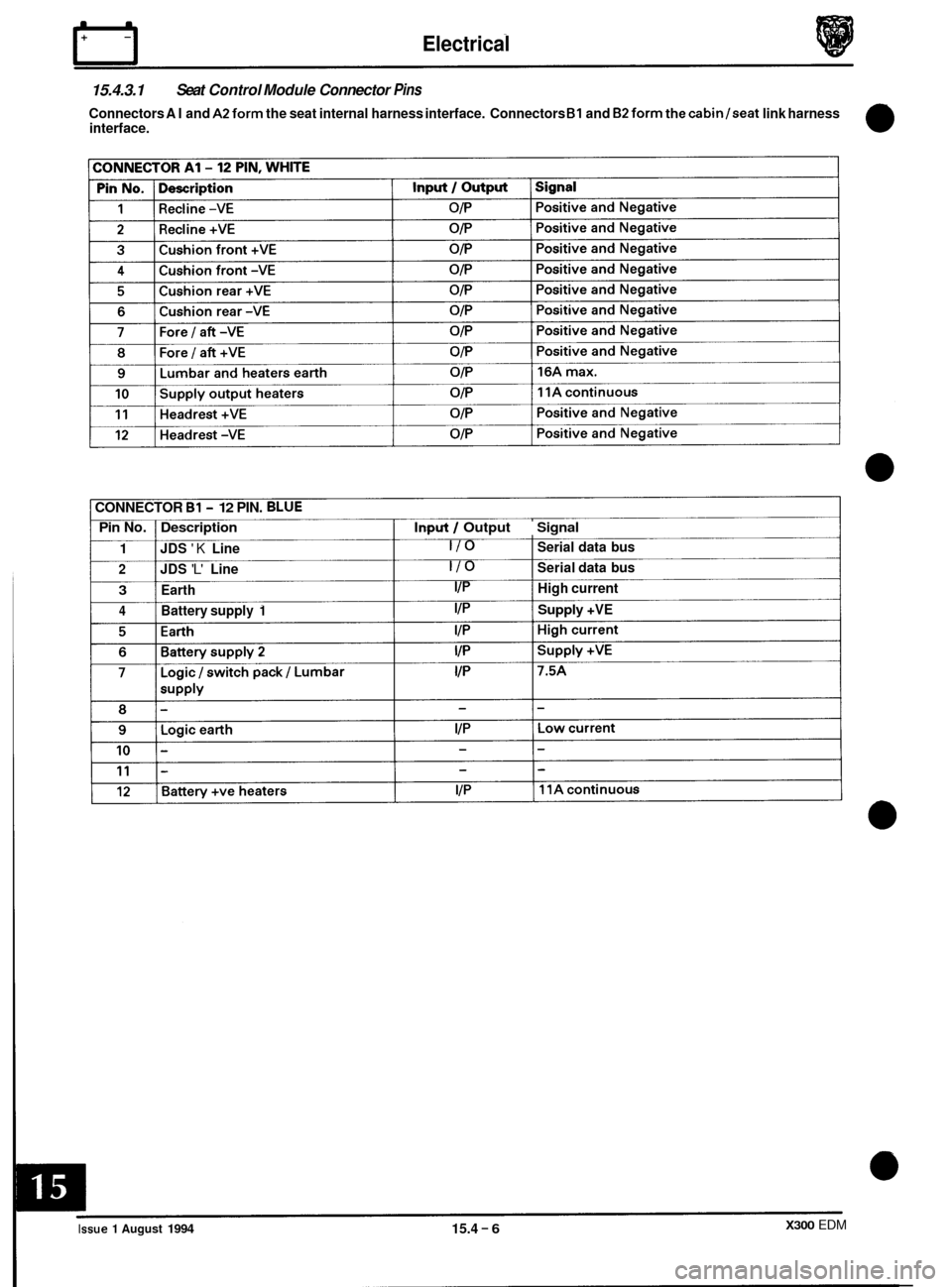
15.4.3.1
Connectors AI and A2form the seat internal harness interface. Connectors B1 and B2form thecabin/seat link harness
interface.
Seat Control Module Connector Pins
0
I CONNECTOR B1- 12 PIN. BLUE 1
Pin No. Description Input / Output Signal
1 JDS 'K Line I/O Serial data bus
2 JDS 'L' Line I/O Serial data bus
3 Earth I/P High current
4 Battery supply 1 I/P Supply +VE
X300 EDM Issue 1 August 1994 15.4 - 6
Page 208 of 327
0
I I- - I 13 l-
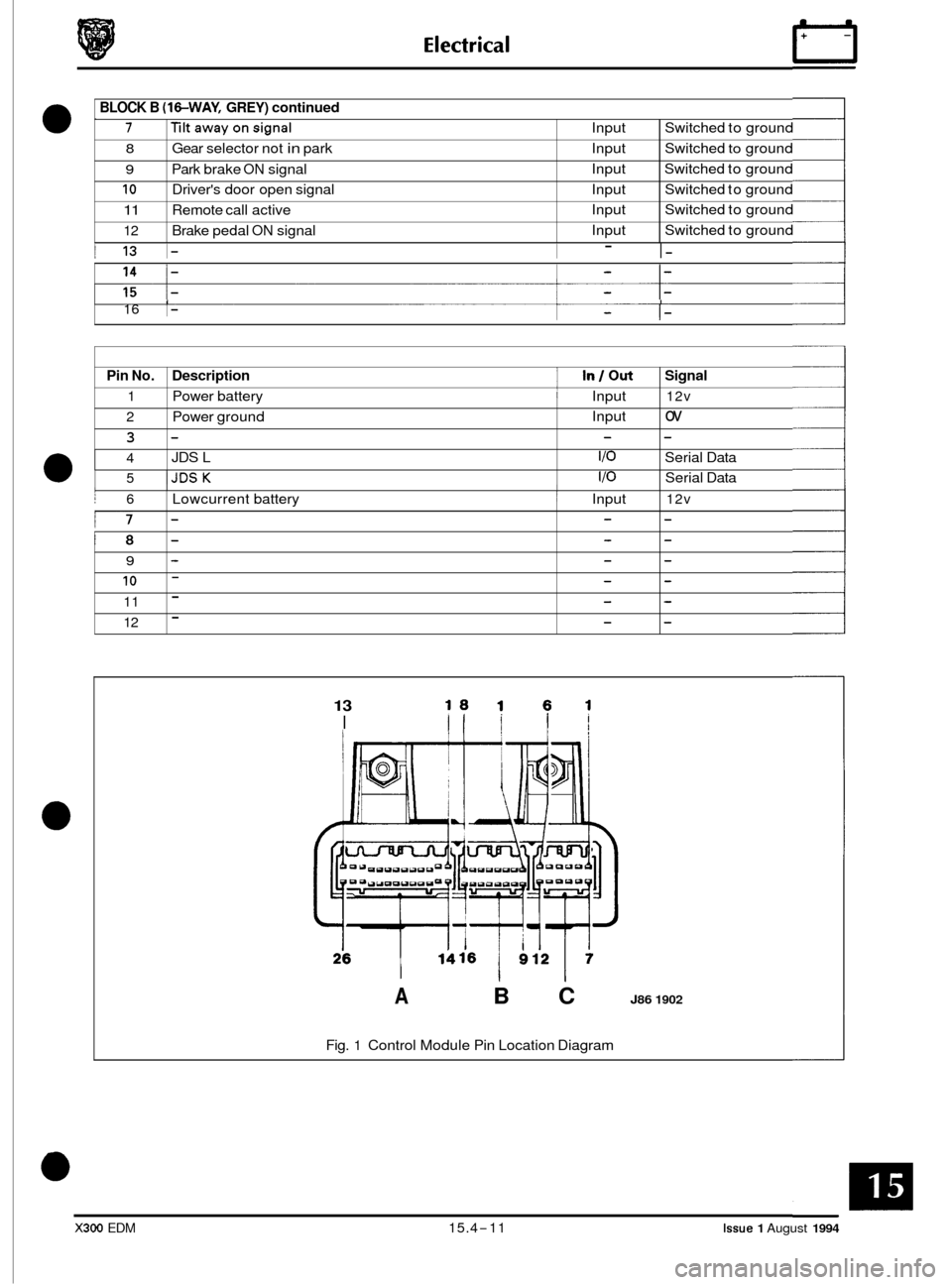
BLOCK B (W-WAY, GREY) continued
' 7 Tiltawayonsignal Input Switched to ground
8 Gear selector not in park Input Switched to ground
9 Park brake ON signal Input
Switched to ground
10 Driver's door open signal Input Switched to ground
11 Remote call active Input
Switched to ground
12 Brake pedal ON signal Input
Switched to ground
I I 16 1- - -
Pin No.
1
2
3
4
Description I In/ out Signal
Power battery i Input 12v
Power ground Input ov
- - -
JDS
L I/O Serial Data
5 IJDSK I/O
13
I I
Serial Data
A B C J86 1902
I j 6
i7
'8
9
10
11
12
Fig. 1 Control Module Pin Location Diagram
I Lowcurrent battery ~ Input 12v
- - -
- - -
- - -
- - -
- - -
- - -
X300 EDM 15.4-11 Issue 1 August 1994
Page 209 of 327

rl E I ect r ical
15.4.6 NON-MEMORY AND MANUAL APPLICATIONS
15.4.6.1
Non-Memory
Seats, column and mirrors may be supplied without memoryfacilities on certain vehicles. In this case, adjustment of
each application is still controlled in the same way but the memory facility is disabled and the memory switch pack
not fitted.
15.4.6.2 Manual Seats
Manual seats are adjustable vertically and horizontally, vertical adjustment being motorized but horizontal adjustment
manually effected. The seats have heated cushions and squab, but are not operated by an electronic control module.
Control is effected using three relays, two for vertical adjustment and one for heating.
Vertical adjustment is requested
by operation of a switch located on the left-hand side of the seat front which completes
the electrical supply to either the raise or lower relay as required. When either relay is energized a change of contact
state connects one side of the motor to
+12V and the other side to ground. Reverse operation reverses supply and
ground connection.
Heating is still controlled by a timed output from the BPU. Operation of a switch located on the
center console indicates
to BPU that heating is required. Battery voltage is then applied to the heater relay for 11 minutes. The relay contact
completes the heater circuit, providing seat heating (and illuminating the switch surround) until the timer expires, or
optimum seat temperature is achieved. Operation of the heater switch before 'time-out' is achieved cancels the heat- ing request. Operation of the heater switch after 'time-out' has been achieved re-starts the heating cycle.
15.4.6.3 Manual Column
Manual column adjustment in the two planes is achieved by purely mechanical means, release catches allowing col-
umn movement within a fixed locking mechanism.
Page 216 of 327
15.4.9 PIN-POINT TESTS
The following tests give detailed information on component fault diagnosis. Refer to sub-section 15.4.9.16 for key to
schematic diagrams.
1. Seat power supply
a.
b.
Check fuses F3, F4, F9 and F12 in RH and fuse F6 in LH 'A' post base fuse boxes are
intact.
If blown determine reason for failure and renew.
Unplug harness connector from SCM and check for battery supply voltage to ground,
at pins 4,6,7 & 12 (B1 connector) and pin 11 (82 connector) with ignition on. If supply
is not recorded on all pins switch off ignition and check harness wiring continuity from
'A' post base fuse boxes to faulty lines as follows:
Connector B1
Pin 4 -fuse F 3, RH fuse box
Pin
6 -fuse F 4, RH fuse box
Pin
7 -fuse F 6, LH fuse box
Pin
12 -fuse F 9, RH fuse box
Connector 82
Pin 11 -fuse F12, RH fuse box
1 I
J86 - 1867
Fig. 1 SCM power supplies
Issue 1 August 1994 15.4 - 19 X300 EDM
Page 233 of 327

E I ect r ica I
15.4.10 ELECTROCHROMATIC REAR VIEW MIRROR
15.4.10.1 Description
The function of the electrochromatic rearview mirror is to vary the reflectivity of the mirror glass. The mirror automati- cally varies its reflectivity to accommodate changes in traffic and light conditions to provide the driver with optimized
forward and rear vision.
The mirror contains an ambient sensor (forward facing) and
a glare sensor (rearward facing). Sensitivity control is
adjustable and at the lowest end of sensitivity control is system off. A reverse over-ride facility is incorporated; when
reverse gear is selected, the mirror operates in a high reflective state.
15.4.10.2 Test Procedure
The ambient and glare sensors and associated circuitry, the sensitivity control and reverse over-ride circuitry are all
contained within the mirror unit. Therefore only the inputs to the mirror unit can be interrogated, and if correct, the
mirror unit is defaulted.
. Measure voltage between mirror pin 1 and ground. Value should indicate battery voltage, i.e. 12V nominal.
. If an abnormally low or zero voltage is recorded, check fuse F14, RH 'A' post fuse-box, check wiring harness continu-
. Check the ground connection at the mirror unit pin 3.
Note: The mirror unit shares a common ground with the roof console and the sliding roof, therefore a fault within
the ground would effect all three systems.
. Check for 12V at mirror unit pin 2 when reverse gear selected, ignition ON; falling to OV on deselection of reverse.
/
ity between mirror unit pin 1 and fuse F14.
----- I +12VIGN ! I I I
I
L',
I I
I ,,J
F14 1. Mirror assembly
2. RH A post fuse-box
3. RearLCM
4. RH reverse lamp
5. Roof console (GND) 6. Sliding roof CM (GND)
J86-1864
Fig. 1 Electrochromatic Rear View Mirror Schematic
Issue 1 August 1994 15.4 - 36 X300 EDM