1994 JAGUAR XJ6 battery
[x] Cancel search: batteryPage 157 of 327

E I ect r ical
15.2.3 COMPONENT DESCRIPTION
15.2.3.1 Speedometer
The speed indication input signal, sent as a pulse rate, is generated by an open collectortransistor within the ABS con- trol module. The instrument pack converts the frequency of this signal to drive the speedometer and to provide two
road speed outputs:
Speed output
1 (pin 2,48 way connector)
This output is connected to the radio head unit, security control module and the power steering module.
Speed output 2 (pin
3,48 way connector)
This output is connected to the body processor unit, cruise control control module, air conditioning control module
and the engine management system.
15.2.3.2 Tachometer
The tachometer input, all engine variants, is provided by the engine management control module. When the engine
is running the control module generates three high state pulses per engine revolution.
15.2.3.3
This signal comes direct from the variable resistance type oil pressure sensor, mounted on the engine. The sensor
resistance values range from 75Q (8 Bar) to 330Q (0 Bar).
When the gauge reaches
a pre-determined reading the instrument pack illuminates the warning light.
Engine Oil Pressure and Warning lamp
15.2.3.4 Engine Coolant Temperature
This signal comes direct from the coolant temperature sensor (variable resistance type), mounted on the engine. The
sensor resistance values range from 34Q (hot) to 241Q (cold), when disconnected from the vehicle.
Note: The coolant temperature gauge is calibrated to indicate at approximately 'Normal' for a wide range of normal
engine operating temperatures.
15.2.3.5 Fuel Tank level Gauge and Warning lamp
This signal (pin 20,24-way connector) comes direct from the variable resistor type fuel level sensor. The sensor resis- tance values range from 80 ohms (full tank) to 900 ohms (empty tank).
When the gauge reaches a pre
-determined reading, the instrument pack illuminates the warning lamp.
15.2.3.6
Battery voltage is displayed on the gauge by measuring the ignition voltage.
The red charge warning lamp will illuminate if either the voltage is too low (below
10.5V) or too high (above 15.5V). In addition, the generator provides a low signal to the instrument pack (pin 9,48-way connector) when battery charging
is unsatisfactory.
Battery Voltage Gauge and Warning lamp
15.2.3.7 Liquid Crystal Display
A single line, six digit, 7 segment display with six trip function flags used for odometer, trip computer and driver mess- ages.
!Y,Q&: If the instrument pack has not been PECUS programmed, the back illumination of the LCD will not switch on.
Check that a PECUS label is attached to the back of the pack.
Issue 1 August 1994 15.2 - 4 X300 EDM
Page 159 of 327

E I ect r ica I
15.2.4.6 Engine Coolant Level
This signal (pin 37,48-way connector) comes from the coolant level switch, mounted in the lower face of the coolant
header tank. The switch is normally in the closed position, providing
a low signal to the instrument pack, when the
coolant level is acceptable. If the coolant level drops, the switch will open, removing the low signal and illuminating
the indicator lamp.
15.2.4.7 SRS Air bag fault
The input signal (pin 45, 48 way connector) is provided by the SRS Diagnostic Module.
WARNING: REFER TO SECTION 15, SUPPLEMENTAL RESTRAINT SYSTEM, BEFORE AlTEMPTlNG ANY DIAGNOSTIC
WORK ON SYSTEMS ASSOCIATED WITH THE
SRS.
15.2.4.8 Charging Fault
Battery voltage is displayed on the gauge by measuring the ignition voltage.
The red charge warning lamp will illuminate if either the voltage is too low (below
10.5V) or too high (above 15.5V). In addition,the generator provides a low signal to the instrument pack (pin 9,48-way connector) when battery charging
is unsatisfactory.
15.2.4.9 Brake System Fault (red)
The brakesystem fault receives a signal (pin 10,4&wayconnector)from the fluid level switch located in the brake fluid
reservoir. The switch is normally in the closed position, providing a low signal to the instrument pack, when the brake
fluid level is acceptable. If the fluid level drops, the switch will open, removing the lowsignal and illuminating the indi
- cator lamp.
15.2.4.10 Park Brake (red)
Park brake warning is indicated on application of the brake, which closes a micro-switch within the park brake handle
assembly. The signal to the instrument pack (pin 17, &way connector) is low when the park brake is applied and il- luminating the indicator lamp.
Issue 1 August 1994 15.2 - 6 X300 EDM
Page 163 of 327

rl E I ect r ica I
15.2.8 INSTRUMENT PACK PIN-POINT TESTS
15.2.8.1 Oil Pressure, Battery Condition, Coolant Temperature and Fuel Gauges
Gauge reads zero, full scale, too high or low
1.
2.
3. Oil
pressure and coolant gauges only; check relevant fluid level is within limits, top up if required and re-check
indication. If fluid levels are within limits on checking proceed to step 2.
Check connections to sensor are correct and secure. For battery gauge only check battery voltage is present at the
battery terminal posts.
Check resistance of sensor (if applicable) to ground, correct readings are as detailed in the following table:
Sensor title Resistance value
Oil pressure 3108 - 3308
Temperature
Fuel level 3461
(warm engine)
- 2418 (cold engine)
8061 (full tank) - 9008 (empty tank)
If resistance is out of range renew sensor.
If sensor resistance is proved correct, check the harness wiring continuity between the sensor and instrument pack
pin as detailed in the table below:
4.
I Sensor title I Instrument pack pin !
I Oil pressure I 21 (24-way connector) I Temperature I 19 (24-way connector) I
Fuel level 120 (24-way connector)
For battery condition gauge, checkvoltage between instrument pack 24
-way connector pins 2 and 4 is 13 f 2.5V. Refer to Section 15.5 for battery diagnostics.
If all previous checks prove correct remove and open the instrument pack. Examine flexi-circuit connections to
relevant gauge, ensuring correct and secure fitment.
Check continuity of flexi
-circuit tracks to gauge connections.
Check continuity of gauge driver windings by disconnecting gauge from flexi
-circuit and testing between the
upper central connection pin and each of the other two pins. If open circuit is recorded renew gauge.
5.
6.
7.
Gauge fluctuates
or gives erratic readings
1. Carry out steps 1 -4 above.
2.
Fit new sensor (where applicable) and re-check gauge.
3. Carry out steps 5
- 7 above
15.2.8.2 Speedometer
Gauge reads zero, full scale, too high or low
1.
2.
3.
4.
5. Refer
to Section 12,
ABS / Traction Control for fault diagnosis of wheel speed sensor.
Check harness wirin and connection from Instrument pack pin 15 (24
-way connector) and ABS /Traction Control
Control Module (AB!! /TC CM).
If all previous checks prove correct remove and open the instrument pack. Examine flexi
-circuit connections to
speedometer, ensuring correct and secure fitment.
Check continuity of flexi
-circuit tracks to speedometer connections.
Check continuity of speedometer driver windings by disconnecting from flexi
-circuit and testing between the
upper central connection pin and each of the other two pins. If open circuit is recorded renew speedometer.
Page 172 of 327
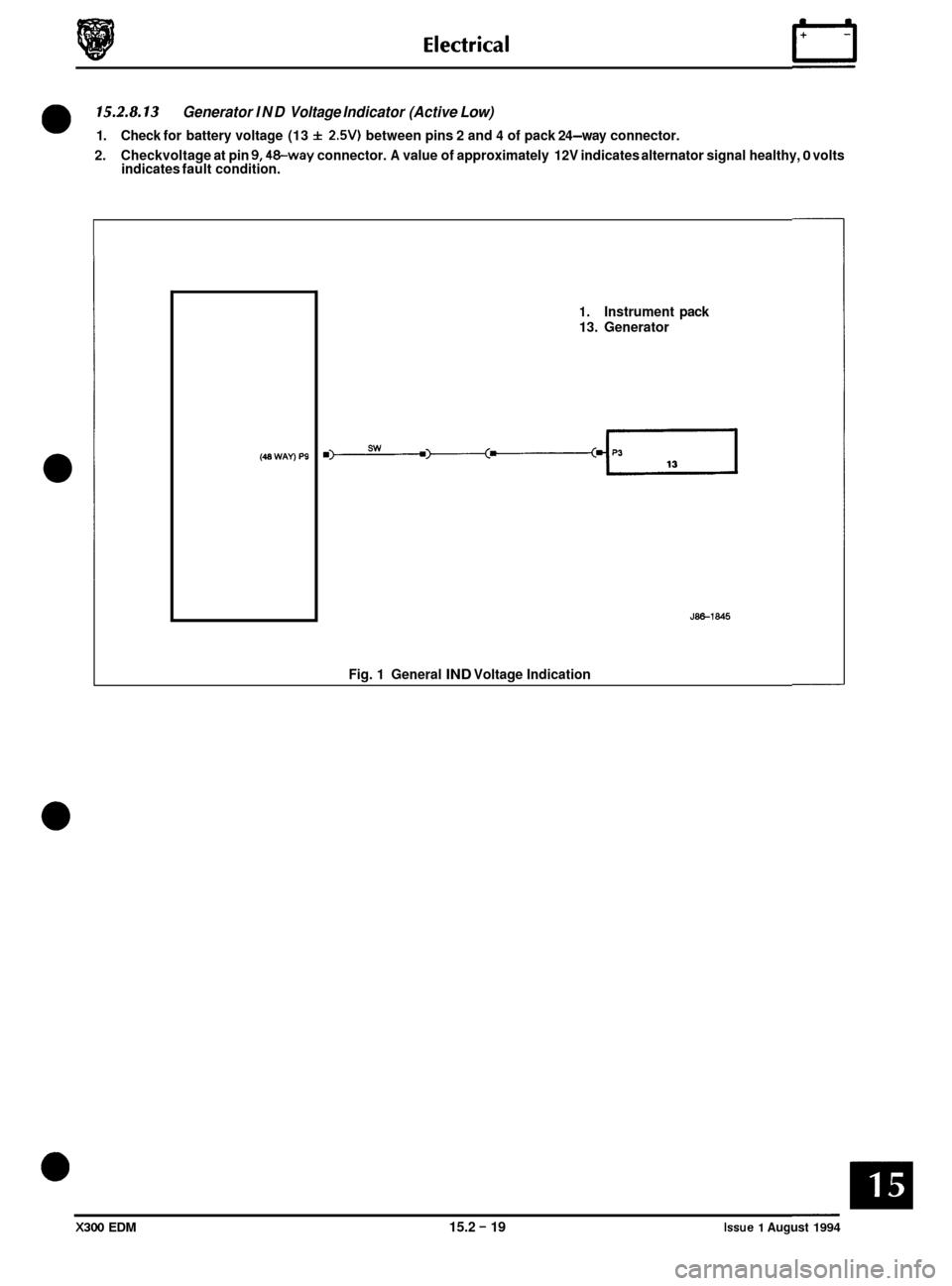
15.2.8.13
2. Checkvoltage at pin 9,48-way connector. A value of approximately 12V indicates alternator signal healthy, 0 volts
indicates fault condition.
Generator IND Voltage Indicator (Active Low)
1. Check for battery voltage (13 f 2.5V) between pins 2 and 4 of pack 24-way connector.
(4a wnv) P9
1. Instrument pack
13. Generator
J86-1845
Fig. 1 General IND Voltage Indication I
X300 EDM 15.2 - 19 Issue 1 August 1994
Page 184 of 327

15.3.5 PIN-POINT TESTS
The following tests give detailed information on component fault diagnosis.
1. Power supply
a. Check fuse FIO in LH 'A' post base fuse-box is intact.
b. Unplug harness connector from SCCM and check for battery supply voltage to ground, at pins 1 and 2
with ignition on. If supply is not recorded on either pin switch off ignition and check harness wiring
continuity from LH
'A' post base fuse-box to splice FCS16.
If supply is recorded at pin 1 only check brake and clutch (where fitted) switch contacts (closed when
pedals not operated). For vehicles with automatic transmission ensure clutch pedal switch link is
correctly fitted. Examine harness wiring and check continuity between pin
2 and splice FCS16.
If supply is recorded at pin 2 only examine harness wiring and check continuity from pin 1 to splice
FCS
16.
c.
d.
m
P1I
1
k wv I wu I
I-------
*+12V Present Only When Ignition ON
1. Speed Control Control Module (SC CM) 7. Dump Valve
2. Clutch Switch / Link 8. Control Valve / Pump Unit
3. Brake Switch
9. Gear Position Module 4. LH 'A' Post Base Fuse-box 10. ABS Control Module 5. Switch Pack 11. Instrument Pack
6. Column Switchgear Dimmer
Fig. 1 Speed Control Power Supply
Issue 1 August 1994 X300 EDM 15.3 - 7
Page 185 of 327

n Electrical
2. Switch pack assembly
a. Unplug switch pack connector and check for battery voltage between pin 4 and ground with
ignition
off. If battery voltage is not present, switch ignition off and examine wiring harness,
checking continuity between pin
4 and splice FCS16.
b. Test operation of switches between pins as follows:
ON: Normally open; closes on operation completing circuit between pins
4 and 5 and pins 1
and 5. A resistance of less than IQ should be recorded when testing pins 4 and 5.
Minimal resistance should be recorded when testing pins 1 and 5.
SET: Normally open; closes on operation completing circuit between pins 2 and 5.
A resistance of approximately 100Q should be recorded.
RES: Normally open; closes on operation completing circuit between pins
2 and 5.
A resistance of approximately 330Q should be recorded.
c. Examine wiring harness and check continuity between pin
5 and ground.
Ptl
PI1
1
m) su
I U0
I
*+12V Present Only When Ignition ON
1. Speed Control Control Module (SC CM)
7. Dump Valve 2. Clutch Switch I Link 8. Control Valve / Pump Unit 3. Brake Switch 9. Gear Position Module
4. LH ‘A’ Post Base Fuse-box 10. ABS Control Module
5. Switch Pack 11. Instrument Pack
6. Column Switchgear Dimmer
Fig. 1 Speed Control Switches
0
0
0
0
Issue 1 August 1994 15.3 - 8 X300 EDM
Page 186 of 327

E I ect r ica I n
3. Brakeswitches
a. Unplug switch connector and check for battery voltage between pin 3 and ground with ignition
b.
on. If battery voltage is not present switch off ignition and examine harness, checking
continuity between pin 3 and splice
FCS16.
Test switch continuity across pins as follows:
Pin
3 - Pin 2; normally closed, opens on pedal operation breaking circuit continuity. Also,
checkcontinuity from pin
2 to clutch switch (where fitted) or link pin 1.
Pin 1
- Pin 4; normally open, closes on pedal operation completing circuit continuity. Also,
check continuity from switch pin 1 to
SC CM pin 15 and switch pin 4 to ground.
4. Clutch switch (where fitted) or link
a. Unplug switch connector and check for battery voltage between pin 1 and ground with ignition
on. If battery voltage is not present switch
off ignition and examine harness, checking continuity
between pin 1 and splice
FCS16.
Check continuity across switch pins 1 and 2, switch (where fitted) is normally closed and opens
on pedal operation.
Examine wiring harness, checking continuity between pin
2 and SC CM pin 12.
b.
C.
1
.---I
1. Speed Control Control Module (SC CM) 7. Dump Valve
2. Clutch Switch 1 Link 8. Control Valve / Pump Unit
3. Brake Switch 9. Gear Position Module 4. LH 'A' Post Base Fuse-box 10. ABS Control Module
5. Switch Pack 11. Instrument Pack
6. Column Switchgear Dimmer
Fig. 1 Brake and Clutch Switches
X300 EDM 15.3 - 9 Issue 1 August 1994
Page 190 of 327

15.4 DRIVER ERGONOMICS
15.4.1 System Description
Adjustment of the seats, steering column and exterior rear view mirrors position is effected by means of control
switches. The switches maintain the adjustment facility while depressed, movement ceasing when the switch is re- leased.
Manual adjustment can be achieved either with the ignition key in place or with the driver‘s door open, or having been
closed within the last
30 seconds.
The system offers the following facilities:
Entry
/ Exit mode; an automatic seat /column position setting for ease of driver entry into / exit from the vehicle.
Driving position set; automatic recall of up to three preferred settings.
Passenger seat set; automatic recall of up to three preferred settings.
Remote recall; automatic recall of up to two memory positions from
a remote transmitter (in key fob).
Reverse mirror dip; automatic adjustment of passenger rear view mirror when reversing.
U: Vehicles intended for the Japanese market are fitted with an additional ‘fold away’ mirror function. This func- tion allows mirrors to fold flat against the car when parking in enclosed areas.
15.4.1.1 Entry/ Exit Mode
Entry / Exit mode is designed to give easier vehicle entry and exit for the driver. The facility is selected by positioning
the mode switch, located on the LH side of the column cowl, to ‘auto’ which designates the current seat / column posi- tion, ie driving positions, as the memorized position. On removal of ignition key or opening of driver‘s door, with igni- tion key still in place, the driver’s seat will move to the rear (current position allowing) and the column will adopt ‘tilt
away’ mode automatically creating additional space for driver exit
/ entry. Insertion of key in ignition or closure of
driver‘s door (with ignition key in place) returns seat / column positions to the memorized (previous) position.
Operation of eitherthe brake pedal or
seat/column manual controls during entry/exit mode execution will abort posi- tional adjustments. Setting the mode switch to OFF disables operation of entry / exit mode.
15.4.1.2 Driving Position Set
Setting of seat, column and external rear view mirrors to preferred driving position is available using the memory but- tons located on the drivers door switch pack. With the ignition key in place enter settings to be memorized as follows:
Adjust seat, column and mirrors to desired positions.
Press the ’memory’ button
so that it becomes illuminated.
Press button
1,2 or 3 to store configuration within four seconds of memory button operation. Memory light will extin- guish and a chime will sound, indicating procedure complete.
The above procedure may be repeated two more times until each button
(1,2 & 3) has a preferred position stored in
memory, accommodating different driver settings. Operation of any push-button (1,2 or 3) will re-position seat col-
umn and mirrors to the stored settings.
Memory recall will operate under the following conditions:
. Ignition key in and gear selector in park.
8 Ignition key in and handbrake on.
8 Ignition key out and driver’s door open (or having been closed within the last 30 seconds).
Re
-setting the preferred position on any setting button automatically erases previously stored information. Memory
information is not erased if power supply to the seat and column / mirror control modules is lost (e.g. battery discon- nected).
15.4.1.3 Passenger Seat Set
The procedure for setting and recalling a preferred passenger seat position is identical to that for a driving position.
Memory recall will only operate with ignition key in auxiliary position or passenger door open, or having been closed
within the last
30 seconds.
X300 EDM 15.4 - 1 Issue 1 August 1994