Page 80 of 385
Shift Light
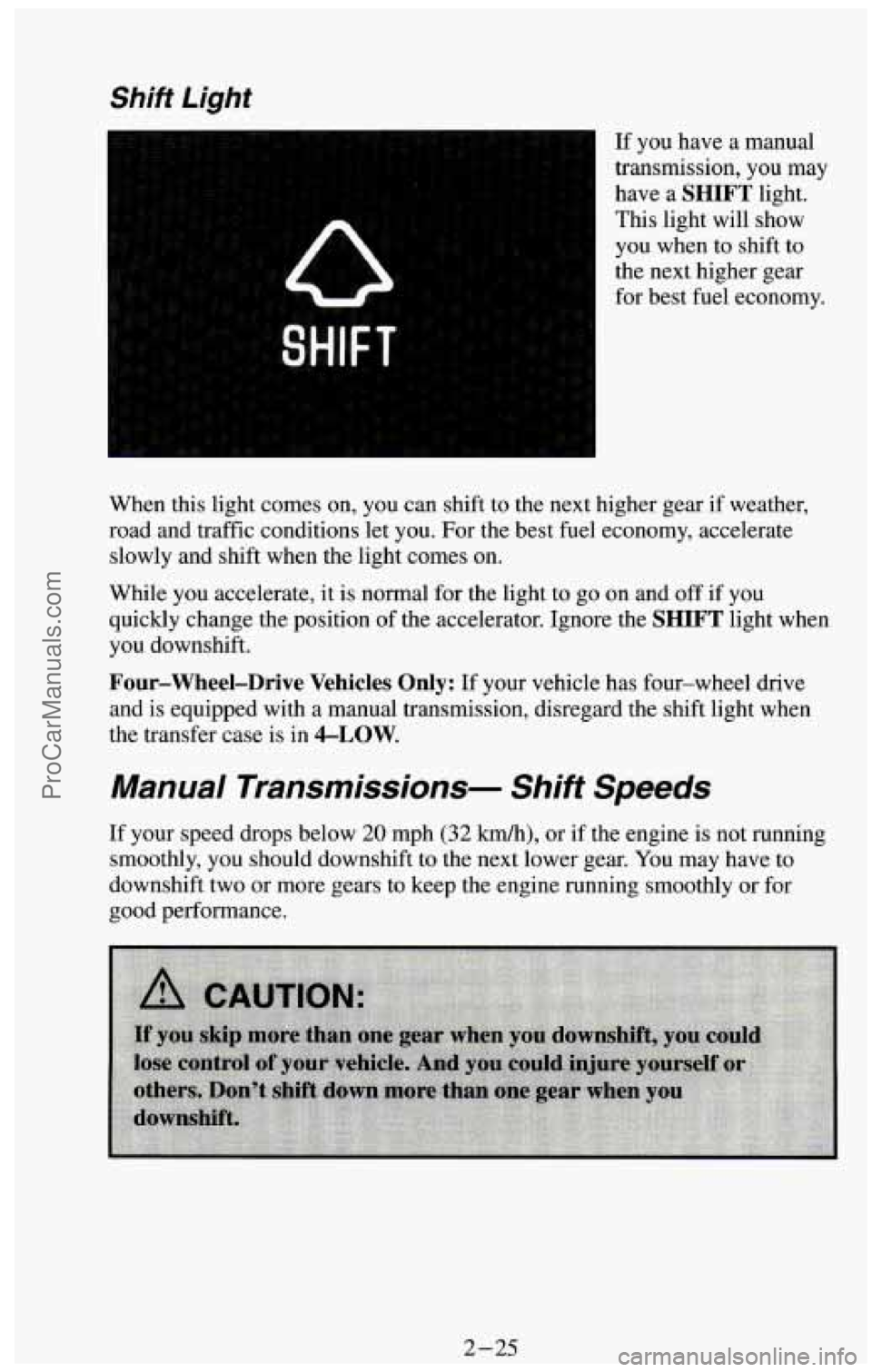
If you have a manual
transmission, you may
have a
SHIFT light.
This light will show
you when to shift to
the next higher gear
for best fuel economy.
When this light comes on, you can shift to the next higher gear if weather,
road and traffic conditions let you. For the best fuel economy, accelerate
slowly and shift when the light comes on.
While you accelerate, it is normal for the light to go on and off if you
quickly change the position of the accelerator. Ignore the
SHIFT light when
you downshift.
Four-Wheel-Drive Vehicles Only: If your vehicle has four-wheel drive
and is equipped with a manual transmission, disregard the shift light when
the transfer case is in
4-LOW.
Manual Transmissions- Shift Speeds
If your speed drops below 20 mph (32 lun/h), or if the engine is not running
smoothly, you should downshift to the next lower gear. You may have to
downshift two or more gears to keep the engine running smoothly or for
good performance.
2-25 ProCarManuals.com
Page 81 of 385
I NOTICE:
If you skip more than one gear when you downshift, or if you
race the engine when you downshift, you can damage the engine,\
clutch
or transmission.
Locking Rear Axle
If you have this feature, your rear axle can give you additional traction on
snow, mud, ice, sand or gravel. It works like a standard axle most of the
time, but when one
of the rear wheels has no traction and the other does, the
locking feature will allow the wheel with traction to move the vehicle.
Parking Brake
To set the parking brake:
Hold the regular brake
pedal down with your
right foot. Push down
the parking brake
pedal with
your left
foot.
If the ignition is on, the brake system warning light will come on.
2-26 ProCarManuals.com
Page 84 of 385
5. Remove the key and take it with you. If you can walk away from your
vehicle with the ignition key in
your hand, your vehicle is in “P”
(Park).
If
you have to leave your vehicle with the engine running, be sure your
vehicle
is in “P’ (Park) and your parking brake is firmly set before you
leave it. If
you have four-wheel drive with a manual transfer case shift
lever, be sure that
the transfer case is in a drive gear - not in “N” (Neutral).
After
you’ve moved the shift lever into the “P” (Park) position, hold the
regular brake pedal down. Then, see if
you can move the shift lever away
from “P” (Park) without first pulling it toward you. If
you can, it means that
the shift lever wasn’t fully locked into
“I?” (Park).
Torque Lock (Automatic Transmission)
If you are parking on a hill and you don’t shift your transmission into “P”
(Park) properly, the weight of the vehicle may put
too much force on the
parking pawl in the transmission. You may find it difficult to pull the shift
lever
out of “P” (Park). This is called “torque lock.’’ To prevent torque lock,
set the parking brake and then shift into
“P’ (Park) properly before you
leave the driver’s seat. To find out how, see “Shifting Into ‘P’ (Park)” in the
Index.
When
you are ready to drive, move the shift lever out of “P” (Park)
BEFORE you release the parking brake.
If “torque lock”
does occur, you may need to have another vehicle push
yours a little uphill to take some
of the pressure from the transmission, so
you can pull the shift lever out of “F”’ (Park).
2-29 ProCarManuals.com
Page 85 of 385
Parking Your Vehicle
(Manual Transmission Models Only)
Before you get out of your vehicle, put your manual transmission in “R”
(Reverse), turn off the engine, and firmly apply the parking brake .
If you have four-wheel drive, be sure your transfer case is in a drive gear.
Your vehicle could roll
if it isn’t.
If you are parking on a hill, or if your pulling a trailer, see “Parking on
Hills” or “Towing a Trailer’’ in the Index.
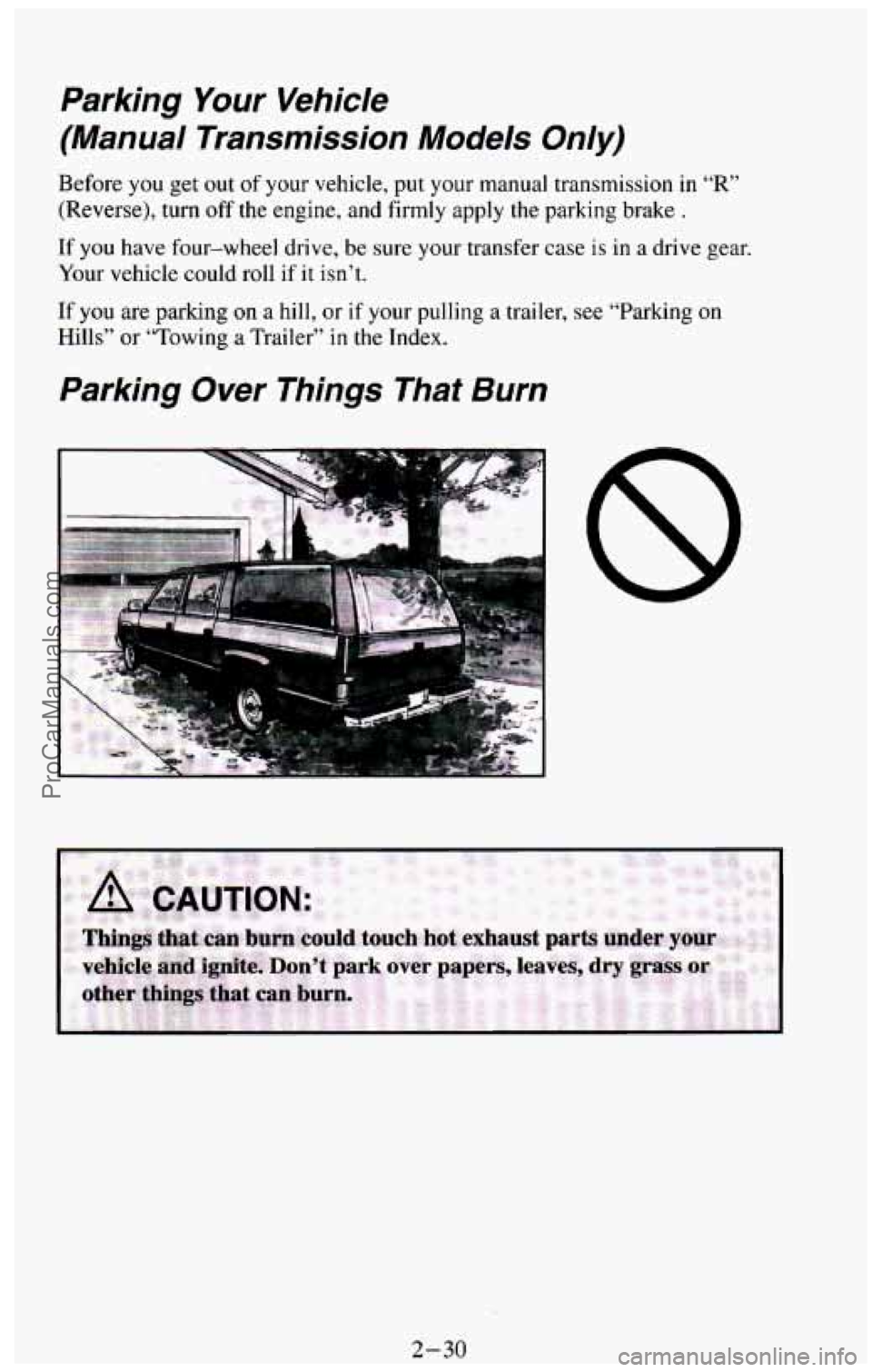
Parking Over Things That Burn
2-30 ProCarManuals.com
Page 86 of 385
Engine Exhaust
Running Your Engine While You’re Parked
(Automatic Transmission)
It’s better not to park with the engine running. But if you ever have to, here
are
some things to know.
2-31
ProCarManuals.com
Page 87 of 385
If you have four-wheel drive and your transfer case is in “N” (Neutral),
your vehicle will be free to roll, even if your shift lever is in
“P” (Park). So,
be sure the transfer case is in a drive gear - not in “N” (Neutral). Follow
the proper steps
to be sure your vehicle won’t move. See “Shifting Into ‘P’
(Park)” in the Index.
If you’re pulling a trailer, see “Towing a Trailer” in the Index.
Four Wheel Drive
If your vehicle has four-wheel drive, you can send your engine’s driving
power
to all four wheels for extra traction. To get the most satisfaction out
of four-wheel drive, you must be familiar with it’s operation. Read the part
that follows before using four-wheel drive.
You should use 2H for most
normal driving conditions.
Rear-wheel antilock brakes do
not work when you shift into four-wheel
drive. Your regular brakes will
still work. When you shift back into
two-wheel drive, your rear-wheel antilock brakes will take over again.
2-32
ProCarManuals.com
Page 105 of 385
If your vehicle has an
overhead console with
reading lights, they
can be swiveled to
point in the direction
you want.
To turn the light on, press the button next to the light with the master
lighting switch symbol on it. Press the button again to
turn the light off.
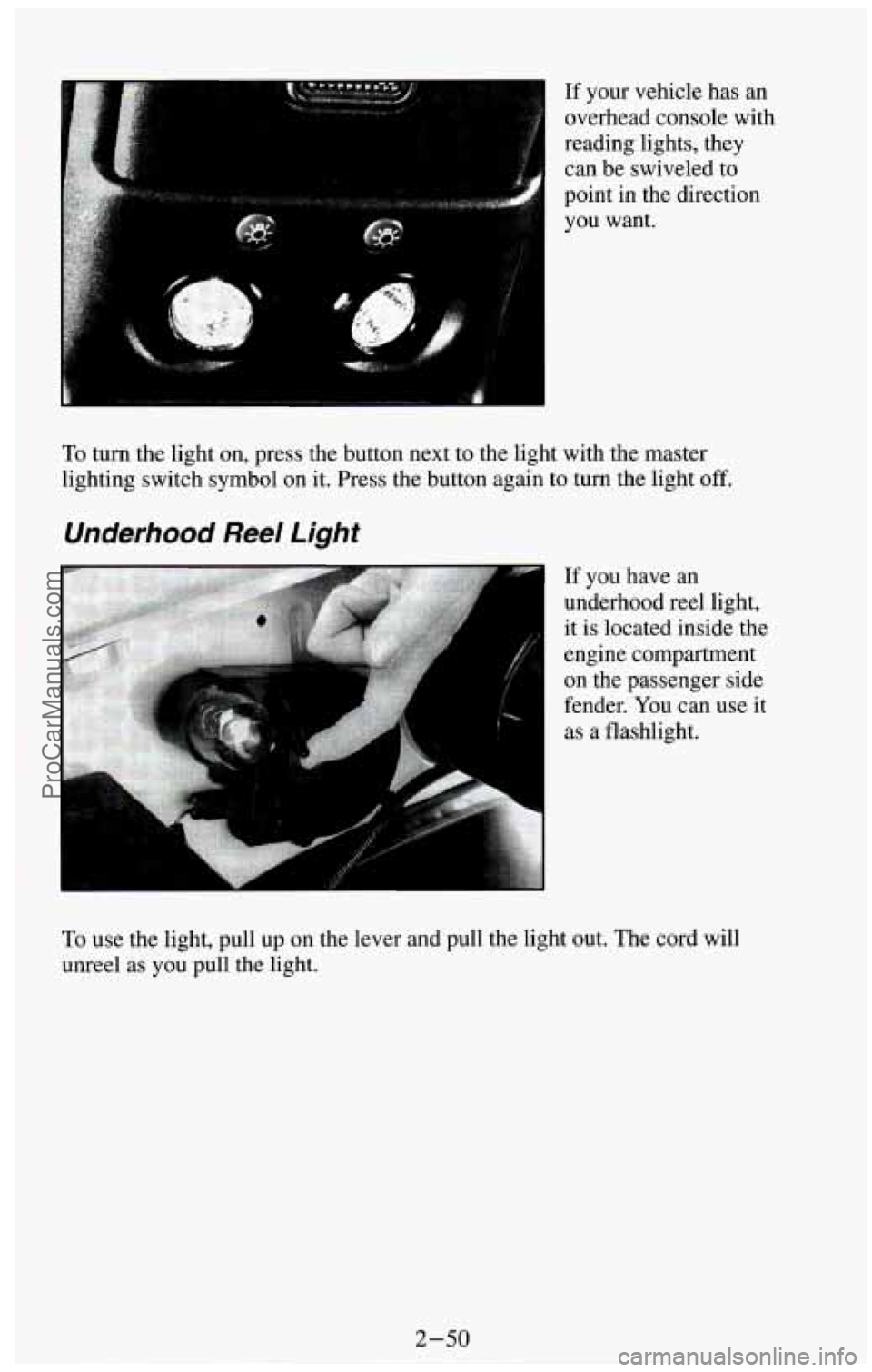
Underhood Reel Light
If you have an
underhood reel light,
it is located inside the
engine compartment
on the passenger side
fender. You can use it
as a flashlight.
To use the light, pull up on the lever and pull the light out. The cord will
unreel as you pull the light.
2-50
ProCarManuals.com
Page 119 of 385
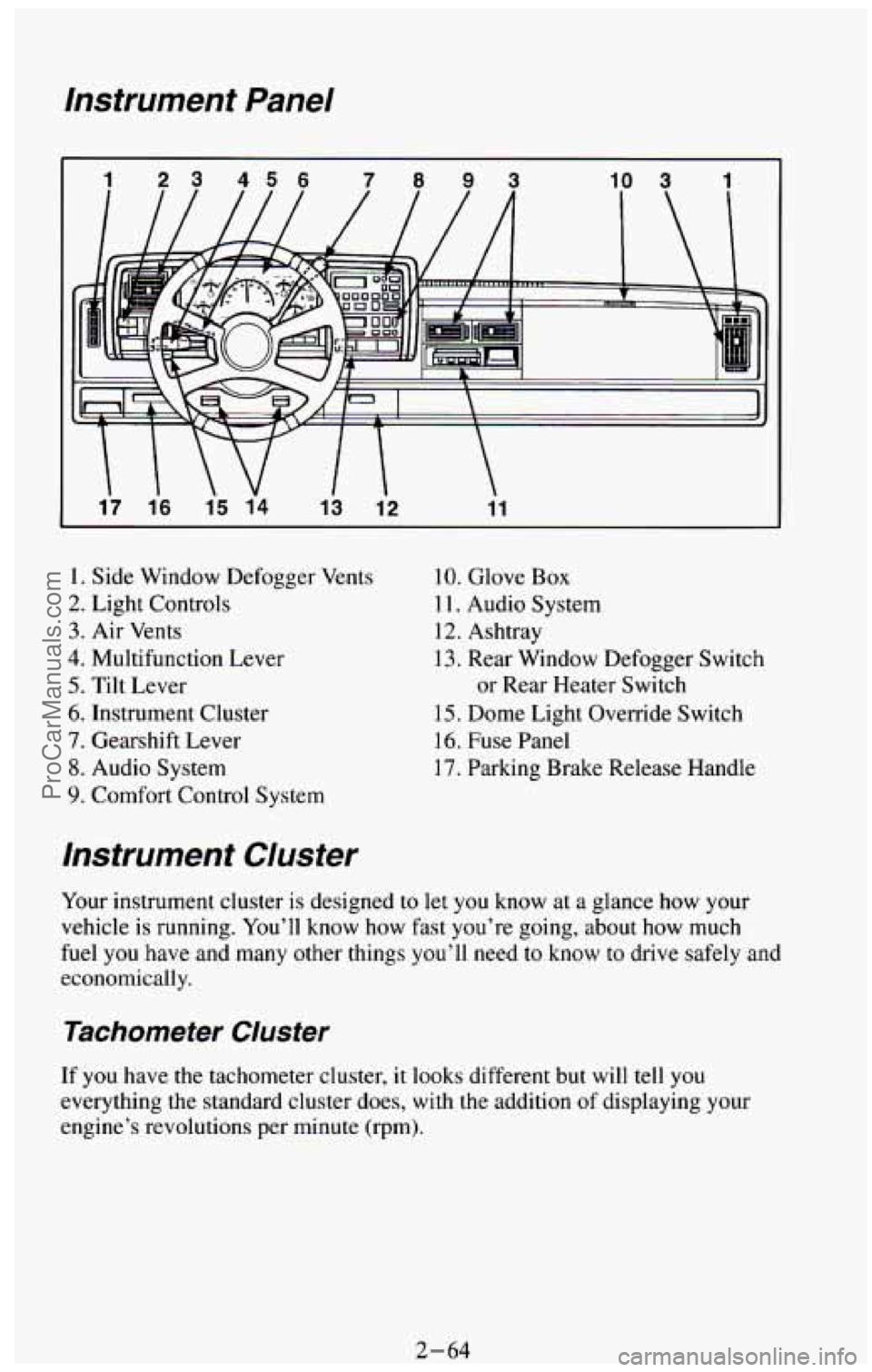
Instrument Panel
13 1’2
1. Side Window Defogger Vents
2. Light Controls
3. Air Vents
4. Multifunction Lever
5. Tilt Lever
6. Instrument Cluster
7. Gearshift Lever
8. Audio System
9. Comfort Control System
10. Glove Box
1 1. Audio System
12. Ashtray
13. Rear Window Defogger Switch
or Rear Heater Switch
15. Dome Light Override Switch
16. Fuse Panel
17. Parking Brake Release Handle
Instrument Cluster
Your instrument cluster is designed to let you know at a glance how your
vehicle is running.
You’ll know how fast you’re going, about how much
fuel you have
and many other things you’ll need to know to drive safely and
economically.
Tachometer Cluster
If you have the tachometer cluster, it looks different but will tell you
everything the standard cluster does, with the addition of displaying your
engine’s revolutions per minute (rpm).
2-64 ProCarManuals.com