Page 195 of 385
4. Engage the power take-off.
If you are going to drive the vehicle, shift the transmission into the gear
you want. Then shift the transfer case into the range you want, apply
the regular brakes and release the parking brake.
When
you release the clutch, the power take-off will start.
5. Release the clutch (and the regular brakes) as you normally would.
Using a Transfer Case Mounted Power Take-Off
(Automatic Transmission)
1. Set the parking brake.
2. Shift the transfer case into “N” (Neutral).
3. Shift the transmission into “N’ (Neutral).
4. Engage the power take-off.
If you are going to drive the vehicle, shift the transfer case into the
range you want. Then apply the regular brakes and release the parkin\
g
brake.
5. Shift the transmission to “D” (Drive) to start the power take-off.
6. Release the regular brakes to drive the vehicle.
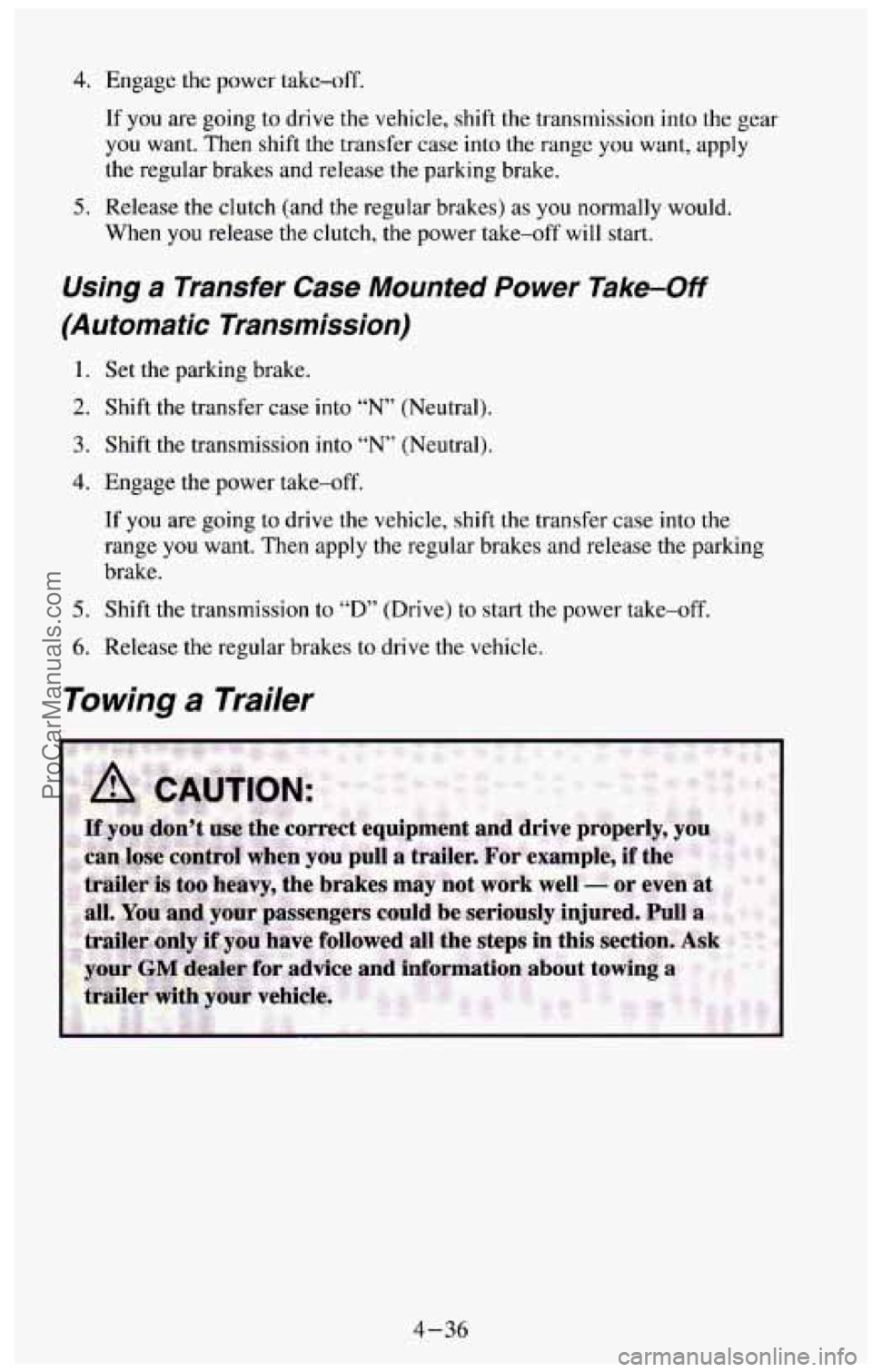
Towing a Trailer
4-36
ProCarManuals.com
Page 207 of 385
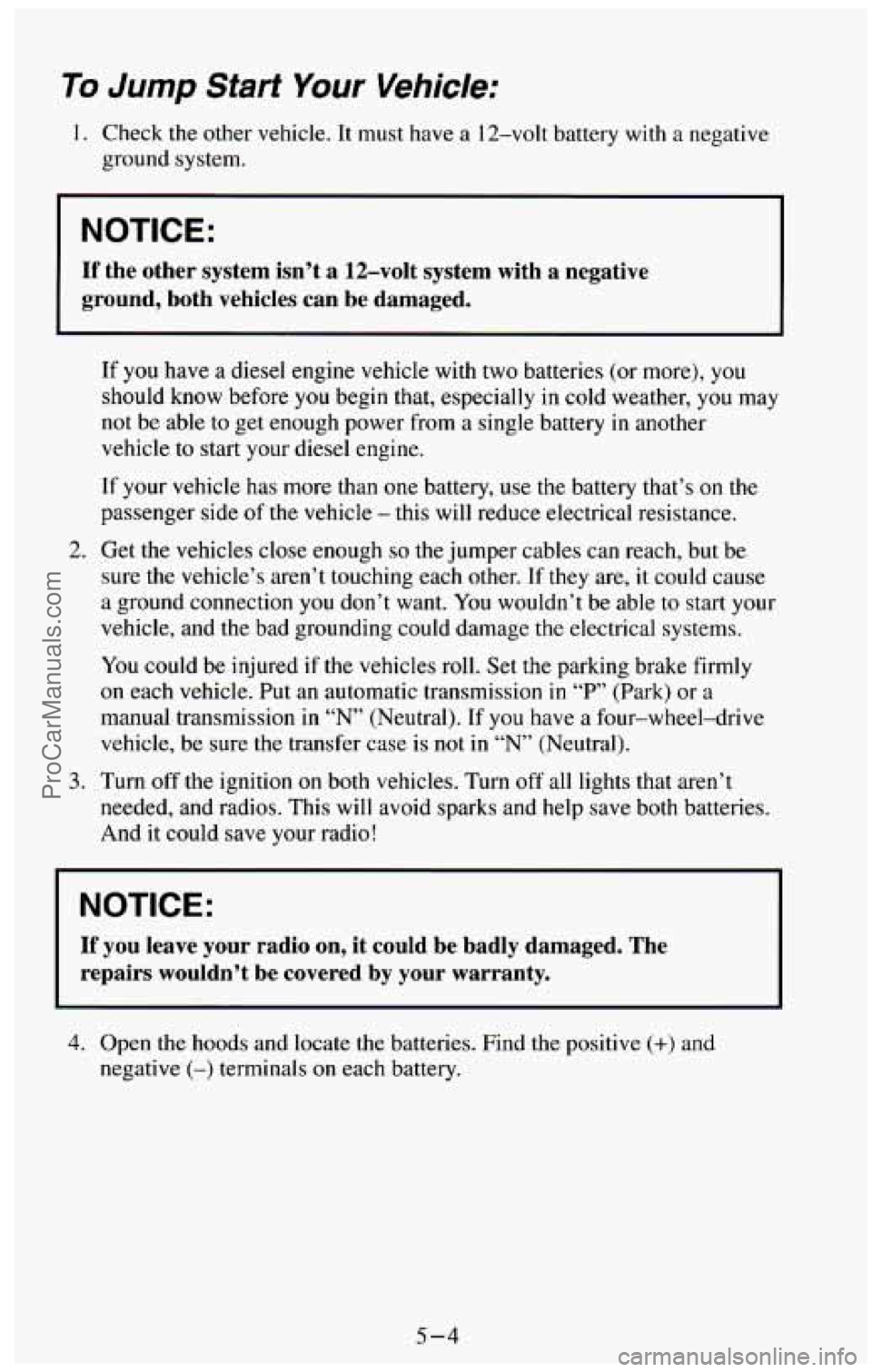
Tu Jump Start Your Vehicle;
1. Check the other vehicle. It must have a 12-volt battery with a negative
ground system.
I NOTICE:
I
If the other system isn’t a 12-volt system with a negative
ground, both vehicles can be damaged.
If you have a diesel engine vehicle with two batteries (or more), you
should know before you begin that, especially in cold weather, you may
not be able to get enough power from a single battery in another
vehicle to start your diesel engine.
If your vehicle has more than one battery, use the battery that’s on the
passenger side
of the vehicle - this will reduce electrical resistance.
2. Get the vehicles close enough so the jumper cables can reach, but be
sure the vehicle’s aren’t touching each other.
If they are, it could cause
a ground connection
you don’t want. You wouldn’t be able to start your
vehicle, and the bad grounding could damage the electrical systems.
You could be injured if
the vehicles roll. Set the parking brake firmly
on each vehicle. Put an automatic transmission in “P’ (Park) or a
manual transmission in “N’ (Neutral). If you have a four-wheel-drive
vehicle, be sure the transfer case is not in “N” (Neutral).
3. Turn off the ignition on both vehicles. Turn off all lights that aren’t
needed, and radios. This will avoid sparks and help save both batteries.
And it could save your radio!
NOTICE:
If you leave your radio on, it could be badly damaged. The
repairs wouldn’t
be covered by your warranty.
4. Open the hoods and locate the batteries. Find the positive (+) and
negative
(-) terminals on each battery.
5-4
ProCarManuals.com
Page 246 of 385
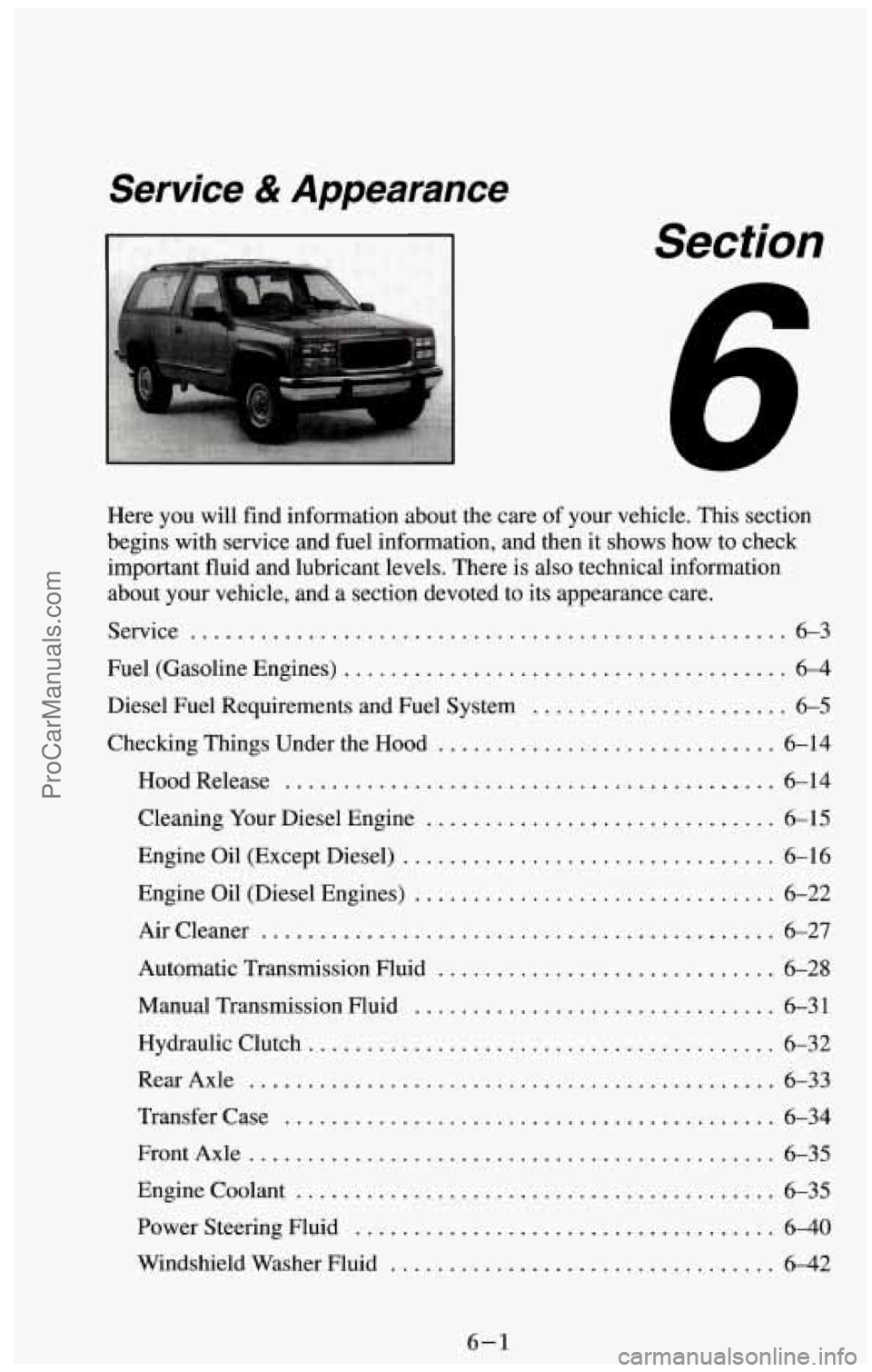
Service & Appearance
I Section
Here you will find information about the care of your vehicle . This section
begins with service and fuel information. and then it shows how to check
important fluid and lubricant levels
. There is also technical information
about your vehicle. and a section devoted to its appearance care
.
Service ................................................... 6-3
Fuel (Gasoline Engines)
............................
Diesel Fuel Requirements and Fuel System ..........
Checking Things Under the Hood ........... .....
........ 6-4
.......... 6-5
......... 6-14
HoodRelease
.......................................... 6-14
Cleaning Your Diesel Engine
............................ 6-15
Engine Oil (Except Diesel)
................................ 6-16
Engine Oil (Diesel Engines)
............................... 6-22
Aircleaner
.................... .................. 6-27 ..
Automatic Transmission Fluid ............................. 6-28
Manual Transmission Fluid
............................... 6-31
Hydraulic Clutch
........................................ 6-32
RearAxle
............................................. 6-33
Transfer Case
.......................................... 6-34
FrontAxle
........................................... 6-35
Engine Coolant
......................................... 6-35
Power Steering Fluid
.............. .................. 640
Windshield Washer Fluid
............................... 6-42
6-1
ProCarManuals.com
Page 285 of 385
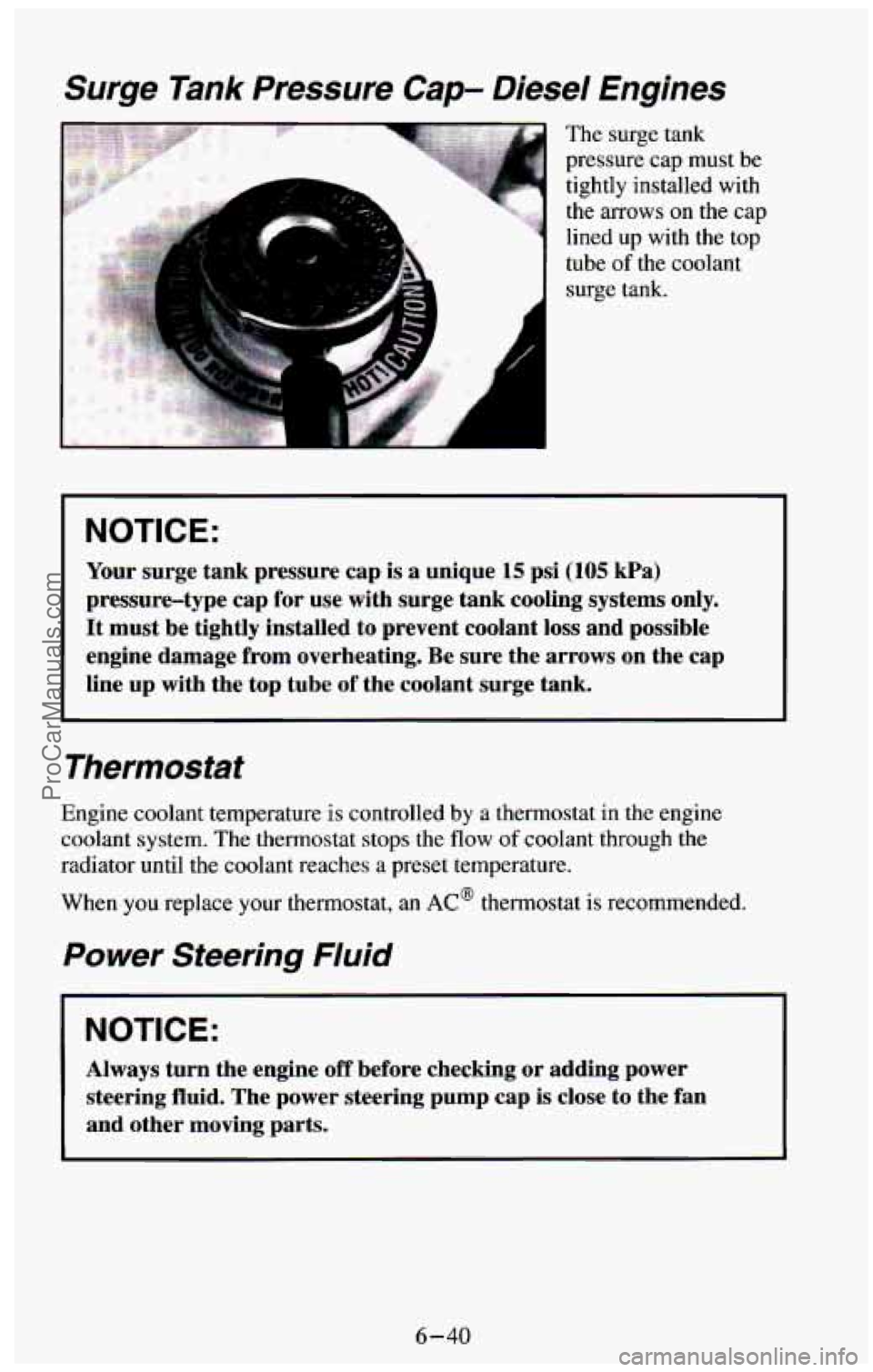
Surge Tank Pressure Cap- Diesel Engines
The surge tank
pressure cap must be
tightly installed with
the arrows
on the cap
lined up with the top
tube
of the coolant
surge tank.
NOTICE:
Your surge tank pressure cap 1s a unique 15 psi (105 kPa)
pressure-type cap for use with surge tank cooling systems only.
It must be tightly installed to prevent coolant loss and possible
engine damage from overheating. Be sure the arrows on the cap
line up with the top tube
of the coolant surge tank.
Thermostat
Engine coolant temperature is controlled by a thermostat in the engine
coolant system. The thermostat stops the flow
of coolant through the
radiator until the coolant reaches a preset temperature.
When you replace your thermostat, an
AC@ thermostat is recommended.
Power Steering Fluid
I NOTICE:
Always turn the engine off before checking or adding power
steering
fluid. The power steering pump cap is close to the fan
and other moving parts.
6-40
ProCarManuals.com
Page 286 of 385
How To Check Power Steering Fluid
l
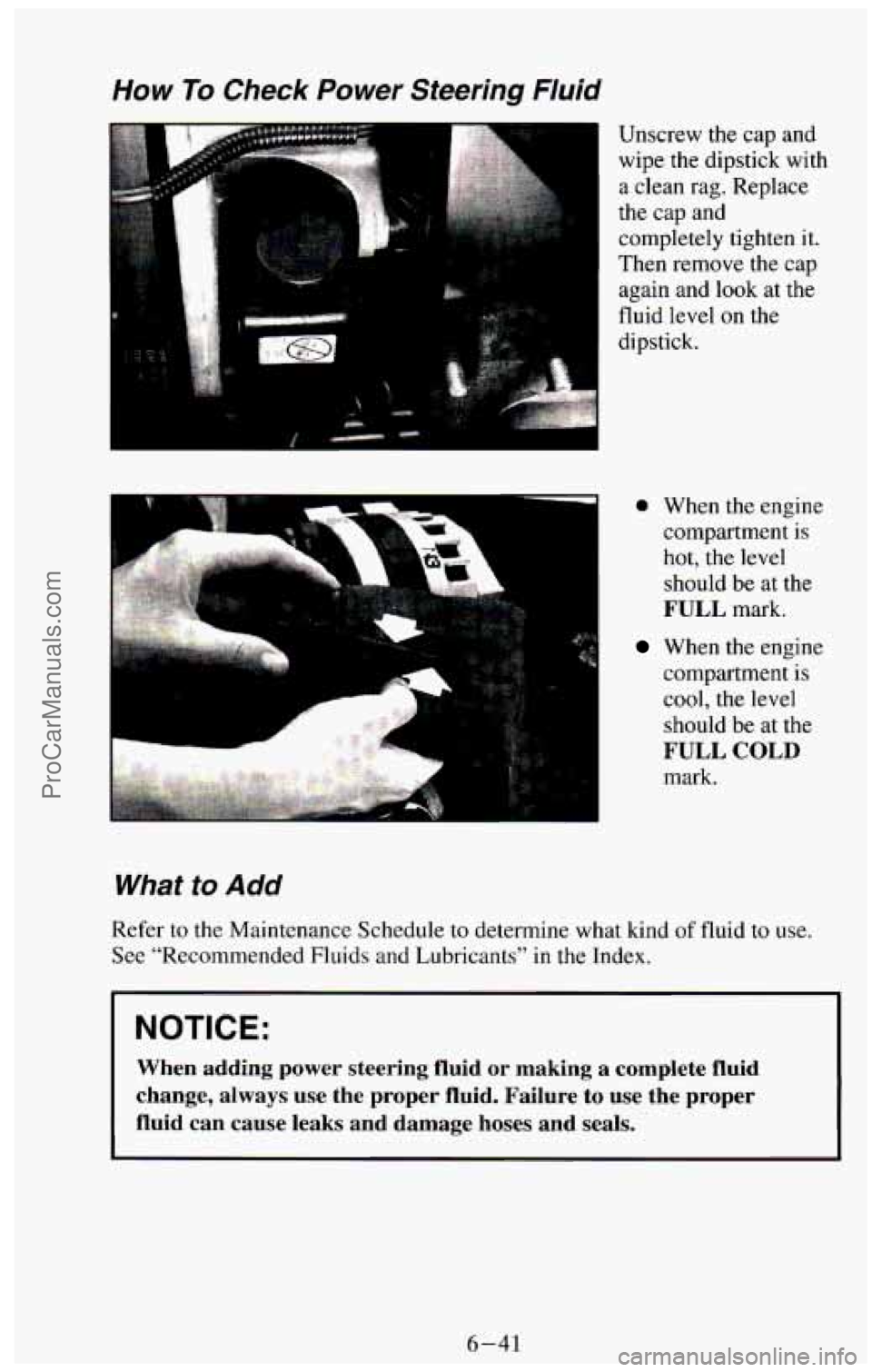
Unscrew the cap and
wipe the dipstick with
a clean rag. Replace
the cap and
completely tighten it.
Then remove the cap
again and look
at the
fluid level on the
dipstick.
0 When the engine
compartment is
hot, the level
should
be at the
FULL mark.
When the engine
compartment is
cool, the
level
should be at the
FULL COLD
mark.
Whaf fo Add
Refer to the Maintenance Schedule to determine what kind of fluid to use.
See “Recommended Fluids and Lubricants” in the Index.
NOTICE:
When adding power steering fluid or making a complete fluid
change, always
use the proper fluid. Failure to use the proper
fluid can cause leaks and damage hoses and
seals.
6-41
ProCarManuals.com
Page 287 of 385
Hydro-Boost Brake System (Hydraulic Pump)
The power steering pump is also used as the Hydro-boost pump. Refer to
“Power Steering System” in this section when checking fluid level
or
adding fluid.
Windshield Washer Fluid
To Add
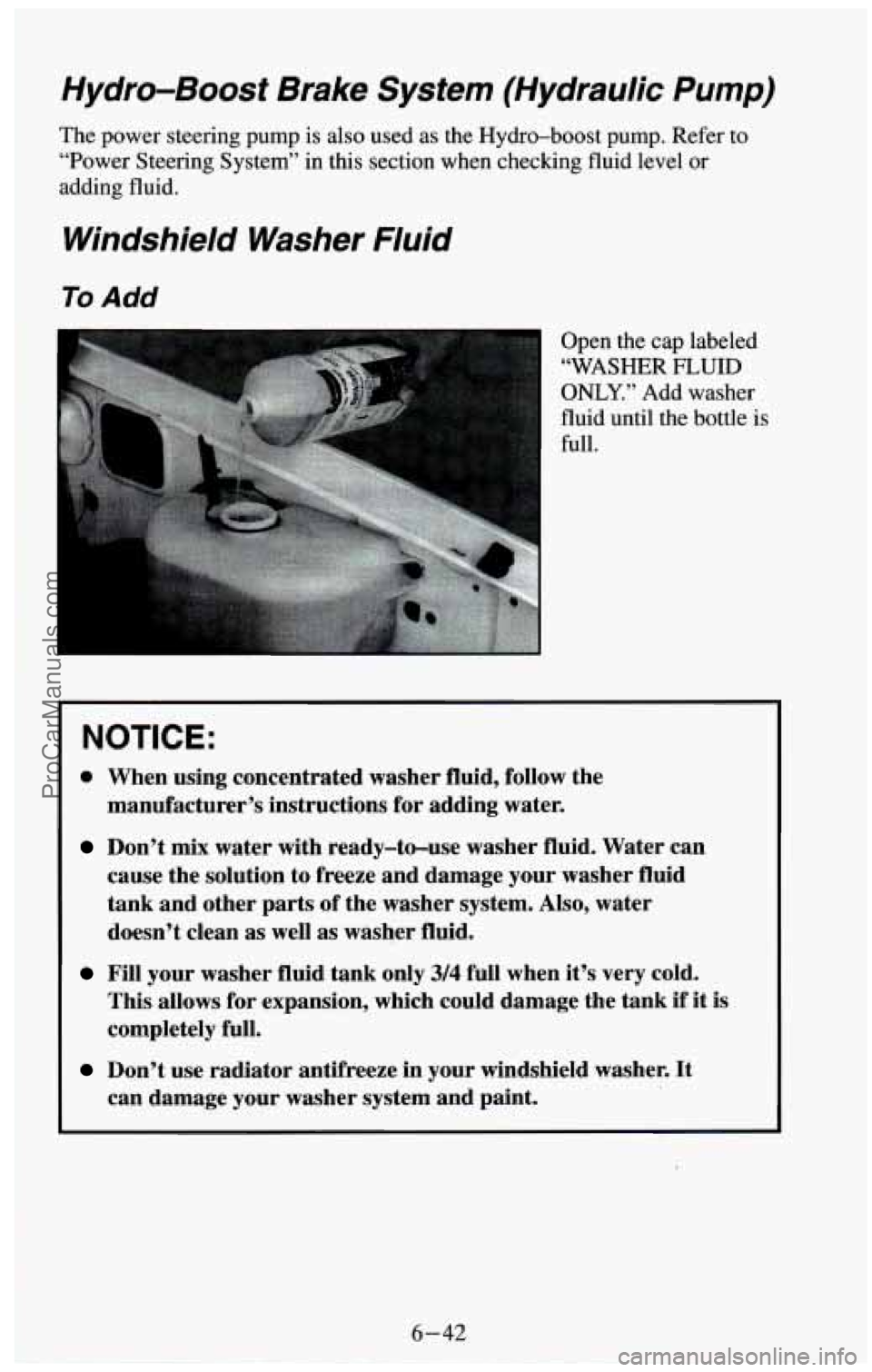
Open the cap labeled
“WASHER
FLUID
ONLY.” Add washer
fluid until the bottle is
full.
~ NOTICE:
0 When using concentrated washer fluid, follow the
manufacturer’s instructions for adding water.
Don’t mix water with ready-to-use washer fluid. Water can
cause the solution to freeze and damage your washer fluid
tank and other parts of the washer system. Also, water
doesn’t clean as well
as washer fluid.
Fill your washer fluid tank only 3/4 full when it’s very cold.
This allows for expansion, which could damage the tank
if it is
completely full.
Don’t use radiator antifreeze in your windshield washer. It
can damage your washer system and paint.
ProCarManuals.com
Page 302 of 385
Power Windows and Other Power Options
Circuit breakers in the fuse panel protect the power windows and other
power accessories. When the current load is too heavy, the circuit breaker
opens and closes. This protects the circuit until the current load returns to
normal or the problem is fixed
.
Trailer Wiring Harness
The optional seven-wire trailer wiring harness is protected by an in-line
fuse in the battery feed wire. This fuse is near the junction block. See
“Trailer Wiring Harness” in the Index for more information.
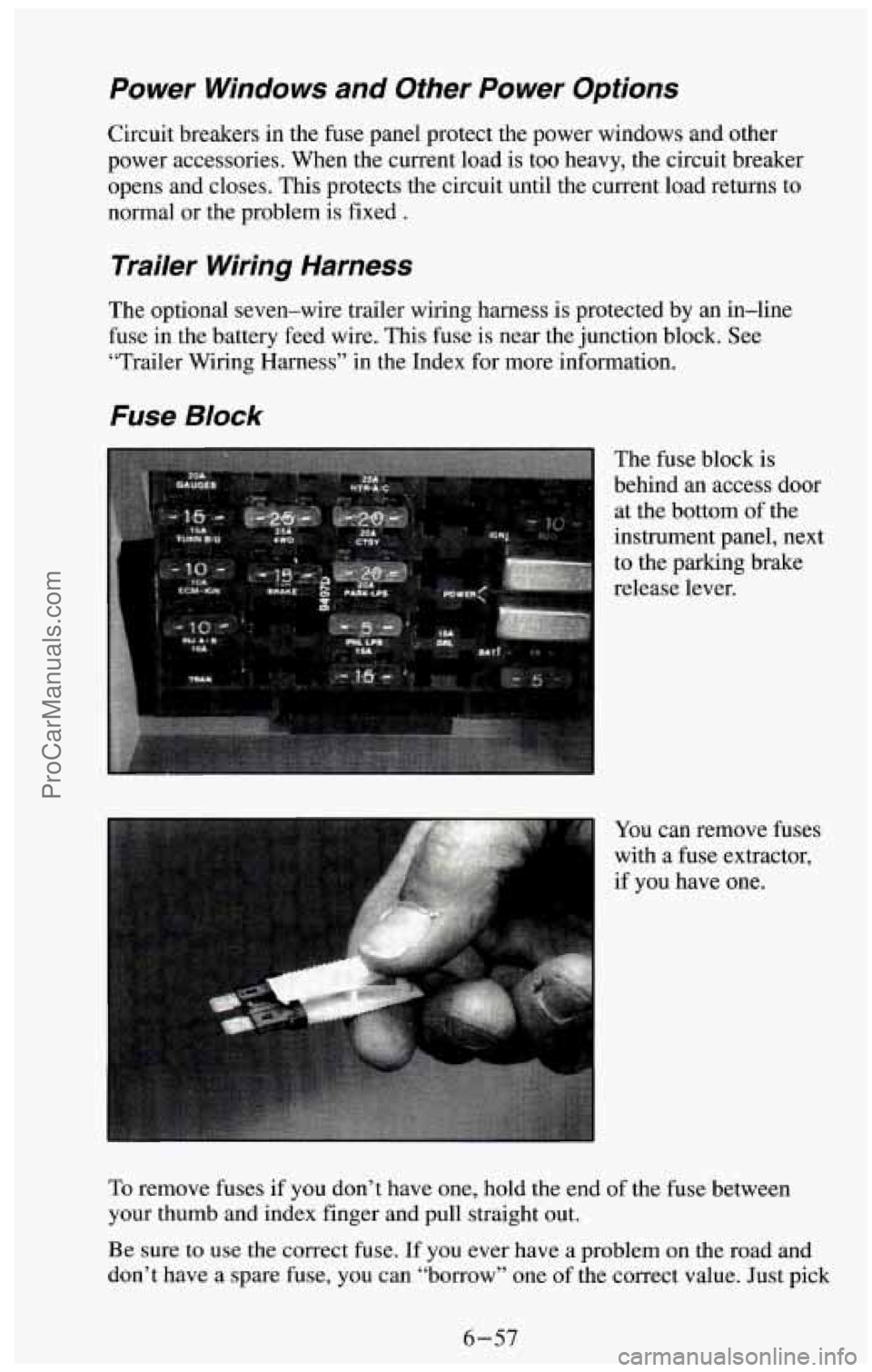
Fuse Block
The fuse block is
behind an access door
at the bottom
of the
instrument panel, next
to the parking brake
release lever.
You can remove fuses
with a fuse extractor,
if you have one.
To remove fuses if you don’t have one, hold the end of the fuse between
your thumb and index finger and pull straight out.
Be sure to use the correct fuse. If
you ever have a problem on the road and
don’t have a spare fuse, you can “borrow” one of the correct value. Just pick
6-57
ProCarManuals.com
Page 331 of 385
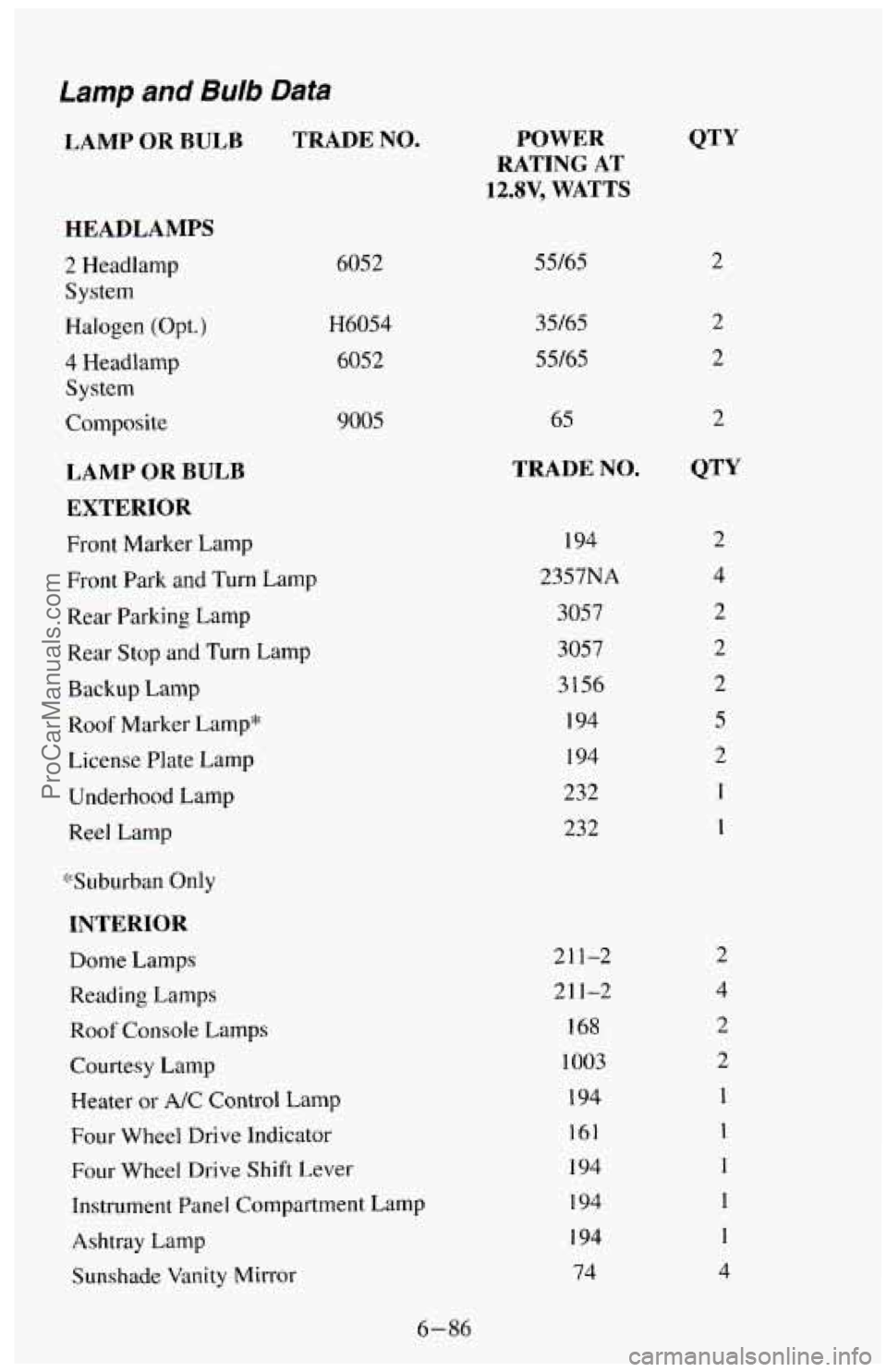
Lamp and Bulb Data
LAMP OR BULB TRADE NO.
HEADLAMPS
2 Headlamp
System
Halogen
(Opt.)
4 Headlamp
System
Composite
LAMP OR BULB
EXTERIOR
Front Marker Lamp
Front Park
and Turn Lamp
Rear Parking Lamp
Rear Stop and Turn Lamp
Backup Lamp
Roof Marker Lamp"
License Plate Lamp
Underhood Lamp
Reel Lamp
*Suburban Only 6052
H6054 6052
9005
INTERIOR
Dome Lamps
Reading Lamps
Roof Console Lamps
Courtesy Lamp
Heater
or A/C Control Lamp
Four Wheel Drive Indicator
Four Wheel Drive Shift Lever
Instrument Panel Compartment Lamp
Ashtray Lamp
Sunshade
Vanity Mirror
POWER
RATING AT
12.8V, WATTS
55/65
35/65 55/65
65
TRADE NO.
194
2357NA
3057 3057
3156
194 194
232 232
211-2
21 1-2
I68
1003
194
161
194
194
194
74
i
2
2
2
2
4
2
2
2
5
2
1
1
2
4 2
2
1
1
1
1
1
4
6-86
ProCarManuals.com