Page 181 of 340
Downloaded from www.Manualslib.com manuals search engine Power Winches
If you wish to use a power wlncn on your vehicle, only use it when your
vehicle
is stationary or anchored.
NOTICE:
When operating a power winch on your vehicle always leave the \
transmission in the neutral position.
Do not leave an automatic
transmission in P (Park) or a manual transmission in gear or\
the
transmission may be damaged.
Use the regular brakes, set the parking brake or block the wh\
eels to keep
your vehicle from rolling.
4-45
Page 191 of 340
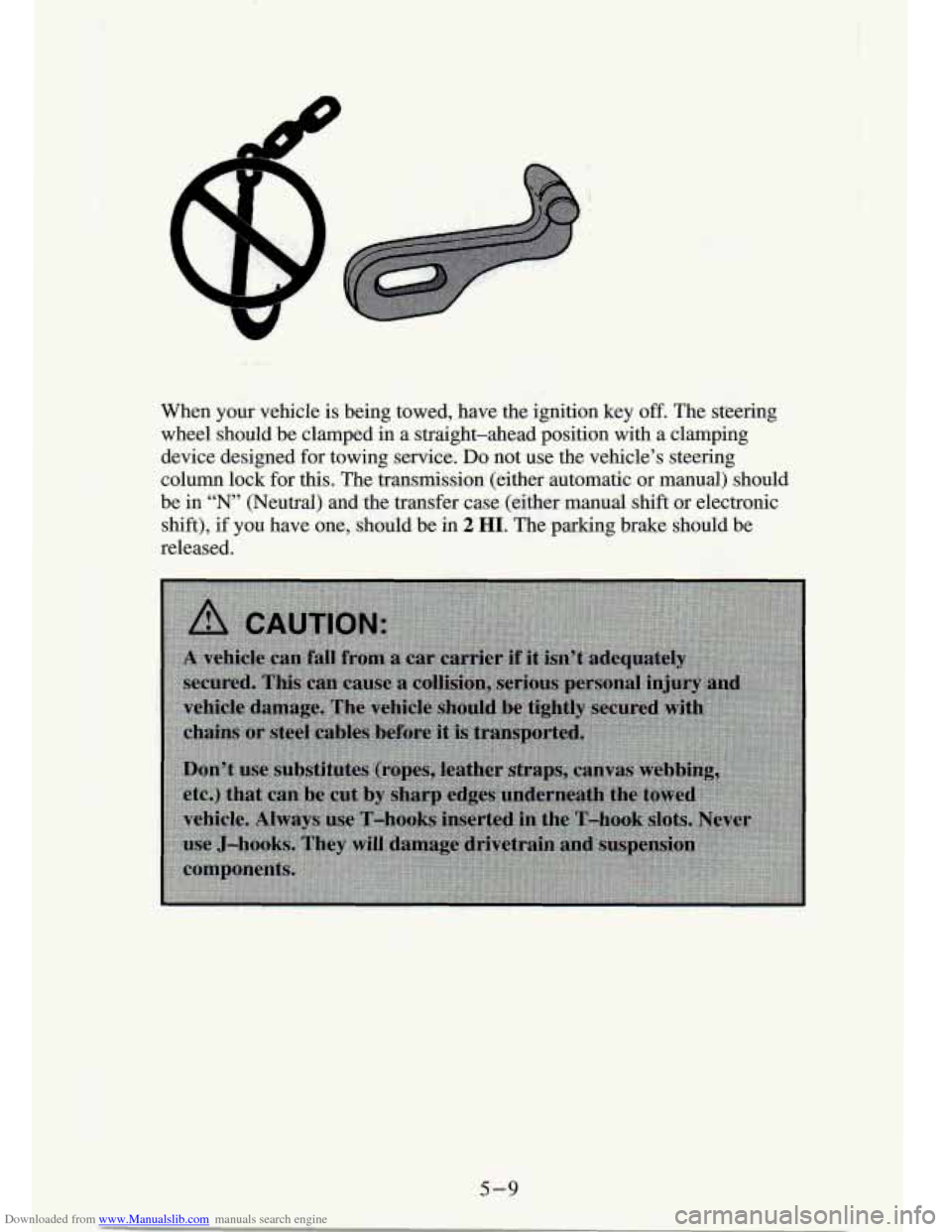
Downloaded from www.Manualslib.com manuals search engine When your vehicle is being towed, have the ignition key off. The steering
wheel should be clamped in a straight-ahead position
with a clamping
device designed for towing service.
Do not use the vehicle’s steering
column lock for this. The transmissi,on (either automatic or manual) should
be
in “N’ (Neutral) and the transfer case (either manual shift or electronic
shift),
if you have one, should be in 2 HI. The paking brake should be
released.
5-9
Page 203 of 340
Downloaded from www.Manualslib.com manuals search engine Flat Tire
L Blocked Tire
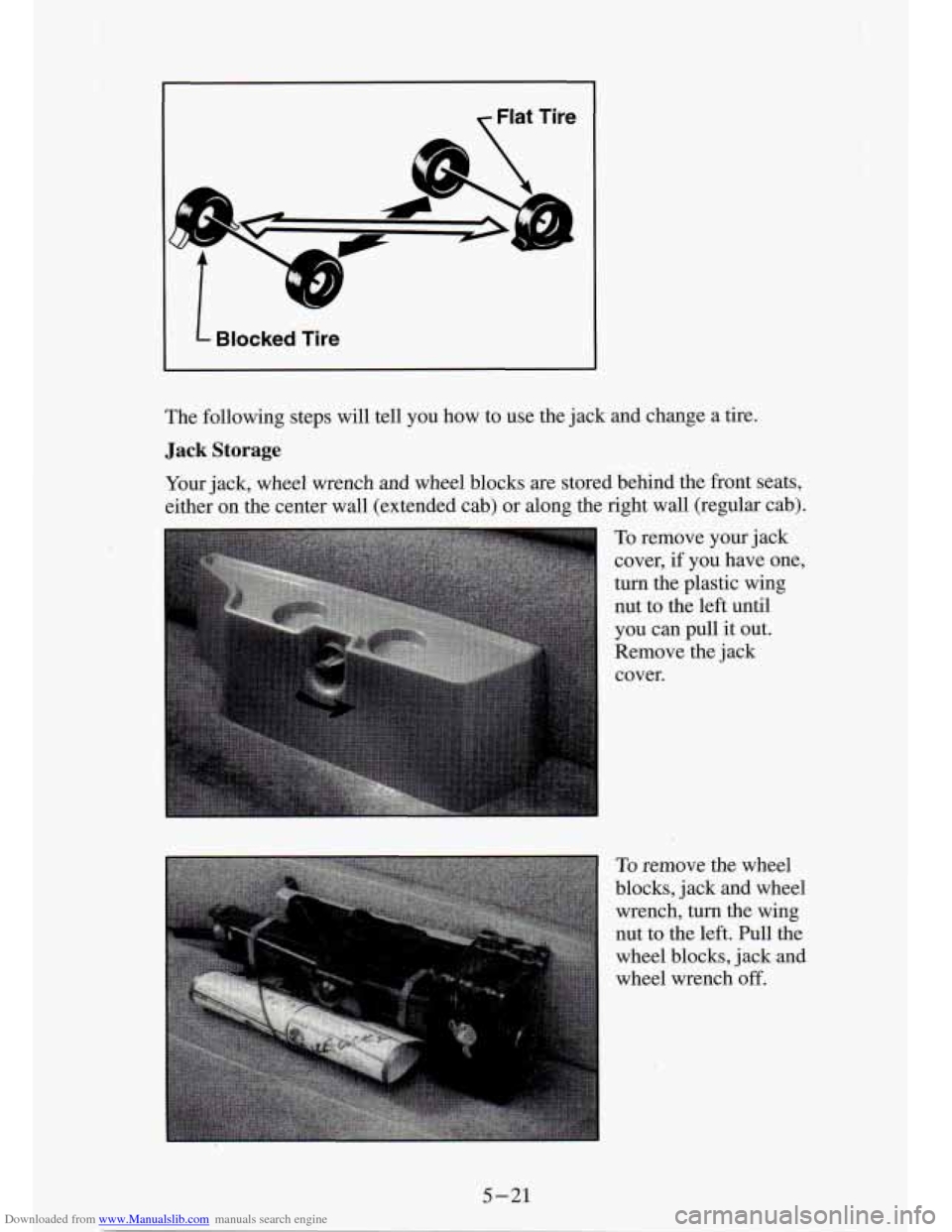
The following steps will tell you how to use the jack and change a tire.
Jack Storage
Your jack, wheel wrench and wheel blocks are stored behind the front seats,
either on the center wall (extended cab) or along the right wall (regular \
cab).
To remove your jack
cover, if you have one,
turn the plastic wing
nut to the left until
you can pull it out.
Remove the jack
cover.
To remove the wheel
blocks, jack and wheel
wrench,
turn the wing
nut to the left. Pull the
wheel blocks, jack and
wheel wrench
off.
5-21
Page 204 of 340
Downloaded from www.Manualslib.com manuals search engine 7
1.
2.
3.
4.
5.
6.
7.
8.
9.
10.
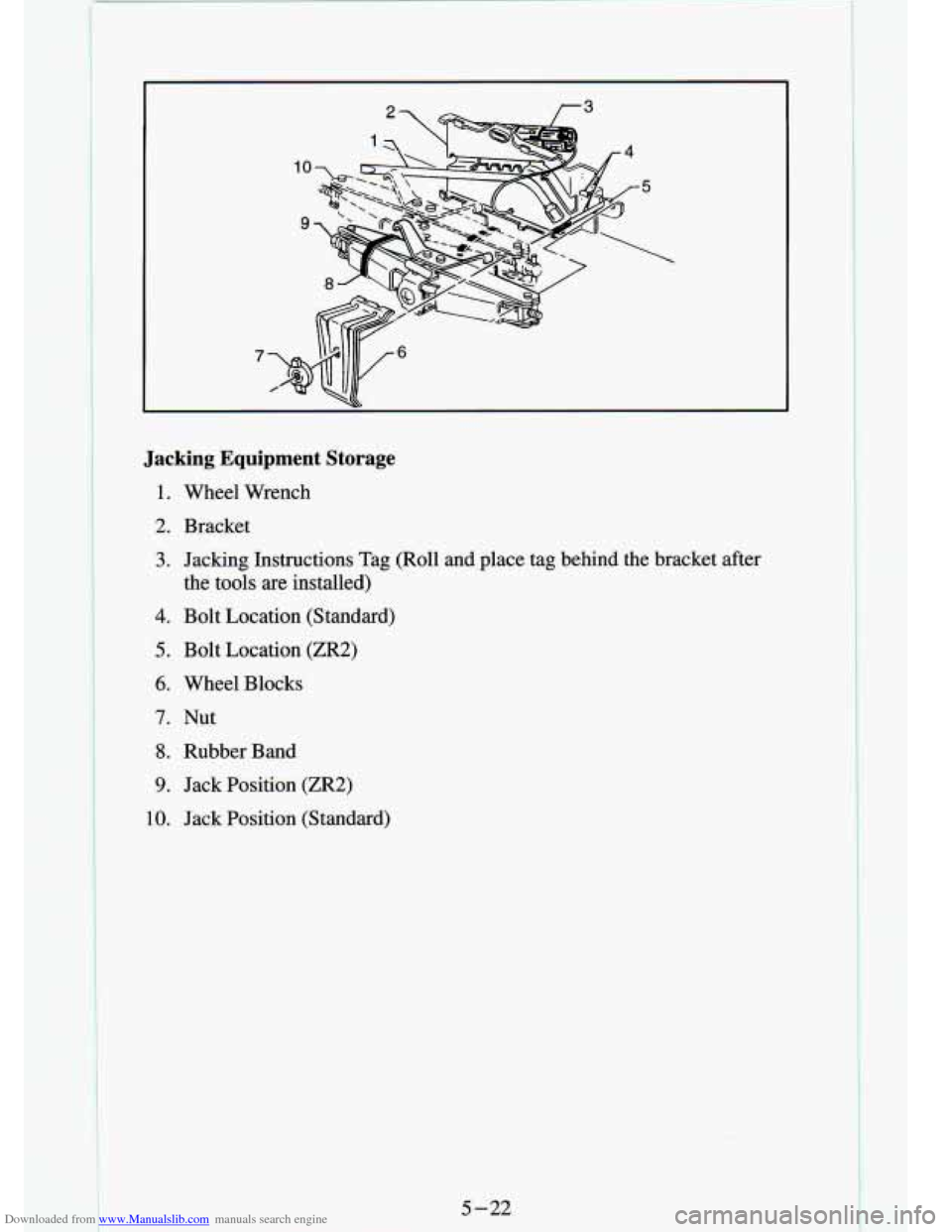
Jacking Equipment Storage
Wheel Wrench
Bracket
Jacking Instructions Tag (Roll and place tag behind the bracket after
the tools are installed)
Bolt Location (Standard)
Bolt Location
(ZR2)
Wheel Blocks
Nut Rubber Band
Jack Position
(ZR2)
Jack Position (Standard)
Page 208 of 340
Downloaded from www.Manualslib.com manuals search engine Changing the Tire
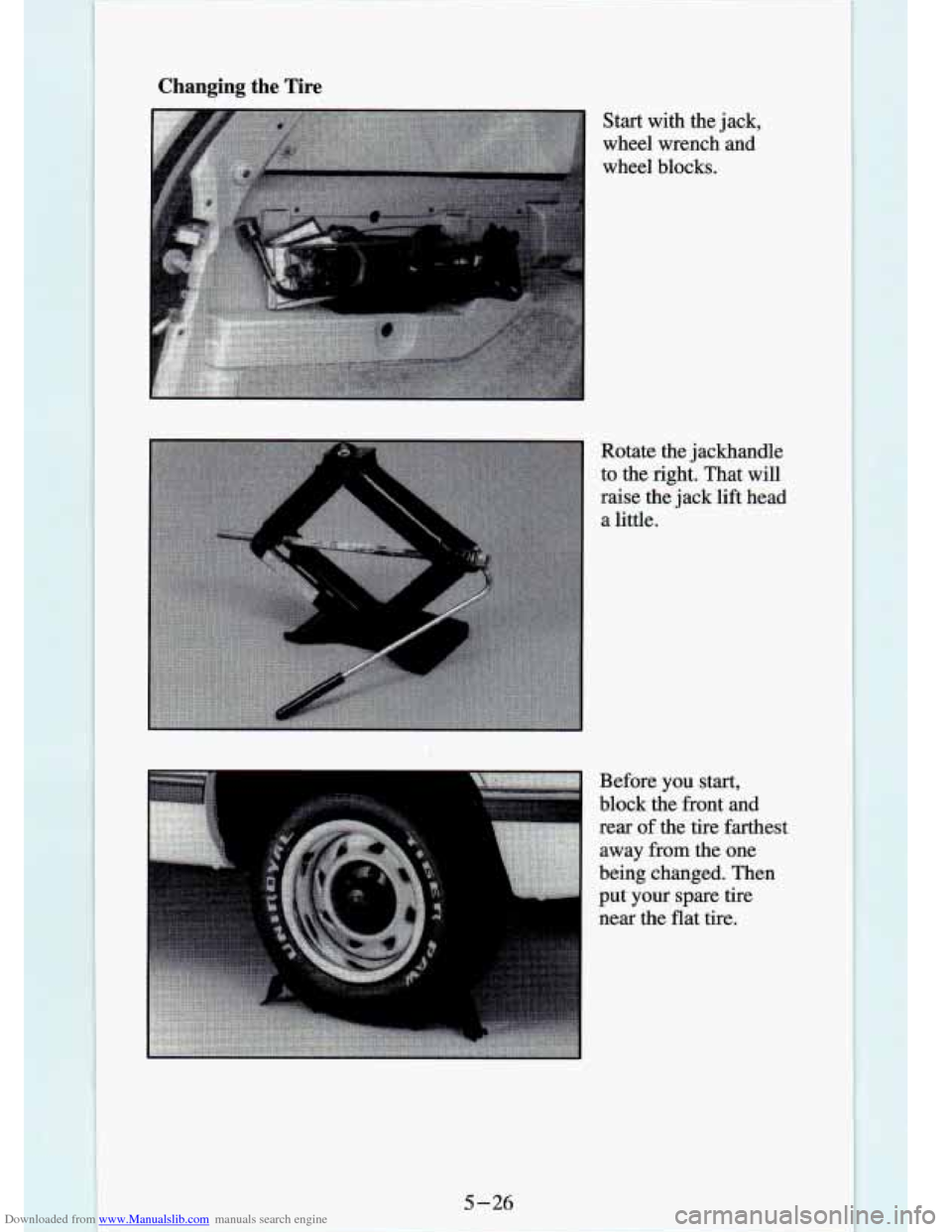
Start with the jack,
wheel wrench and
wheel blocks.
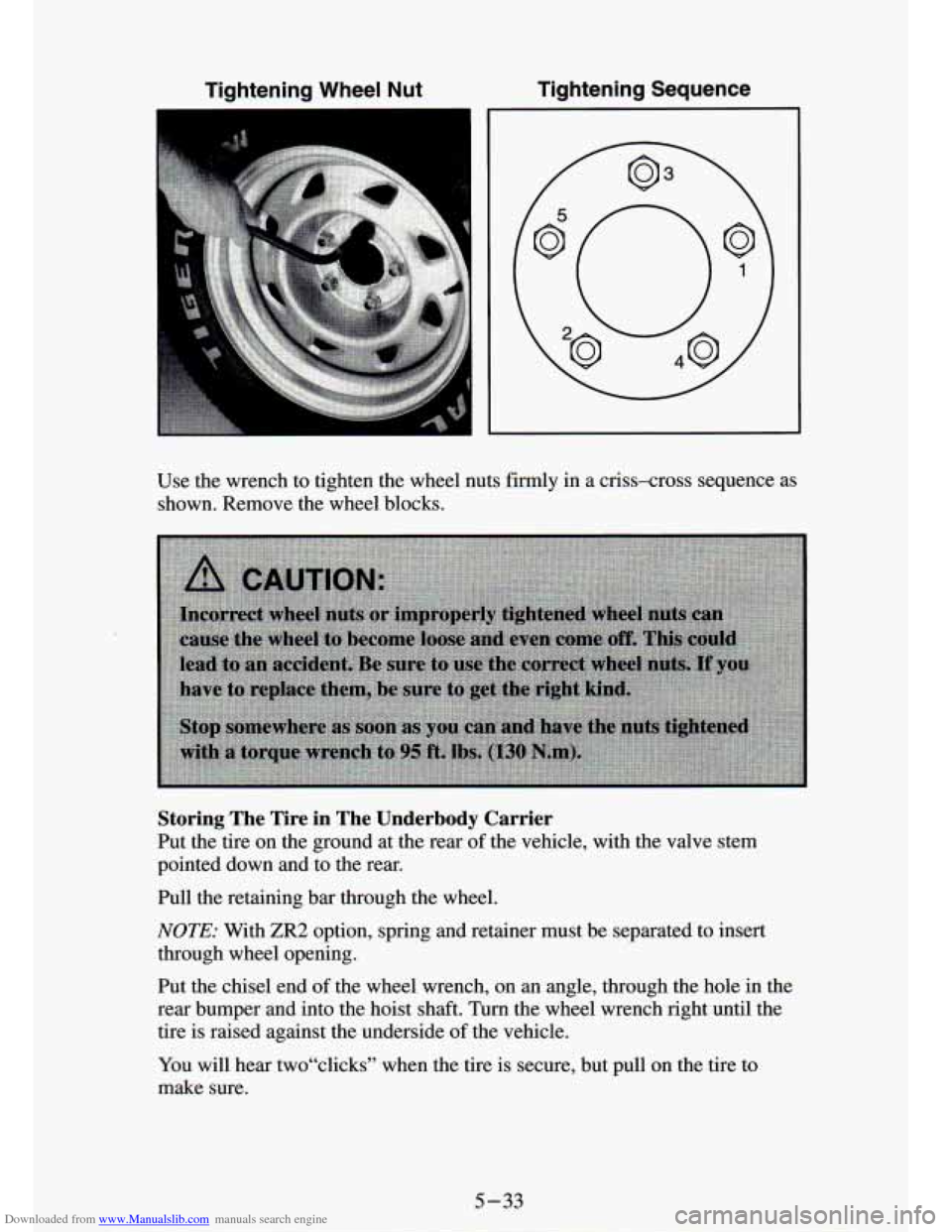
Rotate the jackhandle
to the right. That will
raise the jack lift head
a little.
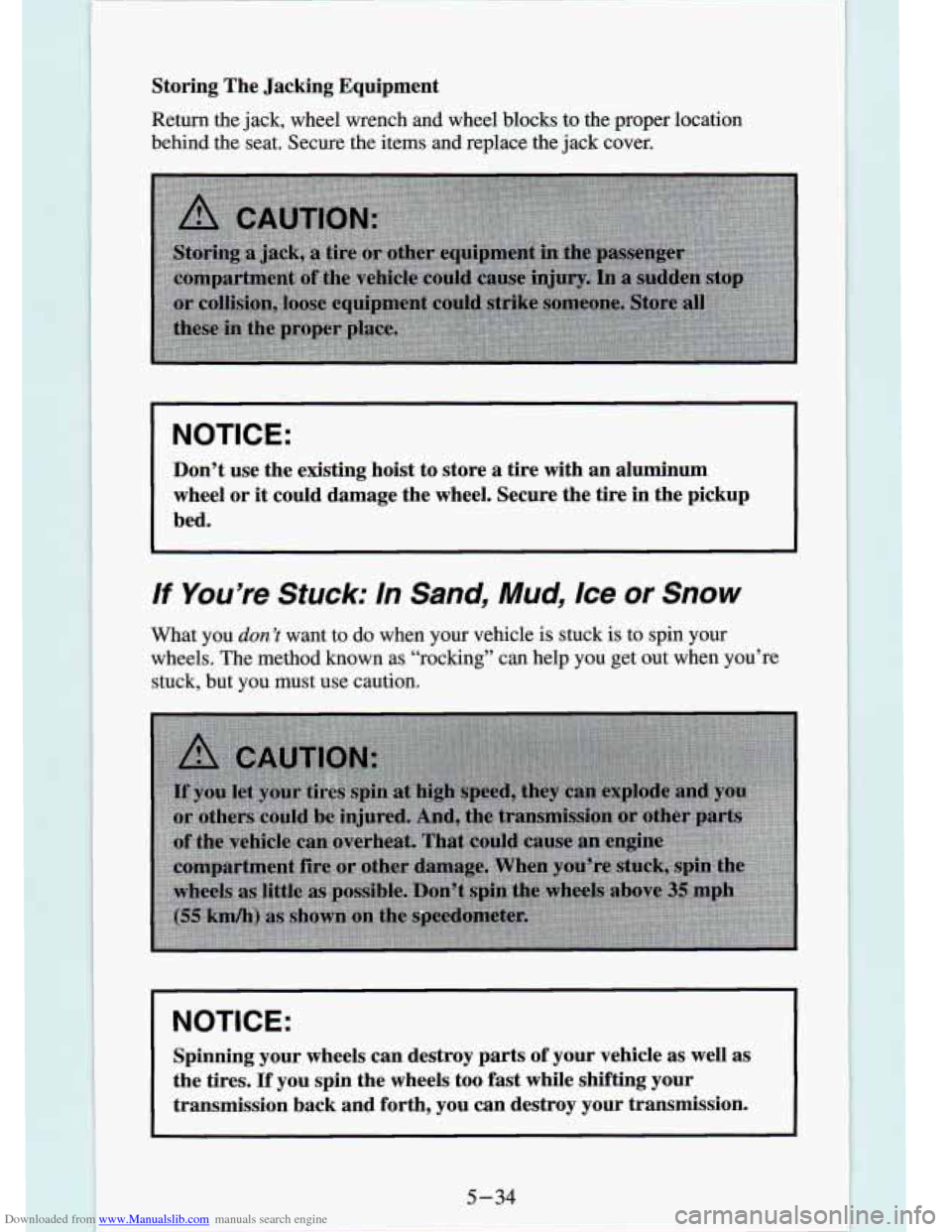
Before you start,
block the front and
rear of the tire farthest
away from the one
being changed. Then
put your spare tire
near the flat tire.
5-26
Page 215 of 340
Downloaded from www.Manualslib.com manuals search engine Tightening Wheel Nut Tightening Sequence
Use the wrench to tighten the wheel nuts firmly in a criss-cross sequence as
shown. Remove the wheel blocks.
Storing 'The Tire in The Underbody Carrier
Put the tire on the ground at the rear of the vehicle, with the valve stem
pointed down and to the rear.
Pull the retaining bar through the wheel.
NOTE: With ZR2 option, spring and retainer must be separated to insert
through wheel opening.
Put the chisel end
of the wheel wrench, on an angle, through the hole in the
rear bumper and into the hoist shaft. Turn the wheel wrench right until the
tire is raised against the underside
of the vehicle.
You will hear two"clicks" when the tire is secure, but pull on th\
e tire to
make sure.
5-33
Page 216 of 340
Downloaded from www.Manualslib.com manuals search engine Storing The Jacking Equipment
Return the jack, wheel wrench and wheel blocks to the proper location
behind the seat. Secure the items
and replace the jack cover.
NOTICE:
Don’t use the existing hoist to store a tire with an aluminum
wheel or it could damage the wheel. Secure the tire in the pickup
bed.
If You’re Stuck: In Sand, Mud, Ice or Snow
What you don’t want to do when your vehicle is stuck is to spin your
wheels. The method
known as “rocking” can help you get out when you’re
stuck, but
you must use caution.
NOTICE:
Spinning your wheels can destroy parts of your vehicle as well as
the tires.
If you spin the wheels too fast while shifting your
transmission back and forth, you can destroy your transmission.
5-34
Page 231 of 340
Downloaded from www.Manualslib.com manuals search engine Engine Oil Additives
Don’t add anything to your oil. Your GM dealer is ready to advise if you
think something should be added.
When to Change Engine Oil
See if any one of these is true for you:
Most trips are less than 4 miles (6 km).
0 It’s below freezing outside and most trips are less than 10 miles (16
km).
The engine is at low speed most of the time (as in door-to-door
delivery, or in stop-and-go traffic).
You tow a trailer often.
Most trips are through dusty places.
0 The vehicle is frequently operated off-road.
If any one of these is true for your vehicle, then you need to change your oil
andfilter every 3,000 miles (5 000 km) or 3 months - whichever comes
first.
If none of them is true, change the oil every
7,500 miles (12 500 km) or 12
months - whichever comes first. Change the filter at the first oil change
and at every other oil change after that.
Four-wheel Drive Remote Oil Filter
If your vehicle has four-wheel drive, you will have a remote oil filter
located under the radiator support. There is a special access \
door in the
vehicle body skirt shield.
Engine Coolant Heater (Engine Block Heater)
An engine coolant heater can be a big help if you have to park outside in
very cold weather,
0 “F (-1 8 O C) or colder. If your vehicle has this option,
see “Engine Coolant Heater
” in the Index.
What to Do with Used Oil
Did you know that used engine oil contains certain elements that may be
unhealthy for your skin and could even cause cancer? Don’t let used oil stay
on your skin for very long. Clean your skin and nails with soap and water,
or a good hand cleaner. Wash or properly throw away clothing or rags
containing wed engine oil. (See the manufacturer’s warnings about the use
and disposal of oil products.)
6-13