1994 CHEVROLET S10 lights
[x] Cancel search: lightsPage 172 of 340
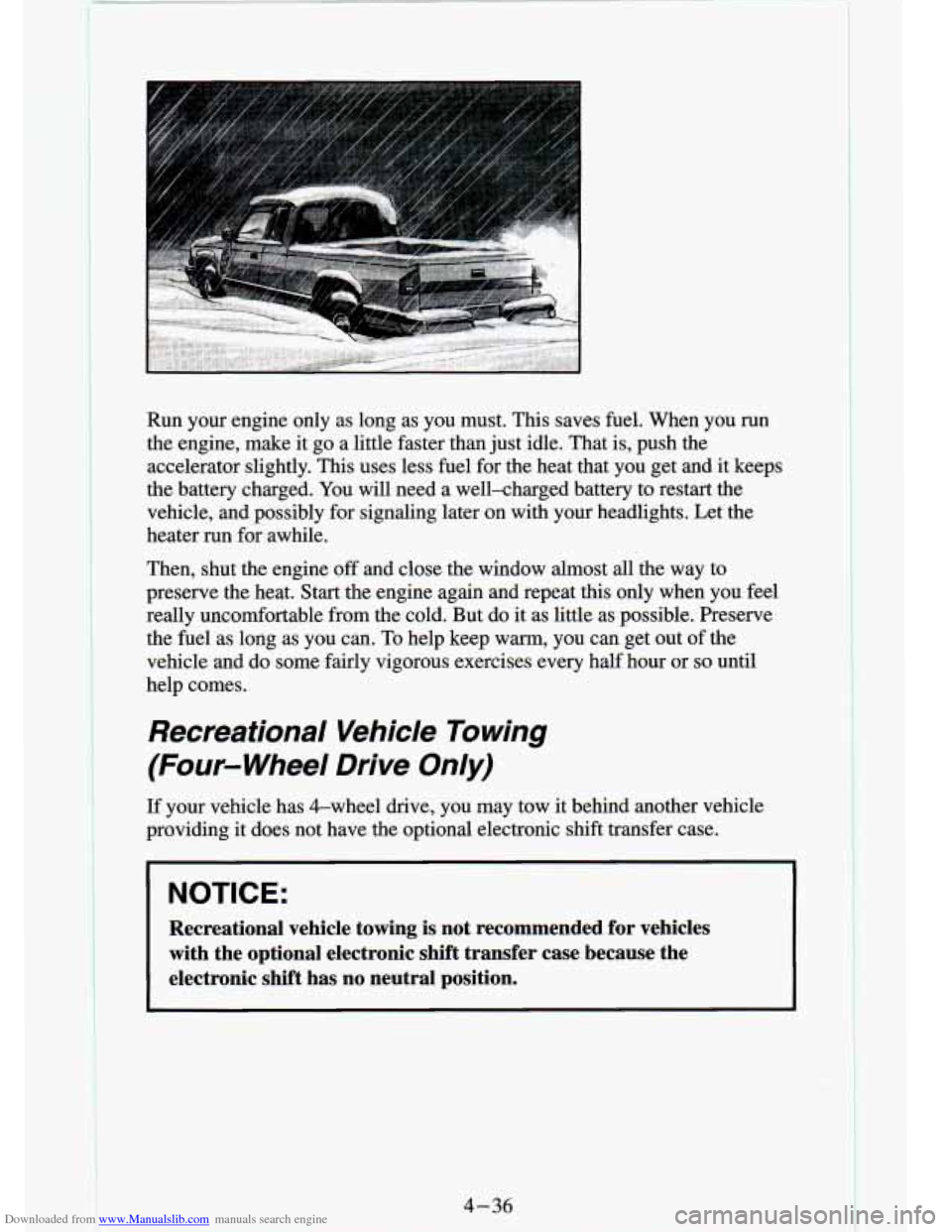
Downloaded from www.Manualslib.com manuals search engine Run your engine only as long as you must. This saves fuel. When you run
the engine, make it go a little faster than just idle. That is, push the
accelerator slightly. This uses less fuel for the heat that you get and it keeps
the battery charged. You will need a well-charged battery to restart the
vehicle, and possibly for signaling later on with your headlights. Let the
heater run for awhile.
Then, shut the engine off and close the window almost all the way to
preserve the heat. Start the engine again and repeat this only\
when you feel
really uncomfortable from the cold. But do it as little as possible. Preserve
the fuel as long as you can. To help keep warm, you can get out of the
vehicle and do some fairly vigorous exercises every half hour \
or
so until
help comes.
Recreational Vehicle Towing
(Four- Wheel Drive Only)
If your vehicle has &wheel drive, you may tow it behind another vehicle
providing it does not have the optional electronic shift transfer case.
NOTICE:
Recreational vehicle towing is not recommended for vehicles
with the optional electronic shift transfer case because the
electronic shift has no neutral position.
4-36
Page 177 of 340
Downloaded from www.Manualslib.com manuals search engine You can tow trailers to 2,000 pounds (900 kg) with a step bumper hitch, but
if your trailer tongue has a V-shaped foot, your bumper could be damaged
in sharp turns. Check the distance from the front edge of the foot to the
middle of the hitch ball socket.
If the distance is less than 12 inches, take the
foot
off the trailer tongue.
Safety Chains
You should always attach chains between your vehicle and your trail\
er.
Cross the safety chains under the tongue of the trailer
so that the tongue will
not drop
to the road if it becomes separated from the hitch. Instructions
about safety chains may be provided by the hitch manufacturer \
or by the
trailer manufacturer. Follow the manufacturer’s recommendation for
attaching safety chains. Always leave just enough slack
so you can turn with
your rig. And, never allow safety chains to drag
on the ground.
Trailer Brakes
If your trailer weighs more than 1,000 pounds (450 kg) loaded, then it needs
its own brakes
- and they must be adequate. Be sure to read and follow the
instructions for the trailer bE---:s
so you’ll be able to install, adjust and
maintain them properly.
Your trailer brakes system can tap into vehicle’s hydraulic brake system
except:
Don’t tap into your vehicle’s brake system if the trailer’s brake system will
use more than
0.02 cubic inch (0.3~~) of fluid from your vehicle’s master
cylinder. If it does, both braking systems won’t work well. You could even
lose your brakes.
Will the trailer parts take
3,000 psi (20 650 Pa) of pressure? If not, the
trailer brake system must not be used with your vehicle.
If everything checks out this far, then make the brake fluid tap at the port on
the master cylinder that sends fluid to the rear brakes. But don’t use copper
tubing for this.
If you do, it will bend and finally break off. Use steel brake
tubing.
Driving with a Trailer
Towing a trailer requires a certain amount of experience. Before setting out
for the open road, you’ll want to get to know your rig. Acquai\
nt yourself
with the feel
of handling and braking with the added weight of the trailer.
And always keep
in mind that the vehicle you are driving is now a good
deal longer and not nearly
so responsive as your vehicle is by itself.
Before you start, check the trailer hitch and platform, safety chains,
electrical connector, lights, tires and mirror adjustment. If th\
e trailer has
electric brakes, start your vehicle and trailer moving and then\
apply the
4-41
Page 178 of 340
Downloaded from www.Manualslib.com manuals search engine trailer brake controller by hand to be sure the brakes are working. This lets
you check your electricql connection at the same time.
During your trip, check occasionally to be sure that the load \
is secure, and
that the lights and any trailer brakes
are still working.
Following Distance
Stay at least twice as far behind the vehicle ahead as you would when
driving your vehicle without a trailer. This can help you avoid situations \
that
require heavy braking apd sudden turns.
Passing
You’ll need more passing distance up ahead when you’re to\
wing a trailer.
And, because you’re a good deal longer, you’ll need to g\
o much farther
beyond the passed vehicle before you can return to your lane. \
Backing Up
Hold the bottom of the steering wheel with one hand. Then, to move the
trailer to the left, just move that hand to the left. To move the trailer to the
right, move your hand to the right. Always back up slowly and\
, if possible,
have someone guide you.
Making Turns
When you’re turning with a trailer, make wider turns than n\
ormal. Do this
so your trailer won’t strike soft shoulders, curbs, road signs, \
trees, or other
objects. Avoid jerky or sudden maneuvers. Signal well in advance.
Turn Signals When Towing a Trailer
When you tow a trailer, your vehicle has to have a different \
turn signal
flasher and extra wiring. The green arrows on your instrument panel wi\
ll
flash whenever you signal a turn or lane change. Properly hooked up, the
trailer lights will also flash, telling other drivers you’re \
about
to turn,
change lanes or stop.
When towing a trailer, the green arrows on your instrument pan\
el will flash
€or
turns even if the bulbs on the trailer are burned out. Thus, you may think
drivers behind you are seeing your signal when they are not. It’s importan\
t
to check occasionally to be sure the trailer bulbs are still \
working.
4-42
Page 184 of 340
Downloaded from www.Manualslib.com manuals search engine Hazard Warning Flashers
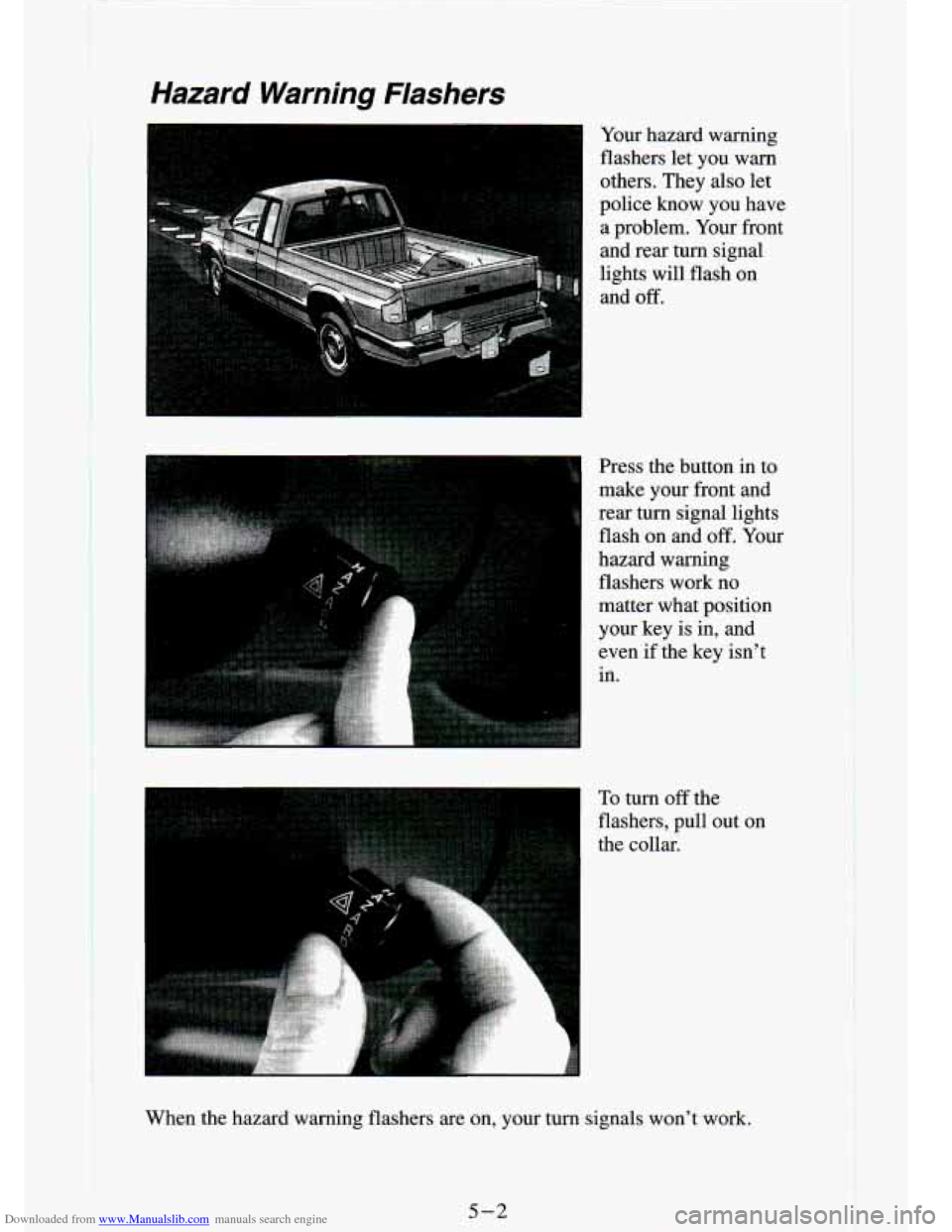
-1 Your hazard warning
flashers let you warn
others. They also let
and
off.
I police know you have a problem. Your front
and rear turn signal
lights will flash on
Press the button in to
make your front and
rear
turn signal lights
flash on and off. Your
hazard warning
flashers work no
matter what position
your key is in, and
even if the key isn’t
in.
To turn off the
flashers, pull out
on
the collar:
When the hazard warning flashers are
on, your turn signals won’t work.
Page 186 of 340

Downloaded from www.Manualslib.com manuals search engine I E
To Jump Start Your Vehicle:
1. Check the other vehicle. It must have a 12-volt battery wlm a\
negauve
ground system.
NOTICE:
If the other system isn’t a 12-volt system with a negative \
ground, both vehicles can be damaged.
2. Get the vehicles close enough so the jumper cables can reach, but be
sure the vehicles aren’t touching each other. If they are, it could cause
a
ground connection you don’t want. You wouldn’t be able to start your
vehicle, and the bad grounding could damage the electrical syst\
ems.
You could be injured if the vehicles roll, Set the parking brake
firmly
on each vehicle. Put an automatic transmission in “P” (Park)\
or a
manual transmission
in “N’ (Neutral). If you have a four-wheel drive
vehicle with
a manual transfer case shift lever, be sure the transfer case
is not in “N’ (Neutral).
3. Turn off the ignition on both vehicles. Turn off all lights t\
hat aren’t
needed, and radios. This will avoid sparks and help save both batteries.
And it could save your radio!
I NOTICE:
I
If you leave your radio on, it could be badly damaged. The
repairs wouldn’t be covered by your warranty.
4. Open the hoods and locate the batteries. Find the positive (+) and
negative
(-) terminals on each battery.
5-4
I
Page 241 of 340
, add enou\
gh lubricant
to raise the level to the bottom of the filler")
Downloaded from www.Manualslib.com manuals search engine If the differential is at operating temperature (w,arm), add enou\
gh lubricant
to raise the level to the bottom of the filler plug hole.
If the differential is cold, add enough lubricant to raise the level to 1/2 inch
(12
mm) below the filler plug hole.
What to use
Refer to the Maintenance Schedule to determine what kind of lubricant to
use. See “Recommended Fluids and Lubricants” in the Index.
Engine Coolant
The following explains your cooling system and how to add coolant \
when it
is low.
If you have a problem with engine overheating, see “Engine
Overheating” in the Index.
The proper coolant for your vehicle will:
Give freezing protection down to -20 “F (-29” C), or -34°F (-37 “C) in
Canada and for vehicles with the cold climate option.
e Give boiling protection up to 258°F (125°C).
Protect against rust and corrosion.
Help keep the proper engine temperature.
Let the warning lights and gages work as they should.
What to Use
Use a mi,xture of one-half clean water (preferably distilled) and one-half
antifreeze that meets “GM Specification 603%” or “GM Specification
6043-M ”for the 2.2L (LN2) Code 4 engine, which won’t damage
aluminum parts. You can also use
a recycled coolant conforming to “GM
Specification 603%” or “GM Specification 6043-M ”for the 2.2L (LN2)
Code 4 engine with a complete coolant flush and refill.
If you use this
mixture, you don’t need to add anything else.
6-23
Page 251 of 340
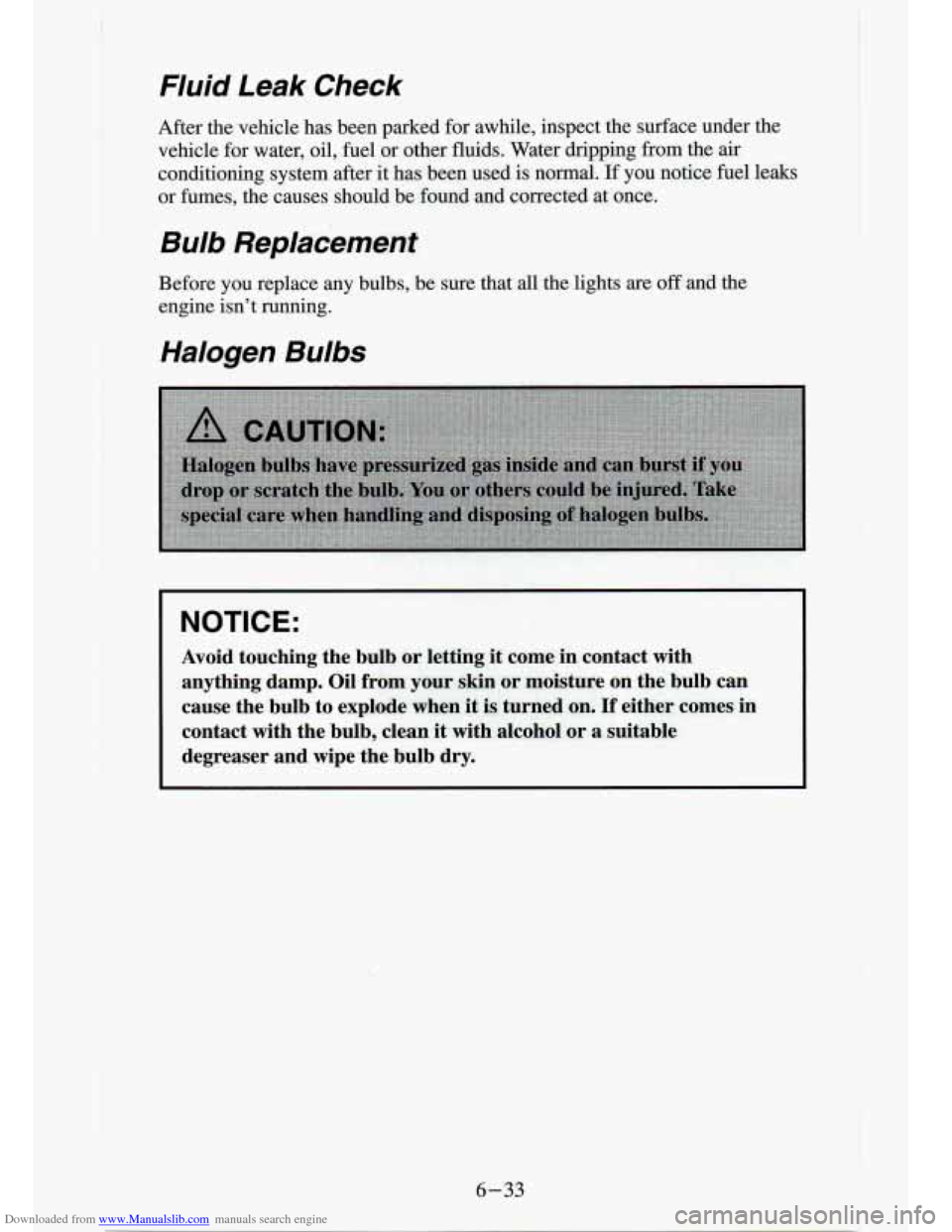
Downloaded from www.Manualslib.com manuals search engine Fluid Leak Check
After the vehcle has been parked for awhile, inspect the surface under the
vehicle
for water, oil, fuel OX other fluids. Water dripping from the air
conditioning system after it has been used is normal. If you notice fuel leaks
or fumes, the causes should be found and corrected at once.
Bulb Replacement
Before you replace any bulbs, be sure that all the lights are off and the
engine isn’t running.
Halogen Bulbs
NOTICE:
Page 252 of 340
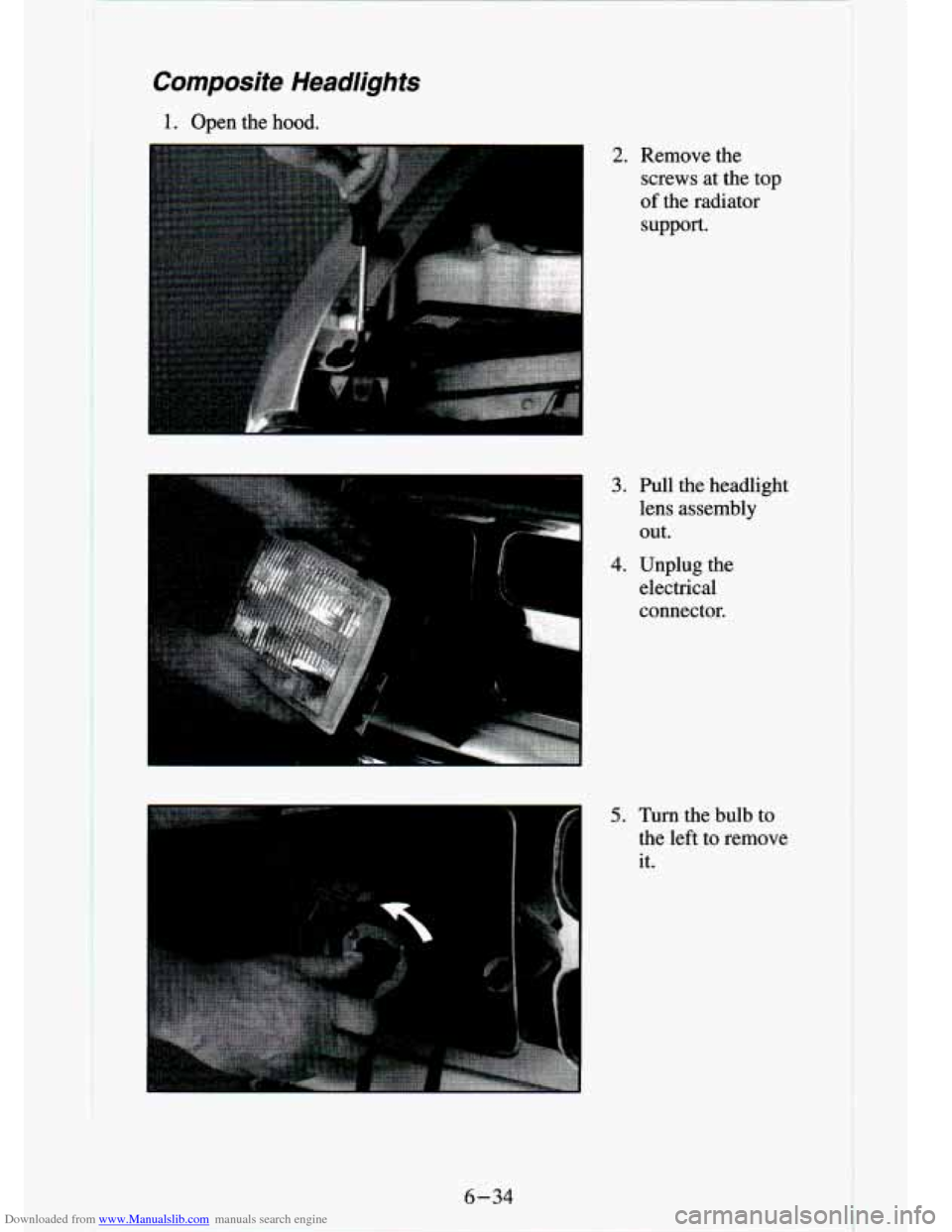
Downloaded from www.Manualslib.com manuals search engine Composite Headlights
1. Open the hood.
2. Remove the screws at the top
of the radiator
support.
3. Pull the headlight
lens assembly
out.
4. Unplug the
electrical
connector.
1 5. Turn the bulb to
6-34