Page 111 of 340
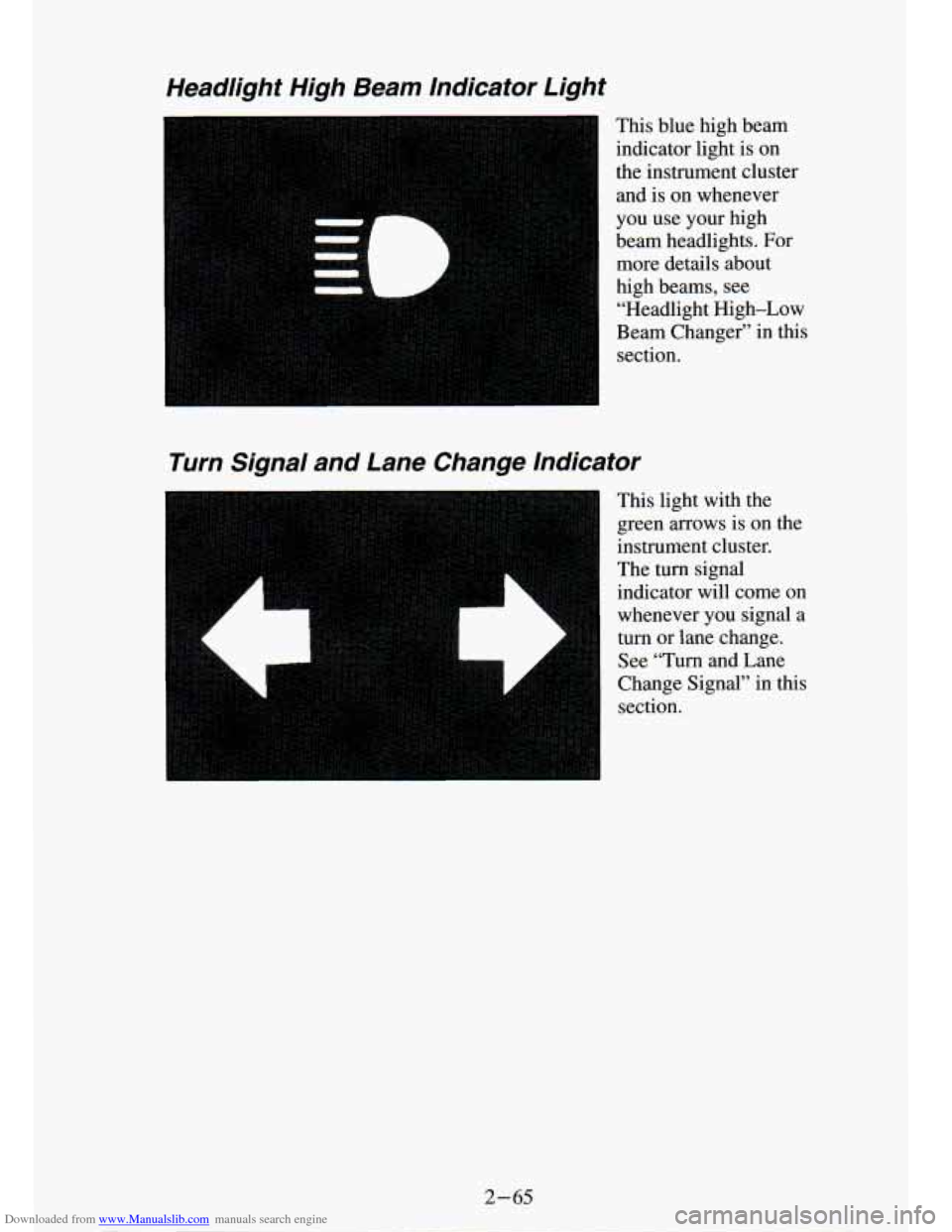
Downloaded from www.Manualslib.com manuals search engine Headlight High Beam Indicator Light
This blue high beam
indicator light
is on
the instrument cluster and is on whenever
you use your high
beam headlights. For
more details about
high beams, see
“Headlight High-Low
Beam Changer” in this
section.
Turn Signal and Lane Change Indicator
instrument cluster.
The turn signal indicator will come on
whenever you signal a
turn or lane change.
See “Turn and Lane
Change Signal” in this
section.
2-65
Page 154 of 340
Downloaded from www.Manualslib.com manuals search engine Driving Uphill
Once you decide you can safely drive up the hill, you need t\
o take some
special steps.
Use a low gear and get a firm grip on the steering wheel.
Get a smooth start up the hill and try to maintain your spee\
d. Don’t use
more power than you need, because you don’t want your wheel\
s to start
spinning or sliding.
turns, you might want to find another route.
Try to drive straight up the hill if at all possible. If the path twists and
Ease up on your speed as you approach the top of the hill.
Attach a flag to the vehicle to make you more visible to approaching
Sound the horn as you approach the top of the hill to let opposing
traffic on trails or hills.
traffic know you’re there.
Use your headlights even during the day. They make you more v\
isible
to oncoming traffic.
..
4- 18
Page 161 of 340
Downloaded from www.Manualslib.com manuals search engine After Off-Road Driving
Remove any brush or debris that has collected on the underbody, chassis or
under the hood. These accumulations can be a fire hazard.
After operation in mud or sand, have the brake linings cleaned and checked.
These substances can cause glazing and uneven braking. Check th\
e body structure, steering, suspension, wheels, tires, and exhaust syste\
m for
damage. Also, check the fuel lines and cooling system for any leakage.
Your vehicle will require more frequent service due to off-road use.\
Refer
to the Maintenance Schedule booklet for additional information.
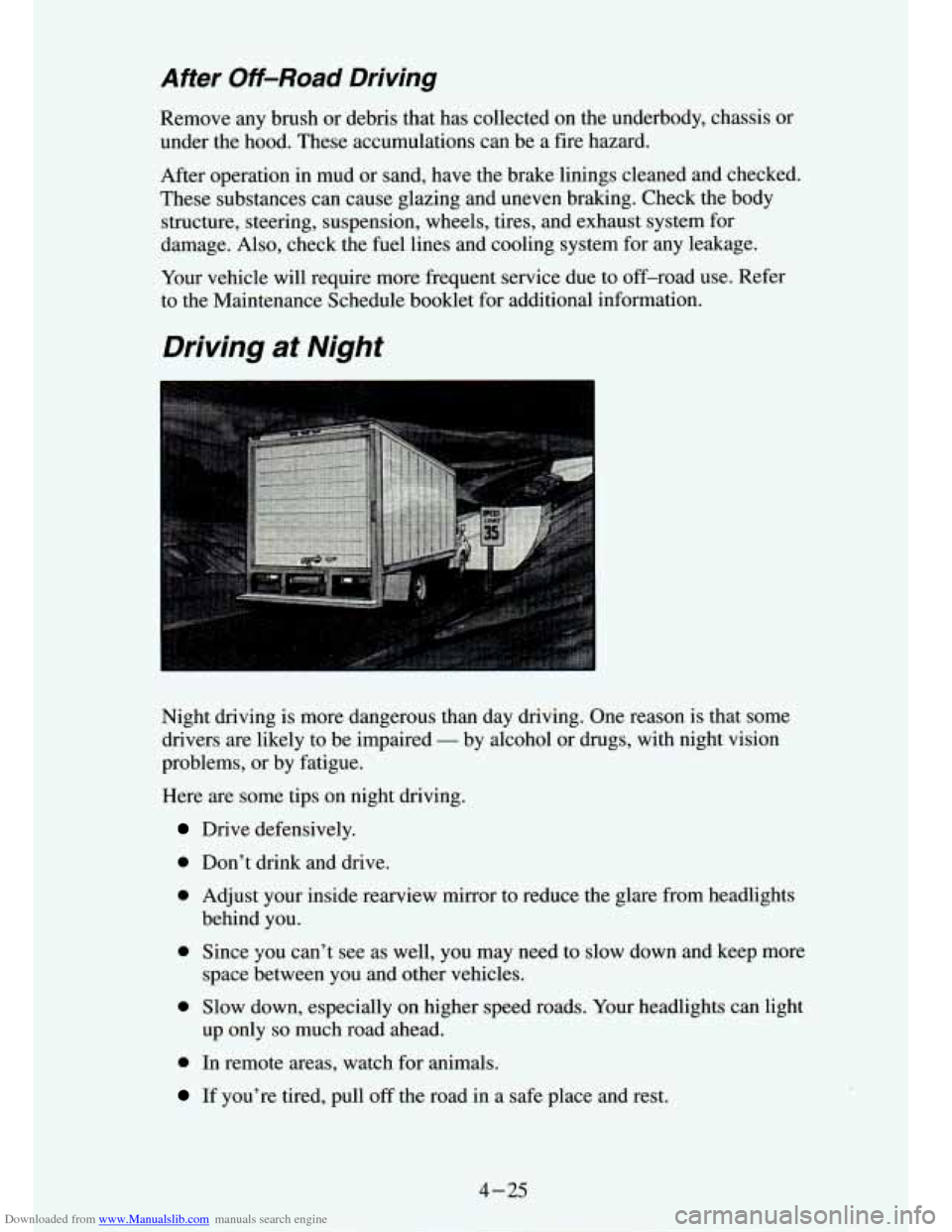
Driving at Night
Night driving is more dangerous than day driving. 0 ne reason is that some
drivers are likely to be impaired
- by alcohol or drugs, with night vision
problems,
or by fatigue.
Here are some tips on night driving.
Drive defensively.
0 Don’t drink and drive.
0 Adjust your inside rearview mirror to reduce the glare from ndlights
behind you.
0 Since you can’t see as well, you may need to slow down and keep more
0 Slow down, especially on higher speed roads. Your headlights can light
space between you and other vehicles.
up only
so much road ahead.
0 In remote areas, watch for animals.
If you’re tired, pull off the road in a safe place and rest.
4-25
Page 162 of 340
Downloaded from www.Manualslib.com manuals search engine -- I’
I
Night Vision
No one can see as well at night as in the daytime. But as we get older these
differences increase. A 50-year4d driver may require at least twice as
much light to see the same thing at night as a 20-year-old.
What you do in the daytime can also affect your night vision.\
For example,
if you spend the day in bright sunshine you are wise to wear sunglasses.
Your eyes will have less trouble adjusting to night. But if you’re driving,
don’t wear sunglasses at night. They may cut down on glare \
from
headlights, but they also make a lot of things invisible.
You can be temporarily blinded by approaching lights. It can take a second
or two, or even several seconds, for your eyes to readjust to the dark. When
you are faced with severe glare (as from a driver who doesn’\
t lower the high
beam, or a vehicle with misaimed headlights), slow down a little. A\
void
staring directly into the approaching lights.
Keep your windshield and all the glass on your vehicle clean
- inside and
out. Glare at night is made much worse by dirt on the glass. Even the inside
of the glass can build up a film caused by dust. Dirty glass makes lights
dazzle and flash more than clean .glass would, making the pupils of your
eyes contract repeatedly.
Remember that your headlights light up far less of a roadway when you
are
in a turn or curve. Keep your eyes moving; that way, it’s \
easier to pick out
dimly lighted objects. Just as your headlights should be checked regularly
for proper aim,
so should your eyes be examined regularly. Some drivers
suffer from night blindness
- the inability to see in dim light - and aren’t
even aware of it.
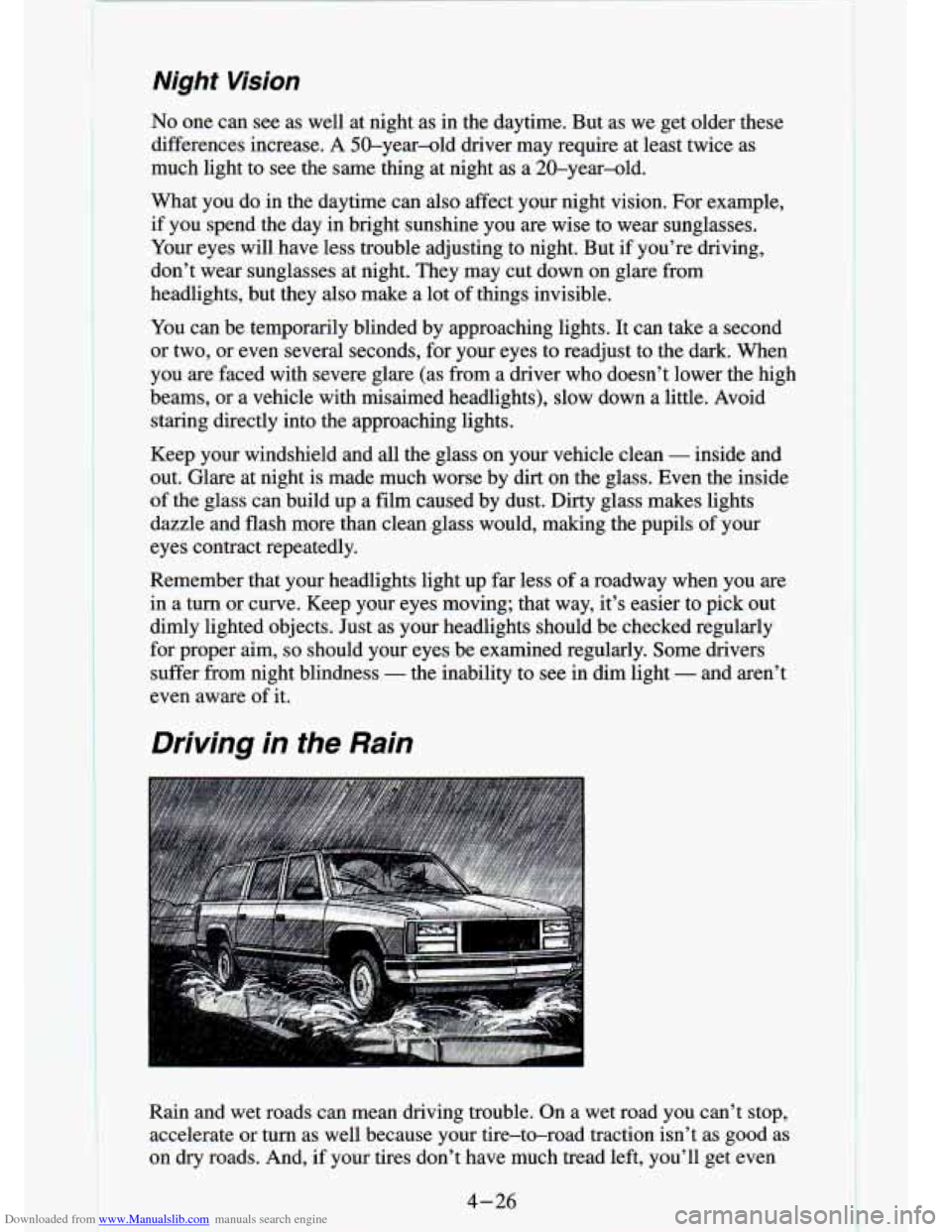
Driving in the Rain
Rain and wet roads can mean driving trouble. On a wet road you can’t st\
op,
accelerate or
turn as well because your tire-to-road traction isn’t as good as
on dry roads. And, if your tires don’t have much tread left, you’ll get even
4-26
Page 164 of 340
Downloaded from www.Manualslib.com manuals search engine Hydroplaning doesn’t happen often. But it can if your tires haven’t much
tread or
if the pressure in one or more is low. It can happen if a lot of water
is standing
on the road. If you can see reflections from trees, telephone
poles, or other vehicles, and raindrops “dimple” the water’s surfa\
ce, there
could be hydroplaning.
Hydroplaning usually happens at higher speeds. There just isn’t a hard and
fast rule about hydroplaning. The best advice
is to slow down when it is
raining.
Some Other Rainy Weather Tips
0 Turn on your low-beam headlights - not just your parking lights - to
help make you more visible to others.
Besides slowing down, allow some extra following distance. And \
be
especially careful when you pass another vehicle. Allow yourself more
clear room ahead, and be prepared to have your
view restricted by road
spray.
Have good tires with proper tread depth. (See “Tires” in\
the Index.)
City Driving
I
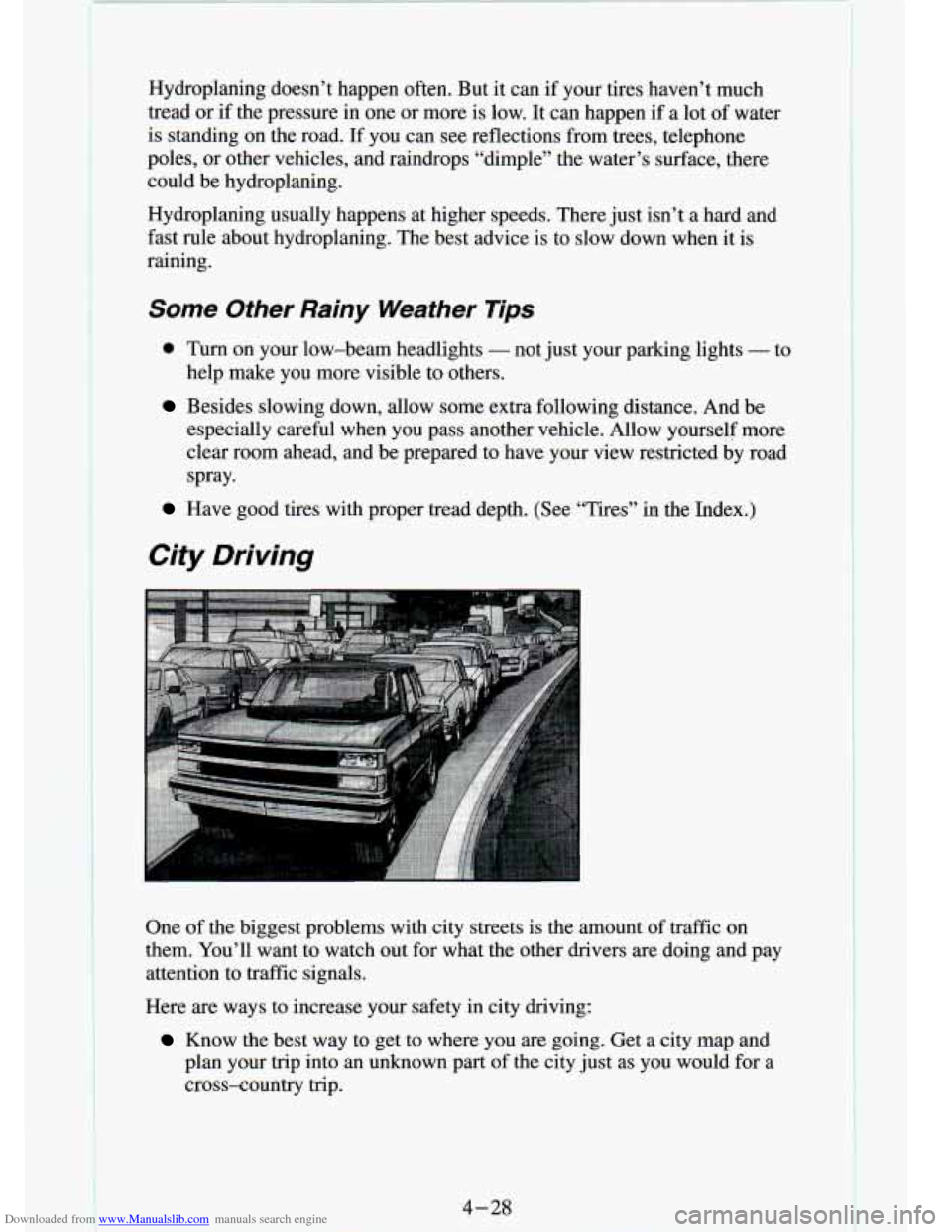
One of the biggest problems with city streets is the amount of traffic on
them. You’ll want
to watch out for what the other drivers are doing and pay
attention to traffic signals.
Here are ways to increase your safety
in city driving:
Know the best way to get to where you are going. Get a city\
map and
plan your trip into an unknown part of the city just as you would for
a
cross-country trip.
4-28
E
Page 172 of 340
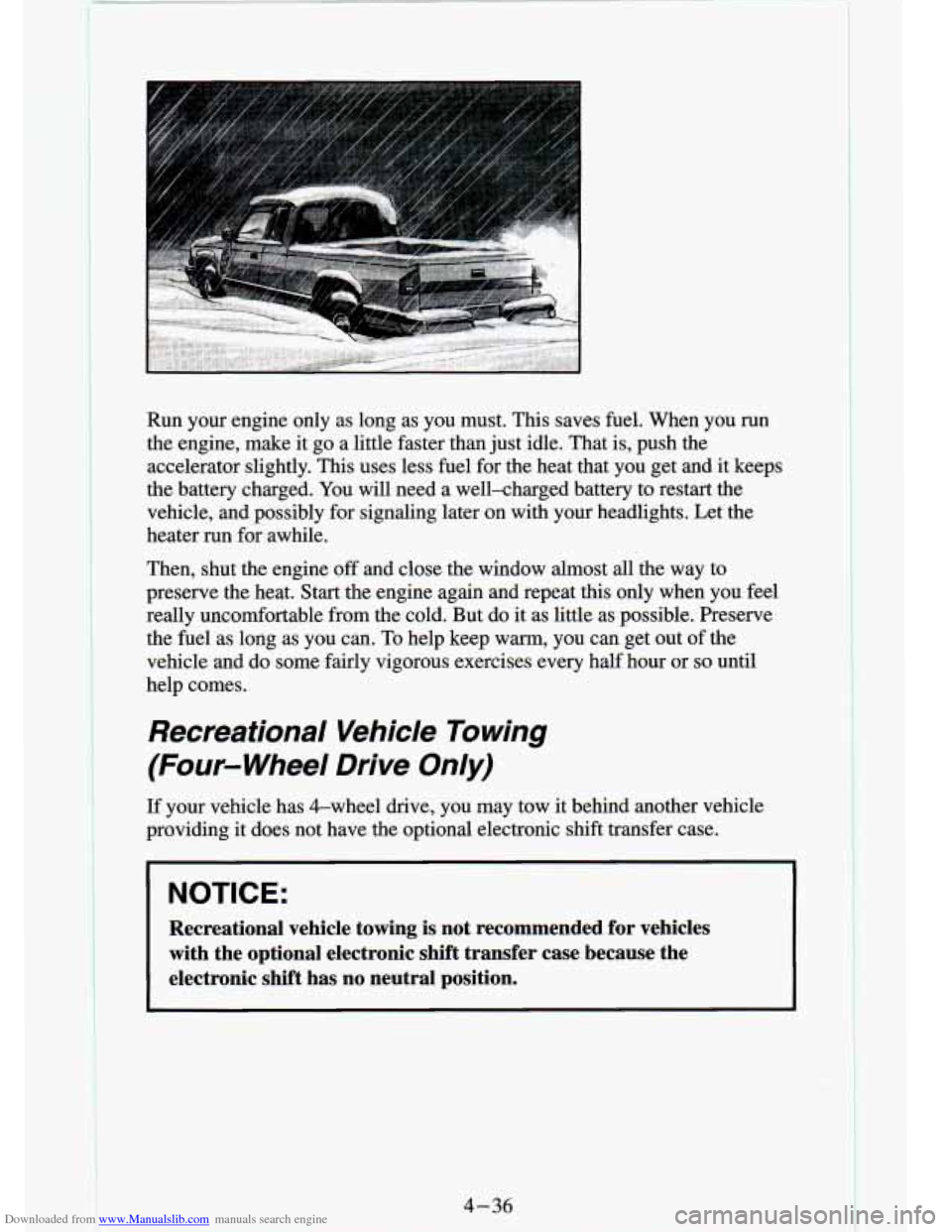
Downloaded from www.Manualslib.com manuals search engine Run your engine only as long as you must. This saves fuel. When you run
the engine, make it go a little faster than just idle. That is, push the
accelerator slightly. This uses less fuel for the heat that you get and it keeps
the battery charged. You will need a well-charged battery to restart the
vehicle, and possibly for signaling later on with your headlights. Let the
heater run for awhile.
Then, shut the engine off and close the window almost all the way to
preserve the heat. Start the engine again and repeat this only\
when you feel
really uncomfortable from the cold. But do it as little as possible. Preserve
the fuel as long as you can. To help keep warm, you can get out of the
vehicle and do some fairly vigorous exercises every half hour \
or
so until
help comes.
Recreational Vehicle Towing
(Four- Wheel Drive Only)
If your vehicle has &wheel drive, you may tow it behind another vehicle
providing it does not have the optional electronic shift transfer case.
NOTICE:
Recreational vehicle towing is not recommended for vehicles
with the optional electronic shift transfer case because the
electronic shift has no neutral position.
4-36
Page 252 of 340
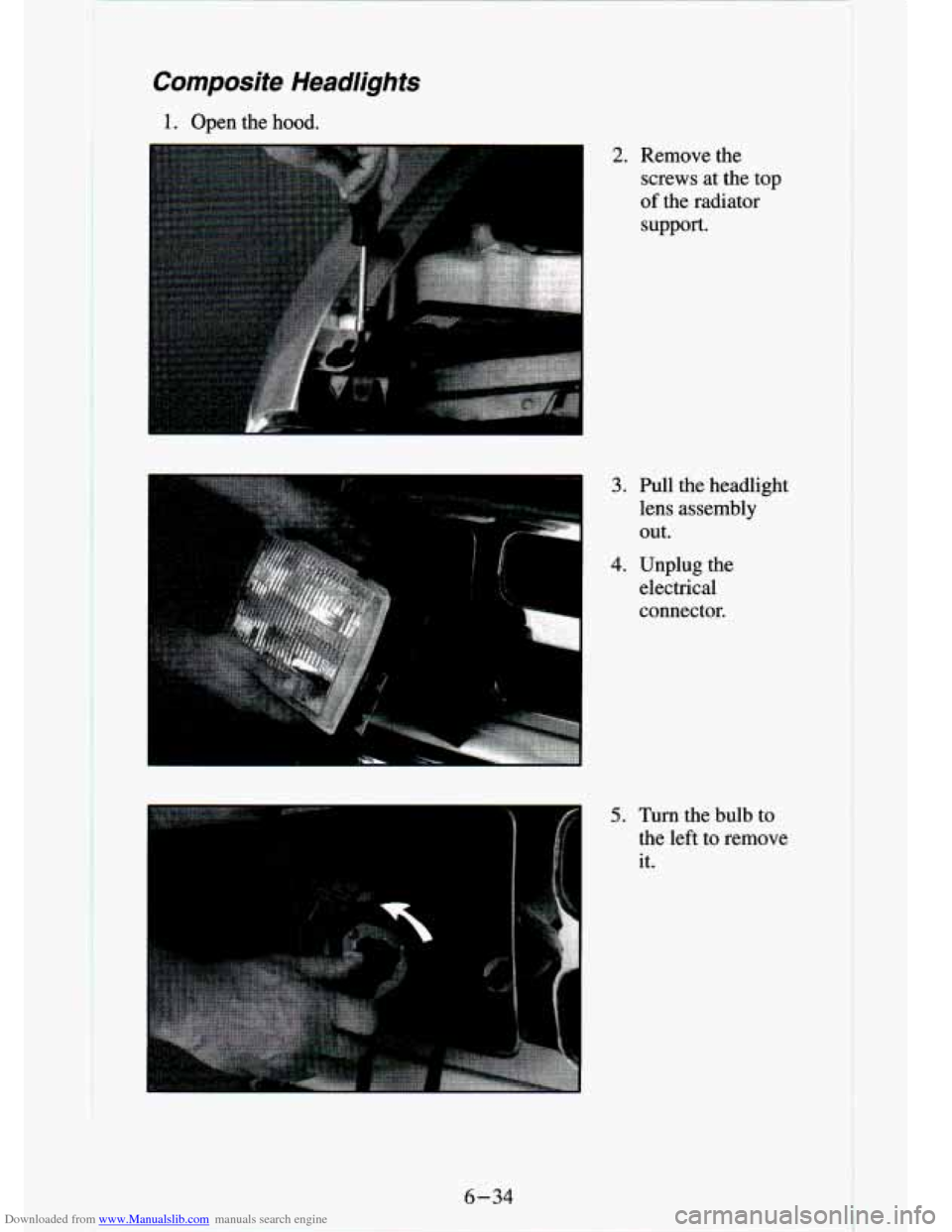
Downloaded from www.Manualslib.com manuals search engine Composite Headlights
1. Open the hood.
2. Remove the screws at the top
of the radiator
support.
3. Pull the headlight
lens assembly
out.
4. Unplug the
electrical
connector.
1 5. Turn the bulb to
6-34
Page 253 of 340
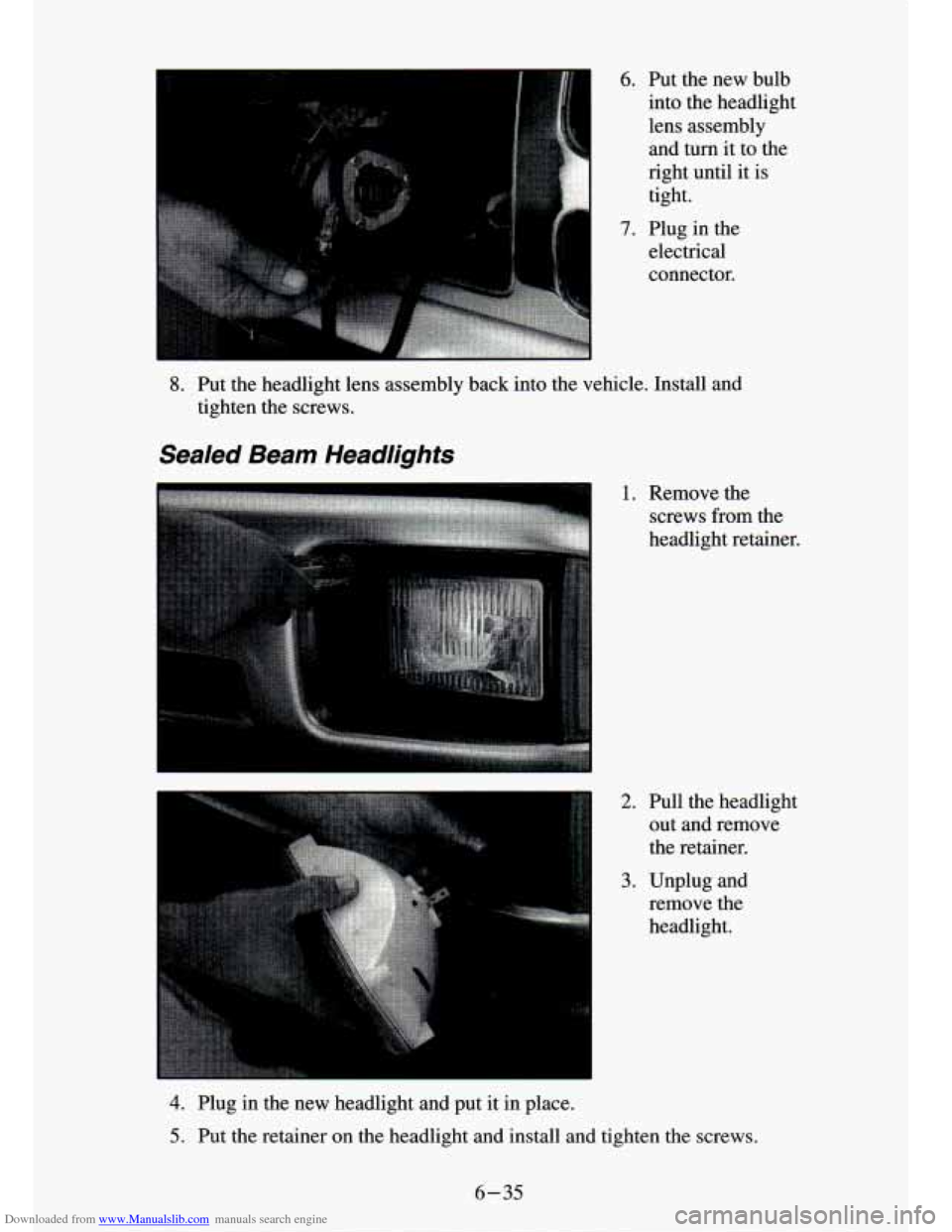
Downloaded from www.Manualslib.com manuals search engine 6. Put the new bulb
into the headlight
lens assembly
and turn it to the
right until
it is
tight.
7. Plug in the electrical
connector.
8. Put the headlight lens assembly back into the vehicle. Install and
tighten the screws.
Sealed Beam Headlights
1. Remove the
screws from the
headlight retainer.
2. Pull the headlight
out
and remove
the retainer.
3. Unplug and
remove the
headlight.
4. Plug in the new headlight and put it in place.
5. Put the retainer on the headlight and install and tighten the \
screws.
6-35