1994 CHEVROLET CORVETTE transmission fluid
[x] Cancel search: transmission fluidPage 137 of 274
Downloaded from www.Manualslib.com manuals search engine Your Driving and the Road
What can you do about highway
hypnosis? First, be aware that
it can
happen.
Then here are some tips:
0 Make sure your vehicle is well
ventilated, with a comfortably cool
interior.
0 Keep your eyes moving. Scan the road
ahead and to the sides. Check your
rearview mirrors and your instruments
frequently.
0 If you get sleepy, pull off the road into
a rest, service, or parking area and
take a nap, get some exercise, or both.
For safety, treat drowsiness on
the
highway as an emergency.
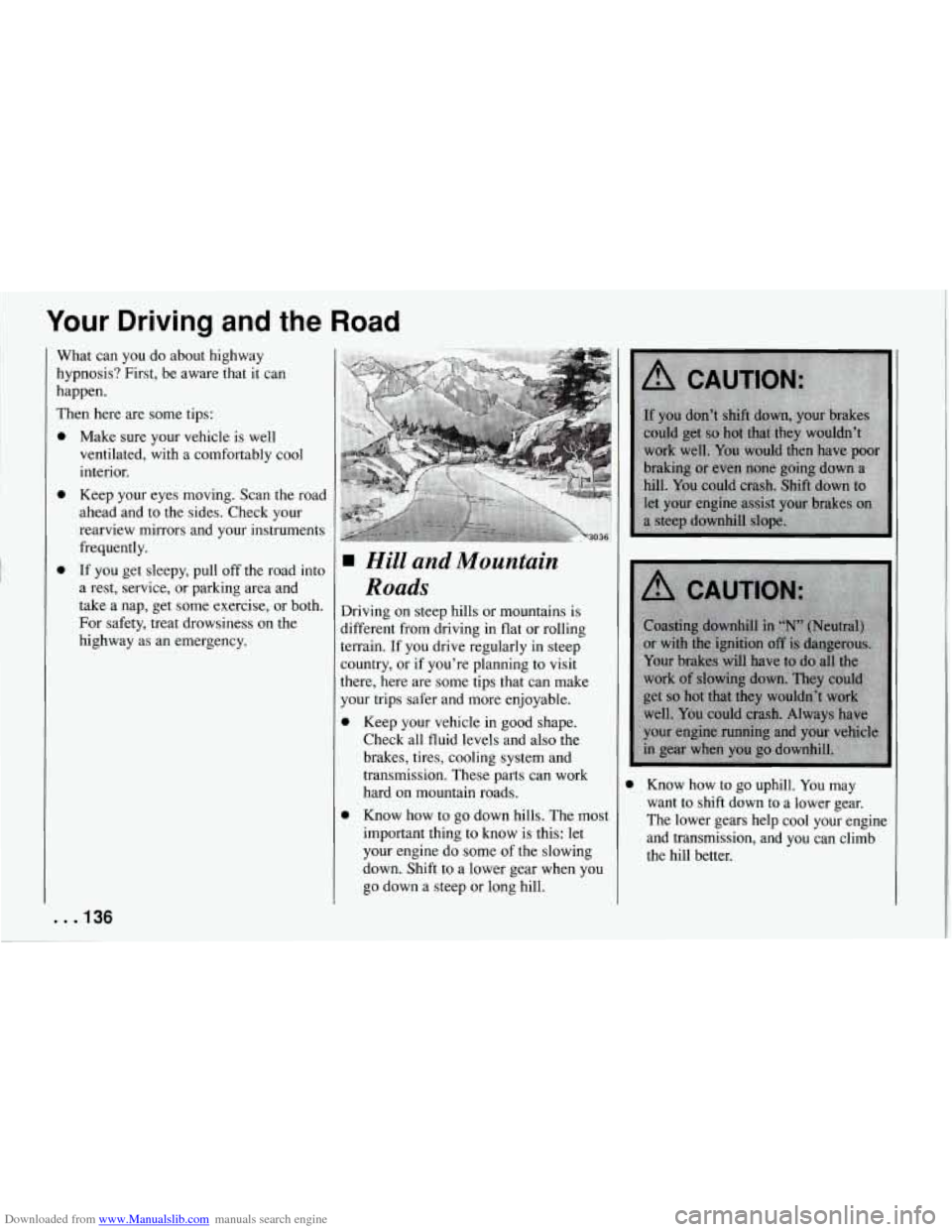
Hill and Mountain
Roads
Driving on steep hills or mountains is
jifferent from driving in flat or rolling
terrain. If you drive regularly in steep
zountry, or if you’re planning to visit there, here are some tips that can make
your trips safer and more enjoyable.
Keep your vehicle in good shape.
Check all fluid levels and also the
brakes, tires, cooling system and
transmission. These parts can work
hard on mountain roads.
Know how to go down hills. The most
important thing to know is this: let
your engine do some
of the slowing
down. Shift to a lower gear when you
go down a steep or long hill.
0 Know how to go uphill. You may
want to shift down to a lower gear.
The lower gears help cool your engine and transmission, and you can climb
the hill better.
. . .136
Page 172 of 274

Downloaded from www.Manualslib.com manuals search engine Here you will find information
about the care of your Corvette
.
This part begins with service
and fuel information. and then it
shows how
to check important
fluid and lubricant levels
. There
is also technical information
about your vehicle. and a section devoted
to its
appearance care
.
Part 6
Service & Appearance Care
Service ........................................................
Fuel ..........................................................
Checking Things under the Hood ...................................
HoodRelease .................................................
Engineoil .................................................
Aircleaner ........................... ...................
Automatic Transmission Fluid ..................................
Manual Transmission Fluid ......................................
Hydraulic Clutch ...............................................
RearAxle ....................................................
Enginecoolant ................................................
Power Steering Fluid ...........................................
Windshield Washer Fluid ........................................
Brake Master Cylinder ..........................................
Battery ......................................................
Bulb Replacement ...............................................
Windshield Wiper Blades ..........................................
Tires ..........................................................
Appearancecare ................................................
Appearance Care Materials Chart ...................................
Vehicle Identification Number (VIN) ................................
Service Parts Identification Label ...................................
Add-on Electrical Equipment ......................................
Fuses and Circuit Breakers ........................................
Replacement Bulbs ..............................................
Capacities and Specifications ...................................
LoadingYourVehicle ............................................
172
173
175
175
178
182 184
186
187
188
188
191
192
193
195
195
202
202
204
210
217
218
218
218
219
223
224
171 ..
Page 177 of 274
Downloaded from www.Manualslib.com manuals search engine Service and Appearance Care
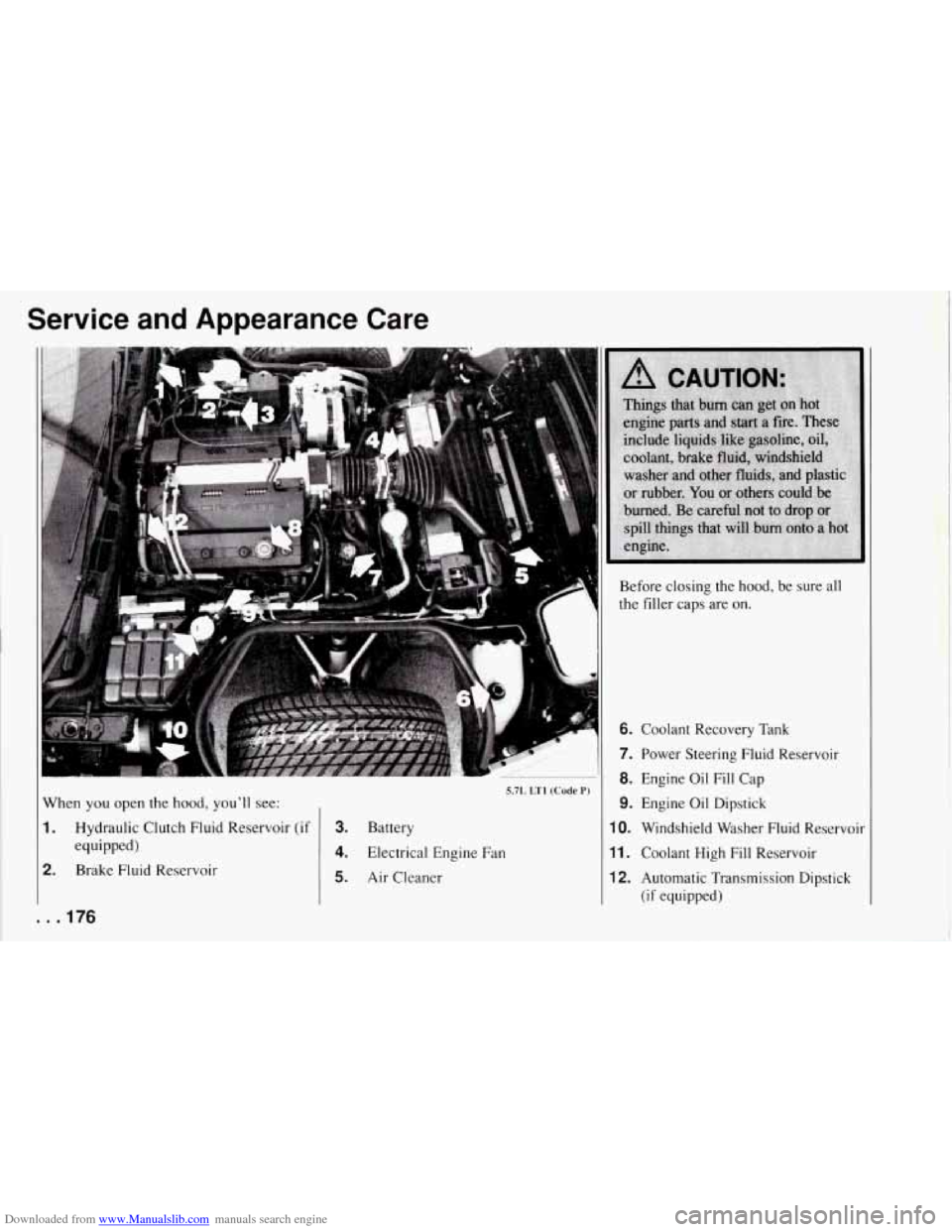
When you open the hood, you'll see:
1. Hydraulic Clutch Fluid Reservoir (if
2. Brake Fluid Reservoir
equipped)
. . .I76
1
Before closing the hood, be sure all
the filler caps are on.
'*?-
5.7L LTI (Code P)
3. Battery
4. Electrical Engine Fan
5. Air Cleaner
6. Coolant Recovery Tank
7. Power Steering Fluid Reservoir
8. Engine Oil Fill Cap
9. Engine Oil Dipstick
10. Windshield Washer Fluid Reservoir
11. Coolant High Fill Reservoir
12. Automatic Transmission Dipstick
(if equipped)
I
Page 185 of 274

Downloaded from www.Manualslib.com manuals search engine Service and Appearance Care
5.
0
0
Reverse the steps.
Align the tabs
to the slots in the
bottom of the assembly before you
replace it.
Install the short knob into the middle
hole first. Then install the longer
knobs into the outer holes.
Automatic Transmission Fluid
When to Check and Change
4 good time to check your automatic
:ransmission fluid level is when the
mgine oil is changed. Refer to the
Maintenance Schedule to determine when
co change your fluid. See “Scheduled
Maintenance Services” in the Index.
How to Check
Because this operation can be a little
iifficult, you may choose to have this
done at a Chevrolet dealership Service
Department.
[f you do it yourself, be sure to follow all
the instructions here, or you could get a
false reading on the dipstick.
NOTICE:
Too much or too little fluid can dam-
age your transmission.
Too much can
mean that some of the fluid could
come out and fall
on hot engine parts
or exhaust system, starting a fire. Be
sure to get an accurate reading if you
check your transmission fluid. Wait
at least 30 minutes before checking
the transmission fluid level if you have
been driving:
0 When outside temperatures are above
0 At high speed for quite a while.
0 In heavy traffic - especially in hot
To get the right reading, the fluid should
be at normal operating temperature, which is
180°F to 200°F (82°C to 93°C).
To check transmission fluid hot: Get
the vehicle warmed up by driving
about
15 miles (24 km) when outside
temperatures are above
50°F (10°C). If
it’s colder than
50°F (10°C)’ drive the
vehicle in
“D’ (Third Gear) until the
engine temperature gage moves and then
remains steady for ten minutes. Then follow the hot check procedures.
To check transmission fluid cold: A cold
check is made after the vehicle has been sitting for eight hours or more with the
engine
off and is used only as a reference.
Let the engine run at idle for five minutes
if outside temperatures are 50” F ( 1 OOC)
or more. If it’s colder than 50°F ( 10°C)’
you may have to idle the engine longer.
Should the fluid level be low during a
90°F (32°C).
weather.
. . .184
Page 186 of 274
Downloaded from www.Manualslib.com manuals search engine cold check, you must perform a hot check
before adding fluid. This will give you a
more accurate reading
of the fluid level.
To check the fluid hot or cold
0
Park your vehicle on a level place.
With the parking brake applied, place
the shift lever in “P” (Park).
With your foot
on the brake pedal,
move the shift lever through each gear
range, pausing for about three seconds
in each range. Then, position the shift
lever
in “P’ (Park).
Let the engine run at idle for three
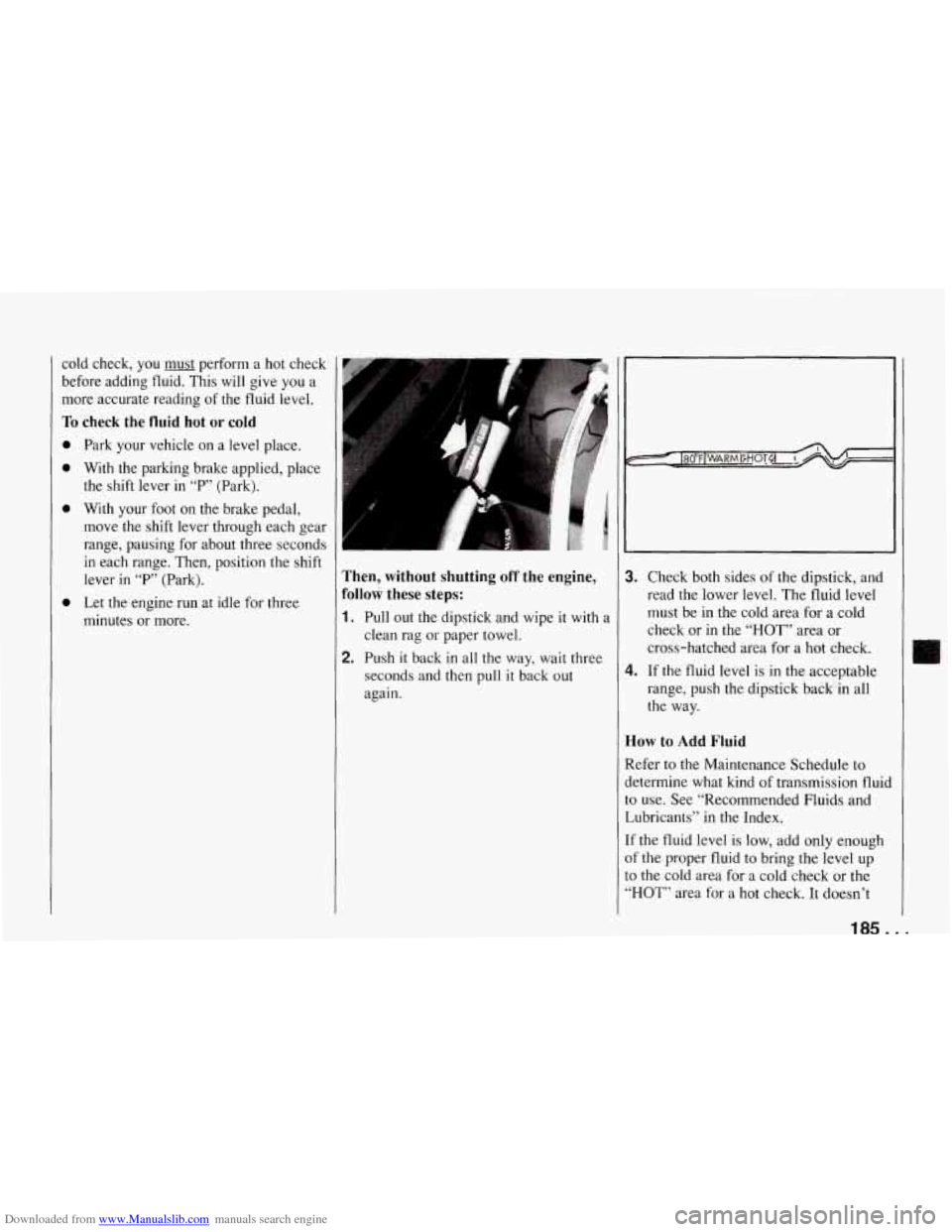
minutes or more. Then, without shutting off the engine,
Follow these steps:
1. Pull out the dipstick and wipe it with a
clean rag or paper towel.
2. Push it back in all the way, wait three
seconds and then pull
it back out
again.
3. Check both sides of the dipstick, and
read the lower level. The fluid level
must be in the cold area for a cold
check or in the
“HOT” area or
cross-hatched area for a hot check.
range, push the dipstick back in all
the way.
4. If the fluid level is in the acceptable
How to Add Fluid
Refer to the Maintenance Schedule to
determine what kind of transmission fluid to use. See “Recommended Fluids and
Lubricants” in the Index.
If the fluid level
is low, add only enough
of the proper fluid to bring the level up
to the cold area for a cold check or the
“HOT” area for a hot check. It doesn’t
Page 187 of 274
Downloaded from www.Manualslib.com manuals search engine Service and Appearance Care
;ake much fluid, generally less than a pint.
Don’t overfill. We recommend you use
mly fluid labeled DEXRON@-111 or
DEXRON@-IIE, because fluids with that
label are made especially for your
automatic transmission. Dama e caused
by fluid other than DEXRON -111 or
DEXRON@-IIE is not covered by your
new vehicle warranty.
0 After adding fluid, recheck the fluid
level as described under “How to
Check.”
obtained, push the dipstick back in all
the way.
D
0 When the correct fluid level is
Manual Transmission Fluid
How to Check:
Because this operation can be difficult,
you may choose to have this done at a
Chevrolet dealership Service Department.
If you do it yourself, be sure to follow all
the instructions here, or you could get a
false reading.
. . .I86
NOTICE:
Too much or too little fluid can
damage your transmission.
Too much
can mean that some of the fluid could
come out and fall on hot engine parts
or exhaust system, starting a fire. Be
sure to get an accurate reading if
you
check your transmission fluid.
:heck the fluid level only when your
mgine is
off, the vehicle is parked on a
eve1 place and the transmission is cool
:nough for you to rest your fingers on
he transmission case. Then, follow these steps:
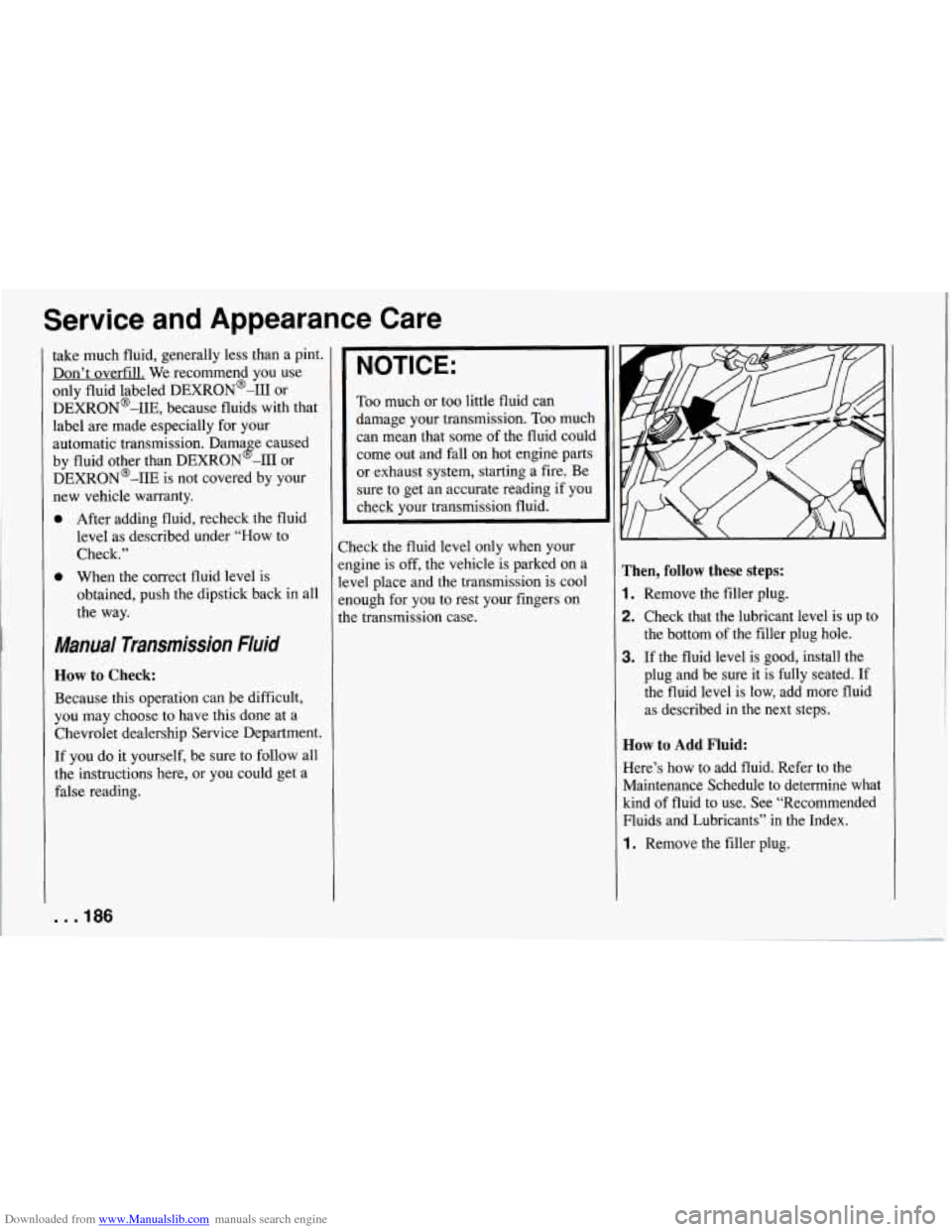
1. Remove the filler plug.
2. Check that the lubricant level is up to
the bottom of the filler plug hole.
3. If the fluid level is good, install the
plug and be sure it is fully seated. If
the fluid level is low, add more fluid
as described in the next steps.
How to Add Fluid:
Here’s how to add fluid. Refer to the
Maintenance Schedule to determine what
kind of fluid to use. See “Recommended
Fluids and Lubricants”
in the Index.
1. Remove the filler plug.
Page 227 of 274
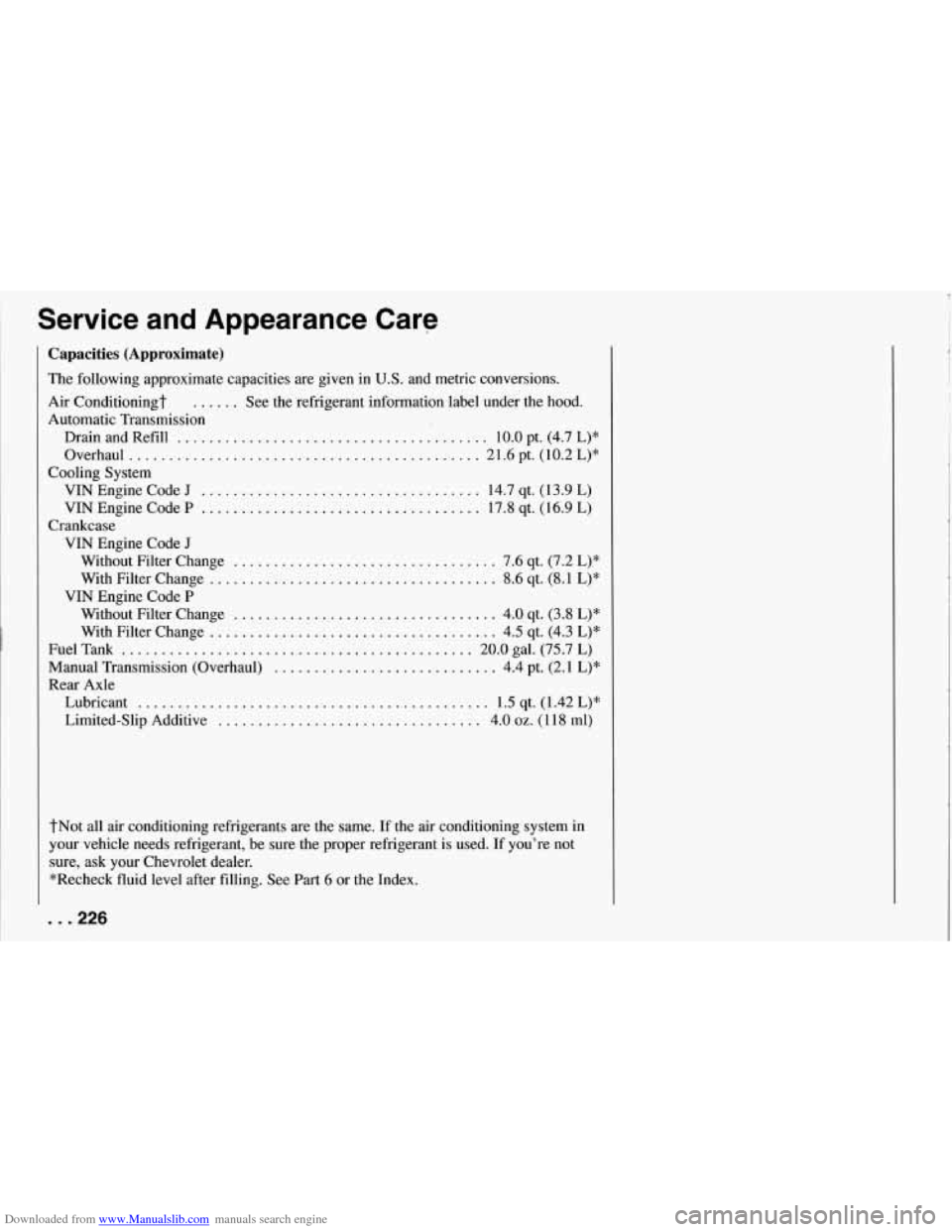
Downloaded from www.Manualslib.com manuals search engine l Service and Appearance Care
Capacities (Approximate)
The following approximate capacities are given in U.S. and metric conversions.
Air Conditioningt
...... See the refrigerant information label under the hood.
Automatic Transmission
Drain and Refill
....................................... 10.0 pt. (4.7 L)*
Overhaul
............................................ 21.6 pt. (10.2 L)*
VIN Engine Code J ................................... 14.7 qt. (1 3.9 L)
VIN Engine Code
P ................................... 17.8 qt. (16.9 L)
VIN Engine Code J
Cooling System
Crankcase Without Filter Change
................................. 7.6 qt. (7.2 L)*
With Filter Change
.................................... 8.6 qt. (8.1 L)*
Without Filter Change ................................. 4.0 qt. (3.8 L)*
With Filter Change .................................... 4.5 qt. (4.3 L)*
Fuel Tank ............................................ 20.0 gal. (75.7 L)
Manual Transmission (Overhaul)
............................ 4.4 pt. (2.1 L)*
Rear Axle
Lubricant
............................................ 1.5 qt. (1.42 L)*
Limited-Slip Additive
................................. 4.0 oz. (1 18 ml)
VIN Engine
Code
P
tNot all air conditioning refrigerants are the same. If the air conditioning system in
your vehicle needs refrigerant, be sure the proper refrigerant is used. If you’re not
sure, ask your Chevrolet dealer.
*Recheck fluid level after filling. See Part
6 or the Index.
.. .226
Page 237 of 274

Downloaded from www.Manualslib.com manuals search engine Maintenance Schedule
C L Section A: Scheduled Maintenance Services (Cont.)
Explanation of Scheduled
Maintenance Services
Following are explanations of the services
listed in Schedule I and Schedule
11.
The proper fluids and lubricants to use are
listed in Section D. Make sure whoever
services your vehicle uses these. All parts
should be replaced and all necessary
repairs done before you or anyone else
drives the vehicle.
NOTE: To determine your engine’s
displacement and code, see
“Engine Identification” in the
Index.
ITEM
NO. SERVICE
1 Engine Oil and Filter Change* -
Always use SH or SG Energy
Conserving I1 oils of proper
viscosity. The engine requires a
special oil meeting GM Standard
GM4718M. Oils meeting this
Standard may be identified as
synthetic, and should also be
identified as API Service
SH or
SG. However, not all Synthetic
API Service
SH oils will meet
ITEM
NO. SERVICE
this GM Standard. You should
look for and use only an oil that
meets GM Standard GM4718M.
To determine the preferred
viscosity for your vehicle’s
engine (e.g.,
SAE 5W-30 or SAE
10W-30), see “Engine Oil” in
the Index.
Your vehicle has an Engine Oil
Life Monitor. This monitor will
show you when to change the oil
- usually between 3,000 miles
(5 000 km) and 7,500 miles
( 12 500 km) since your last oil
change. Under severe conditions
the indicator may come on before
3,000 miles
(5 000 km). Never
drive your vehicle more than
7,500 miles (12
500 km) or 12
months without an oil change.
The system won’t detect dust in
the oil..
So if you drive in a dusty
area be sure
to change your oil
every 3,000 miles
(5 000 km) or
sooner if the “Change Oil” light
comes on.
ITEM
NO.
2
3
4
SERVICE
Remember to reset the Oil Life
Monitor when the oil has been
changed. For more information, see “Engine Oil Life Monitor”
in the Index.
Chassis Lubrication
- Lubricate
suspension and steering linkage.
Lubricate the transmission shift
linkage, and parking brake cable guides, underbody contact points
and linkage.
Engine Accessory Drive Belt(s) Inspection
- Inspect the belt(s)
for cracks, fraying, wear and
proper tension. Replace as needed. (Belts can have many
small cracks in individual ribs
without affecting performance.)
Cooling System Service*
-
Drain, flush and refill the system with
new or approved recycled
coolant conforming to GM
Specification 1825M. Keep
coolant at the proper mixture as
specified. See “Coolant” in the
* An Emission Control Service.
. . .236