1994 CHEVROLET CORVETTE service
[x] Cancel search: servicePage 205 of 274
Downloaded from www.Manualslib.com manuals search engine t .'
Service and Appearance Care
Tires
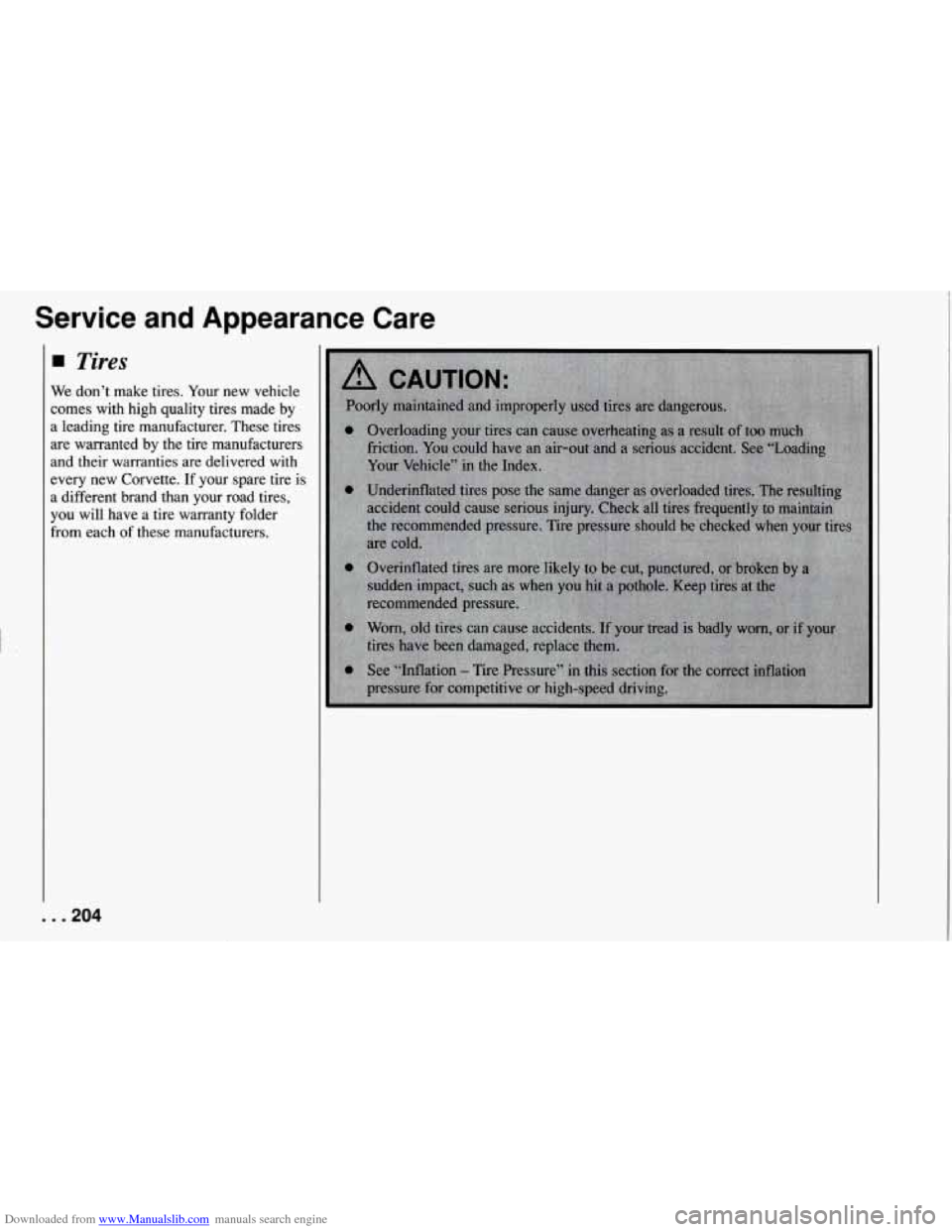
We don't make tires. Your new vehicle
comes with high quality tires made by
a leading tire manufacturer. These tires
are warranted by the tire manufacturers
and their warranties are delivered with
every new Corvette. If your spare tire
is
a different brand than your road tires,
you will have a tire warranty folder
from each
of these manufacturers.
. . .204
Page 206 of 274
Downloaded from www.Manualslib.com manuals search engine Extended Mobility Tires (omoiv)
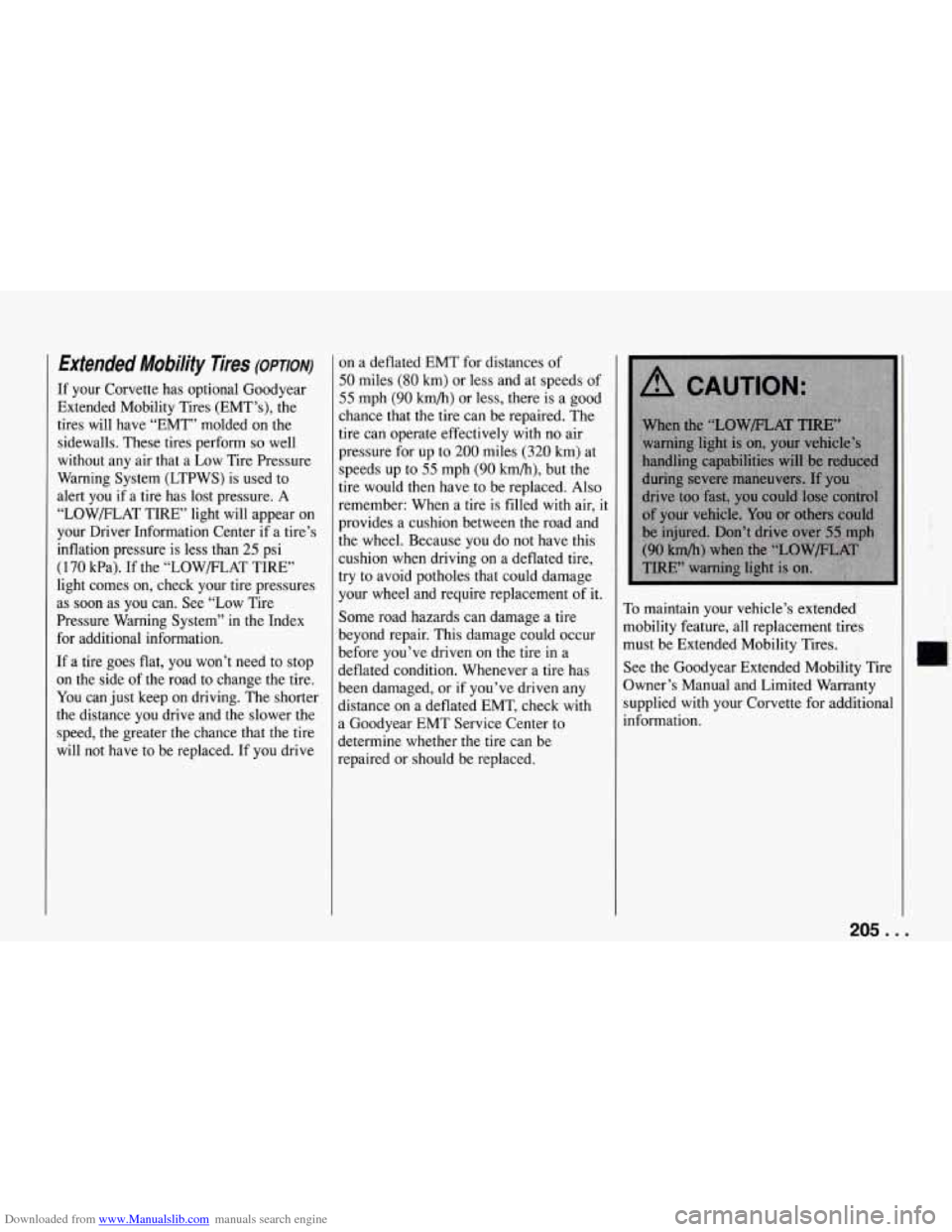
If your Corvette has optional Goodyear
Extended Mobility Tires (EMT’s), the tires will have “EMT” molded on the
sidewalls. These tires perform
so well
without any air that a Low Tire Pressure
Warning System (LTPWS)
is used to
alert you if a tire has lost pressure.
A
“LOWELAT TIRE” light will appear on
your Driver Information Center if a tire’s
inflation pressure is less than
25 psi
(1 70 kPa). If the “LOWELAT TIRE”
light comes on, check your tire pressures
as soon as you can. See “Low Tire
Pressure Warning System” in
the Index
for additional information.
If a tire goes flat, you won’t need to stop
on the side of the road to change the tire.
You can just keep on driving. The shorter
the distance you drive and the slower the
speed, the greater the chance that the tire
will not have to be replaced. If you drive on
a deflated EMT for distances
of
50 miles (80 km) or less and at speeds of
55 mph (90 km/h) or less, there is a good
chance that the tire can be repaired. The
tire can operate effectively with no air
pressure for up to
200 miles (320 km) at
speeds up to
55 mph (90 km/h), but the
tire would then have to be replaced. Also
remember: When a tire is filled with air, it
provides a cushion between the road and
the wheel. Because you do not have this
cushion when driving on a deflated tire,
try to avoid potholes that could damage
your wheel and require replacement of it.
Some road hazards can damage a tire
beyond repair. This damage could occur
before you’ve driven on the tire in a
deflated condition. Whenever a tire has
been damaged, or if you’ve driven any
distance on a deflated EMT, check with
a Goodyear EMT Service Center to
determine whether the tire can be
repaired or should be replaced. To
maintain your vehicle’s extended
mobility feature, all replacement tires
must be Extended Mobility Tires.
See the Goodyear Extended Mobility Tire
Owner’s Manual and Limited Warranty
supplied with your Corvette for additional
information.
205. .
Page 207 of 274
Downloaded from www.Manualslib.com manuals search engine Service and Appearance Care
Inflation - Tire Pressure
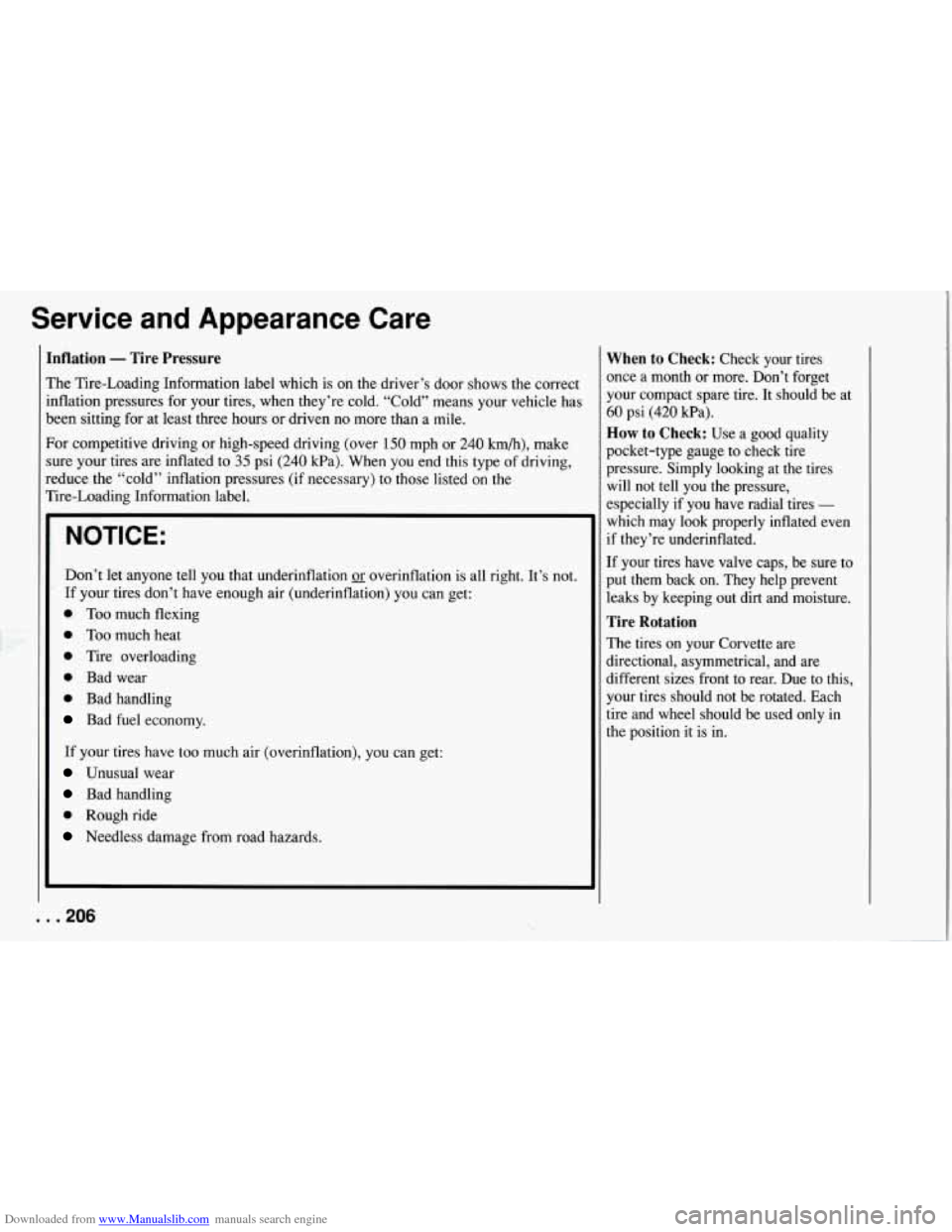
The Tire-Loading Information label which is on the driver’s door shows the correct
inflation pressures for your tires, when they’re cold. “Cold” means your vehicle has
been sitting for at least three hours or driven no more than a mile.
For competitive driving or high-speed driving (over
150 mph or 240 krn/h), make
sure your tires are inflated to
35 psi (240 kPa). When you end this type of driving,
reduce the “cold” inflation pressures (if necessary) to those listed
on the
Tire-Loading Information label.
NOTICE:
Don’t let anyone tell you that underinflation or overinflation is all right. It’s not.
If your tires don’t have enough air (underinflation) you can get:
0 Too much flexing
0 Too much heat
0 Tire overloading
0 Bad wear
0 Bad handling
Bad fuel economy.
If your tires have too much air (overinflation), you can get:
Unusual wear
Bad handling
0 Rough ride
Needless damage from road hazards.
When to Check: Check your tires
mce
a month or more. Don’t forget
your compact spare tire. It should be at
50 psi (420 Wa).
How to Check: Use a good quality
pocket-type gauge to check tire
pressure. Simply looking at the tires
will not tell you the pressure,
=specially if you have radial tires
-
which may look properly inflated even
if they’re underinflated.
Lf your tires have valve caps, be sure to
put them back on. They help prevent
leaks by keeping out dirt and moisture.
Tire Rotation
I’he tires on your Corvette are
lirectional, asymmetrical, and are
different sizes front to rear. Due to this,
your tires should not be rotated. Each
tire and wheel should be used only in
the position it is in.
. . .206
Page 208 of 274

Downloaded from www.Manualslib.com manuals search engine I
When It’s Time for New Tires
One way to tell when it’s time for new
tires is to check the treadwear indicators,
which
will appear when your tires have
only
2/32 inch (1.6 mm) or less of tread
remaining.
You need a new tire if
0 You can see the indicators at three or
You can see cord or fabric showing
0 The tread or sidewall is cracked, cut
more places around the
tire.
through the tire’s rubber.
or snagged deep enough to show cord
or fabric.
0 The tire has a bump, bulge or split.
0 The tire has a puncture, cut, or other
damage that can’t be repaired well
because of the size or location of the
damage.
Buying New Tires
To find out what kind and size of tires
you need, look at the Tire-Loading
Information label.
The tires installed on your vehicle when it
was new had a Tire Performance Criteria
Specification (TPC Spec) number on each
tire’s sidewall. When you get new tires,
get ones with that same TPC Spec
number. That way, yobr vehicle will
continue to have tires that are designed
to give proper endurance, handling,
speed rating, traction, ride and other
things during normal service on your
vehicle. If your tires have an all-season
tread design, the TPC number will be
followed by a
“MS” (for mud and snow).
If you ever replace your tires with those
not having a TPC Spec number, make
sure they are the same size, load range,
speed rating and construction type (bias,
bias-belted or radial) as your original
tires.
Uniform Tire Quality Grading
The following information relates to the
system developed by the United States
National Highway Traffic Safety
Administration which grades tires by
treadwear, traction and temperature
performance. (This applies only to
vehicles sold in the United States.)
Treadwear
The treadwear grade is a comparative
rating based on the wear rate of the tire
when tested under controlled conditions
207. . .
Page 209 of 274
Downloaded from www.Manualslib.com manuals search engine Service and Appearance Care
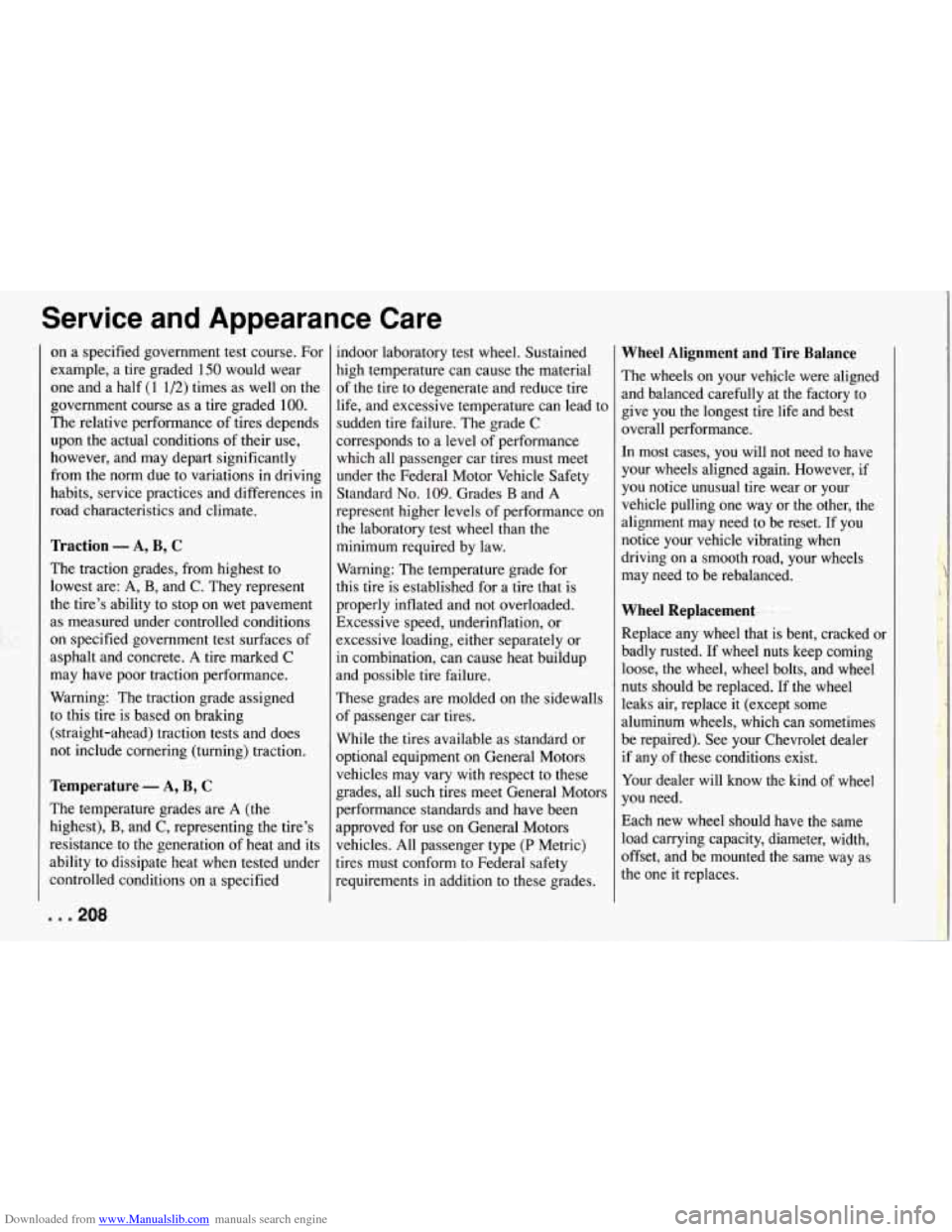
on a specified government test course. For
example, a tire graded 150 would wear
one and a half
(1 1/2) times as well on the
government course as a tire graded
100.
The relative performance of tires depends
upon the actual conditions of their use,
however, and may depart significantly
from the norm due to variations in driving
habits, service practices and differences in
road characteristics and climate.
Traction - A, B, C
The traction grades, from highest to
iowest are:
A, B, and C. They represent
the tire’s ability to stop on wet pavement
as measured under controlled conditions
on specified government test surfaces of
asphalt and concrete.
A tire marked C
may have poor traction performance.
Warning: The traction grade assigned
to this tire is based on braking
(straight-ahead) traction tests and does
not include cornering (turning) traction.
Temperature - A, B, C
The temperature grades are A (the
highest),
B, and C, representing the tire’s
resistance to the generation of heat and its
ability to dissipate heat when tested under
controlled conditions on a specified
. . .208
indoor laboratory test wheel. Sustained
high temperature can cause the material
of the tire to degenerate and reduce tire
life, and excessive temperature can lead to
sudden tire failure. The grade C
corresponds to a level
of performance
which all passenger car tires must meet
under the Federal Motor Vehicle Safety
Standard
No. 109. Grades B and A
represent higher levels of performance on
the laboratory test wheel than the
minimum required by law.
Warning: The temperature grade for
this tire is established for a tire that is
properly inflated and not overloaded.
Excessive speed, underinflation, or
excessive loading, either separately or
in combination, can cause heat buiidup
and possible tire failure.
These grades are molded on the sidewalls
of passenger car tires.
While the tires available as standard or
optional equipment on General Motors
vehicles may vary with respect to these
grades, all such tires meet General Motors
performance standards and have been
approved for use on General Motors
vehicles. All passenger type
(P Metric)
tires must conform to Federal safety
requirements in addition to these grades.
Wheel Alignment and Tire Balance
The wheels on your vehicle were aligned
and balanced carefully at the factory to
give you the longest tire life and best
overall performance.
In most cases, you will not need to have
your wheels aligned again. However, if
you notice unusual tire wear or your
vehicle pulling one way or
the other, the
alignment may need to be reset. If you
notice your vehicle vibrating when
driving on a smooth road, your wheels may need to be rebalanced.
Wheel- Replacement - . -
Replace any wheel that is bent, cracked or
badly rusted. If wheel nuts keep coming
loose, the wheel, wheel bolts, and wheel
nuts should be replaced. If the wheel
leaks air, replace it (except some
aluminum wheels, which can sometimes
be repaired). See your Chevrolet dealer
if any of these conditions exist.
Your dealer will know the kind of wheel
you need.
Each new wheel should have the same
load carrying capacity, diameter, width,
offset, and be mounted
the same way as
the one it replaces.
Page 211 of 274
Downloaded from www.Manualslib.com manuals search engine Service and Appearance Care
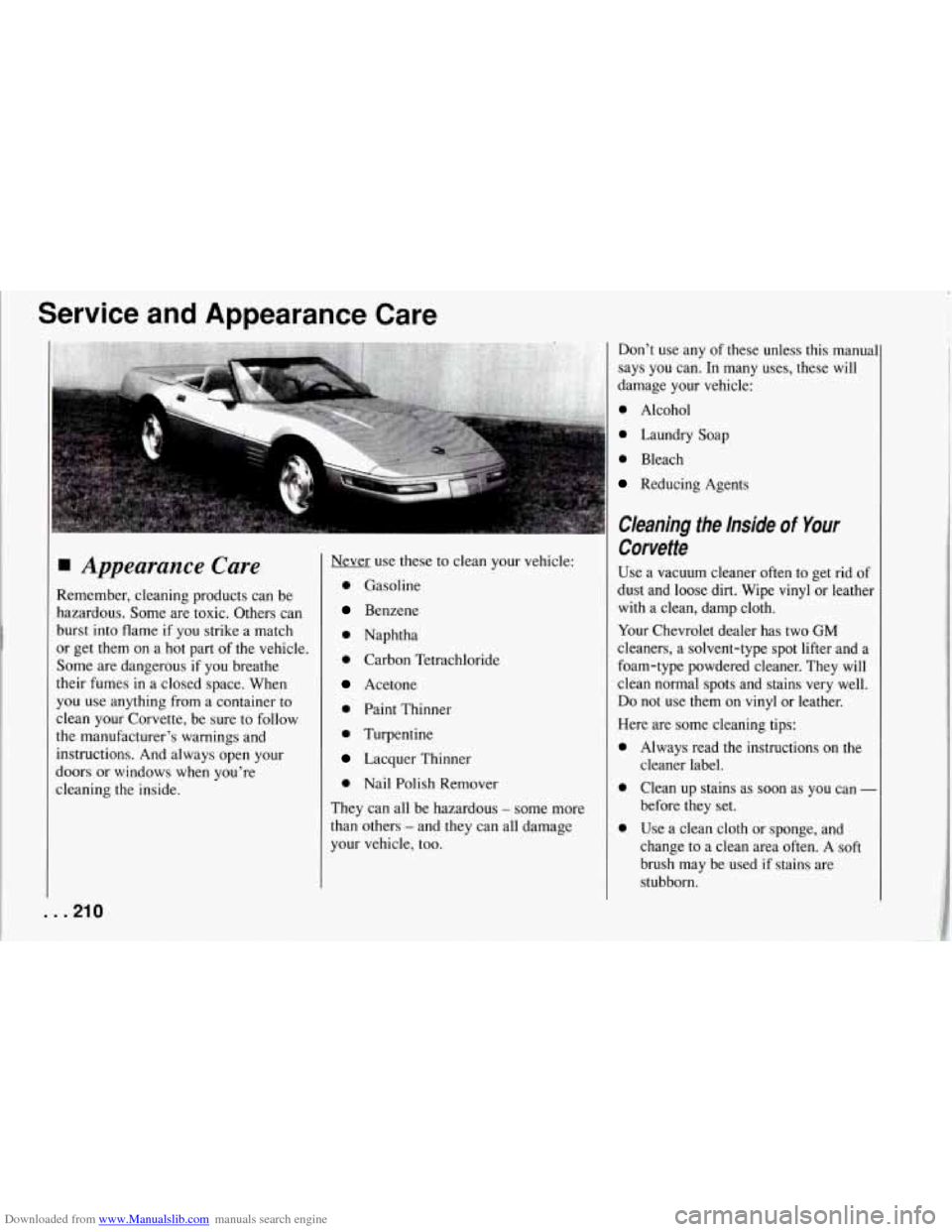
Appearance Care
Remember, cleaning products can be
hazardous. Some are toxic. Others can
burst into flame if you strike a match
or get them on a hot part of the vehicle.
Some are dangerous if you breathe
their fumes in a closed space. When
you use anything from a container to
clean your Corvette, be sure to follow
the manufacturer’s warnings and
instructions. And always open your
doors or windows
when you’re
cleaning the inside. Never use
these to clean your vehicle:
0 Gasoline
Benzene
0 Naphtha
0 Carbon Tetrachloride
Acetone
0 Paint Thinner
0 Turpentine
Lacquer Thinner
0 Nail Polish Remover
They can all be hazardous
- some more
than others
- and they can all damage
your vehicle, too. Don’t use any
of these unless this manual
says you can. In many uses, these will
damage your vehicle:
0 Alcohol
0 Laundry Soap
0 Bleach
Reducing Agents
Cleaning the Inside of Your
Corvette
Use a vacuum cleaner often to get rid of
dust and loose dirt. Wipe vinyl or leather
with a clean, damp cloth.
Your Chevrolet dealer has two
GM
cleaners, a solvent-type spot lifter and a
foam-type powdered cleaner. They will
clean normal spots and stains very well.
Do not use them on vinyl or leather.
Here are some cleaning tips: Always read the instructions on the
cleaner label. Clean up stains as soon as you can
-
before they set.
Use a clean cloth or sponge, and
change to a clean area often. A soft
brush may be used
if stains are
stubborn.
I
. . .210
Page 213 of 274
Downloaded from www.Manualslib.com manuals search engine Service and Appearance Care
Non-greasy stains: Such as catsup,
coffee (black), egg, fruit, fruit juice, milk,
soft drinks, wine, vomit, urine and blood.
Carefully scrape off excess stain, then
sponge the soiled area with cool water.
0 If a stain remains, follow the
foam-type instructions described
earlier.
0 If an odor lingers after cleaning
vomit or urine, treat the area
with
a waterbaking soda solution:
1 teaspoon (5 ml) of baking soda to
1 cup (250 ml) of lukewarm water.
solvent-type cleaner.
0 If needed, clean lightly with
Combination stains: Such as candy,
ice cream, mayonnaise, chili sauce and
unknown stains.
0 Carefully scrape off excess stain, then
clean with cool water and allow to dry.
0 If a stain remains, clean it with
solvent-type cleaner.
Cleaning Vinyl
Use warm water and a clean cloth.
0 Rub with a clean, damp cloth to
remove dirt.
You may have to do it
more than once.
. . .212
0 Things like tar, asphalt and shoe
polish will stain if you don’t get them
off quickly. Use a clean cloth and
solvent-type vinyl cleaner.
Cleaning Leather
Use a soft cloth with lukewarm water and
a mild soap or saddle soap.
For stubborn stains, use a mild
solution of
10% isopropyl alcohol
(rubbing alchohol) and
90% water.
Never use oils, varnishes,
solvent-based or abrasive cleaners,
furniture polish or shoe polish on
leather.
Soiled leather should be cleaned
immediately. If dirt is allowed to work
into finish, it can harm the leather.
Cleaning Soft-Touch Surfaces
Use only mild soap and water to clean the
Soft-Touch paint surfaces in your
Corvette. For protection, use ArmorAll8
or equivalent.
Cleaning the Top of the Instrument
Panel
Use only mild soap and water to clean the
top surfaces of the instrument panel. Sprays containing silicones or waxes
may
cause annoying reflections in the
windshield and even make it difficult to
see through the windshield under certain conditions.
Cleaning Speaker Covers
Vacuum around a speaker cover gently,
so that the speaker won’t be damaged. If
something gets on one of them, follow the
steps under “Using Solvent-Type Cleaner
on Fabric.” Use as little solvent as you
can.
Care of Safety Belts
Keep belts clean and dry.
Page 215 of 274
Downloaded from www.Manualslib.com manuals search engine Service and Appearance Care
Cleaning the Outside of Your
Corvette
The paint finish on your vehicle provides
beauty, depth of color, gloss retention and
durability.
Washing Your Vehicle
The best way to preserve your vehicle’s
finish is to keep it clean by washing it
often with lukewarm or cold water.
Don’t wash your vehicle in the direct rays
of the
sun. Don’t use strong soaps or
chemical detergents. Use liquid hand,
dish or car washing (mild detergent)
soaps. Don’t use cleaning agents that
are petroleum-based, or contain acid or
abrasives. All cleaning agents should be
flushed promptly and not allowed to dry
on
the surface, or they could stain. Dry
the finish with a soft, clean chamois or a
100% cotton towel to avoid surface
scratches and water spotting.
High pressure car washes may cause
water to enter your vehicle.
. . .214
NOTICE:
Conveyor systems on some
automatic car washes may damage a
Corvette. They may not have enough
clearance for the undercarriage or for
the extra wide rear tires on ZR-1
models. Check with the manager
before using a car wash.
Finish Care
3ccasional waxing or mild polishing of
your Corvette may be necessary to
-emove residue from the paint finish.
You
:an get GM approved cleaning products
?ram your dealer. (See “Appearance Care
ind Materials” in the Index.)
Your Corvette has a “basecoat/clearcoat”
Jaint finish. The clearcoat gives more
lepth and gloss to
the colored basecoat.
4lways use waxes and polishes that are
lon-abrasive and made for a
>asecoat/clearcoat paint finish.
NOTICE:
Machine compounding or aggressive
polishing on a basecoat/clearcoat
paint finish may dull the finish or
leave swirl
marks,
Cleaning Your Convertible Top
Your convertible top should be cleaned
often. If you use an automatic car wash,
use one with water jets and hanging
cloths.
When you hand wash the top, do it in
partial shade. Vacuum away any dust and
other material. Use a mild soap,
lukewarm water and a soft sponge.
A
chamois or cloth may leave lint on the
top, and a brush can chafe the threads in
the top fabric. Don’t use detergents, harsh
cleaners, solvents or bleaching agents.
When you clean
the top, put one hand
under it to support
it. Wet the entire
vehicle and wash the top evenly to avoid
spots or rings. Let the soap remain on the
fabric for a few minutes. When the top is
really dirty, use a mild foam-type cleaner.
Thoroughly rinse the entire vehicle,
then
let the top dry in direct sunlight.