1994 CHEVROLET CORVETTE change wheel
[x] Cancel search: change wheelPage 160 of 274

Downloaded from www.Manualslib.com manuals search engine 8. Shut the engine off and replace the
pressure cap. At any time during this
procedure if coolant begins
to flow
out
of the filler neck, reinstall the
pressure cap. Be sure the arrows on
the cap line up like this.
If a Tire Goes Flat
It’s unusual for a tire to “blow out” while
you’re driving, especially if you maintain
your tires properly. If air goes out of a
tire, it’s much more likely
to’ leak out
slowly. But
if you should ever have a
”blowout,” here are a few tips about
what to expect and what to do:
If a front tire fails, the flat tire will create
a drag that pulls the vehicle toward that
side. Take your foot off the accelerator
pedal and grip the steering wheel firmly.
Steer
to maintain lane position, then
gently brake to a stop well out of the
traffic lane.
A rear blowout, particularly on a curve,
acts much like a skid and may require the
same correction you’d use in a skid. In
any rear blowout, remove your foot from
the accelerator pedal. Get the vehicle
under control by steering the way you
want the vehicle to go.
It may be very
bumpy and noisy, but you can still steer.
Gently brake to a stop, well qff the road
if possible.
If a tire goes flat, the next section shows
how to use your jacking equipment to
change a flat tire safely. If your vehicle
has Extended Mobility Tires (tires with
“EMT” molded on the sidewalls), see
“Extended Mobility Tires” in the Index.
Changing a Flat Tire
If a tire goes flat, avoid further tire
damage by driving slowly to a level place.
Turn on your hazard warning flashers.
159 ...
Page 161 of 274
Downloaded from www.Manualslib.com manuals search engine Problems on the Road
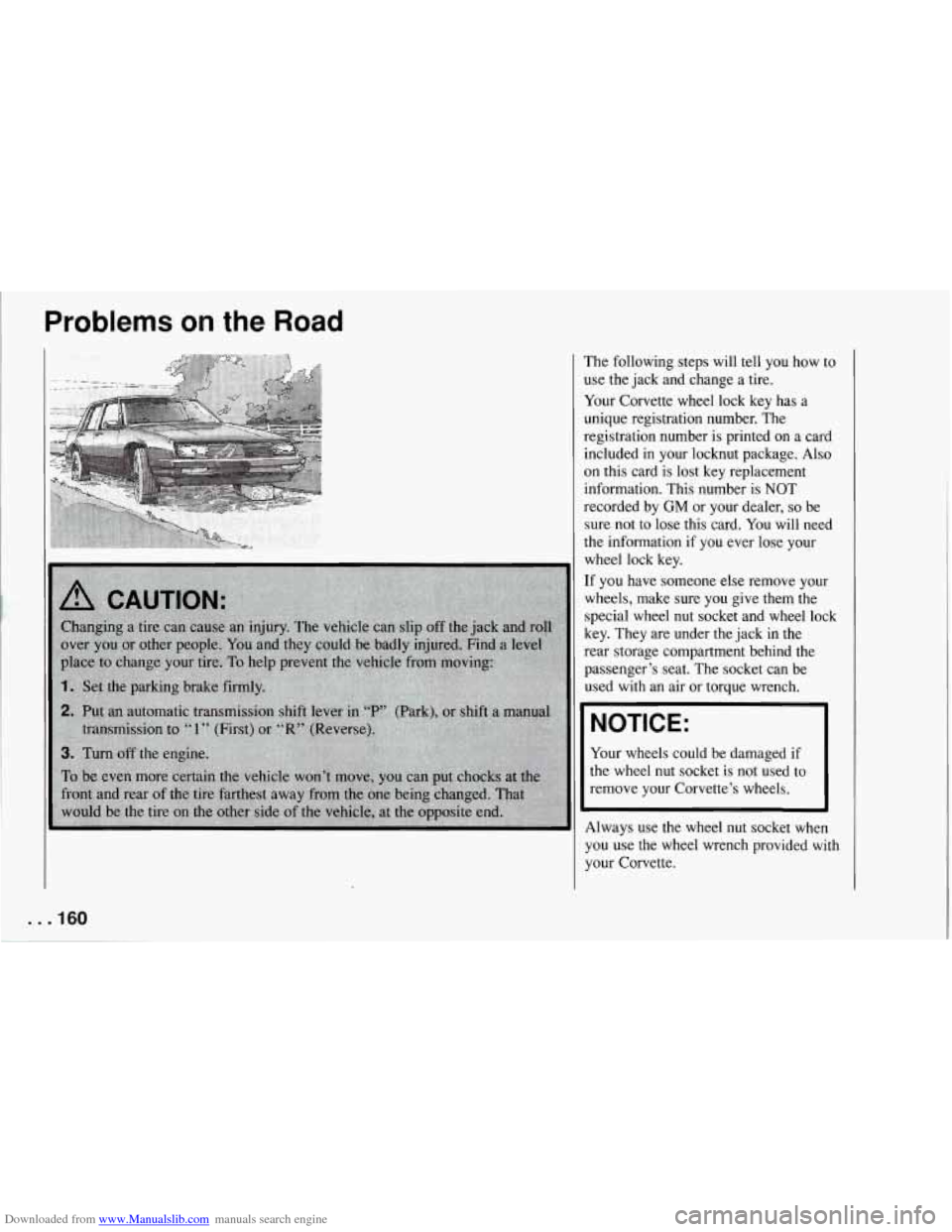
The following steps will tell you how to
use the jack and change a tire.
Your Corvette wheel lock key has a unique registration number. The
registration number is printed on a card
included in your locknut package.
Also
on this card is lost key replacement
information. This number is NOT
recorded by
GM or your dealer, so be
sure not to lose this card. You will need
the information
if you ever lose your
wheel lock key.
If you have someone else remove your wheels, make sure you give them the special wheel nut socket and wheel lock
key. They are under the jack in the
rear storage compartment behind the
passenger’s seat. The socket can be
used with an air or torque wrench.
NOTICE:
Your wheels could be damaged if
the wheel nut socket is not used to
remove your Corvette’s wheels.
Always use the wheel nut socket when
you use the wheel wrench provided with
your Corvette.
. . .I60
Page 195 of 274

Downloaded from www.Manualslib.com manuals search engine Service and Appearance Care
NOTICE:
Don’t let someone put in the
wrong kind of fluid. For example,
just a few drops of mineral-based
oil, such as engine oil, in your
brake system can damage brake
system parts
so badly that they’ll
have to be replaced.
Brake fluid can damage paint,
so
be careful not to spill brake fluid
on your vehicle. If you
do, wash it
off immediately. See “Appearance
Care” in the Index.
Brake Wear
Your Corvette has four-wheel disc brakes.
Disc brake pads have built-in wear
indicators that make a high-pitched
warning sound when the brake pads are
worn and new pads are needed. The
sound may come and go or be heard all
the time your vehicle is moving (except
when you are pushing
on the brake pedal
firmly).
I NOTICE:
I
Continuing to drive with worn-out
brake pads could result in costly brake repair.
Some driving conditions or climates may
cause a brake squeal when the brakes are
first applied or lightly applied. This does not mean something is wrong with your
brakes. Brake linings should always be
replaced as complete axle sets.
Brake Pedal Travel
See your dealer if the brake pedal does
not return to normal height, or if there is
a rapid increase in pedal travel. This
could be a sign of brake trouble.
Brake Adjustment
As you make brake stops, your disc
brakes automatically adjust for wear.
Replacing Brake System Parts
The braking system on a modern vehicle
is complex. Its many parts have to be of
top quality and work well together
if the
vehicle is to have really good braking.
Vehicles we design and test have
top-quality GM brake parts in them, as
your Corvette does when it is new. When
you replace parts of your braking system
- for example, when your brake linings
wear down and you have to have new
ones put in
- be sure you get new
genuine GM replacement parts. If you
don’t, your brakes may no longer work
properly. For example,
if someone puts
in brake linings that are wrong for your
vehicle, the balance between your front
and rear brakes can change, for the worse. The braking performance you’ve come to
expect can change in many other ways
if
someone puts in the wrong replacement
brake parts.
. . .I94
Page 206 of 274
Downloaded from www.Manualslib.com manuals search engine Extended Mobility Tires (omoiv)
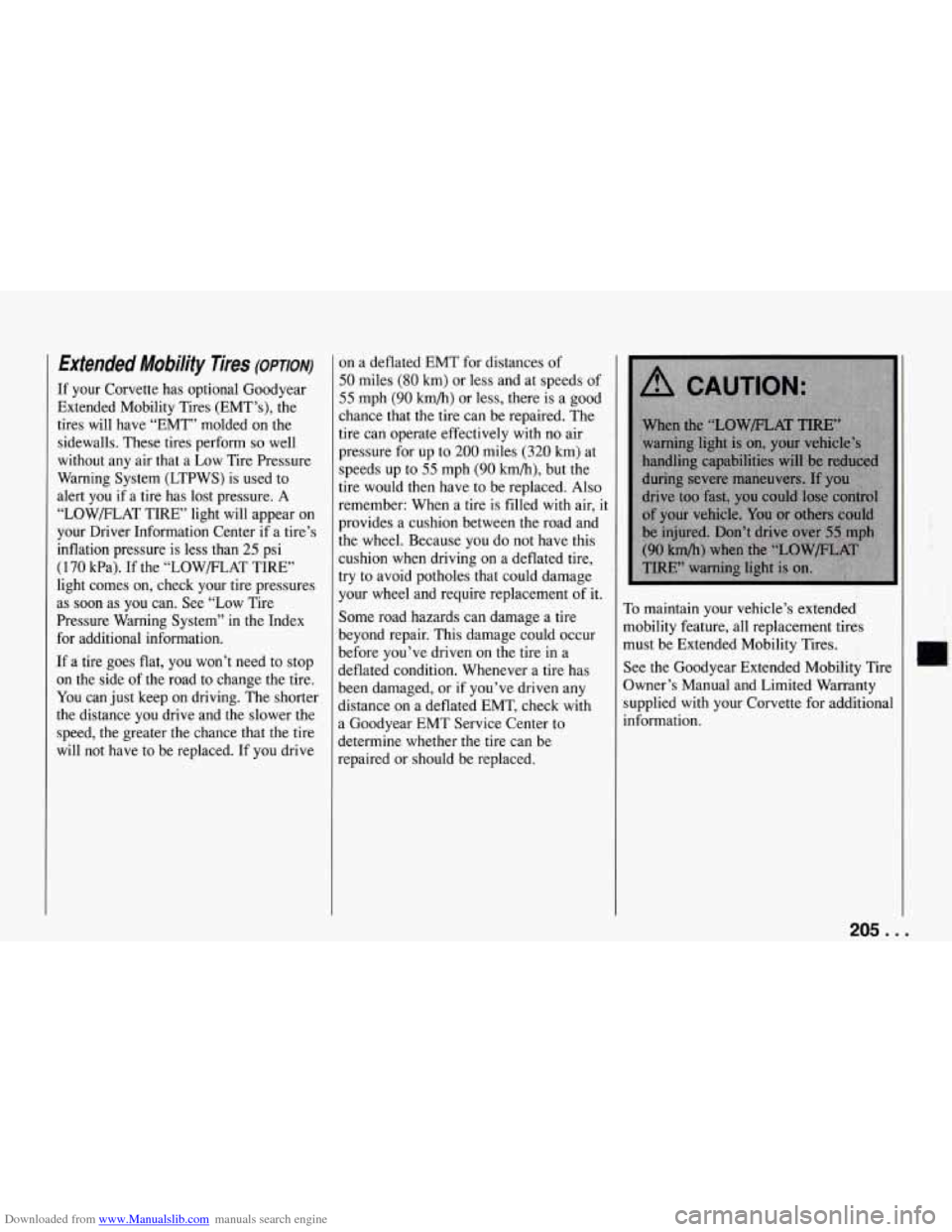
If your Corvette has optional Goodyear
Extended Mobility Tires (EMT’s), the tires will have “EMT” molded on the
sidewalls. These tires perform
so well
without any air that a Low Tire Pressure
Warning System (LTPWS)
is used to
alert you if a tire has lost pressure.
A
“LOWELAT TIRE” light will appear on
your Driver Information Center if a tire’s
inflation pressure is less than
25 psi
(1 70 kPa). If the “LOWELAT TIRE”
light comes on, check your tire pressures
as soon as you can. See “Low Tire
Pressure Warning System” in
the Index
for additional information.
If a tire goes flat, you won’t need to stop
on the side of the road to change the tire.
You can just keep on driving. The shorter
the distance you drive and the slower the
speed, the greater the chance that the tire
will not have to be replaced. If you drive on
a deflated EMT for distances
of
50 miles (80 km) or less and at speeds of
55 mph (90 km/h) or less, there is a good
chance that the tire can be repaired. The
tire can operate effectively with no air
pressure for up to
200 miles (320 km) at
speeds up to
55 mph (90 km/h), but the
tire would then have to be replaced. Also
remember: When a tire is filled with air, it
provides a cushion between the road and
the wheel. Because you do not have this
cushion when driving on a deflated tire,
try to avoid potholes that could damage
your wheel and require replacement of it.
Some road hazards can damage a tire
beyond repair. This damage could occur
before you’ve driven on the tire in a
deflated condition. Whenever a tire has
been damaged, or if you’ve driven any
distance on a deflated EMT, check with
a Goodyear EMT Service Center to
determine whether the tire can be
repaired or should be replaced. To
maintain your vehicle’s extended
mobility feature, all replacement tires
must be Extended Mobility Tires.
See the Goodyear Extended Mobility Tire
Owner’s Manual and Limited Warranty
supplied with your Corvette for additional
information.
205. .
Page 270 of 274
Downloaded from www.Manualslib.com manuals search engine Transmitters. Passive Keyless Entry System
................. 40
Transportation. Courtesy
......... 255
Trip Odometer
.................. 81
Trip. Before Leaving on a Long
.... 135
Turn Signal and Lane Change Indicator
..................... 6 1
Turn Signalmeadlight Beam
Lever
........................ 61
Underbody Maintenance
....... 2 16
Uniform Tire Quality Grading
..... 207
Universal Theft Deterrent
......... 44
Vehicle
Used Replacement Wheels
........ 209
Control of a
................. 124
Damage Warnings
.............. 8
Dimensions
................. 227
Environment and Your
......... 230
Identification Number (VIN)
.... 21 8
Leaving Your
................. 38
Loading Your
................ 202
Parking Your
................. 58
Storage
..................... 195
Symbols
..................... 10
Towing Your ................. 146
Ventilation
.................... 107
Ventilation System. Washing Your
................ 2 14
Flow-Through ............... 11 1 Ventilation Tips
................ 1 12
Visor Vanity Mirror. Covered
....... 75
Visors. Sun
..................... 74
Voltmeter
...................... 90
Vision. Night .................. 131
Devices. Other 142
Hazard Flashers
.............. 142
Safety
........................ 8
Vehicle Damage
................ 8
Washer Fluid. Windshield
........ 192
Washer. Windshield
.............. 63
Washing Your Vehicle
........... 214
Water. Driving Through
Weatherstrips
.................. 2 15
Wheel Nut Torque
.............. 225
Wheel. Tilt
..................... 61
Wheels Alignment and Tire Balance
.... 208
Aluminum
.................. 2 1 5
Replacement
................. 208
Used Replacement
............ 209
Why Safety Belts Work
........... 15
Windows
...................... 60
Defogging and Defrosting ...... 107
Power
....................... 60
Rear Defogger
............... 111
.
...............
Lights. Gauges and Indicators .... 82
Deep Standing
................ 50
Windshield
Cleaning
................... 213
Specially Treated
............. 111
Washer ...................... 63
Washer Fluid
................ 192
Wipers Blades
............... 202
Wipers
...................... 62
Winter Driving
................. 137
Wipers. Windshield
............. 62
Your Driving and the Road
...... 121
26Q . .