1994 CHEVROLET CAVALIER brakes
[x] Cancel search: brakesPage 108 of 243
Downloaded from www.Manualslib.com manuals search engine Here you’ll find information
about driving on different kinds
of
roads and in varying weather
conditions
. We’ve also included
many other useful tips on driving
.
107
Part 4
Your Driving and the Road
Defensive Drlvmg 108
Drunken Driving
........................................................................\
............................. 108
Control
of a Vehicle
Braking
........................................................................\
......................................... 110
Anti-Lock Brakes
........................................................................\
......................... 111
Steering Tips ........................................................................\
................................. 113
Steermg m Emergencies ........................................................................\
............... 114
Passing
........................................................................\
.......................................... 115
Driving at Night ........................................................................\
.............................. 117
Driving in the Rain
........................................................................\
.......................... 118
City Driving ........................................................................\
..................................... 119
Freeway Driving
........................................................................\
.............................. 120
Before Leaving on a Long Trip
........................................................................\
....... 121
Hill and Mountain Roads
........................................................................\
................ 122
Winter Drnmg 123
Recreational Towing
........................................................................\
........................ 125
Towing a Trailer
........................................................................\
.............................. 126
.. ........................................................................\
............................
..
.. ........................................................................\
.................................
......... ~
Page 111 of 243
Downloaded from www.Manualslib.com manuals search engine Your Driving and the Road
true for brain, spinal cord and heart
injuries. That means that
if anyone who
has been drinking
- driver or
passenger
- is in a crash, the chance of
being killed or permanently disabled is
higher than if that person had not been
drinking. And we’ve already seen that
the chance
of a crash itself is higher for
drinking drivers.
Condrol of a Khkk
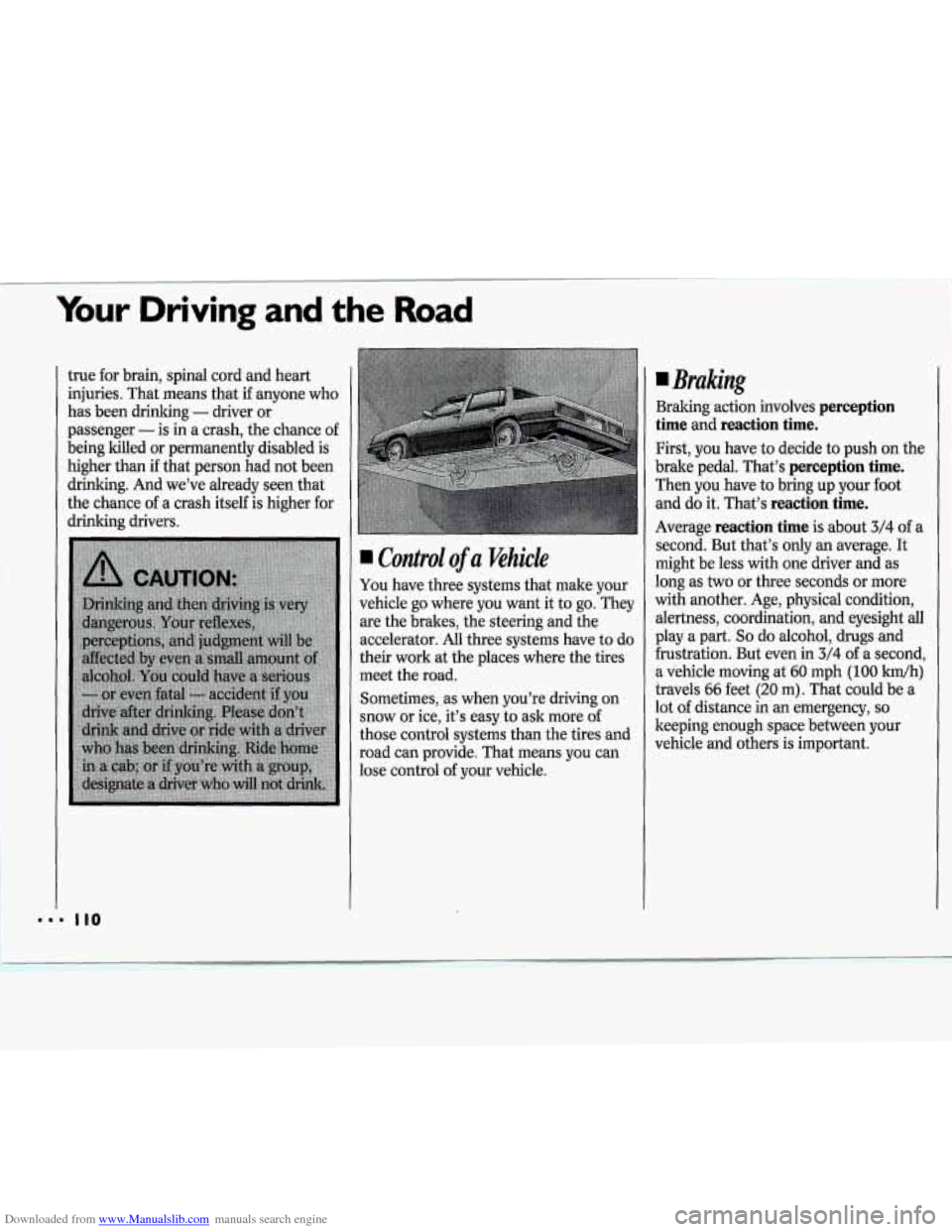
You have three systems that make your
vehicle go where you want it to
go. They
are the brakes, the steering and the
accelerator.
All three systems have to do
their work at the places where the tires
meet the road.
Sometimes, as when you’re driving on
snow or ice, it’s easy ta ask more
of
those control systems than the tires and
road can provide. That means you can
lose control
af your vehicle.
Bruking
Braking action involves perception
time
and reaction time.
First, you have to decide to push on the
brake pedal. That’s
perception the.
Then you have to bring up your foot
and do it. That’s reaction the.
Average reaction time is about 3/4 of a I
second. But that’s only an average. It
might be less with one driver and as
long as
two or three seconds or more
with another. Age, physical condition,
alertness, coordination,
and eyesight all
play a part. So do alcohol, drugs and
frustration. But even
in 3/4 of a second,
a vehicle moving at
60 mph (100 km/h)
travels 66 feet (20 m). That could be a
lot
of distance in an emergency, so
keeping enough space between your
vehicle
and others is important.
Page 112 of 243
Downloaded from www.Manualslib.com manuals search engine And, of course, actual stopping
distances vary greatly with the surface
of the road (whether it’s pavement or
gravel); the condition
of the road (wet,
dry, icy); tire tread; and the condition
of
your brakes.
Avoid needless heavy braking. Some people drive in spurts
- heavy
acceleration followed by heavy braking
- rather than keeping pace with traffic.
This is a mistake. Your brakes may not
have time to cool between hard stops.
Your brakes
will wear out much faster if
you do a lot
of heavy braking. If you
keep pace with the traffic and allow realistic following
distances, you will
eliminate a lot of unnecessary braking.
That means better braking and longer
brake life.
If your engine ever stops while you’re
driving, brake normally but don’t pump
your brakes. If you do, the pedal may
get harder to push down. If your engine
stops, you will still have some power
brake assist. But you will use it when
you brake. Once the power assist is
used
up, it may take longer to stop and
the brake pedal will be harder to push.
L
- 20
- 10
9nti-Lock Brakes (ABS)
Your Chevrolet has an advanced
dectronic braking system that will help
prevent skidding.
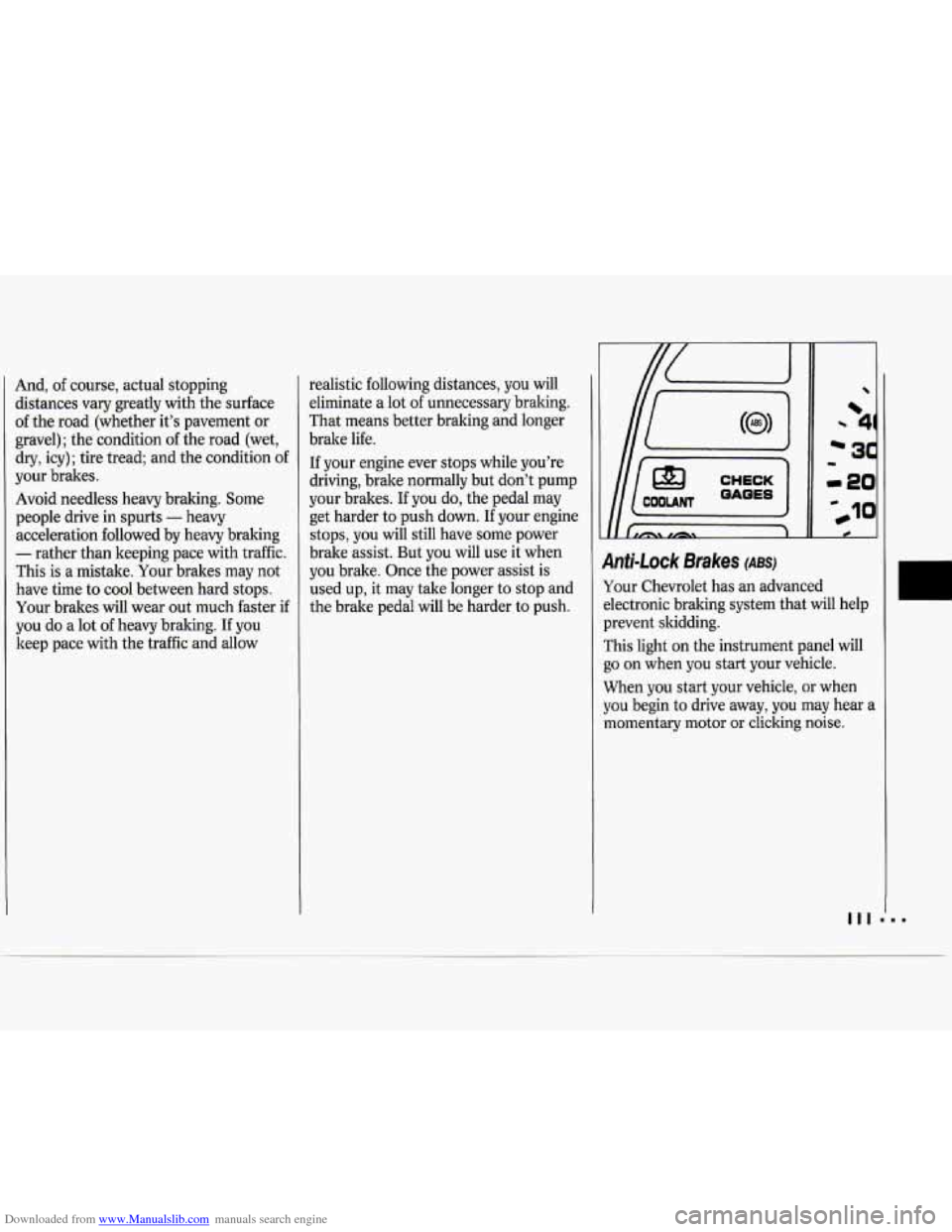
rhis light on the instrument panel will
30 on when you start your vehicle.
When you start your vehicle, or when
you begin to drive away, you may hear a
momentary motor
or clicking noise.
Page 113 of 243
Downloaded from www.Manualslib.com manuals search engine Your Driving and the Road
And you may even notice that your
brake pedal moves a little while this is
going on. This is the ABS system
testing itself.
If there’s a problem with
the anti-lock brake system, the anti-lock
brake system warning light will stay on
or flash.
See
Anti-lock Brake System Warning
Light
in the Index.
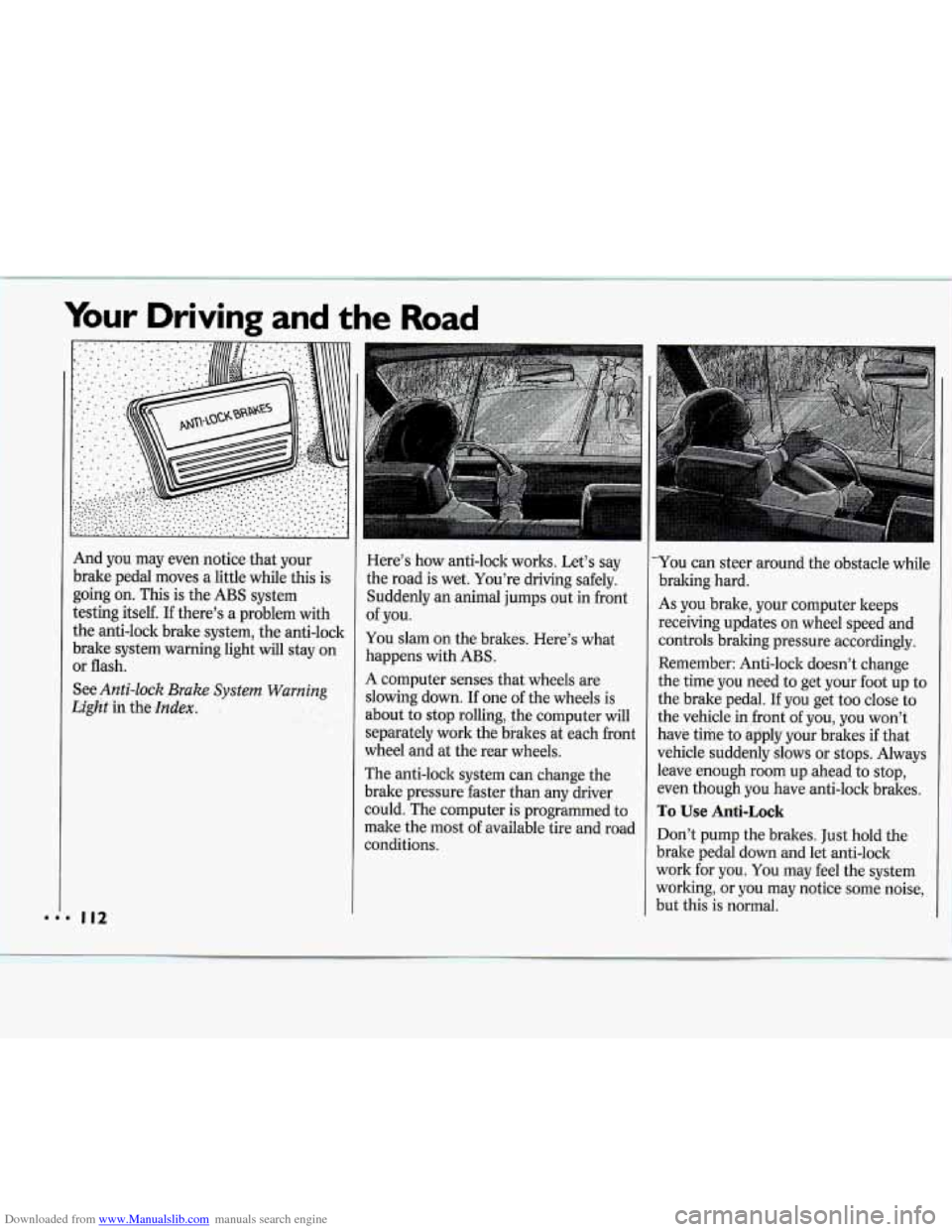
Here’s how anti-lock works. Let’s say
the road is wet. You’re driving safely.
Suddenly
an animal jumps out in front
of you.
You slam on the brakes. Here’s what
happens with ABS.
A computer senses that wheels are
slowing down.
If one of the wheels is
about to stop rolling, the computer wil
separately work the brakes at each fro]
wheel and at the rear wheels.
The anti-lock system can change the
brake pressure faster than any driver
1
nt
could.*The computer is programmed to
make the most of available tire and road
conditions.
L-
You can steer around the obstacle while
braking hard.
As you brake, your computer keeps
receiving updates on wheel speed and
controls braking pressure accordingly.
Remember: Anti-lock doesn’t change
the time you need to get your foot up to
the brake pedal. If you get too close to
the vehicle in front of you, you won’t
have time to apply your brakes if that
vehicle suddenly slows or stops. Always
leave enough room up ahead to stop,
even though you have anti-lock brakes.
To Use Anti-Lock
Don’t pump the brakes. Just hold the
brake pedal down and let anti-lock
work for you. You may feel the system
working, or you may notice some noise,
but this is normal.
Page 115 of 243
Downloaded from www.Manualslib.com manuals search engine Your Driving and the Road
P
..
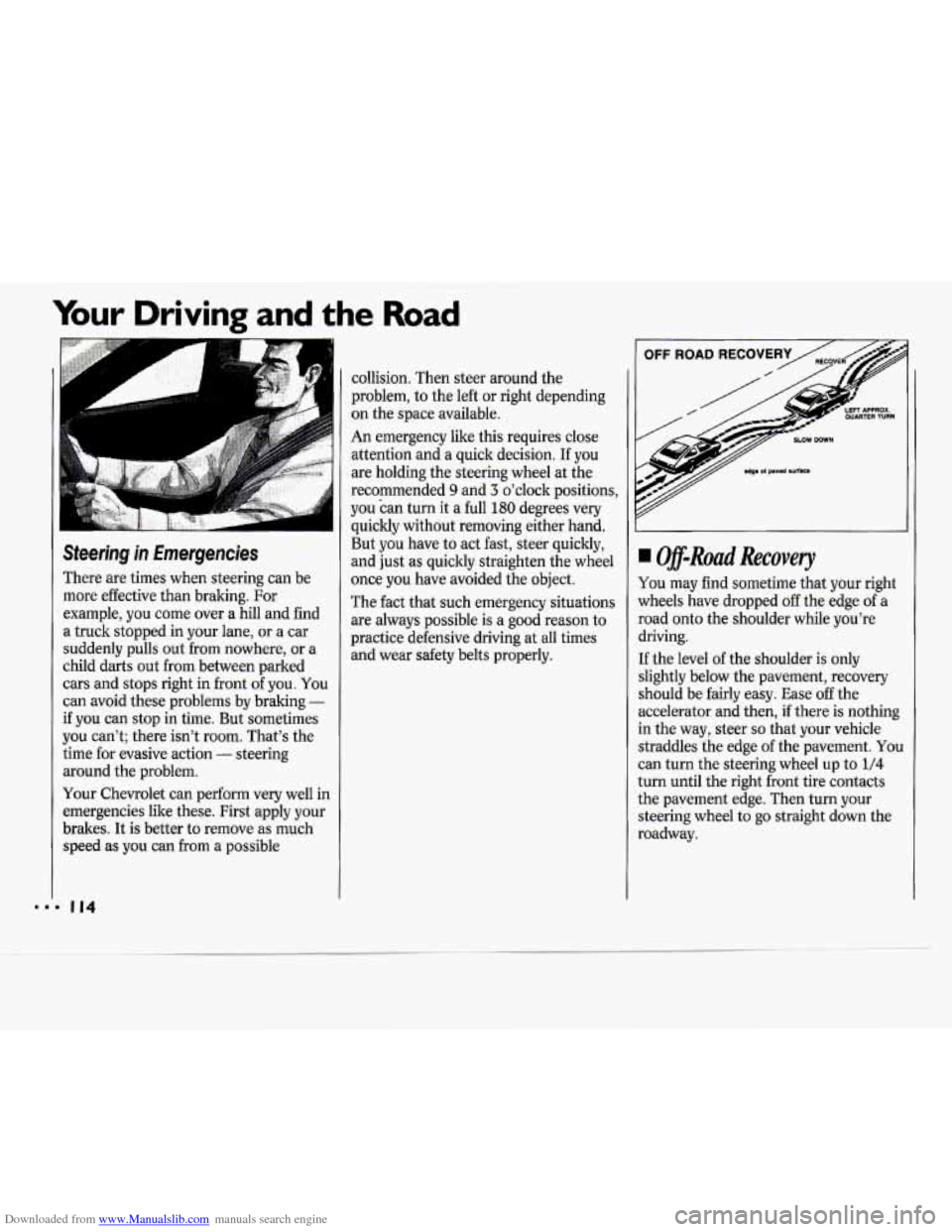
Steering in Emergencies
There are times when steering can De
more effective than braking. For
example, you come over a hill and find
a truck stopped in your lane, or a car
suddenly pulls out from nowhere, or a
child darts out from between parked
cars and stops right in front
of you. You
can avoid these problems by braking -
if you can stop in time. But sometimes
you can't; there isn't room. That's the
time for evasive action
- steering
around the problem.
Your Chevrolet
can perform very well in
emergencies like these. First apply your
brakes. It
is better to remove as much
speed as you can from a possible collision.
Then steer around the
problem, to the left or right depending
on the space available.
An emergency like this requires close
attention and a quick decision.
If you
are holding the steering wheel
at the
recommended
9 and 3 o'clock positions,
you can turn it a full
180 degrees very
quickly without removing either hand.
But you have to act fast, steer quickly,
and just as quickly straighten the wheel
once you have avoided the object.
The fact that such emergency situations
are always possible is a good reason to
practice defensive driving at all times
and wear safety belts properly. I Off-Ruad Recovery
You may find sometime that your right
lvheels have dropped
off the edge of a
soad onto the shoulder while you're
hiving.
:f the level of the shoulder is only
;lightly below the pavement, recovery
;hould be fairly easy. Ease off the
iccelerator and then, if there is nothing
n the way, steer
so that your vehicle
itraddles the edge of the pavement. You
:an turn the steering wheel up to
1/4
urn until the right front tire contacts
he pavement edge. Then turn your
;teering wheel
to go straight down the
toadway.
Page 117 of 243
Downloaded from www.Manualslib.com manuals search engine Your Driving and the Road
If you’re being passed, make it easy
for the following driver to get ahead of
you. Perhaps you can ease a little to
the right.
Loss of Control
Let’s review what driving experts say
about what happens when the three
control systems (brakes, steering and
acceleration) don’t have enough friction
where the tires meet the road to do
what the driver has asked.
In any emergency, don’t give up. Keep
trying to steer and constantly seek an
escape route or area
of less danger.
Skidding
In a skid, a driver can lose control of
the vehicle. Defensive drivers avoid
most skids by taking reasonable care
suited
to existing conditions, and by not
“overdriving” those conditions. But
skids are always possible.
The three types of skids correspond to
your Chevrolet’s three control systems.
In the braking skid your wheels aren’t
rolling.
In the steering or cornering
skid, too much speed or steering in a
curve causes tires to slip and lose
cornering force. And in the acceleration
skid too much throttle causes the
driving wheels to spin.
A cornering skid and an acceleration
skid are best handled by easing your
foot
off the accelerator pedal.
If your vehicle starts to slide, ease your
foot
off the accelerator pedal and
quickly steer the way
you want the
vehicle to go.
If you start steering
quickly enough, your vehicle may
straighten out. Always be ready for a
second skid
if it occurs. Of
course, traction is reduced when
water, snow, ice, gravel, or other
material is
on the road. For safety,
you’ll want to slow down and adjust
your driving to these conditions. It is
important to slow down on slippery
surfaces because stopping distance will
be longer and vehicle control more limited.
While driving
on a surface with reduced
traction,
try your best to avoid sudden
steering, acceleration, or braking (including engine braking by shifting to
a lower gear). Any sudden changes
could cause the tires to slide. You may
not realize the surface is slippery until
your vehicle is skidding. Learn
to
recognize warning clues - such as
enough water, ice or packed snow on
the road to make a “mirrored surface”
- and slow down when you have any
doubt.
Remember: Any anti-lock braking
system (ABS) helps avoid only the
braking slid.
Page 119 of 243
Downloaded from www.Manualslib.com manuals search engine Your Driving and the Road
Driving in the Rain
Rain and wet roads can mean driving
trouble. On a wet road you can’t stop,
accelerate or turn as well because your
tire-to-road traction isn’t as good as on
dry roads. And,
if your tires don’t have
much tread left, you’ll get even less
traction. It’s always wise to go slower
and be cautious if rain starts to fall
while you are driving. The surface may
get wet suddenly when your reflexes are
tuned for driving on dry pavement. The
heavier the rain, the harder it is to
see. Even
if your windshield wiper
blades are in good shape, a heavy rain
can make it harder to see road signs and
traffic signals, pavement markings, the
edge of the road, and even people
walking.
It’s wise
to keep your wiping equipment
in good shape and keep your windshield
washer tank filled. Replace your
windshield wiper inserts when they
show signs of streaking or missing areas
on the windshield, or when strips
of
rubber start to separate from the
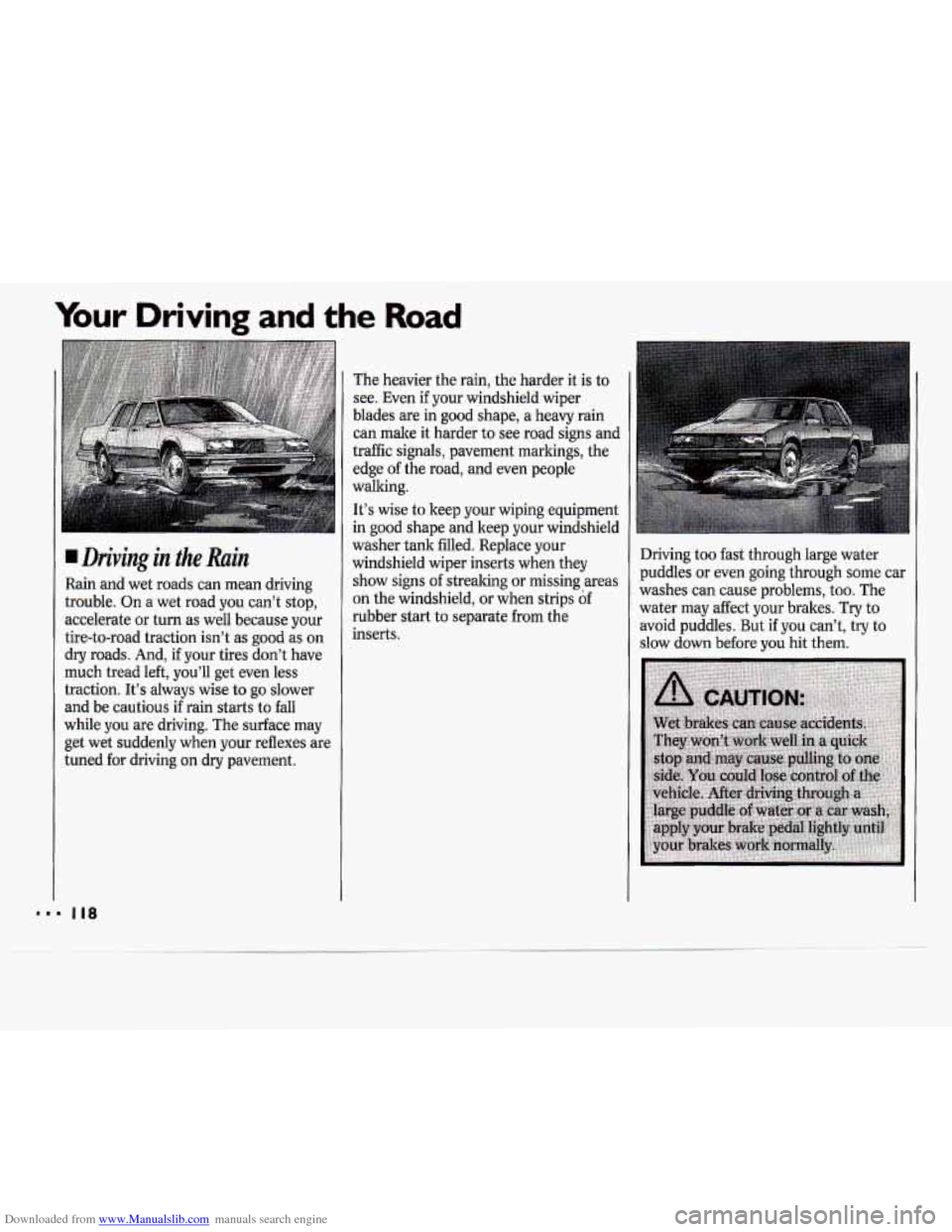
inserts. Driving
too fast through large water
puddles or even going through some car
washes can cause problems, too. The
water may affect your brakes. Try to
avoid puddles. But
if you can’t, try to
slow down before you
hit them.
Page 123 of 243
Downloaded from www.Manualslib.com manuals search engine Your Driving and the Road
Hill and Mountain Roads
Driving on steep hills or mountains is
different from driving in flat
or rolling
terrain.
If you drive regularly in steep country,
or if you’re planning to visit there, here
are some tips that can make your trips
safer and more enjoyable.
Keep your vehicle in good shape.
Check all fluid levels and also the
brakes, tires, cooling system and
transaxle. These parts can work hard
on mountain roads.
Know how to go down hills. The most
important thing to
know is this: let
your engine do some
of the slowing
down. Shift to a lower gear when you
go down a steep or long hill.
Know how to go uphill. You may
want to shift down to a lower gear.
The lower gears help cool your engine
and transaxle, and you can climb the
hill better.
Stay in your own lane when driving
on two-lane roads
in hills or mountains.
Don’t swing wide or cut across the
center of the road. Drive at speeds
that let you stay in your own lane.
As you go over the top of a hill, be
alert. There could be something in
your lane, like a stalled car or an
accident.
You may see highway signs on
mountains that warn of special
problems. Examples are long grades,
passing or no-passing zones,
a falling
rocks area, or winding roads.
Be alert
to these and take appropriate action.