1994 CHEVROLET BLAZER engine oil
[x] Cancel search: engine oilPage 289 of 348
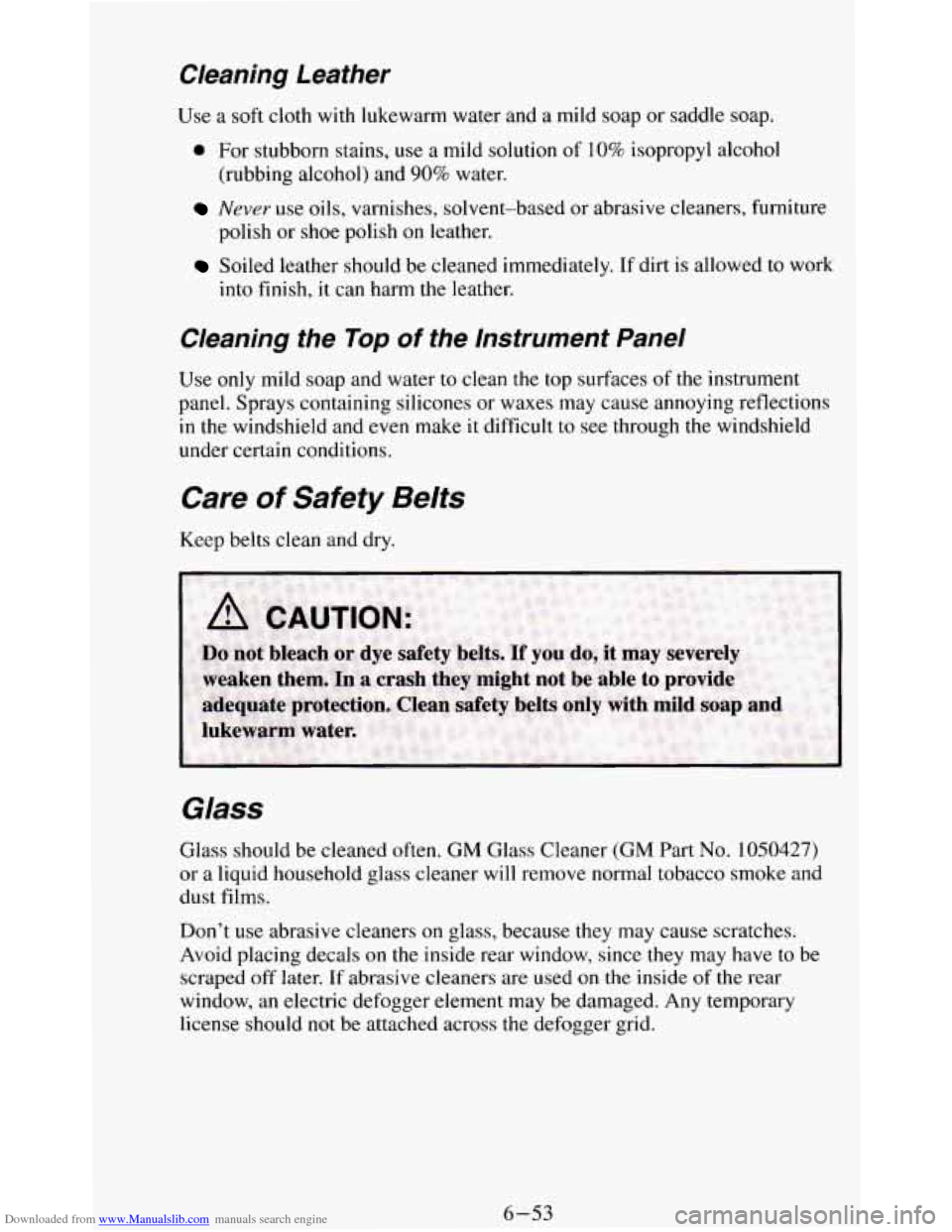
Downloaded from www.Manualslib.com manuals search engine Cleaning Leather
Use a soft cloth with lukewarm water and a mild soap or saddle soap.
0 For stubborn stains, use a mild solution of 10% isopropyl alcohol
(rubbing alcohol) and
90% water.
Never use oils, varnishes, solvent-based or abrasive cleaners, furniture
Soiled leather should be cleaned immediately. If dirt is allowed to work
polish
or shoe polish on leather.
into
finish, it can harm the leather.
Cleaning the Top of the Instrument Panel
Use only mild soap and water to clean the top surfaces of the instrument
panel. Sprays containing silicones or waxes may cause annoying reflections
in the windshield and even make it difficult to see through the windshield
under certain conditions.
Care of Safety Belts
Keep belts clean and dry.
Glass
Glass should be cleaned often. GM Glass Cleaner (GM Part No. 1050427)
or a liquid household glass cleaner
will remove normal tobacco smoke and
dust films.
Don’t use abrasive cleaners on glass, because they may cause scratches.
Avoid placing decals on the inside rear window, since they
may have to be
scraped off later.
If abrasive cleaners are used on the inside of the rear
window, an electric defogger element
may be damaged. Any temporary
license should not be attached across the defogger grid.
6-53
Page 291 of 348
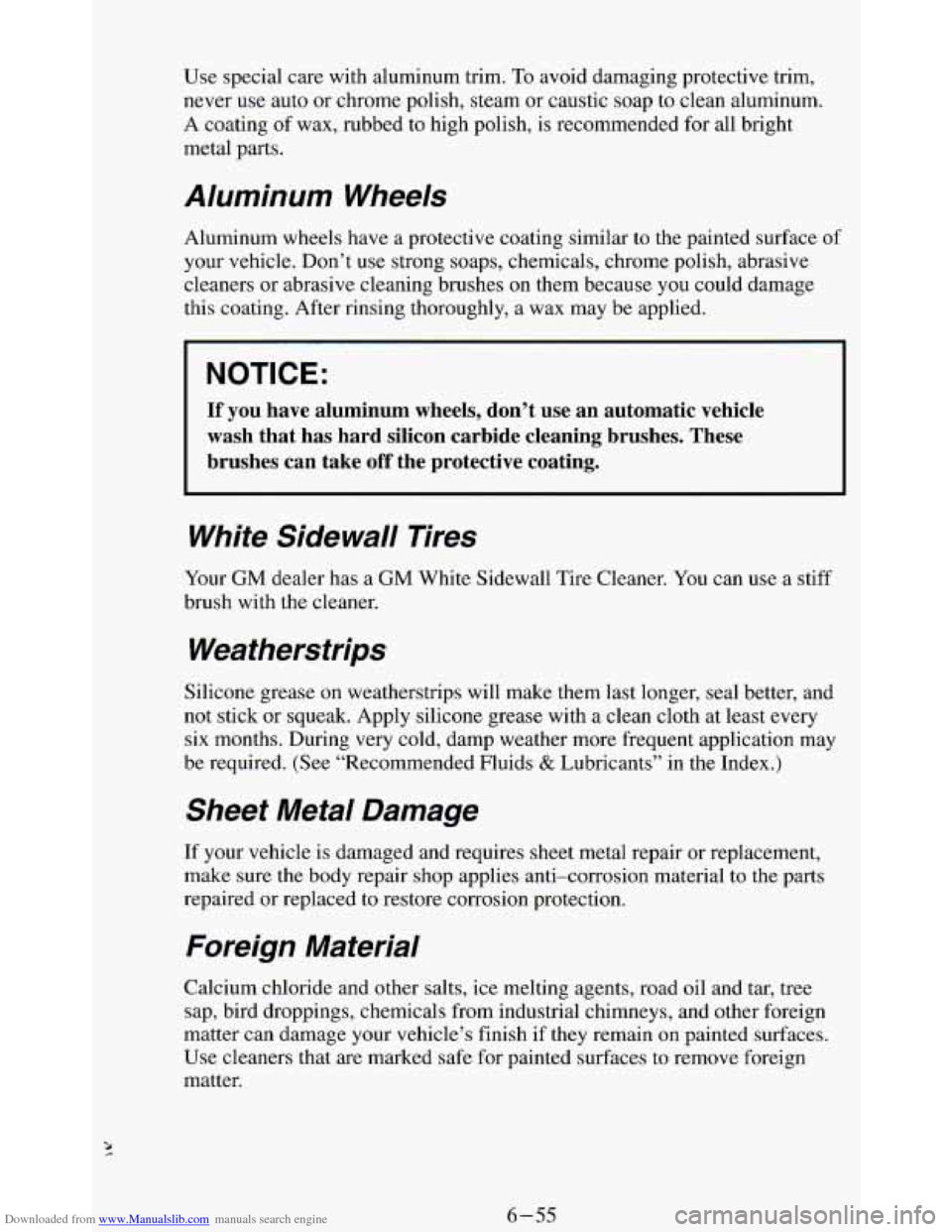
Downloaded from www.Manualslib.com manuals search engine Use special care with aluminum trim. To avoid damaging protective trim,
never use auto or chrome polish, steam or caustic soap to clean aluminum.
A coating of wax, rubbed to high polish, is recommended for all bright
metal parts.
Aluminum Wheels
Aluminum wheels have a protective coating similar to the painted surface of
your vehicle. Don’t use strong soaps, chemicals, chrome polish, abrasive
cleaners or abrasive cleaning brushes on them because you could damage
this coating. After rinsing thoroughly, a wax may be applied.
I NOTICE:
If you have aluminum wheels, don’t use an automatic vehicle
wash that has hard silicon carbide cleaning brushes. These
brushes can take
off the protective coating.
White Side wa// Tires
Your GM dealer has a GM White Sidewall Tire Cleaner. You can use a stiff
brush with the cleaner.
Weatherstrips
Silicone grease on weatherstrips will make them last longer, seal better, and
not stick or squeak. Apply silicone grease with a clean cloth at least every
six months. During very cold, damp weather more frequent application may
be required. (See “Recommended Fluids
& Lubricants” in the Index.)
Sheet Metal Damage
If your vehicle is damaged and requires sheet metal repair or replacement,
make sure the body repair shop applies anti-corrosion material to the parts
repaired
or replaced to restore corrosion protection.
Foreign Material
Calcium chloride and other salts, ice melting agents, road oil and tar, tree
sap, bird droppings, chemicals from industrial chimneys, and other foreign
matter can damage your vehicle’s finish if they remain on painted surfaces.
Use cleaners that are marked safe for painted surfaces to remove foreign
matter.
4
6-55
Page 293 of 348
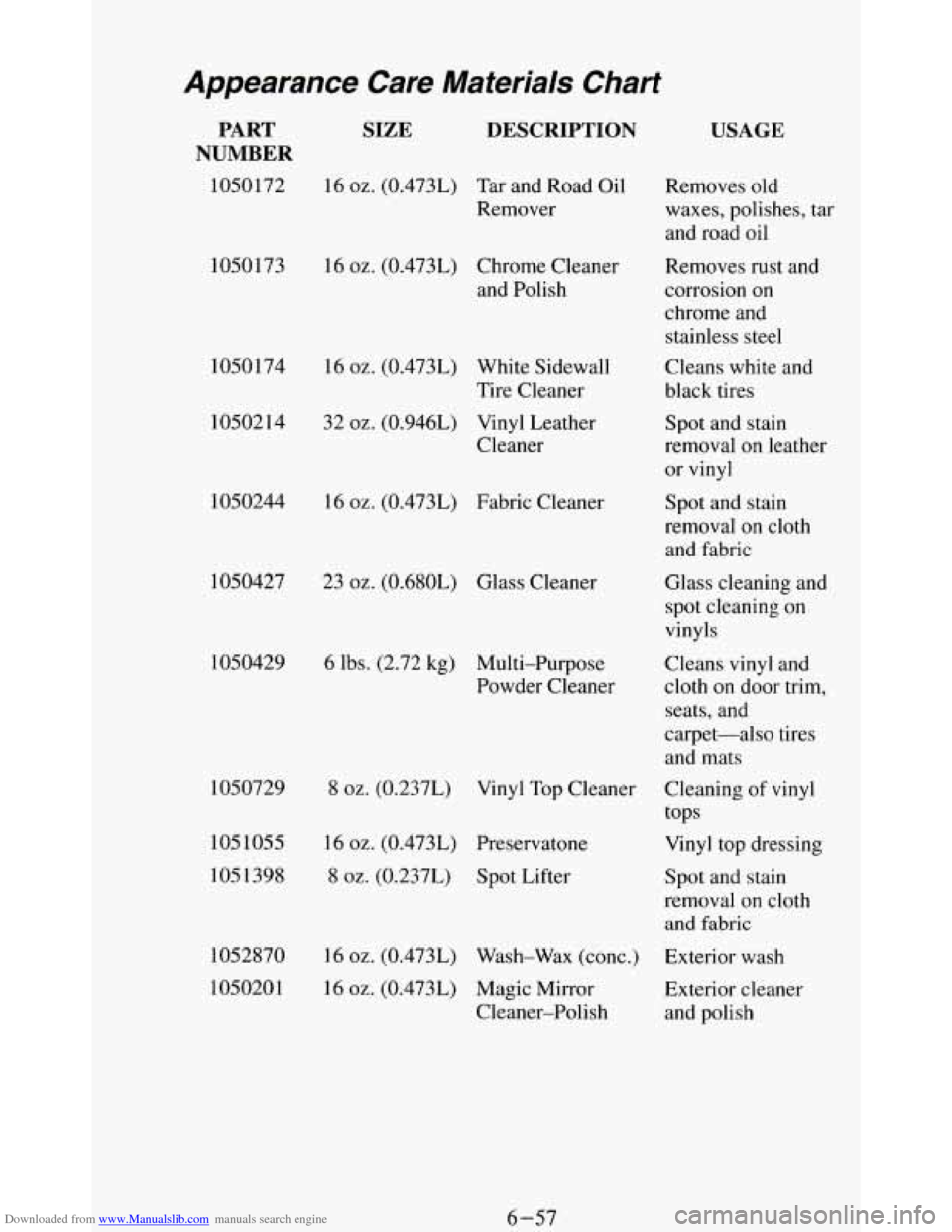
Downloaded from www.Manualslib.com manuals search engine SIZE DESCRIPTION PART
NUMBER
1050172 16 oz. (0.473L) Tar and Road Oil
Remover
1050173 16
oz. (0.4731) Chrome Cleaner
and Polish
1050174 16
oz. (0.473L) White Sidewall
1050214 32
oz. (0.946L) Vinyl Leather
Tire
Cleaner
Cleaner
1050244 16
oz. (0.473L) Fabric Cleaner
1050427 23
oz. (0.680L) Glass Cleaner
1050429
6 lbs. (2.72 kg) Multi-Purpose
Powder Cleaner
1050729
USAGE
Removes old
waxes, polishes, tar
and road oil
Removes rust and
corrosion on
chrome and
stainless steel
Cleans white and
black tires
Spot and
stain
removal on leather
or
vinyl
Spot and stain
removal on cloth
and fabric
Glass cleaning and
spot cleaning on
vinyls
Cleans
vinyl and
cloth
on door trim,
seats, and
carpet-also tires
and mats
8 02. (0.237L) Vinyl Top Cleaner Cleaning of vinyl
tops
105 1055
16 oz. (0.473L) Preservatone
105 1398
8 oz. (0.237L) Spot Lifter
Vinyl top dressing
Spot and stain
removal
on cloth
and fabric
1052870 16
oz. (0.473L) Wash-Wax (conc.)
Exterior wash
1050201
16 oz. (0.473L) Magic Mirror
Exterior cleaner
Cleaner-Polish and polish
6-57
Page 304 of 348

Downloaded from www.Manualslib.com manuals search engine NAME
ECM I
PWR
WINDOW
WIPER
BRAKE DRL
CIRCUITS PROTECTED FUSE
Engine Control Module Power Windows 10 Amp
Windshield Wipers and
25 Amp
Washers
Four-wheel Anti-lock Brake 15 Amp
Module, Digital Ratio Adapter
Module, Speedometer, Auto
Transmission Converter
Clutch
Daytime Running Light
(Canada Only)
Trailer Wiring
Harness
CD PlayedRadio
TRAILER*
CD
PLAYER**
TCCM
Electric Shift Transfer Case
Module
AUX PWR** Aux. Pwr. Outlet
10 Amp
30 Amp
10 Amp
5 Amp
10 Amp
*In-line fuse
**Fuse is attached
to fuse block.
Service Replacement Part and Filter
Recommendafons
ENGINE (VIN)
OIL FILTER
AIR CLEANER
FILTER PCV VALVE
SPARK PLUGS
FUEL FILTER
RADIATOR CAP 4.3L (2)
PF52
A773C
CV789C
.CR43TSM
GF48 1
RC36
CIRCUIT
BREAKER
30 Amp
4.3L(W)
PF52
A1163C
cv774c
.CR43TSM
GF48 1
RC36
*Use copper-cored resistor type spark plugs.
6-68
Page 312 of 348
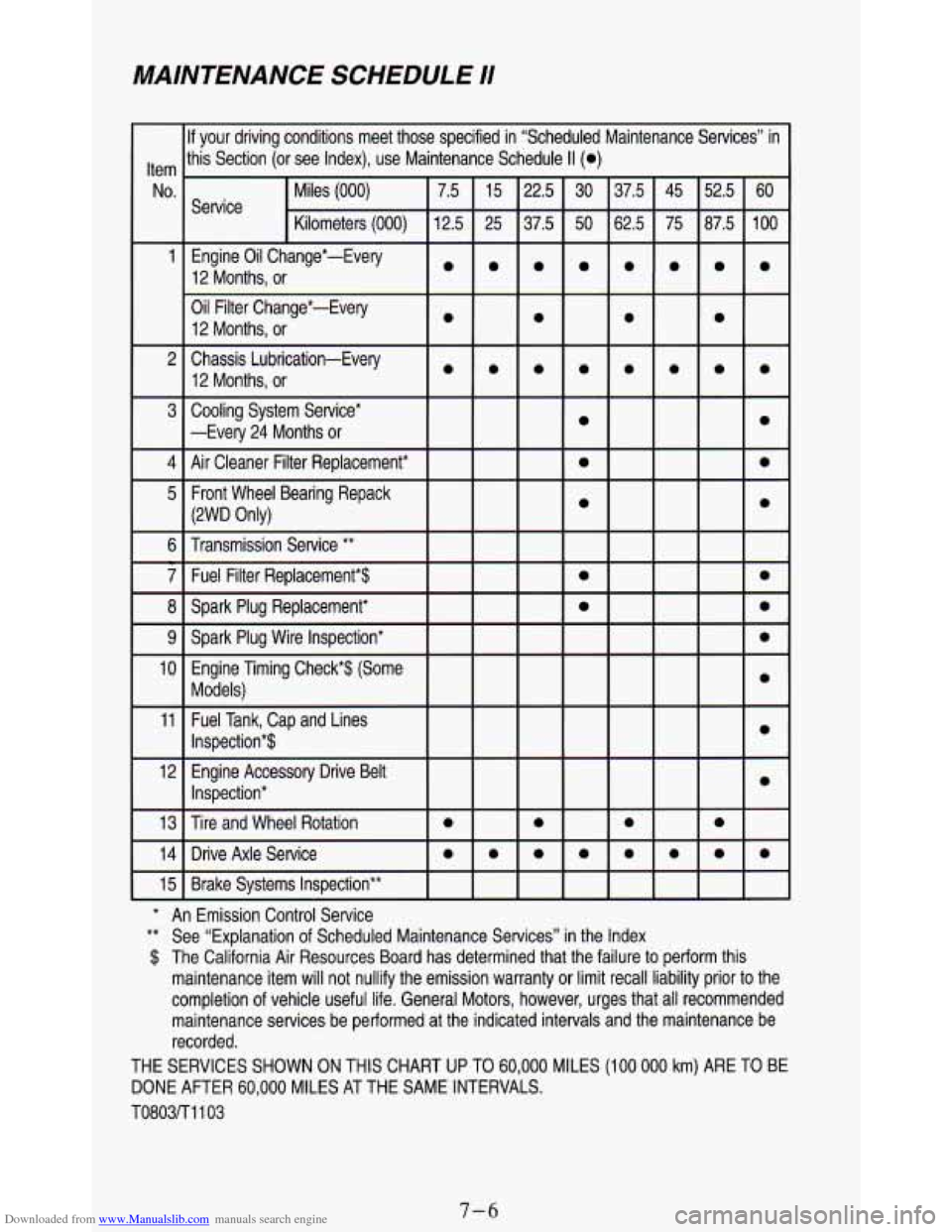
Downloaded from www.Manualslib.com manuals search engine MAINTENANCE SCHEDULE /I
llf your driving conditions meet tho:
Item Ithis
Section (or see Index), use M;
Miles
(000)
Service
Oil Filter Change*-Every 12 Months, or
3 Cooling System Service* -Every 24 Months or
4 Air Cleaner Filter Replacement*
5 Front Wheel Bearing Repack (2WD Only)
6 Transmission Service
**
7 Fuel Filter Replacement*$
8 Spark Plug Replacement*
9 Spark Plug Wire Inspection*
10 Engine Timing Check*$ (Some
11 Fuel Tank, Cap and Lines Models)
Inspection*$
12 Engine Accessory Drive Belt
I Inspection*
13
I Tire and Wheel Rotation
14
I Drive Axle Service
15
I Brake Systems Inspection**
3 specified in “Scheduled Maintc
lntenance Schedule
II (0)
lance Services” in
* An Emission Control service
** See “Explanation of Scheduled Maintenance Services” in the Index
$ The California Air Resources Board has determined that the fail\
ure to perform this
maintenance item will not nullify the emission warranty
or limit recall liability prior to the
completion of vehicle useful life. General Motors, however, urges that all re\
commended
maintenance services be performed at the indicated intervals and\
the maintenance be
recorded.
THE SERVICES SHOWN ON THIS CHART
UP TO 60,000 MILES (100 000 km) ARE TO BE
DONE AFTER
60,000 MILES AT THE SAME INTERVALS.
T0803/Tl103
7-6
Page 313 of 348

Downloaded from www.Manualslib.com manuals search engine Explanation Of Scheduled Maintenance Services
Below are explanations of the services listed in the maintenance charts.
The proper fluids and lubricants to use are listed in this section. Make sure
whoever services your vehicle
uses these. All parts should be replaced and
all necessary repairs done before you or anyone else drives the vehicle.
1.
2.
3.
4.
5.
ENGINE OIL AND OIL FILTER CHANGE* - ALWAYS USE
API SERVICE SH OR SG ENERGY CONSERVING I1 OILS OF THE
PROPER VISCOSITY. The “SH” or “SG” designation may be shown
alone or in combination with others, such as “SHKD”, or
“SH, SG,
CD,” or “SG/CD”, etc.
To determine the preferred viscosity oil for your
vehicle’s engine (e.g. SAE
5W-30), see “Engine Oil” in the Index.
CHASSIS LUBRICATION - Lubricate the front suspension, ball
joint, steering linkage, and transfer case shift linkage, parking brake
cable guides, propshaft splines, universal joints, brake pedal springs,
and clutch pedal springs at the intervals specified on the proper
maintenance schedule, or at every engine oil change, whichever comes
first.
Ball joints should
not be lubricated unless their temperature is 10°F
(-12°C) or higher. When the weather is cold, let them warm up before
lubricating them
or they could be damaged.
Also, be sure to check all the vehicle fluid levels at this time.
COOLING SYSTEM SERVICE* - Drain, flush and refill the
system with new or approved recycled coolant conforming to “GM
Specification
603%”’. See “Engine Coolant” in the Index for the
proper coolant and mixture to use in your vehicle.
Also inspect
the hoses and replace them if they are cracked, swollen, or
deteriorated. Clean the outside of the radiator and air conditioning
condenser. Wash the radiator neck. To ensure proper operation,
pressure test the radiator and cap.
AIR CLEANER FILTER REPLACEMENT” - Replace at
specified intervals. Ask your dealer for the proper replacement
intervals for your driving conditions.
FRONT WHEEL BEARING REPACK (2-WHEEL DRIVE
ONLY) - Clean and repack the front wheel bearings at each brake
relining,
or at the specified interval, whichever comes first.
*An Emission Control Service
7-7
Page 315 of 348
Downloaded from www.Manualslib.com manuals search engine 13. TIRE AND WHEEL ROTATION AND INSPECTION - For
proper wear and maximum tire life, rotate tires at the first
6,000 miles
(10
000 kilometers) for Schedule I or 7,500 miles (12 500 kilometers)
for Schedule I1 and then every 15,000 miles
(25 000 kilometers)
thereafter. Follow the instructions and patterns shown in Section
6.
Check tires for uneven wear or damage. If irregular or premature wear
is apparent, check wheel alignment. Also, check for damaged wheels.
See “Tires” in the Index for more information.
14.
DRIVE AXLE SERVICE - Check readfront axle fluid level and add
as needed. Check constant velocity joints and axle seals for leaking.
Locking Differential - Drain fluid at first oil change and refill.
Check fluid
level and add as needed at subsequent oil changes. In
dusty areas or trailer towing applications, drain fluid at every
15,000 miles (24 135 kilometers) and refill.?
Standard Differential - Check fluid level and add as needed at
every oil change. In dusty areas or trailer towing applications,
drain fluid every
15,000 miles (24 135 kilometers) and refill.?
More frequent lubrication may be required for off-road use.
15. BRAKE SYSTEM INSPECTION - When the engine oil is changed,
inspect the lines and hoses for proper hookup, binding, leaks, cracks,
chafing, etc. Check the parking brake adjustment, and the fluid level in
the master cylinder. A low fluid level can indicate worn disc brake pads
which may need
to be serviced.?
When the wheels are removed for rotation, inspect disc brake pads for
wear and rotors for surface condition. Also inspect drum brake linings
for wear and cracks. Inspect other brake parts, including drums, wheel
cylinders, parking brake, etc. at the same time.
Inspect brakes more often if driving habits or conditions resul\
t in
frequent braking.
.L t A fluid loss in these systems may indicate a problem. Have them inspected
and repaired at once.
7-9
Page 318 of 348
Downloaded from www.Manualslib.com manuals search engine Periodic Maintenance Inspections
Listed below are inspections and services which should be performed at
least twice a year (for instance, each spring and fall). You should let your
GM dealer’s service department or other qualified service center do these
jobs. Make sure any necessary repairs are completed at once.
Steering and Suspension Inspection? - Inspect front and rear suspension
and steering system for damaged,
loose or missing parts, signs of wear or
lack of lubrication. Inspect power steering lines and hoses for proper
hook-up, binding, leaks, cracks, chafing, etc. (On vehicles equipped with
manual steering gear, check for seal leakage). Lubricate the steering linkage.
Accelerator Control System - Lubricate all pivot points with engine oil,
except the
TBI throttle shaft. Do not lubricate the cam pulley. Remove all
external deposits from pulley.
Do not oil any accelerator or cruise control
cables. Replace any cables that have high effort or excessive wear.
Exhaust System Inspection - Inspect the complete system. Inspect the
body near the exhaust system. Look for broken, damaged, missing or
out-of-position parts,
as well as open seams, holes, loose connections or
other conditions which could cause a heat buildup in the floor pan or could
let exhaust fumes seep into the passenger compartments. See “Engine
Exhaust” in the Index.
Drive Axle Service - Check readfront axle fluid level and add as needed.
Check constant velocity joints and axle seals for leaking.
Transfer Case (four-wheel drive) Inspection? - Every 12 months or at
oil change intervals, check front axle and transfer case and add lubricant
when necessary. Check vent hose at transfer case for kinks and proper
installation. More frequent lubrication may be required
on off-road use.
?A fluid loss in these systems may indicate a problem. Have them inspected
and repaired at once.
7- 12