1994 CHEVROLET BLAZER check engine light
[x] Cancel search: check engine lightPage 200 of 348
Downloaded from www.Manualslib.com manuals search engine Making Turns
When you’re turning with a trailer, make wider turns than normal. Do this
so your trailer won’t strike soft shoulders, curbs, road signs, trees, or other
objects. Avoid jerky or sudden maneuvers. Signal well
in advance.
Turn Signals When Towing a Trailer
When you tow a trailer, your vehicle has to have a different turn signal
flasher and extra wiring. The green arrows
on your instrument panel will
flash whenever you signal a turn or lane change. Properly hooked up, the
trailer lights will also flash, telling other drivers you’re about to turn,
change lanes or stop.
When towing a trailer, the green arrows
on your instrument panel will flash
for turns
even if the bulbs on the trailer are burned out. Thus, you may think
drivers behind you are seeing your signal when
they are not. It’s important
to check occasionally to be sure the trailer bulbs are still working.
Driving On Grades
Reduce speed and shift to a lower gear before you start down a long or
steep downgrade. If you don’t
shift down, you might have to use your
brakes
so much that they would get hot and no longer work well.
On a long uphill grade, shift down and reduce your speed
to around 45 mph
(70 kdh) to reduce the possibility of engine and transmission overheating.
If you have an automatic transmission,
you should use “D” when towing a
trailer. Operating your vehicle in “D” when towing a trailer will minimize
heat buildup and extend the
life of your transmission. Or, if you have a
manual transmission with
fifth gear, it’s better not to use fifth gear, just
drive in fourth gear (or, as
you need to, a lower gear).
Parking on Hills
You really should not park your vehicle, with a trailer attached, on a hill. If
something goes wrong, your rig could start to move. People can be injured,
and both your vehicle and the trailer can be damaged.
But if you ever have
to park your rig on a hill, here’s how to do it:
1. Apply your regular brakes, but don’t shift into “P” (Park) yet, or into
gear for a manual transmission.
2. Have someone place chocks under the trailer wheels.
3. When the wheel chocks are in place, release the regular brakes until the
chocks absorb
the load.
4-42
Page 202 of 348
Downloaded from www.Manualslib.com manuals search engine Maintenance When Trailer Towing
Your vehicle will need service more often when you’re pulling a trailer. See
the Maintenance Schedule for more on this. Things that are especially
important in trailer operation are automatic transmission fluid (don’t
overfill), engine oil, axle lubricant, belt, cooling system, and brake
adjustment. Each of these is covered
in this manual, and the Index will help
you find them quickly. If you’re trailering,
it’s a good idea to review these
sections before you start your trip.
Check periodically to see that
all hitch nuts and bolts are tight.
Trailer Light Wiring
See “Trailer Wiring Harness” in the Index.
Power Winches
If you wish to use a power winch on your vehicle, only use it when your
vehicle
is stationary or anchored.
! NOTICE:
~ When operating a power winch on your vehicle always leave the \
l transmission in the neutral position. Do not leave an automatic
transmission in
P (Park) or a manual transmission in gear or the
transmission may be damaged.
Use the regular brakes, set the parking brake or block the wheels to keep
your vehicle from rolling.
4-44
Page 206 of 348
Downloaded from www.Manualslib.com manuals search engine 2.
3.
Get the vehicles close enough so the jumper cables can reach, but be
sure the vehicles
aren’t touching each other. If they are, it could cause
ground connection you don’t want. You wouldn’t be able to start you1
vehicle, and the bad grounding could damage the electrical systems.
You could be injured if the vehicles roll. Set
the parking brake firmly
on each vehicle. Put an automatic transmission in “P’ (Park) or a
a
manual transmission in “N” (Neutral). If you have a four-wheel-drive
vehicle with
a manual transfer case shift lever, be sure the transfer case
is not in “N” (Neutral).
Turn
off the ignition on both vehicles. Turn off all lights that aren’t
needed, and radios. This will avoid sparks and help save both batteries.
And it could save your radio!
~~~
NOTICE:
~~
If you leave your radio on, it could be badly damaged. The
repairs wouldn’t be covered by your warranty.
4. Open the hoods and locate the batteries. Find the positive (+) and
negative (-) terminals on each battery.
5. Check that the jumper cables don’t have loose or missing insulation. If
they do, you could get a shock. The vehicles could be damaged, too.
Before you connect the cables, here are some basic things you should
know. Positive
(+) will go to positive (+) and negative (-) will go to
5-4
Page 256 of 348
Downloaded from www.Manualslib.com manuals search engine Hydraulic Clutch
The hydraulic clutch in your vehicle is self-adjusting. A slight amount of
play (114 inch to 1/2 inch) in the pedal is normal.
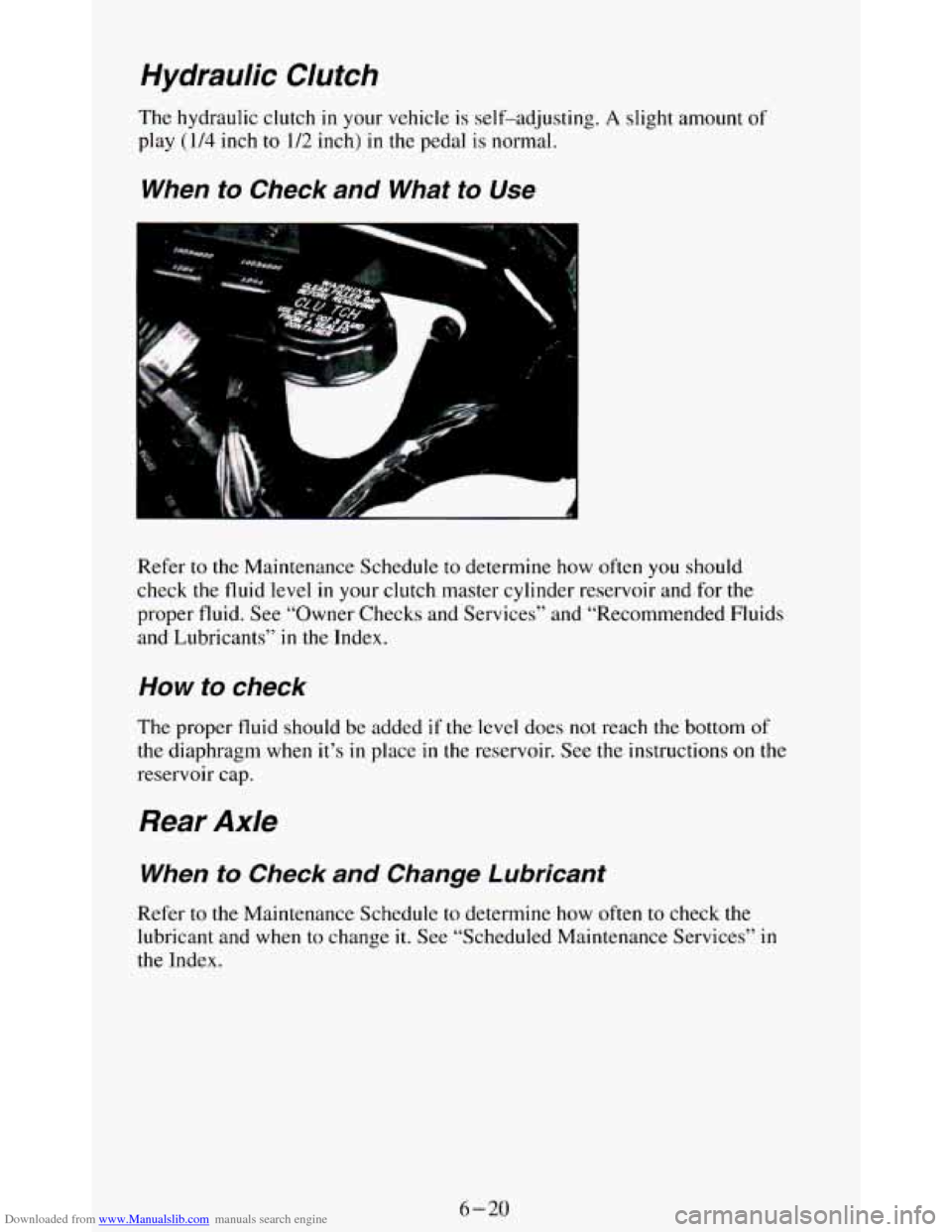
When to Check and What to Use
A
Refer to the Maintenance Schedule to determine how often you should
check
the fluid level in your clutch master cylinder reservoir and for the
proper fluid. See “Owner Checks and Services” and “Recommended Fluids
and Lubricants”
in the Index.
How to check
The proper fluid should be added if the level does not reach the bottom of
the diaphragm when it’s
in place in the reservoir. See the instructions on the
reservoir cap.
Rear Axle
When to Check and Change Lubricant
Refer to the Maintenance Schedule to determine how often to check the
lubricant and when to change
it. See “Scheduled Maintenance Services” in
the Index.
6-20
Page 273 of 348
Downloaded from www.Manualslib.com manuals search engine Propeller Shaft Slip Splines/Universal Joints
Refer to the Maintenance Schedule to determine how often the slip and
universal joints must be lubricated and what type of lubricant to use.
Body
Normal use of your vehicle will cause metal to metal wear at some points on
the cab and body if they are not lubricated.
For exposed surfaces, such as door checks, door lock bolts, lock s\
triker plates,
dovetail bumper wedges, etc., a
thin film of engine oil should be applied.
Where oil holes are provided
in the body or cab, a dripless oil can be used.
The seat adjusters and seat track should be lubricated with chassis grease.
Door weatherstrips and rubber hood bumpers should be wiped clean with a
wet cloth and lightly coated with a rubber lubricant.
Never use too much of any lubricant and be sure to wipe up any extra
lubricant when
you are finished.
Window regulators and controls are inside the doors. They are lubricated
with a long lasting grease.
If lubrication is required your dealer should
perform this service.
Refer to the Maintenance Schedule to determine how often to lubricate
these items and what type of lubricant to use.
Lock Cylinders
To be sure your locks operate properly, they must be lubricated.
Refer to the Maintenance Schedule to determine how often
to lubricate them
and what type of lubricant to
use.
You should not use penetrating oils because they could wash out the factory
installed lubricant and cause
the lock to bind. De-icers which contain
alcohol could also wash away the lubricant,
so be sure to lubricate the lock
after using a de-icer of this type.
Endgate Handle
The endgate handle pivot points on your vehicle should be lubricated to
keep the handle working smoothly.
Refer to the Maintenance Schedule
to determine how often to lubricate them
and what type of lubricant to use.
6-37
Page 297 of 348
Downloaded from www.Manualslib.com manuals search engine Headlights
The headlight wiring is protected by a circuit breaker in the light switch. An
electrical overload will cause the lights to go on and off. If this happens,
have your headlight wiring checked right away.
Windshield Wipers
The windshield wiper motor is protected by a circuit breaker and a fuse. If
the motor overheats due to heavy snow, etc., the wiper will stop until the
motor cools. If the overload is caused by some electrical problem and not
snow, etc., be sure to get it fixed.
Power Windows and Other Power Options
Circuit breakers in the fuse panel protect the power windows and other
power accessories. When the current load is too heavy, the circuit breaker
opens and closes, protecting the circuit until the problem
is fixed.
Trailer Wiring Harness
The optional seven-wire trailer wiring harness is protected by an in-line
fuse in the battery feed wire. This fuse is near the junction block. See
“Trailer Wiring Harness” in the
Features & Controls section.
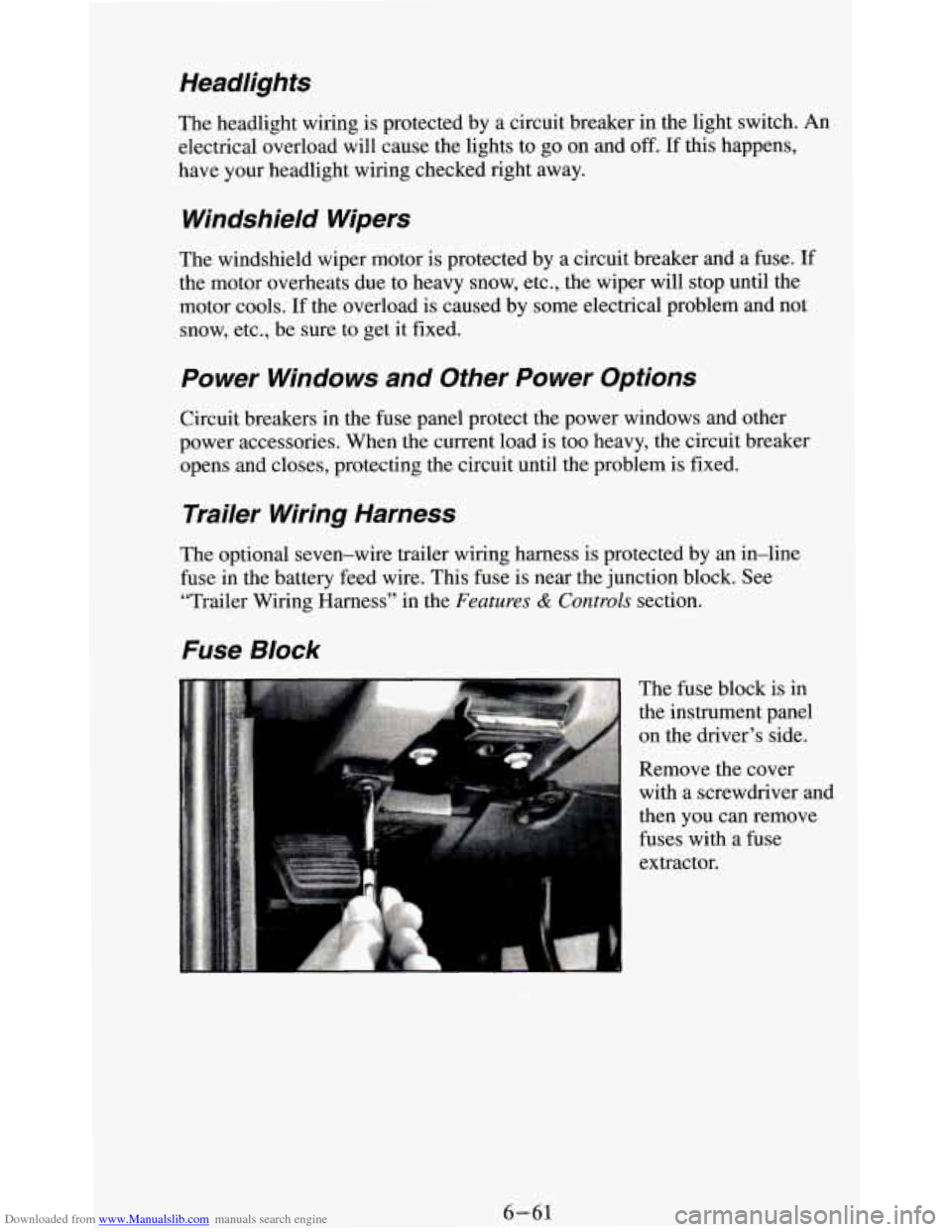
Fuse Block
The fuse block is in
the instrument panel
on the driver’s side.
Remove the cover
with a screwdriver and
then you
can remove
fuses with a fuse
extractor.
6-61
Page 300 of 348
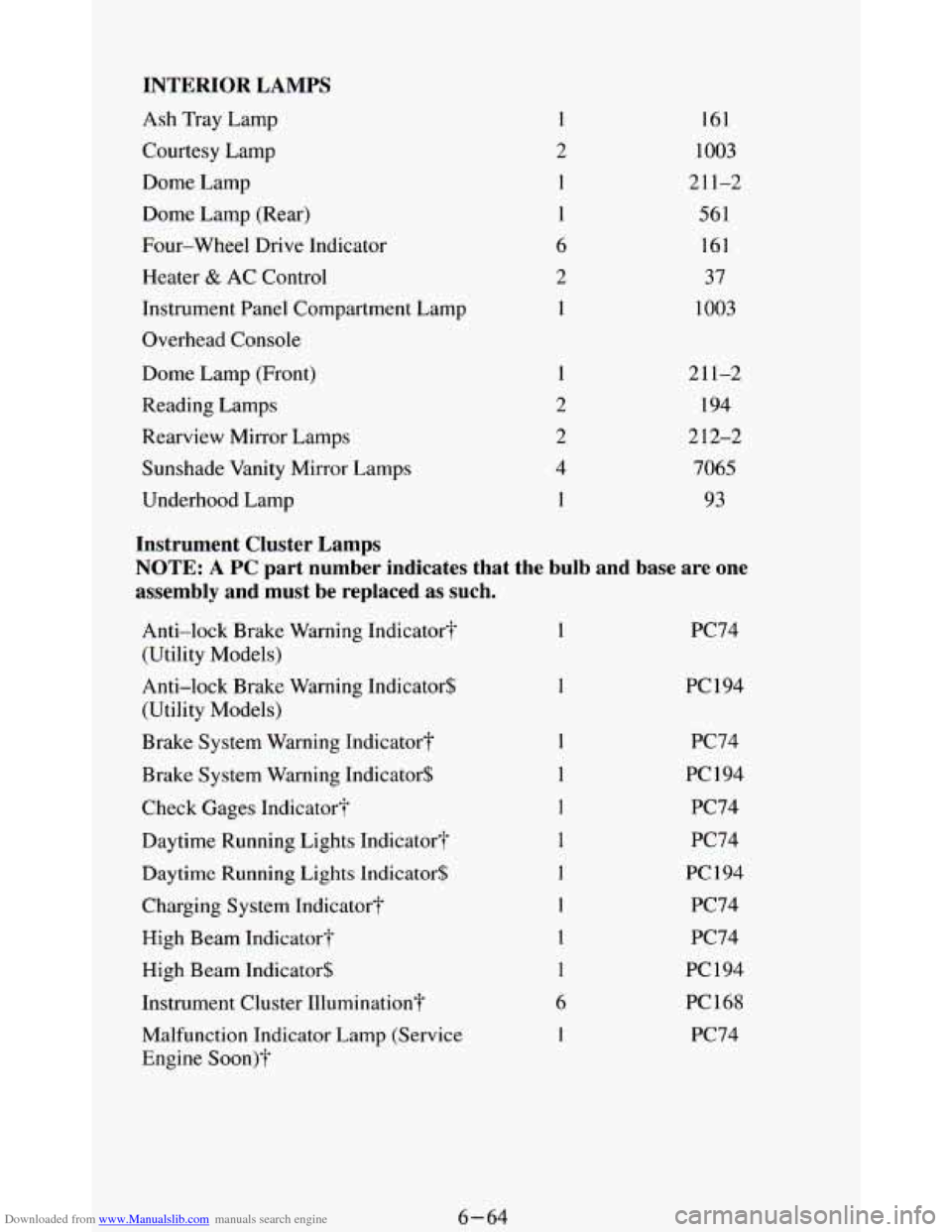
Downloaded from www.Manualslib.com manuals search engine INTERIOR LAMPS
Ash Tray Lamp
Courtesy Lamp
Dome Lamp Dome Lamp (Rear)
Four-wheel Drive Indicator
Heater
& AC Control
Instrument Panel Compartment Lamp
Overhead Console
Dome Lamp (Front)
Reading Lamps
Rearview Mirror Lamps
Sunshade Vanity Mirror Lamps
Underhood Lamp
161
1003
21 1-2
561
161
37
1003
211-2 194
2 12-2
7065 93
Instrument Cluster Lamps
NOTE:
A PC part number indicates that the bulb and base are one
assembly and must be replaced as
such.
Anti-lock Brake Warning Indicator?
(Utility Models)
Anti-lock Brake Warning Indicator$
(Utility Models)
Brake System Warning Indicator?
Brake System Warning Indicator$
Check Gages Indicator?
Daytime Running Lights Indicator’f
Daytime Running Lights Indicator$
Charging System Indicator?
High Beam Indicator?
High Beam Indicator$
Instrument Cluster Illumination?
Malfunction Indicator Lamp (Service
Engine Soon)?
1
1
1
1
1
I
1
1
1
6
1
PC74
PC 194
PC74
PC 194
PC74
PC74
PC 194
PC74
PC74
PC 194
PC168 PC74
6-64
Page 332 of 348
Downloaded from www.Manualslib.com manuals search engine Bulletins cover various subjects. Some pertain to the proper use and care of
your vehicle. Some describe costly repairs. Others describe inexpensive
repairs which, if done on time with the latest parts, may avoid future costly
repairs. Some bulletins tell a technician how to repair a new or unexpected
condition. Others describe a quicker way
to fix your vehicle. They can help
a technician service your vehicle better.
Most bulletins apply to conditions affecting a small number of cars or
trucks. Your Chevrolet dealer or a qualified technician may have to
determine if a specific bulletin applies to your vehicle.
You can subscribe to all Chevrolet’s bulletins by calling Helm, Inc. at
1-800-782-4356. This way you’ll get them
as they become available.
Individual PSP’s
If you don’t want to buy all the PSP’s issued by Chevrolet for all car or
truck models
in the model year, you can buy individual PSP’s, such as those
which may pertain
to a particular model. To do this, you will first need to
see our index of PSP’s. It provides a variety of information. Here’s what
you’ll find in the index and how
you can get one:
What You’ll Find in the Index:
A list of PSP’s published by Chevrolet in a model year (1990 or later).
PSP’s covering all models of Chevrolet cars or light trucks (less than
10,000 pounds (4 536 kg) GVWR) are listed in the same index.
Ordering information so you can buy the specific PSP’s you may want.
0 Price information for the PSP’s you may want to buy.
How You Can Get an Index:
Indexes are published periodically. Most of the PSP’s which could
potentially apply to the most recent Chevrolet models will be listed in the
most recent publication for that model year. This means you may want
to
wait until the end of the model year before ordering an index, if you are
interested in buying PSP’s pertaining to a current model year car or truck.
Some PSP’s pertaining to a particular model year vehicle may be published
in later years, and these would be listed in the later year’s index. When
you
order an index for a model year that is not over yet, we’ll send you the most
recently published issue. Check the ordering form for indexes for earlier
model years.
Cut out the ordering form, fill it out, and mail it in. We will then
see to it
that an index is mailed
to you. There is no charge for indexes for the
1989- 1994 model years.
8-8