Page 274 of 399
Downloaded from www.Manualslib.com manuals search engine NOTICE:
If the air cleaner is off, a backfire can cause a damaging engine
fire.
And, dirt can easily get into your engine, which will damage
it. Always have the air cleaner in place when you’re driving.
AUTOMMTIC TRASAXLE FLUID
Men to Check and Change
A good time to check your automatic transaxle fluid level is when the
engine oil is changed. Refer to the Maintenance Schedule to determine
when to change your fluid. See “Scheduled Maintenance Services”
in the
Index.
How to Check
Because this operation can De a little difficult, you may choose to have
this done at
a Cadillac dealership Service Department.
If you do it yourself, be sure to follow all the instructions here, or you
could get
a false reading on the dipstick.
261
Page 275 of 399
Downloaded from www.Manualslib.com manuals search engine NOTICE:
Too much or too little fluid can damage your transaxle. Too
much can mean that some of the fluid could come out and fall
on hot engine parts or exhaust system, starting a fire. Be sure to
get an accurate reading if
you check your transaxle fluid.
Wait at least 30 minutes before checking the transaxle fluid level if you
have been driving:
When outside temperatures are above 90 F (32 C).
At high speed for quite a while.
a In heavy traffic -- especially in hot weather.
While pulling a trailer.
To get the right reading, the fluid should be at normal operating
temperature, which is 180
F to 200 F (82 C to 93 C).
Get the vehicle warmed up by driving about 15 miles (24 km) when
outside temperatures are above
50 F (10 C). If it’s colder than 50 F
(10 C), you may have to drive longer.
To check the fluid level
Park your vehicle on a level place.
With the parking brake applied, place the shift lever in “P” (Park).
With your foot on the brake pedal, move the shift lever through each
gear range, pausing
for about three seconds in each range. Then,
position the shift lever in “P” (Park).
Let the engine run at idle for three to five minutes.
262
Page 276 of 399
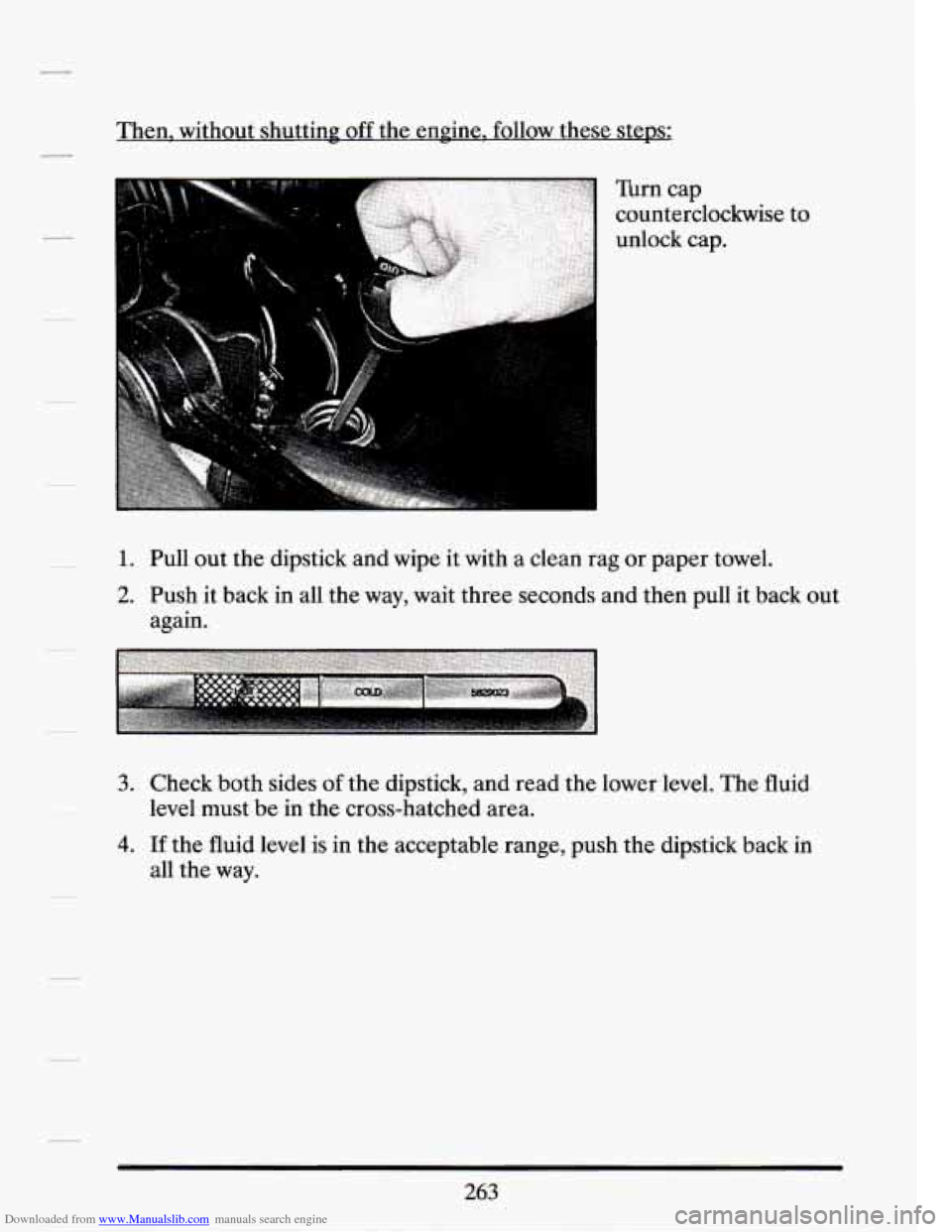
Downloaded from www.Manualslib.com manuals search engine Then, without shutting off the engine, follow these steps;
Turn cap
counterclockwise to
unlock cap.
1. Pull out the dipstick and wipe it with a clean rag or paper towel.
2. Push it back in all the way, wait three seconds and then pull it back out
again.
3. Check both sides of the dipstick, and-read the lower level. The fluid
level must be in the cross-hatched area.
4. If the fluid level is in the acceptable range, push the dipstick back in
all the way.
263
Page 277 of 399
Downloaded from www.Manualslib.com manuals search engine How to Add Fluid
Refer to the Maintenance Schedule to determine what kind of transaxle
fluid to use. See “Recommended Fluids and Lubricants” in the Index.
If the fluid level is low, add only enough of the proper fluid to bring the
level into the cross-hatched area on the dipstick.
1. Pull out the dipstick.
2. Using a long-neck funnel, add enough fluid at the dipstick hole to
bring it to the proper 1evel.It doesn’t take much fluid, generally less
than a pint (OSL).
Don’t overfill. We recommend you use only fluid
labeled DEXR0N’-IIE or DEXRON@-111, because fluids with that
label are made especially for your automatic transaxle. Damage
caused by fluid other than DEXR0N’-IIE or DEXRON@-I11 is not
covered by your new vehicle warranty.
After adding fluid, recheck the fluid level as described under “How to
Check.”
When the correct fluid level is obtained, push the dipstick back in all
How To Reset Transaxle Fluid Change Indicator:
the
way.
Your vehicle is equipped with a transaxle fluid change indicator. A
“CHANGE TRANS FLUID” message will display on the Information
Center when the power train computer determines that the transaxle
fluid needs to be changed or at each
100,000 miles (160,000 km) interval,
whichever occurs first. When this message appears, change the transaxle
fluid and reset the transaxle fluid life indicator as follows:
Turn the key “ON” with the engine stopped.
0 Press and hold the “OFF” and “REAR DEFOG” buttons on the
climate control simultaneously until the “TRANS FLUID RESET”
message appears in the Information Center (between
5 and 20
seconds).
Page 280 of 399
Downloaded from www.Manualslib.com manuals search engine To Add Coolant
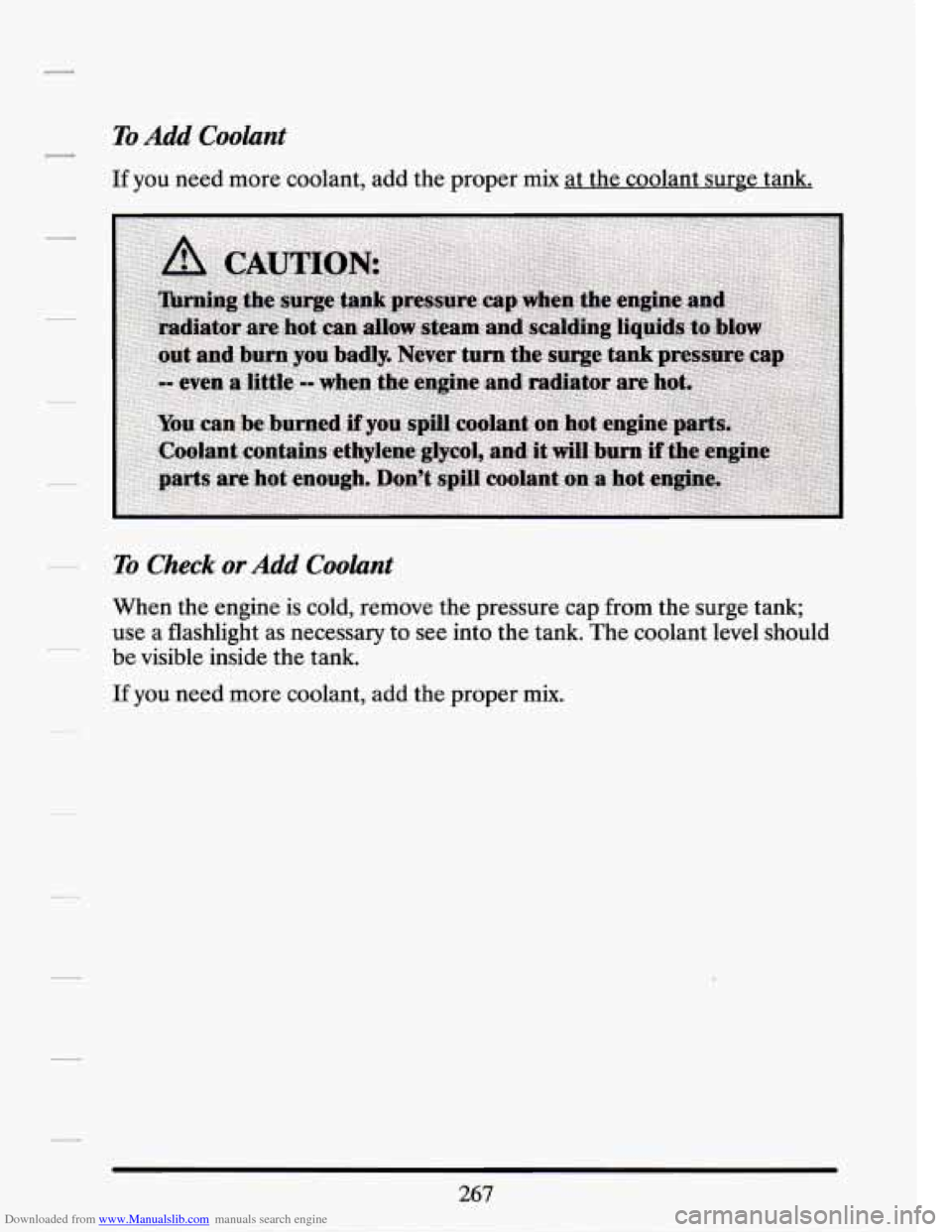
If you need more coolant, add the proper mix at the coolant surge tank.
To Check or Add Coolant
When the engine is cold, remove the pressure cap from the surge tank;
use
a flashlight as necessary to see into the tank. The coolant level should
be visible inside the tank.
If you need more coolant, add the proper mix.
267
Page 282 of 399
Downloaded from www.Manualslib.com manuals search engine How To Check Power Steering Fluid
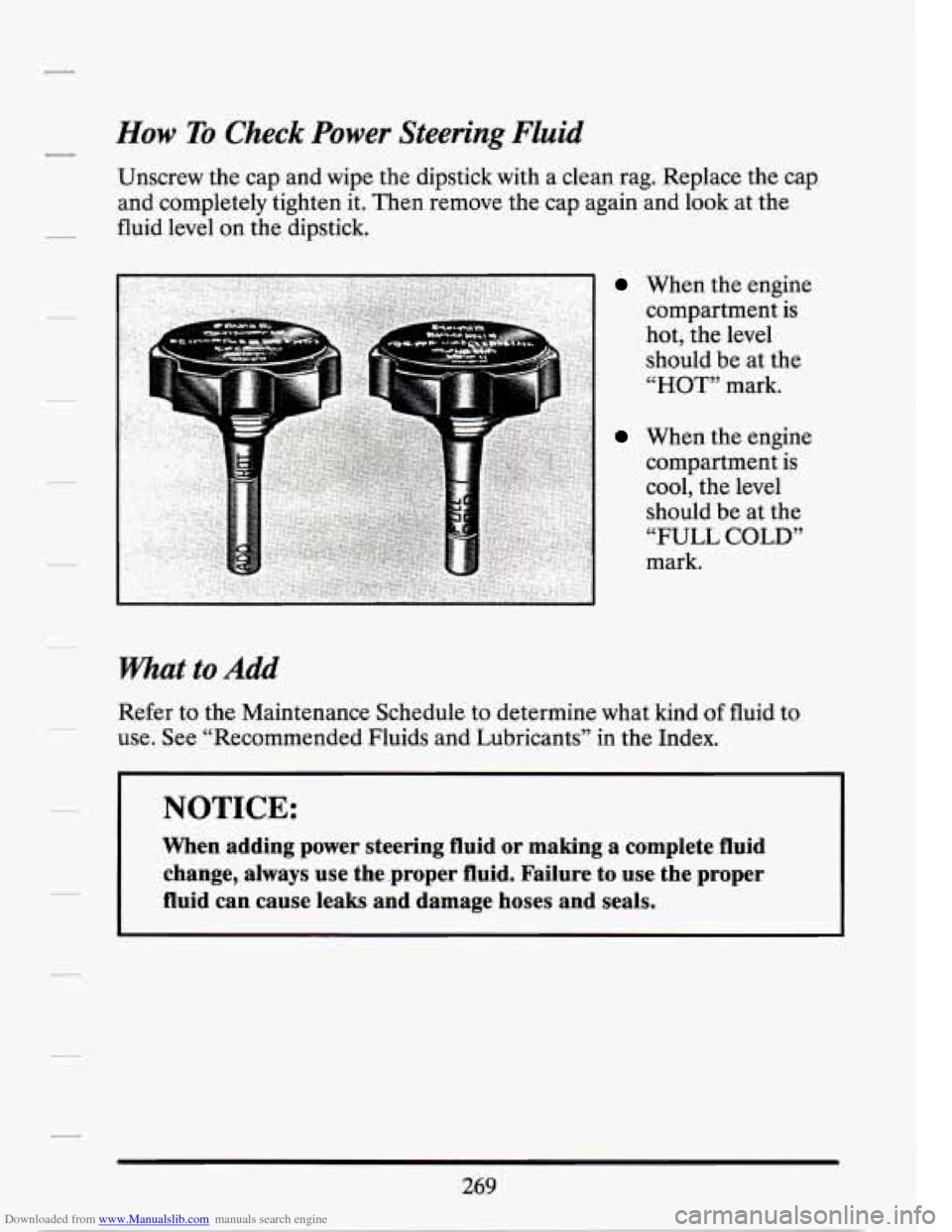
Unscrew the cap and wipe the dipstick with a clean rag. Replace the cap
and completely tighten it. Then remove the cap again and look at the
fluid level on the dipstick.
When the engine
compartment is
hot, the level
should be at the
“HOT” mark.
When the engine
compartment
is
cool, the level
should be at the
“FULL COLD”
mark,
What to Add
Refer to the Maintenance Schedule to determine what kind of fluid to
use. See “Recommended Fluids and Lubricants” in the Index.
NOTICE:
When adding power steering fluid or making a complete fluid
change, always use the .proper fluid. Failure to use the proper
fluid can cause leaks and damage hoses and seals.
269
Page 286 of 399
Downloaded from www.Manualslib.com manuals search engine r
r
I I
!
r I
r
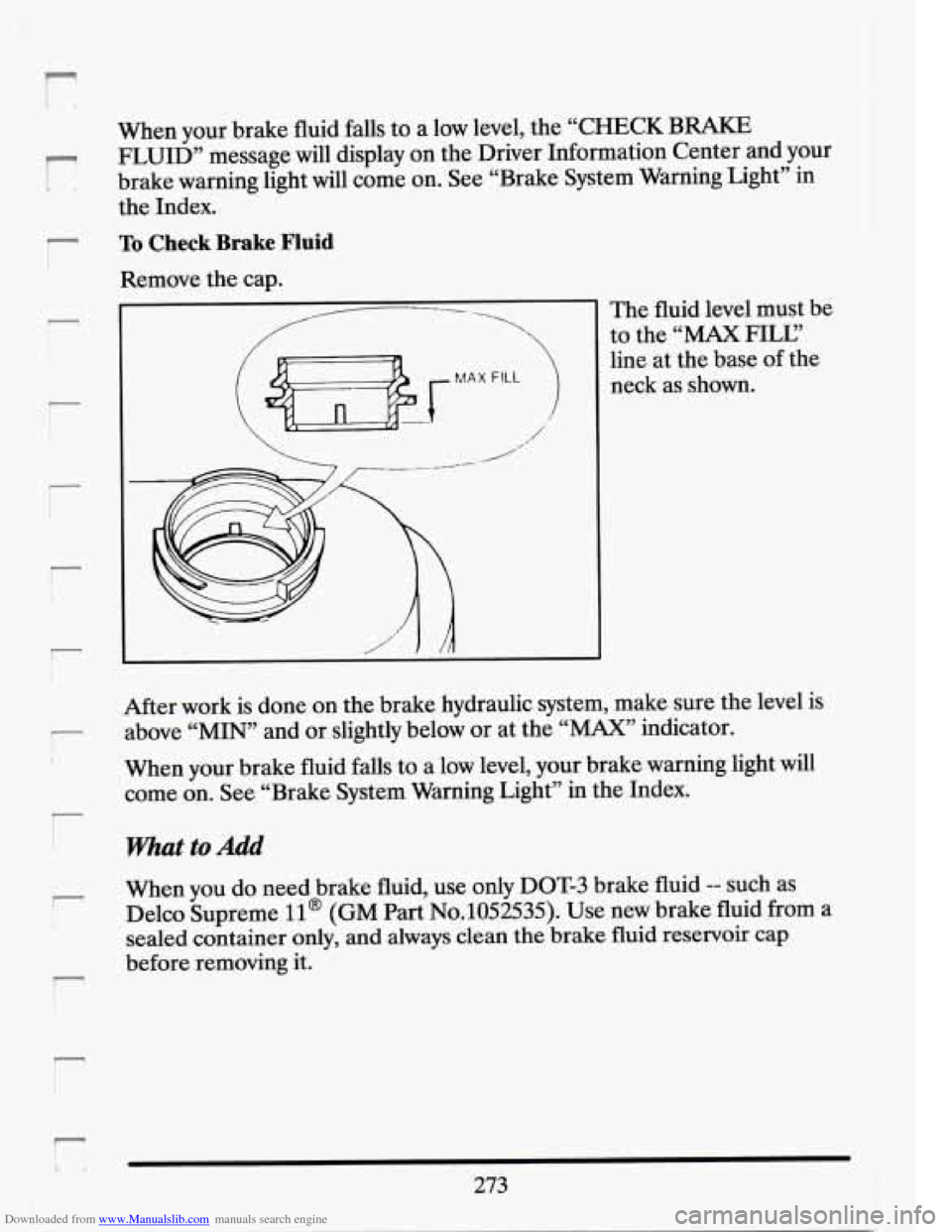
When your brake fluid falls to a low level, the “CHECK BRAKE
FLUID” message will display on the Driver Information Center and your
brake warning light will come on. See “Brake System Warning Light” in
the Index.
To Check Brake Fluid
Remove the cap.
i
MAX FILL
.i
/’
The fluid level must be
to the
“MAX FILE‘
line at the base of the
neck as shown.
After work is done on the brake hydraulic system, make sure the level is
above
“MIN” and or slightly below or at the “MAX” indicator.
When your brake fluid falls to a low level, your brake warning light
will
come on. See “Brake System Warning Light” in the Index.
?Khat to Add
When you do need brake fluid, use only DOT-3 brake fluid -- such as
Delco Supreme
ll@ (GM Part No.1052535). Use new brake fluid from a
sealed container
only, and always clean the brake fluid reservoir cap
before removing it.
i-
r I
r
273
Page 304 of 399
Downloaded from www.Manualslib.com manuals search engine r
f
r
r I 1
i- I
NOTICE:
Don’t let anyone tell you that underidlation or overinflation is
all right. It’s not. If your tires don’t have enough air
(underinflation) you can get:
Too much flexing
Too much heat
Tire overloading
Bad wear
Bad handling
Bad fuel economy.
If your tires have
too much air (overinflation), you can get:
Unusual wear
Bad handling
Rough ride
Needless damage from road hazards.
7 I
!
-
I
How to Check Use a good quality pocket-type gage to check tire
pressure. Simply looking at the tires will not tell you the pressure,
especially if you have radial tires
-- which may look properly inflated even
if they’re underinflated.
If your tires have valve caps, be sure to put them back on. They help
prevent leaks by keeping out dirt and moisture.
When to Check Check your tires once a month or more.
The
SLS tire pressures are:
Front - 28 psi (190 kPa)
Rear - 26 psi (180 Pa)
SLS recommended tire size is:
Michelin XW4 Blackwall (P225/60R16)
291