Page 219 of 398
Downloaded from www.Manualslib.com manuals search engine r
F, 4. Stop and have someone pick up .and store the chocks.
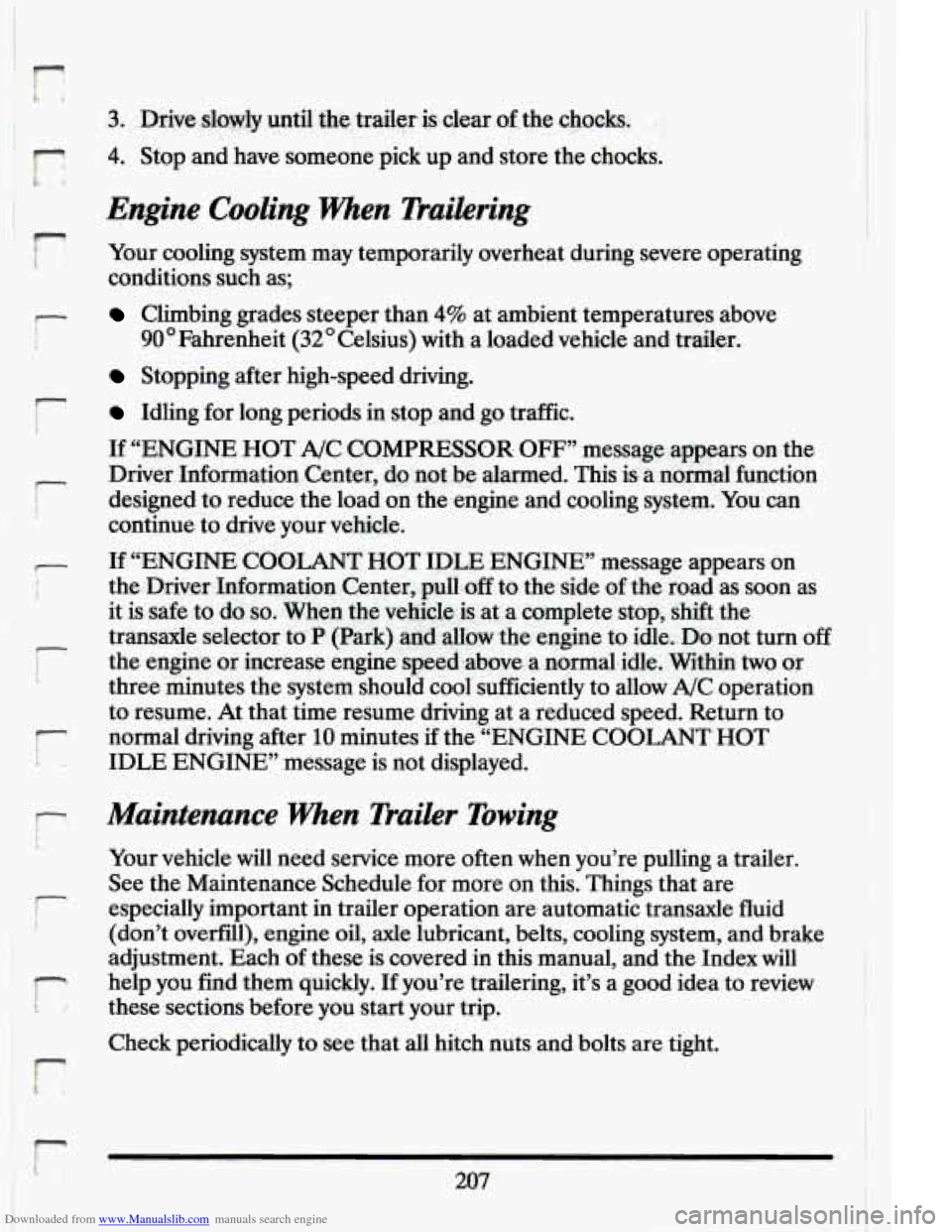
Engine Cooling When Tru.ilering
r
I ? Your cooling system may temporarily overheat during severe operating
conditions such as;
Climbing grades steeper than 4% at ambient temperatures above
90” Fahrenheit (32O Celsius) with a loaded vehicle and trailer.
Stopping after high-speed driving.
I
r Idling for long periods in stop and go traffic. I
If ,“ENGINE HOT A/C COMPRESSOR OFF” message appears on. the
Driver Information Center, do.not be alarmed.
This is. a normal function
continue to drive’your vehicle.
the -Driver Information Center, pull
,off to the side of the road as, soon as
it is safe to do
so. When the vehicle is at a complete stop, shift the
transaxle selector to
P (Park) and allow the engine to idle.:Do not turn off
three minutes the system should cool sufficiently to allow A/C operation
to resume. At that time resume driving at a reduced speed. Return to
normal driving after
10 minutes if the “ENGINE COOLANT HOT
- designed. to reduce the load on the.engine and cooling system. You can
- If “ENGINE COOLANT HOT IDLE ENGINE” message.appears on
c
I the engine or increase engine speed.above a normalidle. Wit-hin two or
b- IDLE ENGINE” message is not displayed.
Maintenance When Trailer Towing
i L.
Your vehicle will need service more often when you’re pulling a trailer.
See the Maintenance Schedule for more on this. Things that are
(don’t overfill), engine oil,
axle lubricant, belts, cooling system, and brake
adjustment. Each
of these is covered in this manual, and the Index will
these sections before you start your trip.
i especially important in trailer operation are, automatic transaxle fluid
7 help you find them quickly. If you’re trailering, it’s a good idea to review
I
‘F
Check periodically to see that all hitch nuts and bolts are tight.
r 207
Page 230 of 398
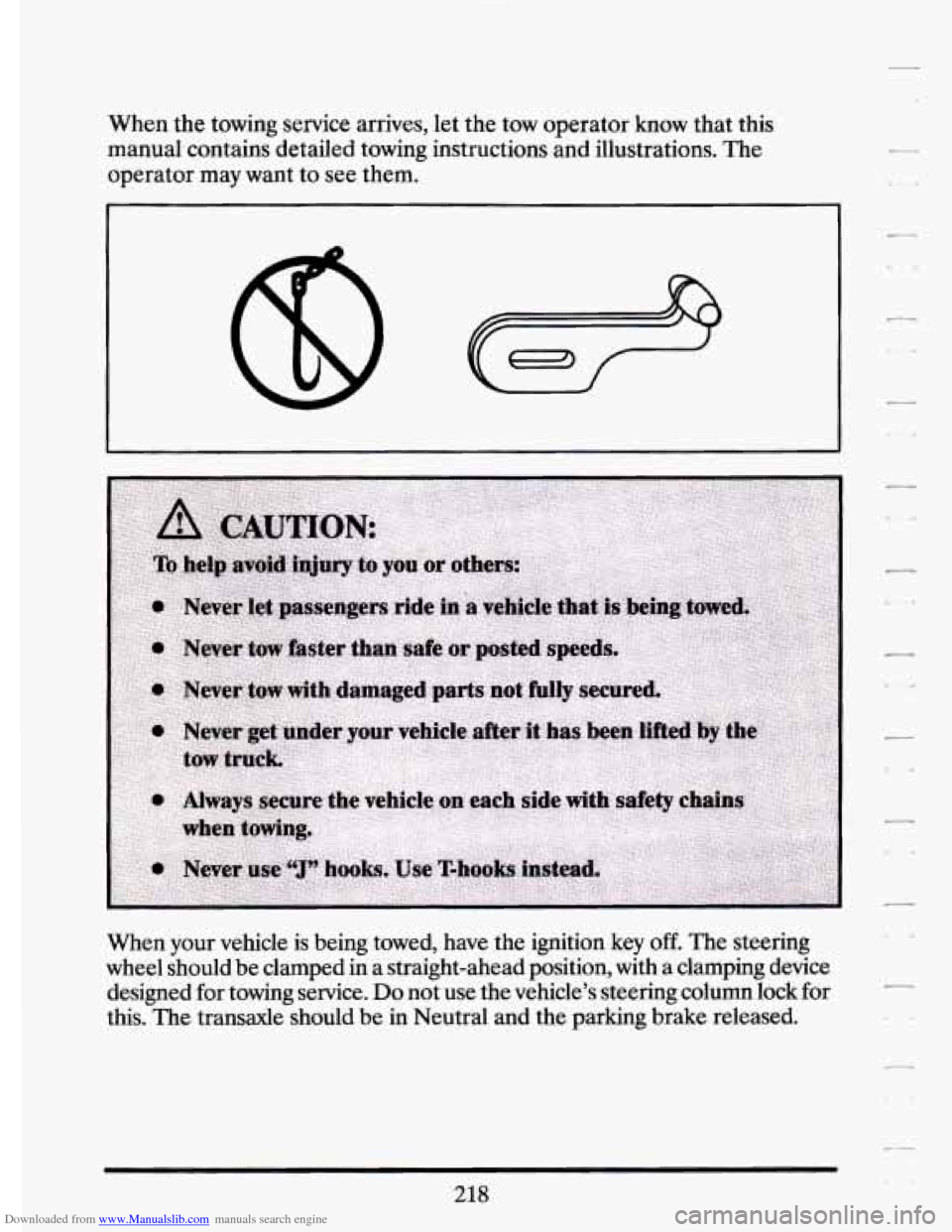
Downloaded from www.Manualslib.com manuals search engine When the towing service arrives, let the tow operator know that this
manual-contains detailed towing instructions and illustrations. The
operator may want to see them.
When your vehicle
is being towed, have the ignition key off. The steering
wheel should be clamped in a straight-ahead position, with
a clamping device
designed for towing service.
Do not use the vehicle’s steering column lock for
this. The transaxle should be in Neutral and the parking brake relea\
sed.
218
-.
Page 241 of 398
Downloaded from www.Manualslib.com manuals search engine !r
r
r
r L
I-
‘.. c ..e
IF A TIRE GOES FLAT
It’s unusual for a: tire to “blow out” while you’re driving, especially if you
maintain your tires properly. If air goes out of a. tire, it’s much more ‘likely
to leak out slowly.
But if you should ever have a “blowout,” here are a
few tips about what to expect and what to do:
If a front tire fails, the flat tire will create a drag that pulls the vehicle
toward that side. Take your
foot, off .the accelerator pedal and grip- the
steering wheel
firmly. Steer to maintain lane position, then-gently brake
to a stop well out of the traffic lane.
A rear blowout, particularly on a curve, acts much like a skid and may
require the same correction you’d use in a skid. In .any rear blowout,
remove your foot from the accelexator pedal. Get the vehicle under
control by steering the way
you want the vehicle to go. It may be very
bumpy and noisy, but you can still steer. Gently brake to a stop, well
off
the. road.if possible.
If a tire goes flat, the next section shows how to use your jacking
equipment to change a flat tire safely.
. . ._ .. . .
229
Page 250 of 398
Downloaded from www.Manualslib.com manuals search engine COMPACT SPm TIRE
Although the compact spare was fully inflated when your vehicle was
new, it can lose air after a time. Check the inflation pressure regularly.
It
should be 60 psi (420 kPa). The compact spare is made to go up to 3,000
miles (5000 km), so you can finish your trip and have your full-size tire
repaired or replaced where you want. Of course, it’s best to replace your
spare with a full-size tire as
soon as you can. Your spare will last longer
and be
in good shape in case you need it again.
Your anti-lock brake system warning light may come on when you are
driving with a compact spare. See “Anti-Lock Brake System Wa\
rning
Light”
in the Index.
r
NOTICE: -
Don’t take your compact spare through an automatic car wash
with guide rails. The compact spare can get caught on the rai\
ls.
That can damage the tire and wheel, and maybe other parts
of
your vehicle.
Don’t use your compact spare on some other vehicle.
And don’t mix your compact spare or wheel with other wheels or tires.
They won’t fit. Keep your spare and its wheel together.
238
Page 272 of 398
Downloaded from www.Manualslib.com manuals search engine NOTICE:
Too much or too little fluid can damage your transaxle. Too
much can mean that some of the fluid could come out and fall\
on hot engine parts or exhaust system, starting a fire.
Be sure to
get an accurate reading
if you check your transaxle fluid.
Wait at least 30 minutes before checking the transaxle fluid level if you
have been driving:
When outside temperatures are above 90'F (32" C).
At high speed for quite a while.
In heavy traffic -- especially in hot weather.
While pulling a trailer.
To get the right reading, the fluid should be at normal operating
temperature, which is
180 F to 200 ' F (82' C to 93 C).
Get the vehicle warmed up by driving about 15 miles (24 km) when
outside temperatures are above
50 "F (10'C). If it's colder than 50'F
(lO'C), you may have to drive longer.
To check the fluid level
Park your vehicle on a level place.
With the parking brake applied, place the shift lever in "P" (Park).
With your foot on the brake pedal, move the shift lever through each
gear range, pausing for about three seconds in each range. Then,
position the shift lever in
"P" (Park).
0 Let the engine run at idle for three to five minutes.
260
Page 282 of 398
Downloaded from www.Manualslib.com manuals search engine Brake Master Cylinder
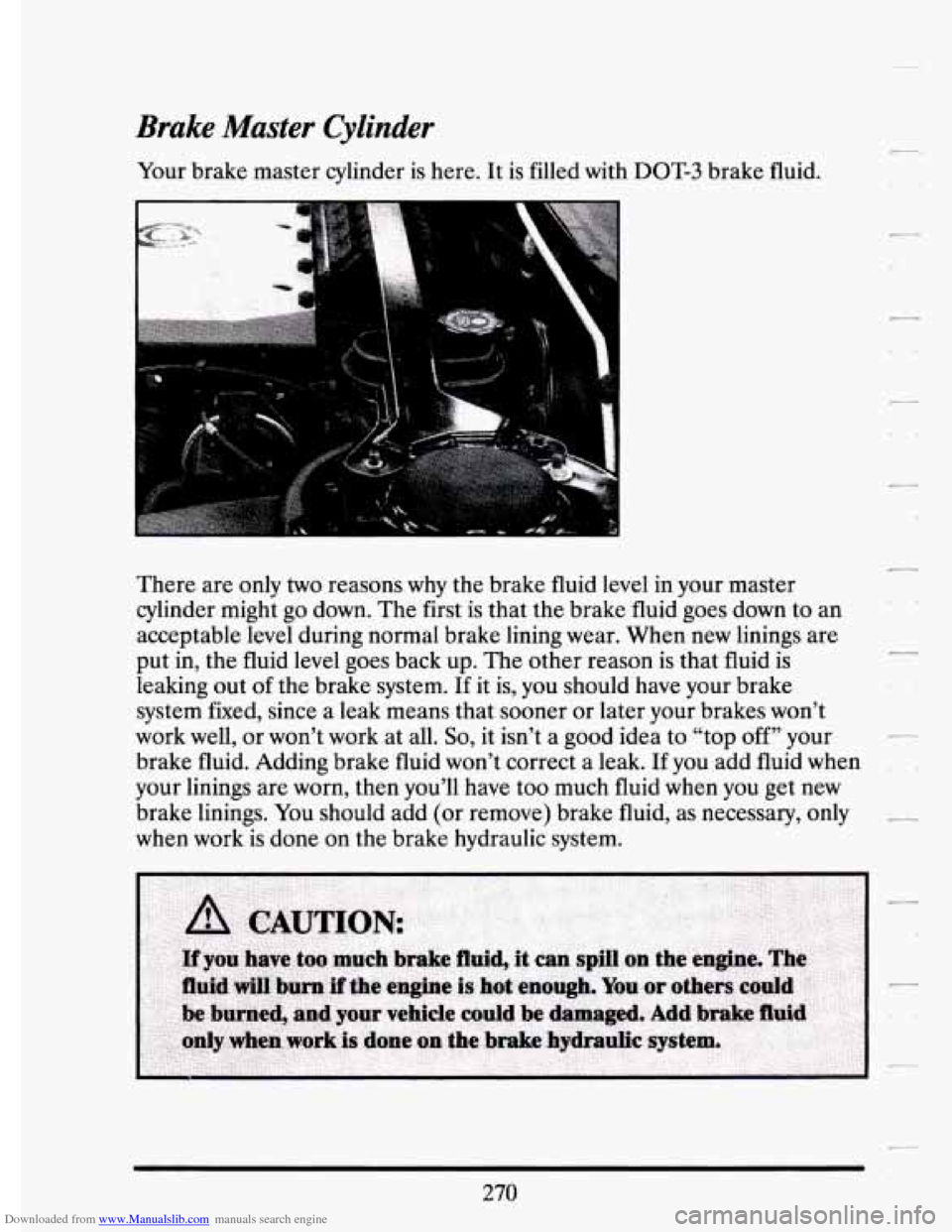
Your brake master cylinder is here. It is filled with DOT-3 brake fluid.
There are only
two reasons why the brake fluid level in your master
cylinder might go down. The first is that the brake fluid goes down to an
acceptable level during normal brake lining wear. When new linings are
put in, the fluid level goes back up. The other reason is that fluid is
leaking out
of the brake system. If it is, you should have your brake
system fixed, since
a leak means that sooner or later your brakes won’t
work well, or won’t work at all.
So, it isn’t a good idea to “top off” your -
brake fluid. Adding brake fluid won’t correct a leak. If you add fluid when
your linings are worn, then you’ll have too much fluid when you get new
brake linings.
You should add (or remove) brake fluid, as necessary, only
when work is done on the brake hydraulic system.
270
Page 283 of 398
Downloaded from www.Manualslib.com manuals search engine R
&
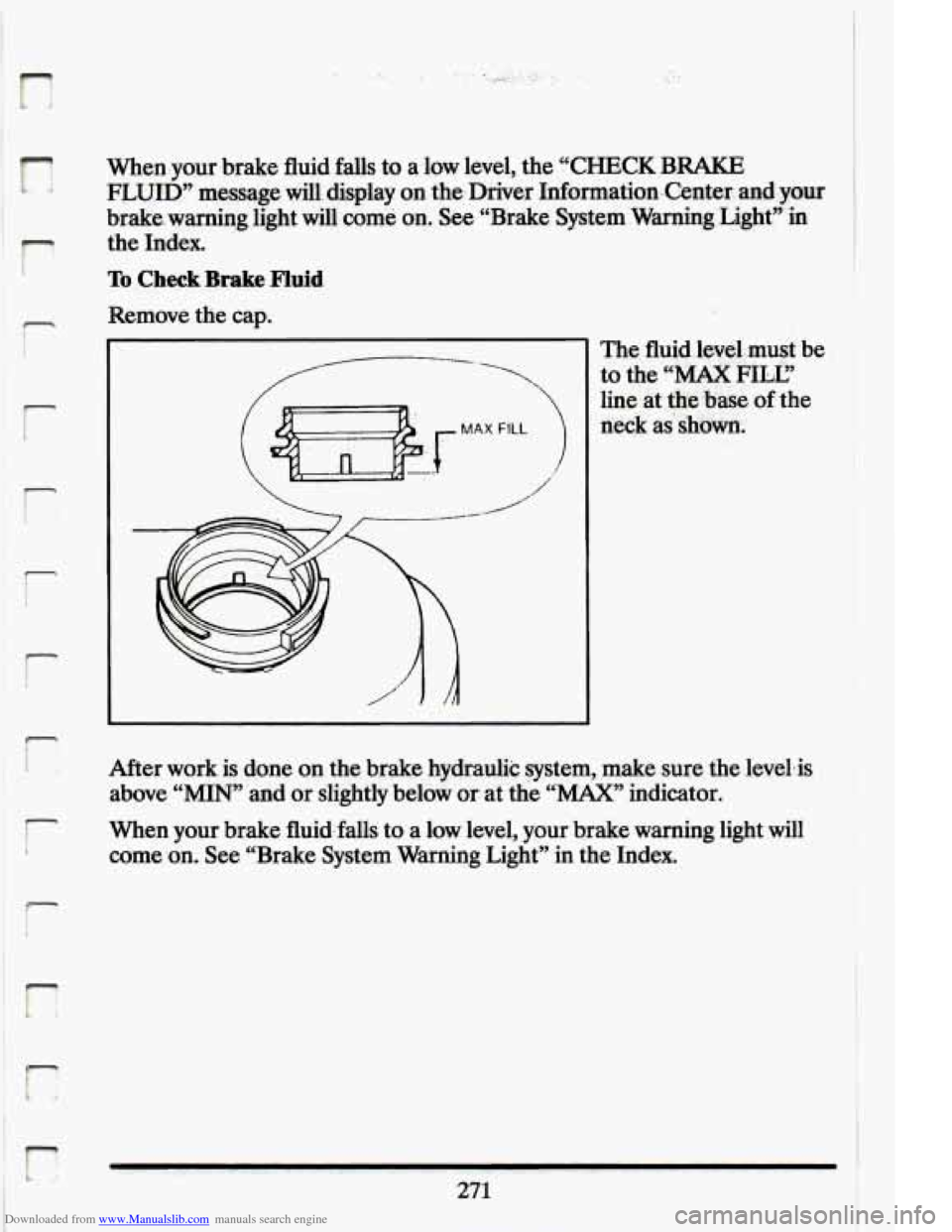
Whenyour brake fluid falls to a low level, the ‘.‘CHECK BRAKE
FLUID” message will. display on the.Driver InformationCenter. and. your . . I
brake. warning light will come on. See “Brake System .Warning Light’% . i
the Index. 1
i ”0 Check Brake Fluid
7 Remove the cap. I 1
I‘
‘K i
r
r
1
,r
MAX FILL.
The fluid 1evel:must .be
line at the base of the
neck as’shok.
to the “MAX HI;.
,r ure the le!
above
‘“IN” and or slightly below or: at thi “MAX“ indicator.
After
work
is done on the brake hydraulic system, make SI ?el : is
When your brake fluid:falls
to a low level, your brake warning.light will
come’on. See “Brake System Warning Light” in the Index.
279
Page 284 of 398
Downloaded from www.Manualslib.com manuals search engine ?%at to Add
When you do need brake fluid, use only DOT-3 brake fluid -- such as
Delco Supreme
1 l@ (GM Part No.1052535). Use new brake fluid from a
sealed container only, and always clean the brake fluid reservoir cap
before removing it.
NOTICE:
Don’t let someone put in the wrong kind of fluid. For
example, just
a few drops of mineral-based oil, such as
engine oil, in your brake system can damage brake system
parts
so badly that they’ll have to be replaced.
Brake fluid can damage paint, so be careful not to spill brake
fluid on your vehicle.
If you do, wash it off immediately. See
“Appearance Care” in the Index.
Brake Wear
Your Cadillac has four-wheel disc brakes.
Disc brake pads have built-in wear indicators that make a high-pitched
warning sound when the brake pads are worn and new pads are needed.
The sound may come and
go or be heard all the time your vehicle is
moving (except when
you are pushing on the brake pedal firmly).
272